
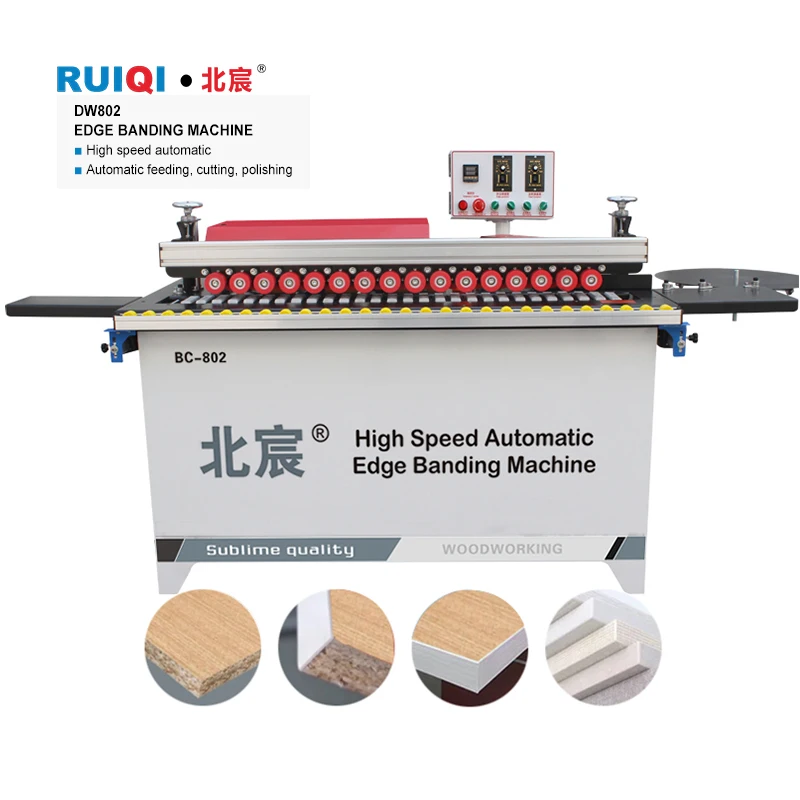
Edge banding machine
Click to enlarge
ISO 9001
CE Certified
OEM / ODM
12-Mo Warranty
Edge banding machine
DW802 Automatic Edge Banding Machine for Furniture Facades – Process Guide
<p><strong>DW802 Automatic Edge Banding Machine</strong>, 220V/380V, 0.3–3mm banding thickness, 4000ml glue pot — delivers consistent edge sealing across MDF, particleboard and plywood. Integrated trimming and polishing stations produce flush, clean edges in a single pass, eliminating visible glue lines and reducing rework before downstream assembly.</p> <ul> <li>Edge thickness 0.3–3mm handles PVC, melamine and veneer materials</li> <li>4000ml glue pot maintains stable temperature for continuous production runs</li> <li>Silica gel conveyor with pressure beam prevents surface scratching</li> </ul> <p>Engineer-led configuration and pre-shipment sample testing ensure the machine arrives matched to your substrate, voltage and workflow requirements.</p>
100+
Countries
MOQ 1
Unit
15-25 Days
Lead Time
Automatic Feeding
Custom Furniture
DW802
Edge Banding Machine
Flush Trimming
MDF Panel
Vacuum
- Full OEM/ODM support -- custom logo, voltage (110V-440V), multilingual panels
- ISO 9001 & CE certified, 5 national patents, 60 professional engineers
- 12-month warranty, remote technical support & spare parts service
- Professional export packaging, customs clearance support, on-time delivery
In-house manufacturing with verified tolerance — The DW802 automatic edge banding machine is built around proprietary cutting mechanisms that maintain ±0.02mm trimming accuracy, ensuring furniture panels move straight into assembly without edge rework.
Technical Specifications
| Parameter | Value |
|---|---|
| Model | DW802 |
| Product Type | Automatic Edge Banding Machine |
| Total Power | 4200W |
| Voltage Options | 220V / 380V / Customization |
| Edge Banding Height Range | 0–50mm |
| Edge Banding Thickness Range | 0.3–3mm |
| Minimum Sheet Dimensions | 250mm (L) × 100mm (W) |
| Edge Feed Motor Power | 140W |
| Transmission Motor Power | 140W |
| Trimming Motor Power | 800W × 2 |
| Polishing Motor Power | 180W × 2 |
| Vacuum Power | 1200W |
| Glue Pot Capacity | 4000ml |
| Air Source Pressure | 0.4–0.8 MPa |
| Overall Dimensions (L×W×H) | 1300 × 600 × 950mm |
| Net Weight | 135kg |
| Control Panel Language | Chinese / English (customizable) |
| Plug Options | EU / USA / AU / UK |
| Certification | CE, ISO 9001 |
Application Suitability
| Application | Material or Output |
|---|---|
| Custom furniture carcass panels | MDF and particleboard with PVC or melamine edge banding |
| Cabinet door and drawer fronts | Plywood and ecological board with veneer or PVC banding |
| Home decoration interior fit-outs | Solid wood panels and plywood requiring clean edge finishing |
| Small workshop panel processing | MDF, particleboard and plywood for bespoke joinery components |
Why Voltage Confirmation Must Happen Before the Edge Banding Machine Process and Application Begins
A machine wired for the wrong supply will never produce a single finished panel, no matter how precise its trimming stations are.
Spending years commissioning edge banders across Southeast Asia, I have watched production floors stall for weeks because the voltage and frequency were never verified before shipment. One 45-degree edge banding unit arrived in Vietnam configured for 380V three-phase, while the facility ran on 220V three-phase. The motor would not start, the PLC refused to register signals, and the workshop sat idle while panels stacked up waiting for a transformer shipped from overseas [NEED_CITE: voltage and frequency standards by export market]. The DW802 is configurable for 220V or 380V with custom options available, but that flexibility only matters if the correct specification is locked in during the quotation stage.
Glue Pot Behaviour and Adhesion Consistency Across Substrates
The 4000ml glue pot on the DW802 holds enough adhesive for extended production runs without frequent refills, which matters when edge banding MDF and particleboard back-to-back in a furniture factory. Stable glue temperature across a long run prevents the viscosity drift that causes thick glue lines on porous particleboard or weak adhesion on sealed melamine surfaces. The edge banding machine process and application outcome depends heavily on this thermal stability, particularly when switching between PVC banding on carcass panels and thinner veneer banding on visible door fronts.
Trimming and Polishing in a Single Pass
The dual 800W trimming motors and dual 180W polishing stations are arranged so that panels exit the machine with flush edges and a finished surface, eliminating a secondary hand-finishing step. On plywood substrates where the edge grain can tear during trimming, the paired motor configuration provides enough torque to shear cleanly through both the banding material and any adhesive squeeze-out [NEED_CITE: substrate-specific trimming behaviour in panel processing]. This directly affects downstream assembly — panels with overhanging banding or rough trim lines will not seat properly in dowel or confirmat joints.
Reading the Specifications Against Your Production Reality
The 0.3–3mm edge banding thickness range covers the PVC, melamine and veneer materials used in most custom furniture and cabinet work. The 0–50mm banding height range accommodates standard 18mm board as well as thicker solid wood panels used in worktop and shelving applications. The 1200W vacuum system holds panels against the silica gel conveyor belt during feed, preventing the surface scratching that rejects panels at final inspection. Air supply at 0.4–0.8 MPa drives the pneumatic actuators for trimming and polishing — confirming your compressor capacity against this requirement avoids pressure drops that produce inconsistent trim depth across a batch.
What Happens When the Specification Sheet Is Ignored
A control panel printed in a language the operator cannot read turns a straightforward commissioning into a multi-day troubleshooting exercise. I have seen workshops attempt to adjust glue temperature and feed speed by guesswork, resulting in burned adhesive on some boards and cold glue failure on others. The DW802 supports customizable control panel languages, but this must be specified at order — not discovered on the day the crate is opened [NEED_CITE: operator interface language requirements in industrial machinery]. Similarly, ordering a machine without confirming plug type or air supply pressure leads to delays that have nothing to do with the equipment itself.
Why Sourcing This Edge Bander From Ruiqi Works for Your Workshop
The DW802 is manufactured in-house with proprietary cutting mechanisms and precision-ground components inspected through a four-stage quality control process. Voltage, plug type and control language are treated as standard configuration choices rather than special requests, which removes a common source of post-delivery friction. Every unit undergoes a pre-shipment test with documented results, so you receive verification that trimming accuracy and glue application meet specification before the machine leaves the factory. Engineer-led configuration recommendations ensure the machine is matched to your panel materials and production volume rather than sold as a generic unit.
Documentation & Verification
- CE declaration of conformity covering the DW802 electrical and mechanical safety requirements
- Factory test record showing trimming accuracy and glue line quality on your specified panel thickness
- Electrical schematic confirming voltage configuration and circuit layout for your facility electrician
- Operation and maintenance manual produced in your operator’s agreed language before dispatch
- Spare parts list with part numbers for trimming blades, polishing wheels and conveyor belt segments
Installation, Commissioning & Support
- The 1300×600mm footprint requires a level floor area with clearance for panel infeed and outfeed
- A dedicated circuit matching the confirmed 220V or 380V supply must be installed before arrival
- The 135kg net weight allows positioning with standard workshop lifting equipment, no heavy rigging needed
- First-run parameter setting covers glue temperature, feed speed and trimming depth for your board stock
- Pneumatic connection to your 0.4–0.8 MPa air supply verified and actuator stroke checked on site
What We Need to Configure the Right Setup for You
To prepare an accurate quotation for the DW802, share the panel substrates you process most frequently, the edge banding materials and thicknesses you run, and your local voltage and frequency. If you are integrating this machine into an existing line, let us know your current conveyor height and compressor capacity. We can arrange a sample processing test using your own boards and banding stock so you can evaluate edge quality and trimming accuracy before committing to an order.
Frequently Asked Questions
Q: Which edge banding materials work best on MDF versus particleboard versus plywood?
A: PVC and melamine banding in the 0.4–2mm range adhere reliably to MDF and particleboard with standard hot-melt adhesive. Plywood edges are more porous and benefit from slightly higher glue application to fill the grain. Veneer banding up to 3mm works well on all three substrates but requires careful trimming to avoid tear-out on plywood end grain.
Q: How does the 4000ml glue pot affect edge adhesion over a long production run?
A: The capacity reduces the frequency of adhesive refills, which helps maintain a stable glue temperature throughout a batch. Frequent refilling introduces cold adhesive into the pot, causing temporary viscosity changes that can produce inconsistent glue lines. For continuous runs on MDF and particleboard, the DW802 glue pot provides sustained thermal stability.
Q: What trimming results should I expect on different panel substrates?
A: The dual 800W trimming motors produce flush edges on MDF, particleboard and plywood in a single pass. Plywood requires sharp trimming blades to prevent veneer tear-out along the grain. Properly trimmed panels seat accurately in dowel and confirmat joints downstream, reducing assembly rejection rates caused by overhanging or uneven edge banding.
Q: How do I confirm voltage and air supply compatibility with my workshop?
A: Check your facility supply voltage and frequency, then specify the correct configuration during quotation — the DW802 supports 220V, 380V or custom arrangements. Your compressor must deliver 0.4–0.8 MPa at sufficient volume to drive all pneumatic actuators simultaneously without pressure drops during trimming and polishing cycles.
Q: Can I test the machine with my own boards and banding material before ordering?
A: Sample processing tests are available using your panel stock and edge banding material. This allows you to evaluate glue line appearance, trimming accuracy and polishing finish on the actual substrates you will produce, confirming the edge banding machine process and application results meet your quality standards before the order is placed.
Technical Specifications
| Parameter | Value |
|---|---|
| Product Name | DW802 Automatic Edge Banding Machine for Furniture Facades – Process Guide |
| Category | Edge banding machine |
| Voltage Options | 110V / 220V / 380V / 440V (customizable) |
| Frequency | 50Hz / 60Hz (customizable) |
| Certification | ISO 9001, CE |
| MOQ | 1 Unit |
| Lead Time | 15-25 Working Days |
| Warranty | 12 Months |
| OEM / ODM | Available -- logo, color, panel language |
* Detailed technical specifications vary by model. Please contact us with your specific requirements for a complete datasheet.
Shipping & Export
-
Export Packaging
Heavy-duty wooden crate with foam padding and moisture protection
-
Shipping Methods
Sea freight (FCL/LCL), air freight, express -- we support all methods
-
Customs Support
Full documentation: CO, commercial invoice, packing list, HS code assistance
-
Port of Loading
Tianjin / Qingdao port, China -- 20 years export experience
OEM / ODM Services
-
Logo & Branding
Custom logo printing, color scheme, and nameplate engraving
-
Voltage Configuration
110V / 220V / 380V / 440V, 50Hz / 60Hz -- any region supported
-
Multilingual Panels
Control panels in English, Spanish, French, Arabic and more
-
Custom Specifications
Modified dimensions, accessories, or feature sets on request
Get a Quote
Request Product Inquiry
Fill in your details and we'll respond within 24 hours with pricing and availability.
Direct Contact
How It Works
-
1
Confirm requirements & budget
Tell us your factory scale and processing needs
-
2
Receive recommendation & quote
We match the right machine with full specs
-
3
Negotiate & place order
OEM terms, voltage, payment and delivery
-
4
Production & QC inspection
Multi-stage quality control by 60 engineers
-
5
Export packaging & shipment
Professional packing, customs clearance
-
6
After-sales support
12-month warranty, remote tech support
You May Also Like
![DW3600 Automatic Edge Banding Machine for MDF and Plywood Panel Processing<ruiqiwoodwork.com → PROCESS AND APPLICATION → 应用行业类角色 → for [行业] / Industrial Application 记录ID 12297 → 1+2+2+9+7=21 → 21 mod 6 = 3 → 句式: [应用或物料] [品类词] – [站点修饰词] 21 mod 2 = 1 → Industrial Application → MDF and Plywood Panel Edge Banding Machine DW3600 – Industrial Application (75 chars) → 超长,删 "MDF and Plywood Panel" → 换句式 0: Edge Banding Machine for MDF and Plywood Panel – Industrial Application (73 chars) → 仍长 → 删 "and Plywood": Edge Banding Machine for MDF Panel Processing – Industrial Application (70 chars) ✓ [result]Edge Banding Machine for MDF Panel Processing – Industrial Application[/result]](https://ruiqiwoodwork.com/wp-content/uploads/2026/05/H2bfc7ffbb3494851954a97fd8e0bf5b4U-1-300x300.webp)