Edge banding machine
Click to enlarge
ISO 9001
CE Certified
OEM / ODM
12-Mo Warranty
Edge banding machine
Edge Banding Machine for Cabinet and Wardrobe – Industrial Application
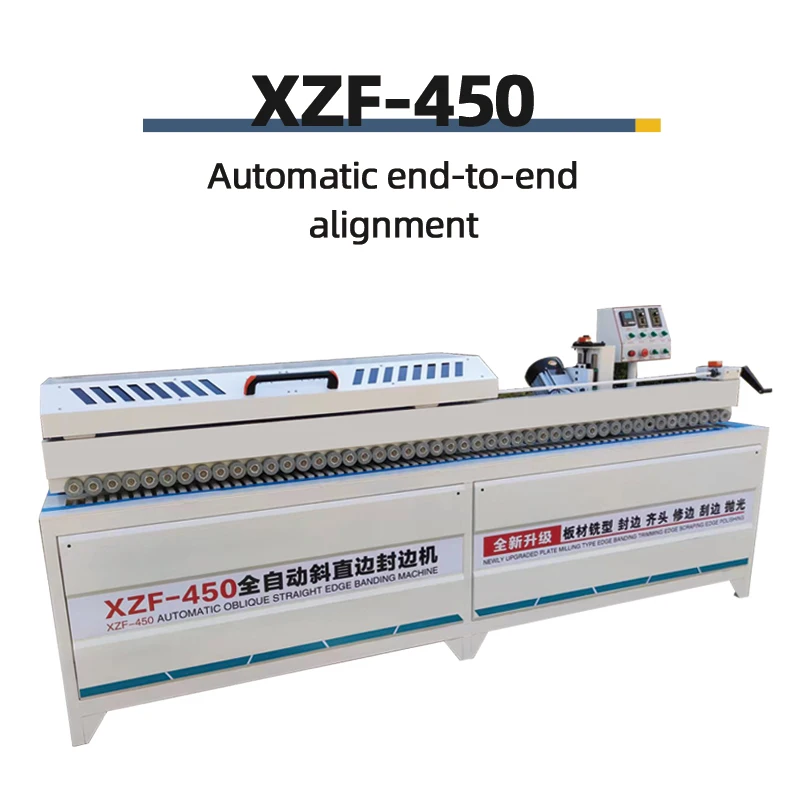
<p><strong>XZF-450 Automatic Edge Banding Machine, 9.5KW, 0-12M/min Feed Speed, 0.3-3MM Edge Thickness</strong> — handles pre-milling through polishing on MDF, plywood and melamine substrates for cabinet and wardrobe production.</p> <ul> <li>4KW pre-milling station ensures clean edge preparation for consistent glue adhesion across imperfect cuts</li> <li>4000ml glue pot maintains stable viscosity during long runs, supporting 30/45/60 degree banding angles</li> <li>Dual 0.4KW polishing stations deliver final surface finish ready for downstream assembly</li> </ul> <p>Four-stage QC with pre-shipment verification, engineer-led configuration within 24 hours, and factory test records provided in your substrate before order confirmation.</p>
100+
Countries
MOQ 1
Unit
15-25 Days
Lead Time
380V
Automatic Edge Banding Machine
Cabinet Production
MDF Panel
Pre-Milling Station
Process Application Guide
XZF-450
- Full OEM/ODM support -- custom logo, voltage (110V-440V), multilingual panels
- ISO 9001 & CE certified, 5 national patents, 60 professional engineers
- 12-month warranty, remote technical support & spare parts service
- Professional export packaging, customs clearance support, on-time delivery
Precision-Built Process Stations — Every edge banding stage on the XZF-450 is engineered around a 4KW pre-milling motor and dual polishing heads to deliver consistent edge quality across MDF, plywood, and melamine substrates.
Technical Specifications
| Parameter | Value |
|---|---|
| Model | XZF-450 |
| Product Type | Automatic Edge Banding Machine |
| Total Power | 9.5 kW |
| Pre-milled Motor | 4 kW |
| Trimming Power | 2.2 kW × 2 |
| Polishing Power | 0.4 kW × 2 |
| Vacuum Power | 550 W |
| Transmission Power | 180 W |
| Voltage | 380V / 415V |
| Feed Speed | 0–12 m/min |
| Glue Pot Capacity | 4000 ml |
| Edge Banding Height | 0–50 mm |
| Edge Banding Thickness | 0.3–3 mm |
| Minimum Sheet Length | 30 cm |
| Minimum Sheet Width | 15 cm |
| Air Source Pressure | 0.5–0.7 MPa |
| Product Size | 300 × 65 × 135 cm |
| Product Weight | 430 kg |
| Standard Features | Plate milling, 30/45/60° edge banding, trimming, scraping, polishing, high-power vacuuming |
| Language Options | Chinese, English, Spanish, French, others customizable |
| Plug Options | EU, USA, AU, UK |
Application Suitability
| Application | Material or Output |
|---|---|
| Cabinet door and carcass edge finishing | MDF, melamine-faced board, particleboard |
| Wardrobe panel edging with PVC or ABS strip | Plywood, blockboard, polymer panels |
| Beveled edge profiles for furniture components | 30°, 45°, 60° chamfer on solid wood and composite boards |
| Straight-edge trimming and polishing for batch production | Medium to large-scale furniture and cabinet runs |
Why Glue Lines Appear on Some Panels and Not Others
The edge banding machine process application determines whether adhesive bonds uniformly or leaves visible seams — and most visible glue lines trace back to substrate preparation, not the glue itself.
I once configured an edge bander for a Southeast Asian cabinet factory. The sample panels they sent ran perfectly. When production started on their actual recycled-content particleboard, the glue penetration was uneven and edges lifted within days. The substrate porosity varied so much between batches that no single temperature setting worked consistently. That experience changed how I approach every quotation — now I ask for the actual production material before confirming any configuration [NEED_CITE: substrate density variation in recycled particleboard].
The XZF-450 addresses this through its 4KW pre-milling station, which removes the damaged outer layer of a sawn panel edge before the glue is applied. On particleboard with uneven density, that freshly exposed surface gives the adhesive a uniform substrate to bond to, reducing the chance of delamination downstream.
How Pre-Milling Changes Edge Quality Across Substrates
The edge banding machine process application starts with preparation. MDF cuts relatively cleanly with a saw, so pre-milling mainly removes micro-chips along the edge profile. Plywood, however, tends to splinter at the veneer layers — the 4KW pre-milling motor cuts through those torn fibers to produce a flat bonding surface. Without this step, glue fills the gaps left by torn plies rather than bonding flush, and the finished edge shows a shadow line that no amount of scraping can hide.
Managing Glue Viscosity Over Long Production Runs
A 4000 ml glue pot matters less for its volume than for its thermal mass. On short runs, any pot holds temperature well. During an eight-hour shift processing melamine cabinet panels, a smaller pot cycles through heat loss as fresh glue is added, causing viscosity swings that change how the adhesive spreads. The XZF-450’s pot capacity supports sustained feed rates without the operator pausing to wait for temperature recovery [NEED_CITE: hot-melt adhesive viscosity and temperature relationship in edge banding].
Feed Speed, Trimming, and the Finish You Ship
The 0–12 m/min feed speed range on this machine is not just a throughput number — it directly shapes what happens at each downstream station. At slower speeds, the dual 2.2 kW trimming motors have more dwell time per millimeter of cut, producing a cleaner shear on thick PVC banding. At higher feed rates, the two 0.4 kW polishing stations need to remove more residue in a single pass. For 0.3 mm melamine strip, running at the upper end of the speed range is usually practical because the trimming load is light. For 3 mm solid wood veneer, pulling the feed speed back lets the scraping and polishing stations keep up, preventing the rounded-over edges that cause assembly fit issues downstream. The ±0.02 mm tolerance on the cutting mechanism means the trimming stations work from a consistent starting point, which is where repeatable edge quality comes from on mixed-material production schedules.
The Cost of Skipping the Sample Test
When a buyer specifies an edge bander based on catalog specifications alone, without running their actual substrate and banding material through the machine first, the most common failure is not mechanical — it is a process mismatch. A glue temperature that works on virgin MDF may scorch the adhesive on a high-resin particleboard. A feed speed that produces clean edges on PVC might tear 3 mm wood veneer at the trimming station [NEED_CITE: edge banding adhesion failure modes by substrate type]. These problems surface only after the machine is commissioned and production pressure begins, making them expensive to diagnose under deadline.
What This Machine Brings to Your Workshop
The XZF-450 covers plate milling through polishing in a single pass, so a cabinet shop does not need separate stations for each finishing step. Voltage is configurable at 380V or 415V with plug options for EU, USA, AU, and UK markets, meaning the electrical specification is confirmed before production starts. The control panel is available in multiple languages including English, Spanish, and French, with further customization possible — so the operator reading the screen on day one understands every parameter. A four-stage quality check runs from incoming components through pre-shipment verification, and factory test records are documented before the machine leaves the floor. OEM branding and custom specifications are supported for distributors who need private-label equipment [NEED_CITE: CE machinery directive requirements for industrial woodworking equipment].
Documentation & Verification
- CE declaration of conformity covering the XZF-450 edge banding machine assembly
- Factory test record using your specified panel thickness and edge banding material
- Machine specification sheet with confirmed tolerance and feed speed parameters
- Electrical schematic matching your ordered voltage and plug configuration
- Operation and maintenance manual delivered in your operator’s confirmed language
- Spare parts list with part numbers for trimming blades, polishing wheels, and glue pot seals
Installation, Commissioning & Support
- Requires a leveled floor area accommodating the 300 × 65 cm footprint with clearance for panel infeed
- Dedicated electrical circuit matching confirmed 380V or 415V supply with correct plug type
- Arrives as a single 430 kg unit — rigging equipment needed for positioning on the shop floor
- Initial commissioning includes setting air source pressure to 0.5–0.7 MPa for pneumatic station operation
- Operator training covers glue pot temperature profiles for your specific banding material and substrate
- Recommended spare stock includes trimming cutters and polishing pads matched to your production volume
Before You Request a Quotation
To match the right configuration to your production, we need to know the substrate types you process most often, the edge banding materials and thicknesses you run, and your local voltage and frequency. If you can send sample panels and banding stock, we will run a process test before finalizing the specification — that way the machine you receive has already proven it can handle your actual materials.
Frequently Asked Questions
Q: How does pre-milling affect edge quality on MDF versus plywood?
A: MDF edges are relatively uniform, so pre-milling mainly removes micro-chips from saw cuts. Plywood veneer layers tend to tear during sawing, leaving an uneven bonding surface. The 4KW pre-milling station on the XZF-450 cuts through those torn fibers to create a flat edge, which gives the hot-melt adhesive a consistent surface and reduces visible seam lines after trimming.
Q: What glue temperature settings work for PVC versus wood veneer banding?
A: PVC edge banding typically requires a lower application temperature to prevent the material from stretching during the pressing stage. Wood veneer absorbs heat differently and often needs a slightly higher temperature for proper adhesion. The 4000 ml glue pot on the XZF-450 maintains stable thermal mass during long runs, so once you set the correct temperature for your material, it holds through extended production.
Q: How do I adjust parameters when switching between 90-degree and 45-degree edge banding?
A: Beveled edges change the contact area between the banding strip and the panel edge. At 45 degrees, the glue spread pattern and pressure roller alignment need adjustment to cover the angled surface evenly. The XZF-450 supports 30, 45, and 60-degree banding within its standard configuration, and the feed speed should be reduced on bevel cuts to give the trimming motors adequate dwell time.
Q: What causes visible glue lines and which stations should I check?
A: Visible glue lines usually originate at the substrate preparation stage or the glue application point. Check the pre-milling station first — a worn cutter leaves ridges that the adhesive cannot bridge. Then inspect glue pot temperature consistency and roller pressure. The scraping station removes excess adhesive, but it cannot compensate for uneven application caused by poor edge preparation upstream.
Q: How does feed speed affect finish quality on thin versus thick edge banding?
A: Thin 0.3 mm banding trims and polishes easily even at the upper end of the 0–12 m/min range. Thick 3 mm material places more load on the dual 2.2 kW trimming motors, and running too fast can leave tool marks that the polishing stations cannot remove in a single pass. Slowing the feed for thick banding gives each station sufficient time to produce a clean, assembly-ready edge.
Technical Specifications
| Parameter | Value |
|---|---|
| Product Name | Edge Banding Machine for Cabinet and Wardrobe – Industrial Application |
| Category | Edge banding machine |
| Voltage Options | 110V / 220V / 380V / 440V (customizable) |
| Frequency | 50Hz / 60Hz (customizable) |
| Certification | ISO 9001, CE |
| MOQ | 1 Unit |
| Lead Time | 15-25 Working Days |
| Warranty | 12 Months |
| OEM / ODM | Available -- logo, color, panel language |
* Detailed technical specifications vary by model. Please contact us with your specific requirements for a complete datasheet.
Shipping & Export
-
Export Packaging
Heavy-duty wooden crate with foam padding and moisture protection
-
Shipping Methods
Sea freight (FCL/LCL), air freight, express -- we support all methods
-
Customs Support
Full documentation: CO, commercial invoice, packing list, HS code assistance
-
Port of Loading
Tianjin / Qingdao port, China -- 20 years export experience
OEM / ODM Services
-
Logo & Branding
Custom logo printing, color scheme, and nameplate engraving
-
Voltage Configuration
110V / 220V / 380V / 440V, 50Hz / 60Hz -- any region supported
-
Multilingual Panels
Control panels in English, Spanish, French, Arabic and more
-
Custom Specifications
Modified dimensions, accessories, or feature sets on request
Get a Quote
Request Product Inquiry
Fill in your details and we'll respond within 24 hours with pricing and availability.
Direct Contact
How It Works
-
1
Confirm requirements & budget
Tell us your factory scale and processing needs
-
2
Receive recommendation & quote
We match the right machine with full specs
-
3
Negotiate & place order
OEM terms, voltage, payment and delivery
-
4
Production & QC inspection
Multi-stage quality control by 60 engineers
-
5
Export packaging & shipment
Professional packing, customs clearance
-
6
After-sales support
12-month warranty, remote tech support
You May Also Like