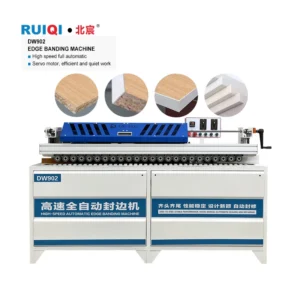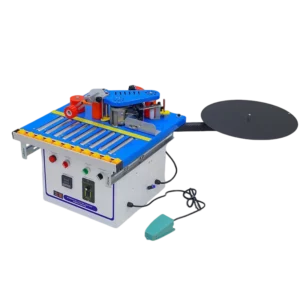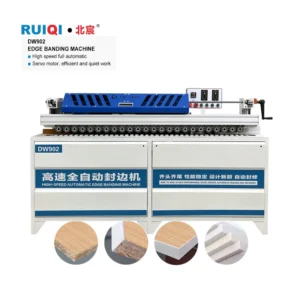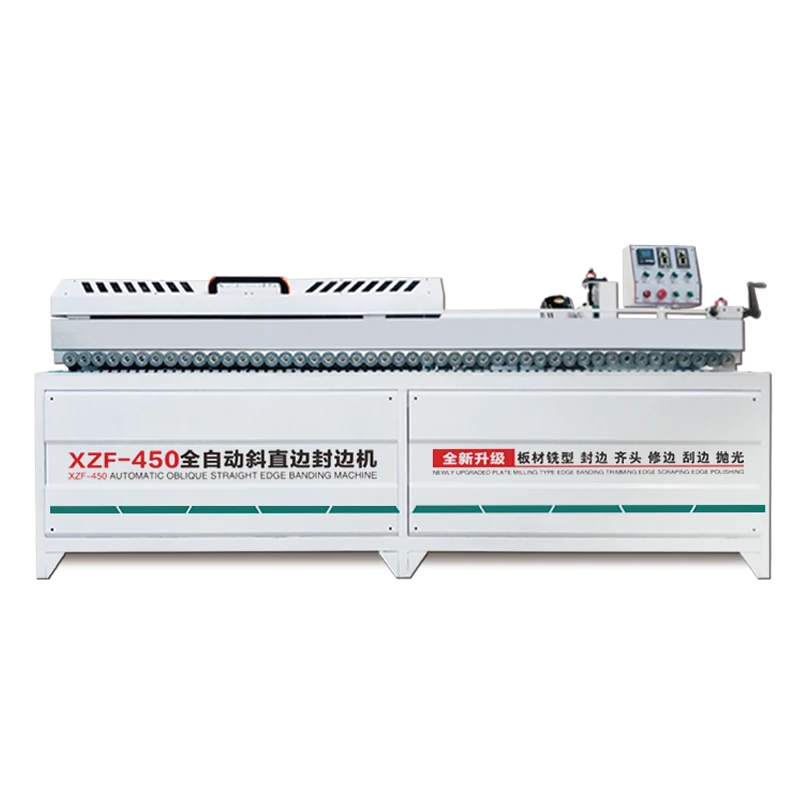
Edge banding machine
Click to enlarge
ISO 9001
CE Certified
OEM / ODM
12-Mo Warranty
Edge banding machine
Edge Banding Machine for MDF and PVC – Industrial Application
<p><strong>XZF-450 Automatic Edge Banding Machine, 9.5KW, 380V/415V, 0-12M/min Feed Speed</strong> — engineered for MDF, plywood and particleboard edge processing with pre-milling, trimming and polishing in one pass.</p> <ul> <li>4KW pre-milling station removes surface irregularities before glue application for consistent bond quality</li> <li>Dual 2.2KW trimming motors followed by scraping and 0.4KW×2 polishing deliver assembly-ready edges</li> <li>30/45/60 degree edge banding capability handles angled panel joints alongside standard straight edges</li> <li>4000ml glue pot capacity supports sustained production runs without frequent refill interruptions</li> </ul> <p>Four-stage quality control with pre-shipment verification ensures each machine meets your panel thickness and tolerance requirements before dispatch.</p>
100+
Countries
MOQ 1
Unit
15-25 Days
Lead Time
380V
Automatic Feeding
Edge Banding Machine
MDF Panel
Pre-milling
Process Application
XZF450
- Full OEM/ODM support -- custom logo, voltage (110V-440V), multilingual panels
- ISO 9001 & CE certified, 5 national patents, 60 professional engineers
- 12-month warranty, remote technical support & spare parts service
- Professional export packaging, customs clearance support, on-time delivery
Precision Pre-Milling — a 4 kW cutting head squares the panel edge before adhesive contact, eliminating the visible glue lines that appear when MDF or particleboard edges are left unprepared.
Technical Specifications
| Parameter | Value |
|---|---|
| Model | XZF450 |
| Product Type | Automatic Edge Banding Machine |
| Total Installed Power | 9.5 kW |
| Pre-Milling Motor | 4 kW |
| Trimming Power | 2.2 kW × 2 |
| Polishing Power | 0.4 kW × 2 |
| Feed Speed Range | 0 – 12 m/min |
| Edge Banding Height | 0 – 50 mm |
| Edge Banding Thickness | 0.3 – 3 mm |
| Minimum Sheet Length | 300 mm |
| Minimum Sheet Width | 150 mm |
| Glue Pot Capacity | 4000 ml |
| Required Air Pressure | 0.5 – 0.7 MPa |
| Voltage | 380V / 415V |
| Overall Dimensions | 300 × 65 × 135 cm |
| Net Weight | 430 kg |
| Standard Process Stations | Pre-milling, gluing, end cutting, rough trimming, fine trimming, scraping, polishing |
| Control Panel Language | English (customizable to other languages) |
Application Suitability
| Application | Material or Output |
|---|---|
| Cabinet door and carcass edge finishing | MDF, melamine-faced chipboard, plywood |
| Custom furniture panel edging | Particleboard, blockboard, solid wood panels |
| Angled panel joint preparation | 30°, 45°, and 60° bevel cuts on MDF and plywood |
| Polymer door profile banding | PVC edge banding on shaped substrates |
| High-volume batch runs | Continuous feed of panels from 0.3 mm to 3 mm banding thickness |
Why Substrate Density Changes Everything About the Edge Banding Process
The edge banding machine process application you see on a factory test panel will not repeat itself on your shop floor unless the substrate, adhesive temperature, and feed speed are all matched to your actual material.
When a production manager receives sample panels processed on high-density MDF, the glue line is invisible and the trimmed edge is clean. The assumption is that the same setup will produce identical results on the particleboard or plywood that actually runs through the workshop. That assumption is where batches fail. Low-density particleboard absorbs hot-melt adhesive differently, often pulling glue away from the banding interface before it cures, leaving a visible seam or a weak bond that delaminates during assembly. Plywood presents a different problem: its cross-grain layers create micro-irregularities along the cut edge that a machine without pre-milling simply bridges over with extra adhesive, producing a thick, uneven glue line. [NEED_CITE: substrate density variation and hot-melt adhesive bond strength]
How Pre-Milling Rescues Edge Quality on Irregular Substrates
The edge banding machine process application begins at the pre-milling station before any adhesive is applied. The 4 kW pre-milling motor removes a thin layer from the panel edge, squaring it to the face and eliminating tear-out left by the panel saw. On MDF this is a finishing cut; on particleboard and plywood it is essential, because without it the adhesive must fill voids and bridge uneven surfaces. A squared, clean edge means the glue film stays uniform in thickness, which is the single largest factor in achieving an invisible bond line on the finished panel.
Glue Temperature, Feed Speed, and the Banding Material Variable
The 4000 ml glue pot maintains adhesive temperature across sustained runs, but temperature alone does not guarantee bond quality. PVC banding at 0.3 mm thickness requires a lower glue temperature and faster feed speed to prevent the banding from softening and stretching under the pressure rollers. Veneer banding at 2 mm or thicker needs higher temperature and slower feed to allow the adhesive to wet the porous wood backing fully. The XZF450’s variable feed speed from 0 to 12 m/min gives the operator the range to dial in these combinations, but the correct pairing must be established during commissioning for each material combination the workshop will run. [NEED_CITE: hot-melt adhesive temperature profiles for PVC and wood veneer banding]
Reading the Specification Sheet Against Your Production Reality
The 2.2 kW × 2 trimming motors handle both rough and fine trimming in a single pass, which matters when switching between 0.3 mm PVC and 3 mm solid wood banding on the same shift. A machine that undersizes its trimming motors will chatter on thick banding, leaving witness marks that scraping cannot fully remove. The dual 0.4 kW polishing wheels that follow are the final station: they buff away residual adhesive and bring the banding edge flush with the panel face. If the trimming stations leave too much material for polishing to clean up, the operator will slow the feed speed to compensate, which then drops the throughput of the entire edge banding machine process application below what the line requires. The 0.5 – 0.7 MPa air pressure requirement is non-negotiable; the pressure rollers, end-cutting guillotine, and trimming actuators all depend on consistent pneumatic supply, and a workshop compressor that dips below 0.5 MPa will produce intermittent banding lift at the leading and trailing edges.
What Happens When Configuration Ignores the Actual Material Stream
A workshop that orders an edge bander without confirming the full range of substrates it processes will encounter problems that do not appear during the factory acceptance test. If the machine is set up for MDF only and the workshop later runs recycled-content particleboard, the adhesive penetration changes, the scraping station may not remove the altered glue residue cleanly, and the finished panels show a dull streak along the edge. If the control panel arrives in a language the operator cannot read, the temperature and feed speed adjustments that would correct these issues remain undiscovered until a technician arrives on site. [NEED_CITE: language barrier impact on CNC and edge banding machine commissioning]
Why Procurement Follow-Through Matters at This Level
The XZF450 is built with an in-house cutting mechanism that holds verified tolerance on the pre-milling cut, which directly determines the glue-line quality downstream. The four-stage QC process includes a pre-shipment test run on the buyer’s specified panel thickness and banding material, not just a standard MDF sample. Voltage is confirmed at order stage for 380V or 415V to match the destination workshop supply, preventing the situation where a machine arrives and cannot be powered without a transformer. The control panel language is set before dispatch, so the operator can begin commissioning on day one. Factory test records with measured edge tolerance on the buyer’s actual substrate ship with the machine, giving the production manager a baseline to verify against once the line is running.
Documentation & Verification
- Factory test record on your specific panel thickness and banding material before dispatch
- Electrical schematic confirming 380V or 415V wiring for your workshop supply
- Operation and maintenance manual in your operator’s working language
- CE declaration of conformity for the XZF450 configuration as shipped
- Spare parts list matching the trimming, polishing, and pre-milling consumables on your unit
Installation, Commissioning & Support
- Dedicated 380V or 415V circuit rated for 9.5 kW total draw with appropriate breaker sizing
- Compressed air supply maintaining 0.5 – 0.7 MPa at the machine inlet for reliable pneumatic actuation
- Level floor pad supporting 430 kg net weight across the 300 × 65 cm footprint
- First-run parameter setting for glue temperature matched to your PVC or veneer banding stock
- Pre-milling depth adjustment calibrated to your specific panel saw cut quality
- Trimming and scraping station alignment verified against your thickest banding material
What to Include in Your Inquiry
Send the substrate types and thicknesses your workshop runs most frequently, along with the PVC or veneer banding thickness range. Confirm your local voltage and frequency, and specify the language your operators need on the control panel. If your production includes angled panel joints, indicate whether 30°, 45°, or 60° edge banding is required so the tooling setup is configured before the machine leaves the factory.
Frequently Asked Questions
Q: How does pre-milling affect edge quality on MDF versus particleboard?
A: On MDF, pre-milling produces a glass-smooth edge that allows a thin, uniform glue film. On particleboard, it removes the tear-out and loose particles left by the panel saw, which would otherwise absorb adhesive unevenly and create a thick, visible bond line. Without pre-milling, particleboard edges require excess glue to compensate, increasing scrape cleanup time and the risk of adhesive residue on finished panels.
Q: Which glue type and temperature work best for PVC versus veneer edge banding?
A: Standard EVA hot-melt adhesive suits most PVC banding at 0.3 – 2 mm thickness, typically applied at the upper range of the glue pot’s temperature setting. Wood veneer banding is more porous and benefits from a slightly higher temperature to ensure full wetting of the backing. The exact temperature depends on the specific adhesive formulation; the commissioning process establishes the correct pairing for your materials.
Q: What is the practical feed speed range when switching between thin and thick banding?
A: Thin PVC at 0.3 mm can be run at the higher end of the 0 – 12 m/min range because it conforms quickly to the panel edge under pressure roller contact. Thick banding at 3 mm, especially solid wood veneer, requires a slower feed speed to allow the adhesive adequate open time and to prevent the trimming motors from chattering on the heavier cut. The transition point is established during first-run testing.
Q: How do I verify edge trimming accuracy before panels move to downstream assembly?
A: Run a test panel through the full sequence and measure the trimmed edge with a straight edge and feeler gauge. The trimming station should leave the banding flush with the panel face within the machine’s tolerance. Any visible step or overhang means the trimming cutters need adjustment. The factory test record shipped with your machine provides the baseline measurement to compare against.
Q: Can the XZF450 handle 45-degree edge banding on both MDF and plywood with the same setup?
A: The machine supports 30°, 45°, and 60° angled banding. However, MDF and plywood behave differently at the glue and pressure roller stage due to their density and surface porosity. The operator will need to adjust glue temperature and possibly feed speed when switching between the two substrates at 45 degrees. The pressure roller configuration for angled work is set during commissioning and remains fixed for the banding angle itself.
Technical Specifications
| Parameter | Value |
|---|---|
| Product Name | Edge Banding Machine for MDF and PVC – Industrial Application |
| Category | Edge banding machine |
| Voltage Options | 110V / 220V / 380V / 440V (customizable) |
| Frequency | 50Hz / 60Hz (customizable) |
| Certification | ISO 9001, CE |
| MOQ | 1 Unit |
| Lead Time | 15-25 Working Days |
| Warranty | 12 Months |
| OEM / ODM | Available -- logo, color, panel language |
* Detailed technical specifications vary by model. Please contact us with your specific requirements for a complete datasheet.
Shipping & Export
-
Export Packaging
Heavy-duty wooden crate with foam padding and moisture protection
-
Shipping Methods
Sea freight (FCL/LCL), air freight, express -- we support all methods
-
Customs Support
Full documentation: CO, commercial invoice, packing list, HS code assistance
-
Port of Loading
Tianjin / Qingdao port, China -- 20 years export experience
OEM / ODM Services
-
Logo & Branding
Custom logo printing, color scheme, and nameplate engraving
-
Voltage Configuration
110V / 220V / 380V / 440V, 50Hz / 60Hz -- any region supported
-
Multilingual Panels
Control panels in English, Spanish, French, Arabic and more
-
Custom Specifications
Modified dimensions, accessories, or feature sets on request
Get a Quote
Request Product Inquiry
Fill in your details and we'll respond within 24 hours with pricing and availability.
Direct Contact
How It Works
-
1
Confirm requirements & budget
Tell us your factory scale and processing needs
-
2
Receive recommendation & quote
We match the right machine with full specs
-
3
Negotiate & place order
OEM terms, voltage, payment and delivery
-
4
Production & QC inspection
Multi-stage quality control by 60 engineers
-
5
Export packaging & shipment
Professional packing, customs clearance
-
6
After-sales support
12-month warranty, remote tech support
You May Also Like