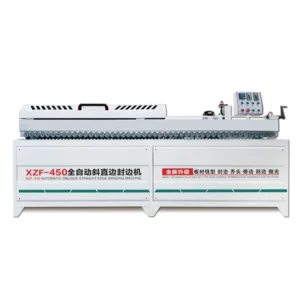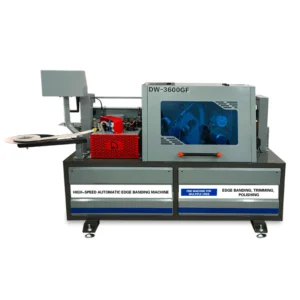
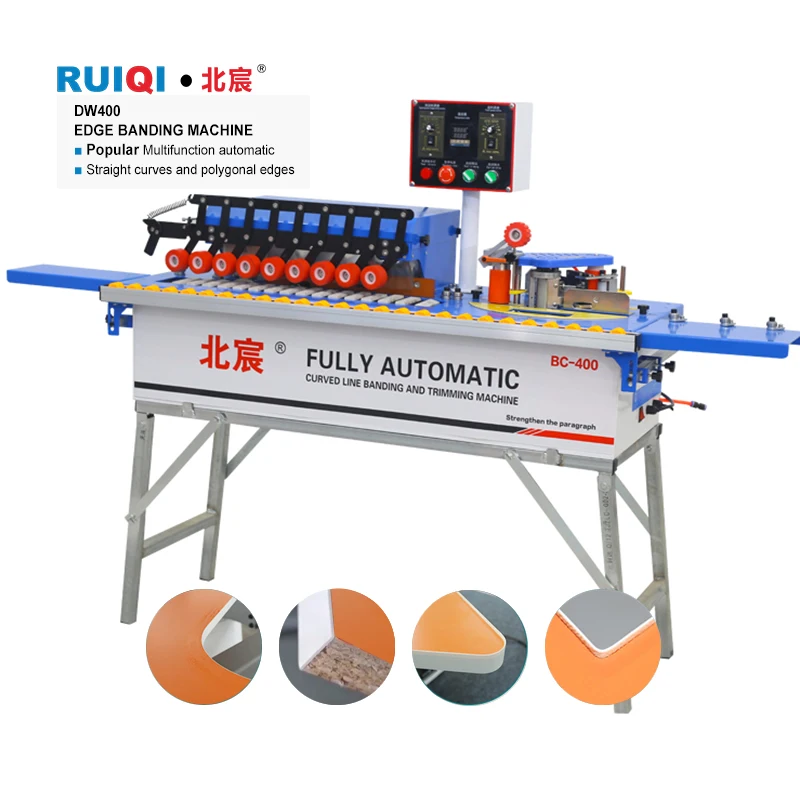
Edge banding machine
Click to enlarge
ISO 9001
CE Certified
OEM / ODM
12-Mo Warranty
Edge banding machine
Edge Banding Machine for Office Furniture Cabinet Doors – Industrial Application
<p><strong>DW400 Edge Banding Machine, 220V/380V, 0.3–3MM Edge Thickness, 650W×2 Trimming</strong> — designed for MDF, particleboard, plywood and polymer door panel processing in cabinet and office furniture production.</p> <p>This edge bander addresses substrate-specific glue line visibility and trimming finish quality. The 1000ml glue pot supports continuous small-to-medium batch runs, while 0.5–0.8Mpa air source pressure stabilizes edge adhesion across varying panel densities. Dual 650W trimming stations deliver clean edge profiles critical for downstream assembly fit.</p> <ul> <li>Edge banding height 0–50MM with 25CM minimum sheet length</li> <li>Language and plug options configurable per operator and region</li> </ul> <p>Factory test records with sample edge banding output available before shipment, with operation manuals delivered in your chosen language for immediate commissioning.</p>
100+
Countries
MOQ 1
Unit
15-25 Days
Lead Time
380V Voltage
Automatic Trimming
Cabinet Door Production
DW400
Edge Banding Machine
MDF Panel
Process Application
- Full OEM/ODM support -- custom logo, voltage (110V-440V), multilingual panels
- ISO 9001 & CE certified, 5 national patents, 60 professional engineers
- 12-month warranty, remote technical support & spare parts service
- Professional export packaging, customs clearance support, on-time delivery
Patented Cutting Mechanism — Achieves ±0.02mm edge finishing tolerance, verified through four-stage quality control from raw material inspection to pre-shipment testing.
Technical Specifications
| Parameter | Value |
|---|---|
| Model | DW400 |
| Product Type | Edge Banding Machine |
| Total Power | 3800W |
| Voltage Options | 220V/380V/Customization |
| Trimming Power | 650W × 2 |
| Polishing Power | 180W × 2 |
| Glue Pot Capacity | 1000ml |
| Air Source Pressure | 0.5–0.8 MPa |
| Edge Banding Thickness Range | 0.3–3mm |
| Minimum Sheet Dimensions | 250mm (L) × 100mm (W) |
| Edge Banding Height (Panel Thickness) | 0–50mm |
| Machine Footprint | 1160 × 470 × 690mm |
| Net Weight | 70kg |
Application Suitability
| Application Scenario | Substrate & Material Match |
|---|---|
| Custom Cabinet Door Production | MDF and particleboard with 0.4–1.0mm PVC edge banding |
| Office Furniture Panel Processing | Plywood and melamine-faced board with standard ABS or PVC strips |
| Small-Batch Joinery Workshops | Solid wood panels with 1.0–3.0mm veneer or thick PVC edging |
| Polymer Door Manufacturing | Polymer composite substrates requiring adjusted glue temperature and pressure |
Why Edge Banding Quality Varies Across Different Substrates
Substrate density and surface porosity dictate glue penetration, making uniform pressure and consistent glue temperature non-negotiable for invisible glue lines.
Production managers frequently encounter visible glue lines on particleboard while MDF edges appear acceptable on the same machine. This inconsistency rarely stems from operator error; it reflects how different substrates absorb adhesive at varying rates under fluctuating thermal and pneumatic conditions. The Edge Banding Machine process and application demands precise control over these variables to maintain uniform edge quality across mixed-material production runs [NEED_CITE: substrate porosity and adhesive bonding mechanics in wood panel processing].
Glue Pot Stability and Adhesive Behavior on Porous Substrates
The 1000ml glue pot capacity supports continuous small-to-medium batch operations without frequent refills that cause temperature drops. Particleboard and low-density MDF absorb hot-melt adhesive rapidly, requiring the glue to remain within a narrow thermal window to achieve proper wetting before the edge banding material contacts the substrate. Insufficient glue volume or uneven heating leads to starved glue lines on porous boards, while excessive temperature degrades adhesive polymers and creates stringing.
Trimming Configuration and Edge Finish Quality
Dual trimming stations rated at 650W each provide the torque necessary for clean cuts across the full 0.3–3mm edge banding thickness range. The first trimming pass removes bulk overhang, while the second station refines the profile to match the panel surface. This two-stage approach prevents the chatter marks and micro-fractures that single-pass trimming leaves on brittle PVC and acrylic edge materials, directly influencing the tactile quality of finished cabinet doors and furniture components.
Pneumatic Pressure and Bonding Consistency
Edge Banding Machine process and application reliability depends heavily on consistent air source pressure between 0.5–0.8 MPa. The pneumatic system controls the pressure roller force that bonds edge banding to the substrate immediately after glue application. Insufficient pressure allows air pockets to form beneath the banding, creating hollow spots that fail during trimming or later peel in humid conditions. Excessive pressure squeezes adhesive out of the joint, starving the bond line and leaving visible gaps on the panel edge.
The Real Cost of Ignoring Voltage and Frequency Compatibility
Machines specified without confirming local electrical standards arrive at factories unable to operate or suffer premature motor burnout from frequency mismatch. The DW400 supports voltage customization from 220V to 380V, but the factory must confirm the destination market’s exact voltage, phase configuration, and frequency before production begins [NEED_CITE: international voltage and frequency standards for industrial machinery]. A 50Hz motor running on 60Hz supply operates at higher RPM than designed, accelerating bearing wear and altering feed speed calibration without visible warning until components fail.
Why Source Verification and Factory Testing Matter
The Edge Banding Machine process and application requires validation on your specific substrate and edge banding material combination before committing to a purchase order. Request factory test records showing trimming and polishing results on samples matching your production materials. Verify that the machine specification sheet documents the exact edge banding thickness range and panel height your products require. Confirm that the operation and maintenance manual will be delivered in the language your operators read, preventing commissioning delays and safety hazards from misunderstood controls [NEED_CITE: industrial equipment documentation requirements for operator safety].
Documentation & Verification
- Factory test record demonstrating edge finish quality on your specific MDF or particleboard grade
- Machine specification sheet confirming 0.3–3mm edge banding thickness compatibility with your material plan
- CE declaration of conformity covering the destination market’s machinery directive requirements
- Electrical schematic with confirmed voltage and frequency matching your facility’s power supply
- Operation and maintenance manual in the agreed operator language with illustrated safety procedures
Installation, Commissioning & Support
- Requires level floor space accommodating the 1160 × 470mm footprint with clearance for sheet infeed and operator access
- Dedicated electrical circuit matching confirmed voltage rating with proper grounding for the 3800W total load
- Air compressor connection delivering stable 0.5–0.8 MPa pressure to the pneumatic system inlet
- Initial commissioning includes glue temperature calibration and pressure roller adjustment for your specific edge banding material
- Trimming and polishing station alignment verification using sample panels from your production stock
Preparing Your Technical Inquiry
Provide details about your primary substrate types, typical edge banding materials and thicknesses, and daily production volume expectations. Specify your facility’s electrical supply voltage, phase configuration, and frequency, along with the preferred control panel language for operators. If you process unusual substrates like polymer composites or high-density specialty boards, include sample specifications so engineering can recommend appropriate glue types and pressure settings.
Frequently Asked Questions
Q: How does substrate porosity affect glue line visibility on particleboard versus MDF?
A: Particleboard’s open surface structure absorbs hot-melt adhesive more aggressively than MDF’s denser fiber matrix. This demands precise glue temperature control and adequate pot capacity to maintain consistent adhesive viscosity throughout the application cycle. The 1000ml glue pot on this machine provides thermal mass stability for continuous runs, while the 0.5–0.8 MPa pneumatic pressure ensures uniform bonding force across both substrate types without squeezing adhesive from the joint.
Q: What edge banding materials work within the 0.3–3mm thickness range?
A: This range covers standard PVC and ABS edging typically used on cabinet doors and office furniture, as well as thicker veneer strips for solid wood applications. Thin melamine paper edging falls at the lower boundary, while 2–3mm solid wood or thick PVC suits high-wear furniture edges. The dual 650W trimming stations handle the full spectrum, removing bulk material and refining the profile without chatter on brittle acrylic or flexible vinyl.
Q: How do the dual trimming stations improve edge finish compared to single-pass systems?
A: The first trimming pass removes the majority of edge banding overhang, reducing cutting load on the second station. This allows the second pass to make a lighter, more precise cut that produces a smoother profile matching the panel surface. Single-pass systems must remove all material in one aggressive cut, often leaving micro-fractures on brittle PVC edges and requiring additional manual cleanup before polishing achieves acceptable smoothness.
Q: What role does air pressure stability play in preventing edge banding adhesion failures?
A: Pneumatic pressure directly controls the force applied by pressure rollers immediately after glue application. Fluctuations below 0.5 MPa allow air pockets to remain trapped beneath the banding material, creating bond weaknesses that manifest as peeling or hollow sounds when tapped. Pressure exceeding 0.8 MPa forces adhesive out of the joint, leaving insufficient material to maintain the bond, particularly on porous substrates that already absorb glue rapidly.
Q: How should machine settings be adjusted when switching between PVC and wood veneer edge banding?
A: Wood veneer typically requires slightly higher glue temperature and increased pressure roller force compared to PVC, as natural wood fibers absorb adhesive differently than synthetic polymers. Trimming speed may need reduction when processing veneer to prevent tear-out along the wood grain. The machine’s adjustable parameters allow operators to save preset configurations for each material type, reducing changeover time and maintaining consistent edge quality across mixed-material production schedules.
Technical Specifications
| Parameter | Value |
|---|---|
| Product Name | Edge Banding Machine for Office Furniture Cabinet Doors – Industrial Application |
| Category | Edge banding machine |
| Voltage Options | 110V / 220V / 380V / 440V (customizable) |
| Frequency | 50Hz / 60Hz (customizable) |
| Certification | ISO 9001, CE |
| MOQ | 1 Unit |
| Lead Time | 15-25 Working Days |
| Warranty | 12 Months |
| OEM / ODM | Available -- logo, color, panel language |
* Detailed technical specifications vary by model. Please contact us with your specific requirements for a complete datasheet.
Shipping & Export
-
Export Packaging
Heavy-duty wooden crate with foam padding and moisture protection
-
Shipping Methods
Sea freight (FCL/LCL), air freight, express -- we support all methods
-
Customs Support
Full documentation: CO, commercial invoice, packing list, HS code assistance
-
Port of Loading
Tianjin / Qingdao port, China -- 20 years export experience
OEM / ODM Services
-
Logo & Branding
Custom logo printing, color scheme, and nameplate engraving
-
Voltage Configuration
110V / 220V / 380V / 440V, 50Hz / 60Hz -- any region supported
-
Multilingual Panels
Control panels in English, Spanish, French, Arabic and more
-
Custom Specifications
Modified dimensions, accessories, or feature sets on request
Get a Quote
Request Product Inquiry
Fill in your details and we'll respond within 24 hours with pricing and availability.
Direct Contact
How It Works
-
1
Confirm requirements & budget
Tell us your factory scale and processing needs
-
2
Receive recommendation & quote
We match the right machine with full specs
-
3
Negotiate & place order
OEM terms, voltage, payment and delivery
-
4
Production & QC inspection
Multi-stage quality control by 60 engineers
-
5
Export packaging & shipment
Professional packing, customs clearance
-
6
After-sales support
12-month warranty, remote tech support
You May Also Like