Edge banding machine
Click to enlarge
ISO 9001
CE Certified
OEM / ODM
12-Mo Warranty
Edge banding machine
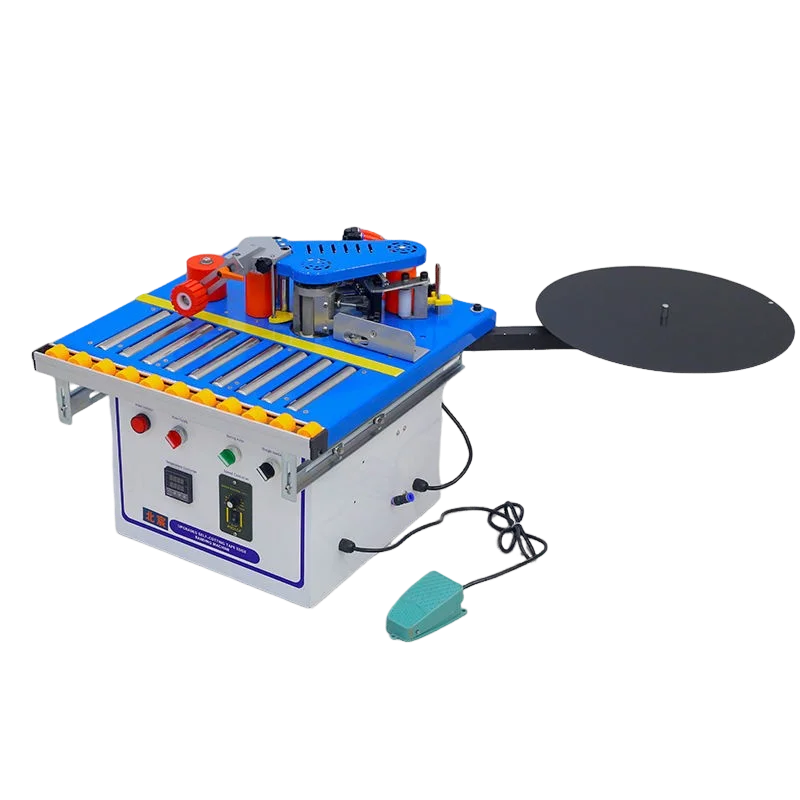
Handheld Edge Bander with Glue Applicator – Compact Small Workshop
<p><strong>Portable Handheld Edge Bander</strong>, 1000W, 0.3-3mm banding thickness — applies hot melt glue consistently on curved and straight edges across MDF, plywood and particleboard. Glue pot holds 1000ml for extended sessions, while the 0-50mm banding height and compact 50×50×47cm footprint suit on-site repair and small workshop tasks. Supports PVC, veneer and melamine banding materials. Backed by four-stage QC with pre-shipment verification, engineer-led configuration within 24 hours, and voltage customization from 110V to 440V to match local supply.</p>
100+
Countries
MOQ 1
Unit
15-25 Days
Lead Time
220V 380V
Curved And Straight Edge Banding
Edge Banding Machine
MDF Panel
Plywood Edge Sealing
Portable Handheld Edge Bander
Process And Application
ST-70
- Full OEM/ODM support -- custom logo, voltage (110V-440V), multilingual panels
- ISO 9001 & CE certified, 5 national patents, 60 professional engineers
- 12-month warranty, remote technical support & spare parts service
- Professional export packaging, customs clearance support, on-time delivery
Glue application consistency on curved profiles — a 1000ml hot melt pot and adjustable feed allow the ST-70 portable edge bander to maintain even adhesive coverage across MDF, plywood and particleboard without cold spots or visible glue lines.
Technical Specifications
| Parameter | Value |
|---|---|
| Product Type | Portable Handheld Edge Banding Machine |
| Total Power | 1000W |
| Voltage | 220V / 380V / customization available |
| Edge Banding Height | 0–50mm |
| Edge Banding Thickness | 0.3–3mm |
| Minimum Sheet Length | 250mm |
| Minimum Sheet Width | 30mm |
| Glue Pot Capacity | 1000ml |
| Edge Power | 20W |
| Air Source Pressure | 0.5–0.8 MPa |
| Product Size | 500 × 500 × 470mm |
| Product Weight | 23kg |
| Banding Capability | Curved and straight edges |
| Plug Options | EU, USA, AU, UK |
| Control Language | Chinese and English standard; other languages customizable |
Application Suitability
| Application | Material or Output |
|---|---|
| Custom furniture repair and small-batch edge sealing | MDF, particleboard, ecological board |
| On-site edge touch-up during home decoration installation | Plywood, solid wood board, melamine-faced panels |
| DIY furniture builds without a full production line | PVC, veneer and melamine edge banding 0.3–3mm |
| Joinery workshop offcut finishing | Small panels down to 250mm length × 30mm width |
Why the Voltage Question Must Come Before the Edge Banding Machine Process and Application Decision
Skipping voltage confirmation is the fastest way to turn a new edge bander into a workshop paperweight.
I once shipped a portable hot melt edge bander overseas without verifying the customer’s local supply. The glue pot would not heat on arrival — the 220V unit hit a 110V circuit and the operator sat idle for weeks waiting on a transformer. With a 1000W total power draw and a glue pot that must reach stable melt temperature before any banding begins, a voltage mismatch does not just slow you down; it stops you completely. Whether the target workshop runs on 220V single-phase or 380V three-phase determines whether the machine ever sees its first panel [NEED_CITE: voltage and frequency standards by export market].
Hot Melt Behaviour Across Different Substrates
The edge banding machine process and application outcome depends heavily on what the glue meets. MDF absorbs heat quickly due to its porous fibre structure, so the adhesive must transfer fast before the open time closes. Plywood behaves differently — its laminated veneer layers create a less absorbent surface, meaning the same glue temperature and feed pressure that work on MDF may leave a starved glue line on plywood. A 1000ml glue pot capacity allows extended sessions without constant refilling, which matters when you are moving between substrate types and need thermal stability throughout the run.
Curved Versus Straight Edge Geometry
Straight edges let gravity and a flat reference surface do half the work. Curved profiles remove that advantage entirely. The operator must maintain consistent pressure and feed angle around a radius, and the banding material must flex without lifting at the tangent points. This unit handles both curved and straight edges within a 0.3–3mm thickness range, covering rigid PVC for straight cabinet carcases and flexible veneer for curved feature panels. Achieving a clean result on curves requires practice and the right adhesive viscosity, not just a machine that physically fits the profile [NEED_CITE: edge banding adhesive selection guidelines for curved profiles].
Reading the Specs Against Your Actual Panels
The 0–50mm edge banding height range covers standard 18mm furniture board as well as thicker worktop panels, but the practical limit depends on how steadily the operator can hold the unit against a tall edge. At 23kg, the machine has enough mass to stay planted on a bench but demands two hands for vertical panels. The 0.5–0.8 MPa air source pressure requirement means a small compressor is mandatory — this is not an electric-only tool. Air drives the pressure roller mechanism that bonds the banding to the substrate, and insufficient pressure shows up immediately as lifting at the leading or trailing edge.
What Happens When Configuration Is Skipped
Buyers who order a handheld edge bander without confirming voltage, plug type and language on the control panel often discover problems only after the crate is open. A unit wired for 380V three-phase arrives at a site with only single-phase supply, and the motor will not start. An English-only interface stalls commissioning when the operator reads another language. These are not warranty claims — they are configuration oversights that cost weeks of downtime while transformers or translated manuals are sourced locally [NEED_CITE: CE machinery directive requirements for industrial equipment].
Why Sourcing This Unit Through Ruiqi Woodwork
The product family spans entry-level handheld tools through full automatic lines, so a workshop can begin with this portable unit and move to a bench-top or automatic edge bander within the same supplier relationship as volume grows. Voltage is configurable across 220V and 380V with plug options for EU, USA, AU and UK markets, eliminating the transformer problem before it starts. Operation manuals are produced in the agreed language, and the pre-shipment test record verifies glue pot temperature stability on the buyer’s actual panel material. Custom logo and colour are available for distributors branding the unit for regional resale.
Documentation & Verification
- CE declaration of conformity covering portable woodworking machinery
- Electrical schematic confirming configured voltage and plug type
- Factory test record on buyer’s specified panel thickness and edge material
- Operation manual in the agreed language with glue pot safety procedures
- Spare parts list covering glue pot elements, pressure roller and air fittings
Installation, Commissioning & Support
- Dedicated 16A circuit recommended for the 1000W total power draw
- Air compressor rated to 0.8 MPa minimum required for pressure roller operation
- Glue pot first heat-up supervised with temperature verification against adhesive spec
- Operator training on curved versus straight feed technique and pressure control
- Replacement glue pot heating element and air seals stocked as standard spares
What to Share With Your Inquiry
Describe the panel materials you seal most often, the edge banding thickness and type you plan to run, and whether your work includes curved profiles. Confirm your workshop voltage and frequency so the unit ships wired correctly. Let us know the operator’s preferred language for the manual and any branding requirements if you are distributing regionally.
Frequently Asked Questions
Q: How does hot melt glue behave on MDF versus plywood with a handheld unit?
A: MDF absorbs heat rapidly due to its fibre structure, requiring a faster feed to prevent the glue from cooling before bonding. Plywood’s veneer layers are less absorbent, so the same temperature may need slightly higher pressure. The 1000ml pot helps maintain stable temperature across both substrates during a session.
Q: Which banding materials fit within the 0.3–3mm thickness range?
A: PVC, natural veneer and melamine banding all fall within this range. Thin 0.3mm melamine suits flat laminate panels, while 2–3mm PVC is common for cabinet carcases. Veneer at around 0.5–1mm works well on curved profiles where flexibility matters during application.
Q: Can I get consistent results on curved edges with a portable tool?
A: Yes, provided the operator maintains steady pressure and feed speed around the radius. The air-driven pressure roller assists, but curved work relies more on technique than straight edges. Practice on offcuts of the same material and radius before committing to finished panels.
Q: What compressor setup does this portable edge bander need?
A: The unit requires 0.5–0.8 MPa air pressure for the pressure roller mechanism. A small workshop compressor rated to at least 0.8 MPa with a regulated output line is sufficient. Without adequate air, the roller cannot maintain contact and the banding will lift at the edges.
Q: How does this handheld unit compare to an automatic edge bander for volume?
A: The handheld tool suits repair work, small batches and on-site finishing where a full machine is impractical. For daily production of hundreds of panels, an automatic edge bander with pre-milling and multiple trimming stations delivers consistency that manual operation cannot match. This unit serves as a complement, not a replacement.
Technical Specifications
| Parameter | Value |
|---|---|
| Product Name | Handheld Edge Bander with Glue Applicator – Compact Small Workshop |
| Category | Edge banding machine |
| Voltage Options | 110V / 220V / 380V / 440V (customizable) |
| Frequency | 50Hz / 60Hz (customizable) |
| Certification | ISO 9001, CE |
| MOQ | 1 Unit |
| Lead Time | 15-25 Working Days |
| Warranty | 12 Months |
| OEM / ODM | Available -- logo, color, panel language |
* Detailed technical specifications vary by model. Please contact us with your specific requirements for a complete datasheet.
Shipping & Export
-
Export Packaging
Heavy-duty wooden crate with foam padding and moisture protection
-
Shipping Methods
Sea freight (FCL/LCL), air freight, express -- we support all methods
-
Customs Support
Full documentation: CO, commercial invoice, packing list, HS code assistance
-
Port of Loading
Tianjin / Qingdao port, China -- 20 years export experience
OEM / ODM Services
-
Logo & Branding
Custom logo printing, color scheme, and nameplate engraving
-
Voltage Configuration
110V / 220V / 380V / 440V, 50Hz / 60Hz -- any region supported
-
Multilingual Panels
Control panels in English, Spanish, French, Arabic and more
-
Custom Specifications
Modified dimensions, accessories, or feature sets on request
Get a Quote
Request Product Inquiry
Fill in your details and we'll respond within 24 hours with pricing and availability.
Direct Contact
How It Works
-
1
Confirm requirements & budget
Tell us your factory scale and processing needs
-
2
Receive recommendation & quote
We match the right machine with full specs
-
3
Negotiate & place order
OEM terms, voltage, payment and delivery
-
4
Production & QC inspection
Multi-stage quality control by 60 engineers
-
5
Export packaging & shipment
Professional packing, customs clearance
-
6
After-sales support
12-month warranty, remote tech support
You May Also Like