Edge banding machine
Click to enlarge
ISO 9001
CE Certified
OEM / ODM
12-Mo Warranty
Edge banding machine
Industrial Application Edge Banding Machine for MDF Board Furniture
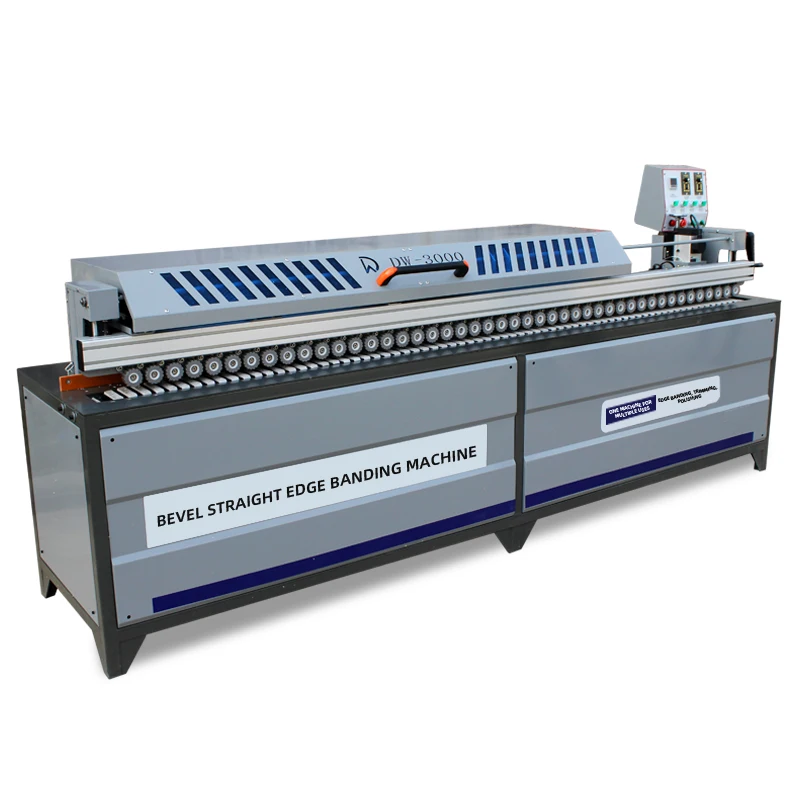
<p><strong>DW3000 45 Degree Edge Banding Machine</strong>, 11 kW, 0–12 m/min feed speed, 0.3–3 mm banding thickness — engineered for straight and bevel edge processing on MDF, particleboard, and plywood substrates.</p> <ul> <li>Double heat gun (2.2 kW × 2) ensures consistent glue activation across varying band materials and substrate densities</li> <li>8-set oblique pressure wheels adjustable 30°–90° deliver precise pressure control for clean bevel profiles that support accurate downstream panel assembly</li> <li>Spindle trimming motors paired with flexible edge scraper eliminate visible glue lines for finishing-ready edges</li> </ul> <p>Request a factory test record with your actual substrate and edge band combination to verify edge finish quality before order.</p>
100+
Countries
MOQ 1
Unit
15-25 Days
Lead Time
11KW Motor
45 Degree Bevel
Double Heat Gun
DW3000
Edge Banding Machine
MDF Panel
Process Application
- Full OEM/ODM support -- custom logo, voltage (110V-440V), multilingual panels
- ISO 9001 & CE certified, 5 national patents, 60 professional engineers
- 12-month warranty, remote technical support & spare parts service
- Professional export packaging, customs clearance support, on-time delivery
Double Heat Gun Gluing — Two 2.2 kW heating elements ensure consistent glue activation across PVC, veneer, and melamine edge bands on MDF substrates.
Technical Specifications
| Parameter | Value |
|---|---|
| Model | DW3000 |
| Product Type | 45 Degree Oblique Straight Edge Panel Furniture Edge Banding Machine |
| Rated Power | 11 kW |
| Voltage & Frequency | 380V / 415V |
| Control System | PLC-based operation panel (Chinese/English default; Spanish and other languages on request) |
| Overall Dimensions (L×W×H) | 299 × 65 × 130 cm |
| Net Weight | 430 kg |
| Feed Speed | 0–12 m/min |
| Minimum Sheet Length | 30 cm |
| Minimum Sheet Width | 15 cm |
| Edge Banding Height Range | 0–50 mm |
| Edge Banding Thickness Range | 0.3–3 mm |
| Pre-milling Motor | 2.2 kW |
| Heating Power | 2.2 kW × 2 (double heat gun) |
| Trimming Power | 2.2 kW × 2 (spindle trimming) |
| Polishing Power | 0.4 kW × 2 |
| Vacuum Power | 550 W |
| Glue Pot Capacity | 4000 ml |
| Air Source Pressure | 0.5–0.7 MPa |
| Oblique Pressure Wheels | 8 sets, adjustable 30°–90° |
| Key Features | Plate pre-milling, 30°–90° oblique and straight edge banding, edge trimming, scraping, polishing, high-power vacuuming, edge band slotting device, double cylinder feeding belt, feeding auxiliary slide, automatic alignment, flexible edge scraper |
Application Suitability
| Application | Material or Output |
|---|---|
| Custom cabinet production | MDF and particleboard panels with PVC or melamine edge bands (0.3–3 mm) |
| Bevel-edge furniture joinery | Plywood and MDF panels requiring 45° oblique edge profiles |
| Panel furniture batch processing | Mixed substrate runs where glue temperature and pressure must adapt between boards |
| Joinery workshop automation | Transition from manual edge finishing to machine-fed straight and bevel banding |
Why Visible Glue Lines Appear on Some Substrates and How to Prevent Them
The glue activation temperature and pressure wheel calibration must match both the edge band material and the substrate density — a setting that works on PVC will fail on melamine or veneer.
I learned this the hard way. Early in my career, I set up an edge bander for a furniture factory using standard PVC parameters from our test samples. When the customer switched to melamine edge banding for their actual production run, the glue didn’t activate properly at the same temperature. The result was visible glue lines, band lifting at the corners, and an entire batch sent back for rework. That experience changed how I approach every machine setup — the woodworking process edge banding machine 45 degree bevel configuration must be validated against the exact materials running through it [NEED_CITE: substrate adhesion behaviour across edge band materials].
The DW3000 addresses this directly with its double heat gun design. Two independent 2.2 kW heating elements bring the glue to the correct activation point across the full width of the edge band, which is critical when you switch between thin 0.3 mm PVC and thicker 3 mm veneer strips. On single-gun machines, the glue at the top of a 50 mm edge band often cools before the pressure wheels engage, especially in drafty workshops during winter.
Substrate Edge Preparation Before Banding
MDF, particleboard, and plywood each behave differently when they enter the pre-milling station. MDF cuts cleanly and leaves a smooth edge, which gives the glue a uniform bonding surface. Particleboard is more porous and can absorb glue unevenly if the edge is not freshly milled. Plywood, with its alternating grain layers, tends to chip at the edge unless the pre-milling cutter is sharp and the feed speed is controlled. The DW3000’s 2.2 kW pre-milling motor removes a thin layer from the panel edge at 45°, restoring edge squareness that may have been lost during the cutting stage.
Pressure Wheel Adjustment for Bevel Profiles
The eight sets of oblique pressure wheels adjust from 30° to 90°, which covers everything from a sharp bevel to a standard straight edge. When you run a 45° bevel profile on a 18 mm MDF cabinet side, the pressure distribution across the edge band is fundamentally different from a flat 90° application. Too little pressure on the bevel face and the band lifts during trimming. Too much and the band deforms, creating a visible wave that shows up under lacquer. Each wheel set can be individually positioned, so you can dial in the pressure profile for your specific panel thickness and band material combination [NEED_CITE: pressure calibration for oblique edge banding profiles].
Feed Speed, Trimming Sequence, and Final Edge Quality
The 0–12 m/min variable feed speed interacts with every downstream station. At the higher end of the range, the glue has less open time before the pressure wheels engage, which works well for thin PVC on MDF but risks poor adhesion on porous particleboard. The spindle trimming motors (2.2 kW × 2) follow immediately, cutting the excess band flush with the panel face. Then the flexible edge scraper removes the micro-burr left by trimming, and the dual polishing wheels finish the edge. This sequence — pre-mill, glue, press, trim, scrape, polish — is what determines whether the finished panel shows a clean edge or a visible seam that catches light on the showroom floor.
What Happens When Machine Configuration Ignores Your Workshop Reality
Machines quoted without confirming local voltage and frequency arrive and simply cannot run. I have seen 380V/50Hz machines shipped to facilities running 415V/60Hz, where the motors overheat within the first week. The DW3000 supports 380V and 415V configurations, but the frequency must be confirmed before production begins.
Control panels in a language the operator cannot read stall commissioning entirely. A production manager cannot train a team on glue temperature adjustment or pressure wheel calibration when every label is in a foreign script. The DW3000’s panel defaults to Chinese and English, with Spanish and other languages available on request — this must be specified at order, not discovered at delivery [NEED_CITE: multilingual control panel requirements for international equipment deployment].
Why Procurement Verification Matters at Every Stage
The DW3000 carries CE and ISO 9001 compliance through our manufacturing process. Our facility in Shandong operates with over 60 engineers and 800 skilled workers across a 10,000 square meter production floor. What sets this woodworking process edge banding machine 45 degree bevel apart is not just the specification sheet — it is the four-stage quality control covering incoming material inspection, in-process checks, finished product testing, and pre-shipment verification.
The patented cutting mechanisms in the trimming stations achieve verifiable tolerances. The 8-set oblique pressure wheels are calibrated on the factory floor before packing. And the double heat gun configuration is tested with actual glue and edge band material to confirm activation consistency across the full 0–50 mm banding height range.
Documentation & Verification
- CE declaration of conformity for DW3000 edge banding machine export clearance
- ISO 9001 certificate covering the manufacturing quality management system
- Electrical schematic confirming your facility’s voltage and frequency match
- Operation manual in your agreed language covering oblique angle and glue temperature adjustment
- Factory test record using your specific substrate and edge band material combination
- Spare parts list with trimming cutters, pressure wheel bearings, and glue pot components
Installation, Commissioning & Support
- Requires a level concrete floor capable of supporting 430 kg across the 299 cm machine footprint
- Dedicated 380V or 415V circuit with appropriate breaker rating for 11 kW total power draw
- Arrives fully assembled; connect air supply at 0.5–0.7 MPa and power before first run
- Initial calibration of all 8 oblique pressure wheel sets to match your panel thickness range
- Operator training on feed speed adjustment, glue pot loading, and pre-milling depth setting
- Spare trimming cutters and scraper blades included for first production cycle
What We Need From You to Configure This Machine Correctly
Tell us the substrate materials you run most often — MDF, particleboard, plywood, or a mix — along with typical panel thickness and the edge band materials and thicknesses in your production schedule. Confirm your workshop’s voltage and frequency supply so we can match the electrical configuration before the machine leaves the factory.
If you are processing bevel-edge panels for cabinet joinery, share the specific angle and panel dimensions so we can preset the pressure wheels and pre-milling station. We can also run sample boards through the DW3000 using your materials before you commit to an order, so you can verify edge quality and glue line appearance firsthand.
Frequently Asked Questions
Q: How does the double heat gun design affect glue activation on different edge band materials?
A: PVC activates at a lower temperature than veneer or ABS. The two independent 2.2 kW heat guns bring the full 4000 ml glue pot to a consistent temperature across the entire band width, which prevents partial activation on thicker materials like 3 mm veneer. This matters most on tall panels where a single heat source would leave the top edge underheated before the pressure wheels engage.
Q: What substrate edge preparation is needed before the pre-milling station processes MDF versus particleboard?
A: MDF typically requires minimal pre-milling since it cuts cleanly on the panel saw. Particleboard edges are more porous and benefit from a deeper pre-milling pass to expose a fresh, compact surface for glue bonding. The 2.2 kW pre-milling motor on the DW3000 removes material at 45° to restore edge squareness before the glue is applied.
Q: How do I adjust the oblique pressure wheels for consistent edge quality across varying panel thicknesses?
A: Each of the 8 wheel sets adjusts independently from 30° to 90°. For thin panels around 12 mm with 0.3 mm PVC, use lighter pressure at a narrower angle. For 18–25 mm boards with 2–3 mm edge bands, increase both the angle and pressure. The goal is uniform contact across the full band width without deforming the edge material.
Q: What feed speed range gives the best glue line finish on different substrate densities?
A: Denser substrates like MDF tolerate the upper end of the 0–12 m/min range because the surface is uniform and glue spreads evenly. Porous particleboard benefits from slower feed speeds, giving the glue more open time to penetrate before the pressure wheels engage. Start at mid-range and adjust based on edge pull-test results from your first batch.
Q: How does the flexible edge scraper and trimming sequence affect downstream assembly accuracy?
A: The spindle trimming motors cut the edge band flush, then the flexible scraper removes the micro-burr that trimming leaves behind. If that burr remains, it creates a visible gap when two panels meet at a corner joint. The polishing wheels then smooth the edge so it does not catch on handling or finishing equipment downstream.
Technical Specifications
| Parameter | Value |
|---|---|
| Product Name | Industrial Application Edge Banding Machine for MDF Board Furniture |
| Category | Edge banding machine |
| Voltage Options | 110V / 220V / 380V / 440V (customizable) |
| Frequency | 50Hz / 60Hz (customizable) |
| Certification | ISO 9001, CE |
| MOQ | 1 Unit |
| Lead Time | 15-25 Working Days |
| Warranty | 12 Months |
| OEM / ODM | Available -- logo, color, panel language |
* Detailed technical specifications vary by model. Please contact us with your specific requirements for a complete datasheet.
Shipping & Export
-
Export Packaging
Heavy-duty wooden crate with foam padding and moisture protection
-
Shipping Methods
Sea freight (FCL/LCL), air freight, express -- we support all methods
-
Customs Support
Full documentation: CO, commercial invoice, packing list, HS code assistance
-
Port of Loading
Tianjin / Qingdao port, China -- 20 years export experience
OEM / ODM Services
-
Logo & Branding
Custom logo printing, color scheme, and nameplate engraving
-
Voltage Configuration
110V / 220V / 380V / 440V, 50Hz / 60Hz -- any region supported
-
Multilingual Panels
Control panels in English, Spanish, French, Arabic and more
-
Custom Specifications
Modified dimensions, accessories, or feature sets on request
Get a Quote
Request Product Inquiry
Fill in your details and we'll respond within 24 hours with pricing and availability.
Direct Contact
How It Works
-
1
Confirm requirements & budget
Tell us your factory scale and processing needs
-
2
Receive recommendation & quote
We match the right machine with full specs
-
3
Negotiate & place order
OEM terms, voltage, payment and delivery
-
4
Production & QC inspection
Multi-stage quality control by 60 engineers
-
5
Export packaging & shipment
Professional packing, customs clearance
-
6
After-sales support
12-month warranty, remote tech support
You May Also Like