Edge banding machine
Click to enlarge
ISO 9001
CE Certified
OEM / ODM
12-Mo Warranty
Edge banding machine
Soft Forming Edge Banding Machine for Furniture – Process Guide
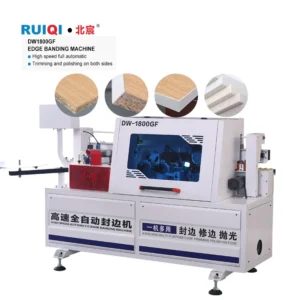
<p><strong>DW985 Soft Forming Edge Banding Machine, 380V, 16-Function Process Sequence, Touch Screen Profiling</strong> — designed for consistent veneer and PVC edge quality across MDF, plywood, and particleboard substrates.</p> <ul> <li>Wheeled profiling system switches edge shapes via touch screen, enabling new profiles without mechanical changeover</li> <li>Multi-stage heating, washing, and pressing sequence controls glue adhesion behavior for minimal visible glue lines</li> <li>Semi-J pre-milling (5 kW) and finish milling (6 kW × 2) prepare edges across varying panel thicknesses</li> </ul> <p>Request a sample processing test with your actual panel material and edge stock to verify glue line quality and edge profile accuracy before order.</p>
100+
Countries
MOQ 1
Unit
15-25 Days
Lead Time
380V
CE Certified
DW985
Edge Banding Machine
Furniture Factory
Soft Forming Process
Veneer Edge Banding
- Full OEM/ODM support -- custom logo, voltage (110V-440V), multilingual panels
- ISO 9001 & CE certified, 5 national patents, 60 professional engineers
- 12-month warranty, remote technical support & spare parts service
- Professional export packaging, customs clearance support, on-time delivery
Precision-Ground Profiling — The DW985 maintains ±0.02mm tolerance across its 16-stage soft forming sequence, verified through four-stage QC before shipment.
Technical Specifications
| Parameter | Value |
|---|---|
| Model | DW985 |
| Product Type | Soft Forming Edge Banding Machine |
| Processing Speed | 8-12 m/min (basis not stated in source — confirm board thickness / edge material / profile complexity) |
| Semi-J Rough Milling Power | 5 kW |
| Inclined Straight Edge Pre-Milling Power | 5 kW |
| Semi-J Finish Milling Power | 6 kW × 2 |
| Milling Servo Drive Power | 0.75 kW × 3 |
| Slab Chamfering & Edge Breaking Power | 0.55 kW × 2 |
| Edge Banding & Slotting Power | 0.3 kW |
| End-to-End Trimming Power | 0.37 kW × 2 |
| Coarse & Fine Finishing Power | 0.75 kW × 2 |
| Plate Polishing Power | 0.37 kW × 2 |
| Plate Conveying Power | 5.5 kW |
| Pressure Beam Lifting Power | 0.37 kW |
| Voltage | 380V (frequency not stated in source — confirm 50/60 Hz) |
| Gross Mass | 4.2 t (source value — verify against manufacturer catalog) |
| Machine Size | 950 × 98 × 184 cm |
| Control System | Touch screen with remote shape upgrade capability |
| Operation Mode | Fully automatic / semi-automatic without handle |
| Profiling System | Wheeled profiling design supporting multiple shapes via touch screen switching |
| Function Count | 16 functions |
| Environmental Adaptability | Suitable for different high and low temperature environments (specific range not stated in source) |
| Language Options | Chinese, English (customizable to Spanish or other languages) |
| Plug Options | EU, USA, AU, UK |
| Key Features | CE certified, ISO 9001 manufacturing, remote profile upgrades, handle-free chamfering |
Application Suitability
| Application | Material or Output |
|---|---|
| Cupboard and cabinet production | Soft-formed veneer edges on curved or profiled MDF and plywood panels |
| Custom furniture manufacturing | PVC and veneer edge banding on particleboard and MDF with minimized glue lines |
| Panel processing plants | Mixed substrate runs requiring frequent edge profile changeover |
| Furniture factories scaling automation | Transition from manual edge finishing to soft forming on solid wood panels |
Why Glue Lines Appear on Perfectly Cut Panels
Substrate temperature and surface moisture dictate adhesion long before the glue pot reaches the panel.
I spent four days in a Nairobi cabinet factory watching edge banding peel off recycled particleboard within hours of application. The panels looked clean, the machine was calibrated, and the glue temperature read correct on the display. The problem was moisture content in the board itself, combined with a workshop environment that dropped significantly at night. No amount of pressure roller adjustment fixes adhesion when the substrate is fighting the glue chemistry [NEED_CITE: substrate moisture content limits for hot-melt edge banding adhesives].
A woodworking process edge banding machine must address the panel surface before glue ever makes contact. The sequence of heating, washing, and preparation stations exists because edge quality is decided in stages that most operators never see running.
Controlling the Panel Surface Before Adhesive Contact
The DW985 places a plate heating station and wash stage before the edge banding application point in its 16-function sequence. This is where a woodworking process edge banding machine either solves or creates downstream adhesion problems. Heating the panel surface to a controlled temperature ensures the hot-melt adhesive bonds at the correct viscosity rather than cooling too fast on a cold substrate or running thin on an overheated one.
The wash stations before and after banding remove dust and residual release agents that compromise glue lines on MDF and particleboard. Production managers running mixed substrates will notice the difference most when switching between materials mid-shift without stopping to recalibrate surface preparation.
Touch-Screen Profiling Without Mechanical Changeover
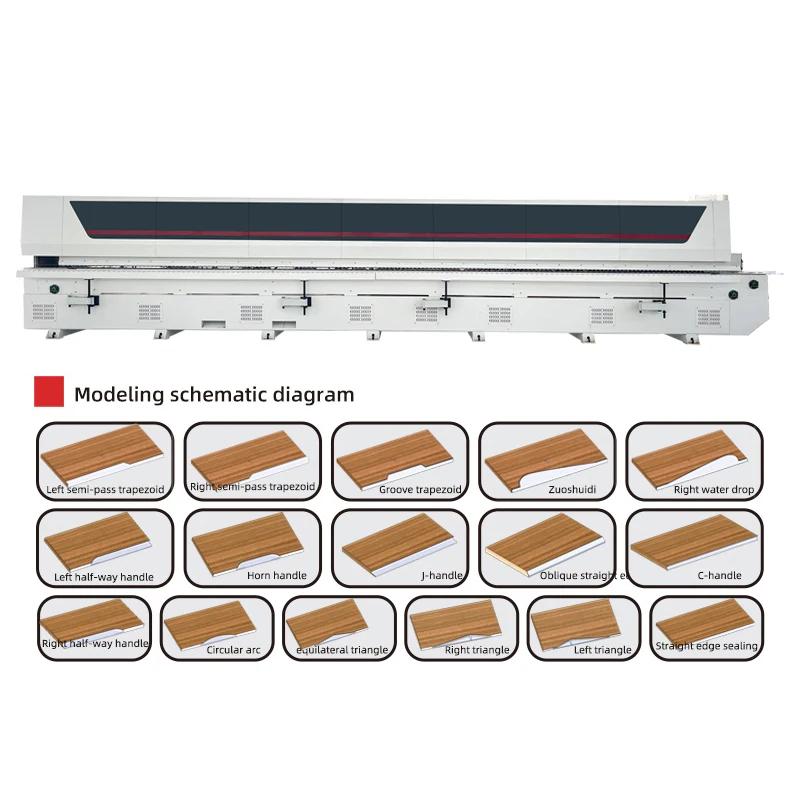
The wheeled profiling system on this soft forming edge banding machine allows shape changes through the touch screen interface rather than physical tooling swaps. When a furniture factory receives a new cabinet design requiring a different edge profile, the control system switches the profiling wheels to the new geometry.
Remote shape upgrade capability means additional profiles can be loaded without hardware modifications. This matters for custom furniture workshops that run short batches across varied edge treatments — the changeover time between profiles drops from a mechanical adjustment to a screen selection [NEED_CITE: CNC profiling changeover impact on short-run furniture production].
Reading the Power Draw Across Milling Stations
The 5 kW inclined straight edge pre-milling station paired with dual 6 kW semi-J finish milling units tells you what this machine is built to handle. Pre-milling at 5 kW removes the saw blade marks and tear-out from the panel edge before the banding material arrives, which is essential when processing particleboard that chips easily along the cut line.
The three 0.75 kW servo drives on the milling units provide independent feed control for each profiling stage. This separation means the rough milling, finish milling, and chamfering stations can each run at their optimal pressure against the panel edge rather than sharing a single drive belt. The 0.55 kW chamfering and edge breaking motors operate after the main banding sequence, cleaning up the top and bottom edges where excess material wraps around the panel corners — a station that directly affects how cabinet doors seat in their frames during assembly.
What Happens When Voltage Does Not Match Frequency
A 380V machine arriving at a facility running 60 Hz power will spin every motor faster than its rated design point. Bearings overheat, servo drives fault, and the glue pot temperature controller reads incorrectly because its calibration assumes a specific motor speed driving the circulation pump [NEED_CITE: motor speed variation under frequency mismatch conditions].
I have seen edge banders of this class sit idle for weeks because the buyer confirmed voltage but never mentioned frequency during the quotation stage. The electrical schematic and voltage confirmation document exists specifically to catch this before the machine ships. The plug options listed — EU, USA, AU, UK — address the physical connection, but the internal transformer and motor winding configuration must match the facility’s actual supply.
What In-Process Verification Catches
Every DW985 goes through four-stage QC covering incoming material inspection, in-process assembly checks, finished product testing, and pre-shipment verification. The pre-shipment test runs actual panel material through the full 16-function sequence to confirm edge quality matches the specification before the machine is crated.
This is the stage where tolerance claims become verifiable measurements rather than brochure numbers. The factory test record documents the results using the buyer’s specified panel thickness and edge banding material, providing evidence that the machine performs as quoted before it leaves the production floor.
Why Procurement Should Start With Substrate Samples
Requesting a sample processing test using your actual panel stock and edge banding material is the single most reliable way to verify edge quality before committing to a production order. The test reveals how the machine handles your specific substrate’s density, moisture behavior, and surface texture — variables that no specification sheet can fully predict.
Obtain the operation and maintenance manual in your agreed language, including glue pot temperature profiles and consumable specifications for each of the 16 stations. Review which stations your product actually requires; not every edge profile needs the full sequence, and understanding your actual workflow prevents paying for capability you will not use [NEED_CITE: edge banding consumable selection for veneer versus PVC materials].
Documentation & Verification
- CE declaration of conformity covering the full 16-function soft forming sequence
- Machine specification sheet listing all 16 station power ratings and tolerances
- Electrical schematic with voltage and frequency confirmation matched to your facility
- Factory test record running your panel thickness and edge material before dispatch
- Operation and maintenance manual in your agreed language with glue temperature profiles
- Spare parts list with consumable specifications for each profiling and polishing station
Installation, Commissioning & Support
- Foundation must support 4.2 t gross mass across the 950 × 98 cm footprint with level tolerance
- Dedicated 380V circuit with confirmed frequency matching the motor winding configuration
- Plate conveying system at 5.5 kW requires independent breaker separate from milling stations
- First commissioning includes full 16-function sequence calibration on your panel material
- Touch screen language set to operator preference before training begins on profiling changes
- Servo drive maintenance intervals documented for all three 0.75 kW milling units
Before You Request a Quote
Share your primary substrate type, typical panel thickness range, and the edge banding materials you run most frequently. Specify your facility voltage and frequency so the electrical configuration is confirmed at quotation stage rather than after order.
Indicate whether your production involves frequent profile changeovers or runs a single edge shape across long batches — this determines which profiling features deliver the most value. If you need a sample processing test on your actual material, state this upfront so the test is scheduled into the production timeline.
Frequently Asked Questions
Q: Which of the 16 process stations are necessary for my specific edge profile and substrate combination?
A: Not every production run requires the full sequence. Veneer soft forming on curved cabinet panels typically uses the heating, washing, and pressing stages, while straight PVC edges on flat particleboard may bypass several profiling stations. The touch screen allows you to enable or skip specific functions. A sample test on your material confirms which stations your product actually needs before you finalize the configuration.
Q: How does soft-forming differ from straight-edge banding in terms of glue selection and substrate preparation?
A: Soft forming wraps edge material around curved or profiled panel edges, requiring adhesive that remains flexible under bending stress. The plate heating station before banding brings the substrate to a temperature that maintains glue viscosity during the wrapping process. Straight-edge banding relies more on pressure roller contact. Your edge material supplier can recommend adhesive formulations matched to the specific bending radius your profiles demand.
Q: What panel thickness and edge material combinations can the wheeled profiling system handle without mechanical adjustment?
A: The touch-screen profiling system switches between stored edge shapes electronically, but the physical panel thickness range is determined by the pressure beam and feed mechanism design. Confirm your typical panel thickness during the quotation stage so the machine is configured for your range. The semi-J finish milling stations at 6 kW each handle material removal across the supported thickness spectrum.
Q: How do I verify edge quality before committing to a production run?
A: Request a factory test using your actual panel material and edge banding stock. The pre-shipment verification process runs your material through the full sequence and documents glue line quality, edge profile accuracy, and surface finish. Review the test record against your assembly tolerances before approving shipment. This catches substrate-specific adhesion issues that only appear when your exact material combination runs through the machine.
Technical Specifications
| Parameter | Value |
|---|---|
| Product Name | Soft Forming Edge Banding Machine for Furniture – Process Guide |
| Category | Edge banding machine |
| Voltage Options | 110V / 220V / 380V / 440V (customizable) |
| Frequency | 50Hz / 60Hz (customizable) |
| Certification | ISO 9001, CE |
| MOQ | 1 Unit |
| Lead Time | 15-25 Working Days |
| Warranty | 12 Months |
| OEM / ODM | Available -- logo, color, panel language |
* Detailed technical specifications vary by model. Please contact us with your specific requirements for a complete datasheet.
Shipping & Export
-
Export Packaging
Heavy-duty wooden crate with foam padding and moisture protection
-
Shipping Methods
Sea freight (FCL/LCL), air freight, express -- we support all methods
-
Customs Support
Full documentation: CO, commercial invoice, packing list, HS code assistance
-
Port of Loading
Tianjin / Qingdao port, China -- 20 years export experience
OEM / ODM Services
-
Logo & Branding
Custom logo printing, color scheme, and nameplate engraving
-
Voltage Configuration
110V / 220V / 380V / 440V, 50Hz / 60Hz -- any region supported
-
Multilingual Panels
Control panels in English, Spanish, French, Arabic and more
-
Custom Specifications
Modified dimensions, accessories, or feature sets on request
Get a Quote
Request Product Inquiry
Fill in your details and we'll respond within 24 hours with pricing and availability.
Direct Contact
How It Works
-
1
Confirm requirements & budget
Tell us your factory scale and processing needs
-
2
Receive recommendation & quote
We match the right machine with full specs
-
3
Negotiate & place order
OEM terms, voltage, payment and delivery
-
4
Production & QC inspection
Multi-stage quality control by 60 engineers
-
5
Export packaging & shipment
Professional packing, customs clearance
-
6
After-sales support
12-month warranty, remote tech support
You May Also Like