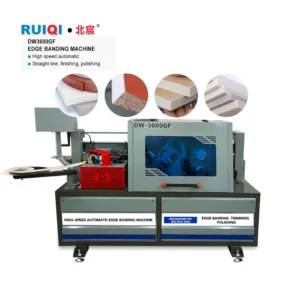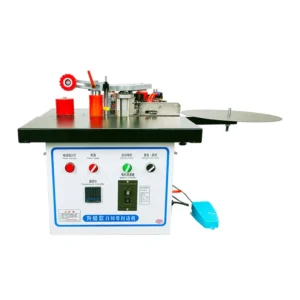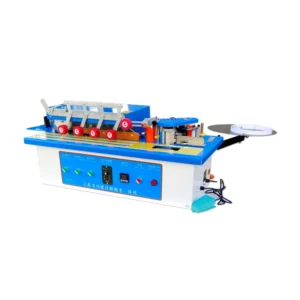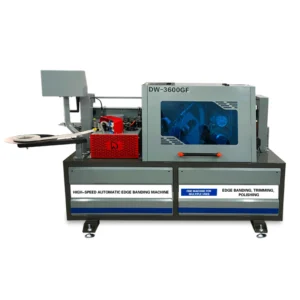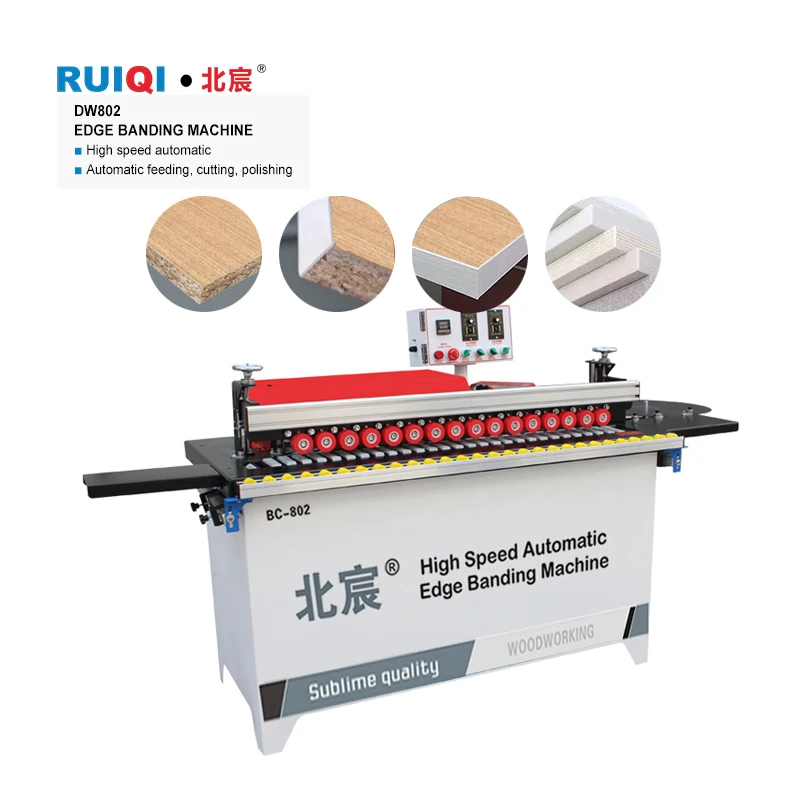
Edge banding machine
Click to enlarge
ISO 9001
CE Certified
OEM / ODM
12-Mo Warranty
Edge banding machine
Wood Based Panels Edge Banding Machine with Trimmer – Process Guide
<p>Factory test records document actual edge quality on your specific substrate and banding combination before shipment confirmation.</p>
100+
Countries
MOQ 1
Unit
15-25 Days
Lead Time
4200W
DW802
Edge Banding Machine
MDF Panel
Plywood Edge Sealing
Process Guide
Vacuum System
- Full OEM/ODM support -- custom logo, voltage (110V-440V), multilingual panels
- ISO 9001 & CE certified, 5 national patents, 60 professional engineers
- 12-month warranty, remote technical support & spare parts service
- Professional export packaging, customs clearance support, on-time delivery
Precision Edge Sealing Workflow — 4200W total output distributed across dedicated trimming and polishing stages ensures stable thermal conditions throughout the run.
Technical Specifications
| Parameter | Value |
|---|---|
| Model | DW802 |
| Product Type | Automatic Edge Banding Machine |
| Total Power | 4200 W |
| Voltage | 220V / 380V / customizable |
| Trimming Motor Power | 800 W × 2 |
| Polishing Motor Power | 180 W × 2 |
| Vacuum Power | 1200 W |
| Glue Pot Capacity | 4000 ml |
| Edge Banding Height Range | 0–50 mm |
| Edge Banding Thickness Range | 0.3–3 mm |
| Minimum Sheet Length | 25 cm |
| Minimum Sheet Width | 10 cm |
| Air Source Pressure | 0.4–0.8 MPa |
| Product Dimensions (L×W×H) | 130 × 60 × 95 cm |
| Net Weight | 135 kg |
| Control Panel Language | Chinese, English (other languages configurable) |
| Plug Options | EU, USA, AU, UK |
Application Suitability
| Application | Material or Output |
|---|---|
| Custom cabinet door edge sealing | MDF and particleboard with PVC or melamine banding |
| Wardrobe carcass production | Particleboard panels up to 50 mm thickness |
| Small-batch plywood furniture | Plywood and ecological board with veneer edge strips |
| Home decoration millwork | Solid wood board components requiring flush-trimmed edges |
| Mixed-material workshop orders | Alternating MDF, plywood, and ecological board within the same shift |
Why Substrate Density Dictates Every Setting on the Line
MDF, particleboard, and plywood do not accept glue the same way — treating them as interchangeable is the most common cause of visible glue lines on finished panels.
I have watched operators load a new batch of particleboard after running MDF all morning, keep the same glue pot temperature, and spend the rest of the afternoon scraping squeeze-out off the edges. The DW802 edge banding machine woodworking process requires deliberate parameter adjustment when switching substrates. Particleboard’s open pore structure absorbs hot melt faster than MDF’s denser fibre matrix, meaning a temperature that produces a perfect bond on MDF may starve the joint on particleboard. Plywood introduces another variable entirely — its laminated veneer layers create an uneven surface that demands different pressure and feed behaviour. [NEED_CITE: hot melt adhesive behaviour across engineered wood substrates]
Glue Film Consistency Across a Full Production Batch
A 4000 ml glue pot is not simply a capacity figure — it determines how often the operator stops to refill during a continuous edge banding machine woodworking process run. Every time the pot drops below a certain level, thermal mass decreases and the remaining adhesive cools unevenly. With four litres of working volume, a typical cabinet door batch runs through without interruption, keeping the glue film thickness uniform from the first panel to the last. This matters particularly when running thinner PVC banding at 0.3 mm, where even a marginal variation in adhesive spread becomes visible as a shadow line after trimming.
Dual Trimming Heads and Board Thickness Transitions
The two 800 W trimming motors work in sequence — the first takes the bulk of the overhang, and the second finishes flush. When a workshop alternates between 18 mm shelf panels and 40 mm worktop sections in the same order, the trimming station must respond to that range without manual recalibration between each piece. The DW802 accommodates this within its 0–50 mm height envelope. [NEED_CITE: sequential trimming station design for variable thickness panels] Without dual-head trimming, operators compensate with hand routers on the thicker stock, introducing inconsistency that shows up at assembly when edge profiles do not match across a cabinet set.
Reading the Specifications Against Your Actual Materials
Feed motor power at 140 W and transmission motor power at 140 W together define how the panel advances through each station. For lighter MDF sheets under 18 mm, this is sufficient to maintain steady feed without chatter marks on the trimmed edge. However, when processing denser ecological board or solid wood panels approaching 50 mm, the operator must watch for any hesitation at the glue application point — a pause of even a fraction of a second deposits excess adhesive that the trimming station then smears rather than cuts clean. The 0.3–3 mm banding thickness range covers standard PVC, melamine paper, and thin veneer strips, but each material requires its own temperature and speed starting point before fine-tuning on the shop floor. Air source pressure between 0.4 and 0.8 MPa feeds the pneumatic cylinders that control banding feed, end-cutting, and trimming head engagement — inconsistent shop air supply directly translates into uneven end cuts.
The Cost of Skipping the Material Conversation Before Purchase
A machine that performs well on the sample board in the showroom can produce unacceptable results on the actual substrate running through your shop. Particleboard with high recycled content behaves differently from virgin-fibre stock — the glue absorption rate changes, and so does the trimming resistance. I have seen workshops receive a new edge bander, run their first batch of ecological board, and discover the trimming motors bog down on the denser core layer, leaving a ragged edge that requires hand-finishing on every single panel. [NEED_CITE: substrate variability impact on edge banding trim quality] That secondary finishing step erases whatever throughput advantage the automatic machine was supposed to deliver. The 1200 W vacuum system on the DW802 pulls chips and offcuts away during trimming and polishing, but if the trimming station is already struggling with material density, vacuum alone cannot rescue the edge surface finish.
Why Procurement Through This Channel Works
The DW802 sits within a broader edge bander family, meaning a workshop that starts with this model can add higher-throughput machines later without retraining operators on a different control interface. Voltage is confirmed and configured before dispatch — 220V, 380V, or a custom specification matching your local supply — so the machine arrives ready to connect rather than requiring a transformer workaround. The four-stage quality verification process covers incoming material inspection through pre-shipment testing, and every unit ships with a factory test record documenting performance on the panel and banding combination you specified. Control panel language is set to your operator’s requirement before the machine leaves the floor, whether that is English, Spanish, or another language. Sample processing tests using your actual substrate and edge banding material are available before order commitment, removing the guesswork from the purchase decision.
Documentation & Verification
- CE declaration of conformity covering the DW802 edge banding machine
- Electrical schematic confirming voltage and plug type as ordered
- Factory test record on your specified panel thickness and banding material
- Operation manual in the agreed operator language with parameter starting points
- Spare parts list identifying trimmer cutters, polishing wheels, and glue pot elements
Installation, Commissioning & Support
- 130 × 60 × 95 cm footprint requires a level floor with clearance for sheet infeed and outfeed
- Dedicated 380V or 220V circuit rated above 4200 W total draw to prevent voltage sag during trimming
- Fully assembled delivery — position, level, connect power and air, then run first test panel
- Initial parameter setting for glue temperature, feed speed, and trimming depth based on your substrate
- Trimmer cutter and polishing wheel replacement intervals documented in the maintenance manual
- Vacuum port connection to workshop dust extraction or standalone 1200 W collection unit
Before You Send the Inquiry
Provide the panel materials you run most often — MDF grade, particleboard type, plywood thickness — along with the edge banding material and thickness range. Specify your workshop voltage and frequency, and whether you need the control panel in a language other than Chinese or English. If you process mixed substrates in a single shift, note that so the configuration recommendation accounts for changeover requirements.
Frequently Asked Questions
Q: How does switching between MDF and particleboard affect DW802 settings?
A: Particleboard absorbs hot melt adhesive faster due to its open pore structure, typically requiring a higher glue pot temperature or slower feed speed compared to MDF. When switching mid-shift, operators should run a test panel on the new substrate and check the trimmed edge for glue starvation or squeeze-out before resuming production.
Q: Which banding materials work within the 0.3–3 mm thickness range?
A: The DW802 processes PVC, melamine paper, and thin wood veneer strips within this range. Thinner materials like 0.3 mm melamine demand tighter glue film control, while 3 mm PVC requires the trimming motors to remove more material. Each material has a different recommended starting temperature and feed speed.
Q: How does the dual trimming station handle boards near 50 mm height?
A: The first 800 W trimming motor removes the bulk overhang, and the second finishes the edge flush. At the upper end of the 0–50 mm range, both motors share the cutting load, preventing the ragged edge that a single-head trimmer would leave on thicker panels.
Q: What role does the 4000 ml glue pot play in batch consistency?
A: A larger working volume maintains thermal mass across a continuous run, reducing temperature fluctuation as adhesive is consumed. This keeps the glue film thickness stable from the first panel to the last, which is particularly noticeable when processing light-coloured PVC banding where variation shows easily.
Q: How does vacuum extraction affect the polished edge surface?
A: The 1200 W vacuum system removes trimming chips and fine dust before they can be dragged across the panel surface by the polishing wheels. Without extraction, embedded particles create micro-scratches on the finished edge that become visible under direct lighting during final inspection.
Technical Specifications
| Parameter | Value |
|---|---|
| Product Name | Wood Based Panels Edge Banding Machine with Trimmer – Process Guide |
| Category | Edge banding machine |
| Voltage Options | 110V / 220V / 380V / 440V (customizable) |
| Frequency | 50Hz / 60Hz (customizable) |
| Certification | ISO 9001, CE |
| MOQ | 1 Unit |
| Lead Time | 15-25 Working Days |
| Warranty | 12 Months |
| OEM / ODM | Available -- logo, color, panel language |
* Detailed technical specifications vary by model. Please contact us with your specific requirements for a complete datasheet.
Shipping & Export
-
Export Packaging
Heavy-duty wooden crate with foam padding and moisture protection
-
Shipping Methods
Sea freight (FCL/LCL), air freight, express -- we support all methods
-
Customs Support
Full documentation: CO, commercial invoice, packing list, HS code assistance
-
Port of Loading
Tianjin / Qingdao port, China -- 20 years export experience
OEM / ODM Services
-
Logo & Branding
Custom logo printing, color scheme, and nameplate engraving
-
Voltage Configuration
110V / 220V / 380V / 440V, 50Hz / 60Hz -- any region supported
-
Multilingual Panels
Control panels in English, Spanish, French, Arabic and more
-
Custom Specifications
Modified dimensions, accessories, or feature sets on request
Get a Quote
Request Product Inquiry
Fill in your details and we'll respond within 24 hours with pricing and availability.
Direct Contact
How It Works
-
1
Confirm requirements & budget
Tell us your factory scale and processing needs
-
2
Receive recommendation & quote
We match the right machine with full specs
-
3
Negotiate & place order
OEM terms, voltage, payment and delivery
-
4
Production & QC inspection
Multi-stage quality control by 60 engineers
-
5
Export packaging & shipment
Professional packing, customs clearance
-
6
After-sales support
12-month warranty, remote tech support
You May Also Like