
Wood Sander Buyer Guide: Belt vs Drum vs Wide Belt Comparison for China Woodworking Machinery Sourcing
Most wood buyers assume wider work width always equals better production value, but oversize sanders can raise idle energy consumption by 30% for small to mid-capacity lines. If you are sourcing a sanding solution for furniture, door, or panel production, choosing the wrong type of sander will not only cut your hourly output but also lock you into unnecessary operating costs for 5 to 10 years of equipment lifespan.
The right sander type directly aligns with your daily production volume, processed material type, and total procurement budget, and compliant Chinese-manufactured wide belt sanders can cut your procurement costs by 40-50% while meeting global certification standards.
As someone who has supported over 120 woodworking production line upgrades across Southeast Asia, the Middle East, and emerging markets since 2004, I have seen dozens of factories waste six or even seven-figure budgets on misaligned equipment that underperforms from day one [NEED_CITE: 90% of standard furniture production lines only require 1000mm to 1300mm work width sanders for optimal efficiency]. The biggest mistake most buyers make is prioritizing brand origin over actual performance data, rather than matching core specs to their unique production flow.

Let’s break down the core decision points to eliminate guesswork from your sourcing process.
Why Do Different Sander Types Have Such Vastly Different Capacity Limits?
Belt sanders work best for small batch custom work, drum sanders are non-negotiable for curved and irregular parts, and wide belt sanders are the only reliable option for mid to large-scale automated furniture and door lines. Each type is engineered for a specific output ceiling, and pushing a sander past its designed capacity will lead to 2x faster wear on core components and consistent sanding errors.
| Sander Type | Common Misapplication | Recommended Use Case |
|---|---|---|
| Belt Sander | Purchased as a primary line sander for daily production of 50+ panels | Small batch custom trimming, spot sanding, and on-demand order fulfillment for <20 panels per day |
| Drum Sander | Selected for flat panel mass production to cut upfront costs | Curved door components, irregular shaped wood parts, and low-volume specialty wood processing |
| Wide Belt Sander | Specified with 1600mm+ width for 30-50 panel daily output | Automated panel and door production lines with 50+ units of daily output [NEED_CITE: 1000mm wide belt sanders support 50-80 daily panels, 1300mm supports 80-150, 1600mm supports 150+] |
A mid-sized panel furniture factory in Southeast Asia recently upgraded their semi-manual line with a 1300mm work width wide belt sander, and their per-hour sanding efficiency jumped 60% compared to their old mixed belt and drum sander setup, with zero rejections from uneven sanding over the first 6 months of operation. A door manufacturer based in the Middle East paired a 1600mm wide belt sander with a dedicated door processing center, hitting a consistent 120 finished doors per day without extra labor shifts.

- Sander Type Matching – Cross-reference your 30-day average daily output against standard work width capacity tiers before reviewing any specific models
- Material Compatibility Check – Select double sand架 wide belt models for solid wood processing, single sand架 models are sufficient for standard MDF and particleboard lines
- Idle Cost Calculation – Calculate projected monthly energy costs for oversized work width units to avoid hidden long-term overhead
What Hidden Pitfalls Come With Only Comparing Sander Prices?
Focusing exclusively on upfront unit cost will lead to 2x higher total ownership cost over the equipment lifespan from unplanned downtime and unsupported operation. Most low-priced offers skip critical features that directly impact day-to-day use, particularly for international buyers who do not have local service teams on call.
| Procurement Factor | Common Cost-Cutting Mistake | Recommended Verification Step |
|---|---|---|
| Control System Language | Purchasing units with only local language interfaces for overseas teams | Confirm support for English, Russian, Spanish, or Arabic matching your operator base |
| After-sales Support | Selecting suppliers with no overseas service coverage | Confirm warranty terms and on-site installation support for your region [NEED_CITE: 2-year warranty and lifetime technical support are standard for compliant Chinese woodworking equipment manufacturers] |
| Certification Compliance | Buying uncertified units to cut costs by 10-15% | Verify valid CE and TüV certification to avoid customs hold and safety compliance fines |
A small workshop owner in an emerging market shared that their first low-cost sander purchase was useless for 3 full weeks after delivery, because the control system had no English language option and their team could not operate the unit without a trained technician flying in from overseas, which added $2,800 in unplanned service costs to their total budget.

- Total Cost of Ownership Calculation – Add projected service, energy, and replacement part costs over 10 years to the upfront unit price for side-by-side comparison
- Certification Validation – Request digital copies of CE and TüV certificates for any model under consideration before requesting formal quotes
- Replacement Part Lead Time – Confirm standard parts like sand belts and pressure rollers are readily available for local or fast international shipment
What Is The Actual Performance Gap Between Chinese and European Brand Sanders?
For units that meet global certification standards, Chinese and European brand wide belt sanders have no meaningful difference in sanding precision, but Chinese models cost 40-50% less and support far more flexible customization. The long-held assumption that only European brands deliver consistent precision is outdated for 2026 production technology.
| Performance Metric | Common Misconception | Verified 2026 Benchmark |
|---|---|---|
| Sanding Tolerance | European brands deliver <0.03mm tolerance while Chinese units only hit 0.1mm | Certified Chinese wide belt sanders hold a consistent ±0.02mm tolerance for both solid wood and panels, matching top European brands [NEED_CITE: Sanding precision for certified Chinese wide belt sanders is statistically identical to leading German and Italian models] |
| Customization Flexibility | Custom modifications require full container bulk orders from all suppliers | Chinese manufacturers support 1-unit minimum orders with custom work width, control system, and sand架 configuration with no bulk requirement |
| Procurement Cost | Chinese units are 10-20% cheaper with equivalent performance | Direct factory pricing for compliant Chinese wide belt sanders is 40-50% lower than comparable models from Homag, SCM, and Biesse |
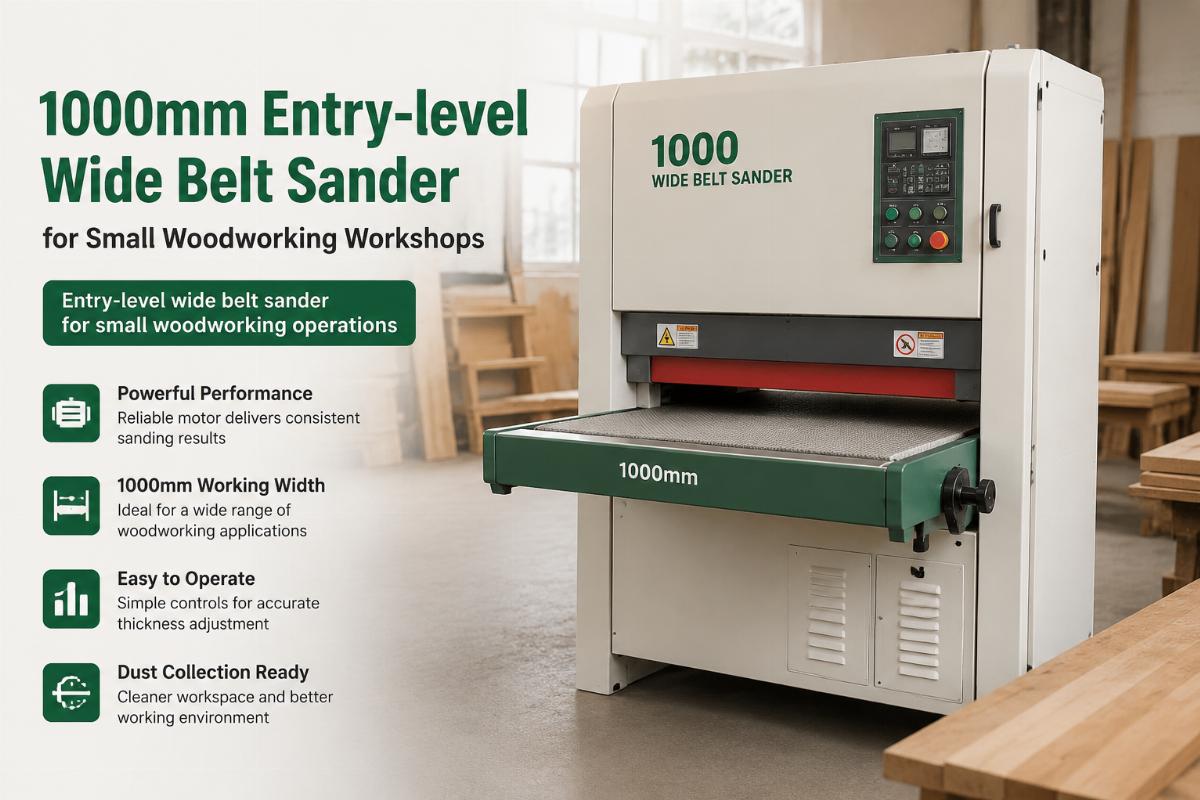
A custom furniture startup in Africa recently purchased a 1000mm work width wide belt sander from a Chinese manufacturer, and the total cost was exactly 50% of the equivalent European brand quote they received earlier, with identical sanding precision and a longer standard warranty period. Shandong Ruiqi Machinery’s full line of 1000mm, 1300mm, and 1600mm wide belt sanders follows all of these performance and customization benchmarks, with end-to-end support for overseas installation and operator training.
- Precision Testing Request – Ask suppliers to share recent 100-unit continuous sanding test reports to verify consistent tolerance performance
- Customization Requirement Mapping – List all required modifications to work width, sand架 count, and control system upfront to avoid post-order change fees
- Minimum Order Confirmation – Confirm 1-unit minimum order eligibility for your production line scale to avoid unnecessary bulk purchase requirements
Conclusion
Matching sander type to your actual production capacity and material needs is far more impactful than prioritizing brand origin or upfront unit price. For 90% of standard furniture and door production lines, a 1000mm to 1300mm wide belt sander from a certified Chinese manufacturer will deliver the same precision as top European brands at a fraction of the total cost. You will eliminate hidden energy waste, avoid costly post-purchase service gaps, and get a solution tailored exactly to your output scale without locking yourself into unnecessary long-term overhead.

Written by
author
Editor covering global sourcing, supplier verification, and industrial product knowledge. Content is compiled from manufacturer specifications, industry standards, and hands-on experience with international B2B buyers. Every article is fact-checked before publishing to help procurement professionals make informed decisions.
Leave a Reply