Edge banding machine
Click to enlarge
ISO 9001
CE Certified
OEM / ODM
12-Mo Warranty
Edge banding machine
45 Degree Automatic Edge Banding Machine for Woodworking – Process Guide
<p>Backed by proprietary cutting mechanism patents with ±0.02 mm verified tolerance and four-stage QC including pre-shipment inspection.</p>
100+
Countries
MOQ 1
Unit
15-25 Days
Lead Time
380V
45 Degree
Edge Banding Machine
Furniture Factory
MDF Panel
Process Application
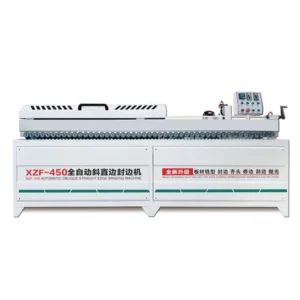
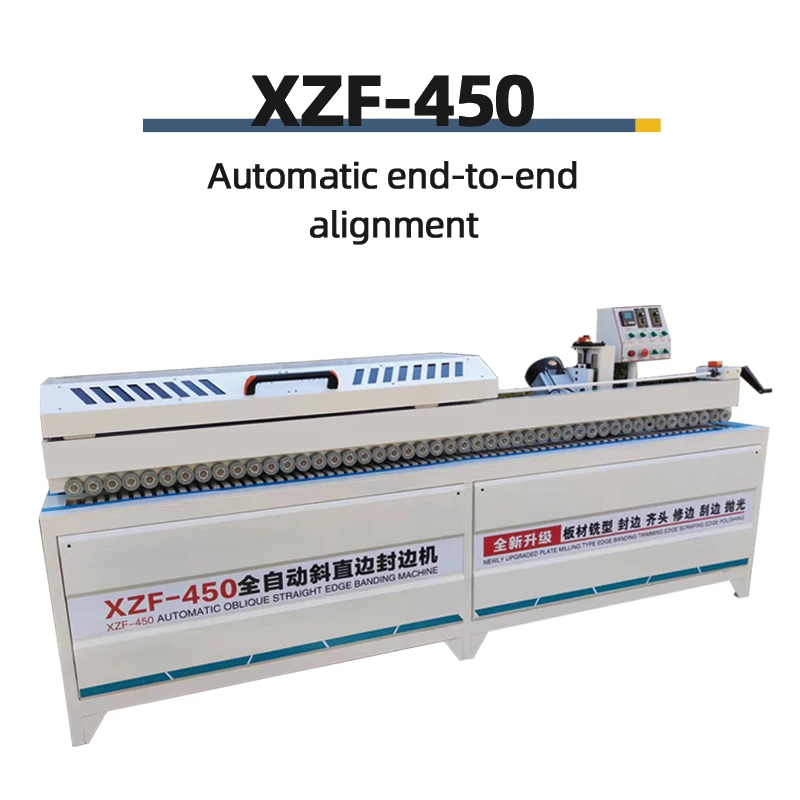
XZF-450
- Full OEM/ODM support -- custom logo, voltage (110V-440V), multilingual panels
- ISO 9001 & CE certified, 5 national patents, 60 professional engineers
- 12-month warranty, remote technical support & spare parts service
- Professional export packaging, customs clearance support, on-time delivery
Patented cutting mechanisms and verified tolerance — the XZF450’s pre-milling station and seven-step workflow are engineered to eliminate visible glue lines across MDF, plywood, and particleboard substrates.
Technical Specifications
| Parameter | Value |
|---|---|
| Model | XZF-450 |
| Product Type | 45 Degree Automatic Edge Banding Machine |
| Total Power | 9.5 kW |
| Voltage & Frequency | 380V / 415V, 50Hz |
| Pre-milled Motor Power | 4 kW |
| Feed Speed | 0–12 m/min |
| Edge Banding Thickness | 0.3–3 mm |
| Edge Banding Height | 0–50 mm |
| Minimum Sheet Length | 300 mm |
| Minimum Sheet Width | 150 mm |
| Glue Pot Capacity | 4000 ml |
| Trimming Power | 2.2 kW × 2 |
| Polishing Power | 0.4 kW × 2 |
| Air Source Pressure | 0.5–0.7 MPa |
| Vacuum Power | 550 W |
| Overall Dimensions (L×W×H) | 3000 × 650 × 1350 mm |
| Net Weight | 430 kg |
| Key Features | Plate milling, 30°/45°/60° edge banding, trimming, scraping, polishing, high-power vacuuming |
| Language Options | Chinese, English; customizable to Spanish, French, or others |
| Plug Options | EU, USA, AU, UK |
Application Suitability
| Application | Material or Output |
|---|---|
| Custom cabinet and furniture edge banding | MDF, melamine board, particleboard |
| Plywood panel edge finishing for joinery | Plywood, blockboard |
| 45° miter-fold edge profiles on premium furniture | Solid wood board, polymer doors |
| Medium to large-scale panel processing | Mixed substrates requiring single-pass edge finishing |
Why Glue Line Consistency Breaks Down When You Switch Substrates
The substrate determines the entire edge banding machine woodworking process — not just the glue temperature, but feed speed, pre-milling depth, and pressure zone calibration.
In my time on the workshop floor here in Ningjin, I have watched a sample test run perfectly on PVC edge banding, only for the same settings to produce visible glue lines when the customer switched to melamine paper banding in actual production. The glue pot temperature, feed rate, and pressure roller tension all need to shift with each banding material and substrate combination. Without pre-milling, particleboard edges chip out and leave an uneven bonding surface that no amount of glue adjustment can fix [NEED_CITE: substrate-specific edge preparation requirements for panel processing]. This is the kind of defect that stalls assembly lines and triggers batch rejections downstream.
Substrate Behaviour Across the Seven-Station Workflow
The 45 degree edge banding machine edge quality depends on how each station interacts with the substrate. Particleboard tends to chip at the cut edge, leaving micro-gaps where glue pools unevenly. The 4 kW pre-milling station removes saw marks and creates a true bonding surface before the glue is ever applied. On MDF, the concern is different — the material is denser and smoother, but it absorbs glue differently, requiring careful temperature management across the 4000 ml glue pot to maintain consistent viscosity throughout sustained production runs.
Multi-Angle Edge Profiles and Downstream Assembly
Beyond standard 90-degree applications, this edge bander handles 30, 45, and 60-degree profiles. The 45-degree miter-fold edge banding is particularly relevant for high-end cabinet and furniture production, where seamless corner aesthetics matter. The angle of the banding affects how panels mate during assembly — a poorly trimmed miter edge introduces gaps that compound across a full cabinet carcase [NEED_CITE: miter-fold edge banding tolerance requirements for cabinet assembly]. The dual trimming stations, each at 2.2 kW, are sized to cut cleanly through banding up to 3 mm thick without tearing or leaving burrs that require manual rework.
How Each Station Contributes to Edge Finish Integrity
The feed speed range of 0–12 m/min gives the operator control over how long each panel spends in the pressure zone. At slower speeds, the glue has more dwell time under pressure, which improves bonding on thicker banding materials like 3 mm PVC or ABS. On thinner melamine paper banding at 0.3 mm, a faster feed speed prevents heat damage to the substrate surface. The scraping station removes excess adhesive residue that trimming alone cannot address, and the dual 0.4 kW polishing wheels deliver a smooth, tactile finish that is immediately visible on high-gloss or dark-toned panels where surface defects are most noticeable.
The Hidden Cost of Ignoring Voltage and Control Panel Language
A machine configured for the wrong voltage frequency will run, but the motors operate outside their rated curve — the pre-milling motor heats up, the feed transmission becomes inconsistent, and the glue pot struggles to hold stable temperature. Panels that looked fine in the first hour of production develop bonding failures by mid-shift. Equally disruptive is a control panel the operator cannot read — commissioning stalls, fault codes go unaddressed, and the machine sits idle while the factory searches for translation or technical support [NEED_CITE: CE machinery directive requirements for industrial equipment exported to international markets].
Why Production Managers Choose This Configuration
The in-house manufacturing process includes precision-ground components and multi-stage inspection across incoming material, in-process assembly, finished product testing, and pre-shipment verification. The XZF-450 ships with a factory test record documenting performance on the customer’s specified panel thickness and banding material range. Engineer-led configuration ensures the voltage, frequency, plug type, and control language are confirmed before production begins. The seven-station workflow — pre-milling through polishing — means a workshop can process mixed substrates without needing separate machines for different edge profiles, supporting phased investment as production volume grows.
Documentation & Verification
- CE declaration of conformity covering the full XZF-450 assembly
- Factory test record run on your specific panel thickness and banding material
- Electrical schematic with voltage and frequency confirmation for your facility
- Operation and maintenance manual in your operator’s required language
- Spare parts list with part numbers for trimming blades and polishing wheels
Installation, Commissioning & Support
- Requires a dedicated 380V/415V circuit rated for the 9.5 kW total power draw
- Allow minimum 3000 × 650 mm floor space plus operator clearance on the infeed side
- Air supply must deliver 0.5–0.7 MPa continuously to all pneumatic stations
- Commissioning includes calibration of the pre-milling depth for your substrate
- Spare trimming blades and polishing pads included in the initial parts kit
What We Need to Quote the Right Configuration
Provide the substrate materials you process most frequently — MDF, particleboard, plywood, or solid wood — along with the edge banding type and thickness range you run. Confirm your facility voltage, frequency, and preferred plug standard. Let us know whether your operators require the control panel and manual in a language beyond English or Chinese, and whether you want a sample processing test on your actual material before committing to order.
Frequently Asked Questions
Q: How does pre-milling affect edge quality on particleboard versus MDF?
A: Particleboard edges are prone to chip-out from the saw cut, leaving an uneven surface that causes glue pooling and visible bond lines. The 4 kW pre-milling station removes this damaged layer to expose a clean, flat bonding surface. MDF is denser and less prone to chipping, so pre-milling serves more to ensure dimensional consistency than to repair damage. On both substrates, pre-milling is essential when edge appearance is critical to the final product.
Q: Which edge banding materials are compatible with this machine’s glue system?
A: The glue pot and pressure zone handle PVC, ABS, wood veneer, and melamine paper banding in the 0.3–3 mm thickness range. Each material requires different glue temperature and feed speed settings — PVC and ABS bond well at standard temperatures, while melamine paper needs lower heat to avoid surface damage. Confirming your primary banding material allows us to set the initial parameters and validate them during the factory test.
Q: What causes visible glue lines on certain substrates?
A: Visible glue lines typically result from an uneven bonding surface, incorrect glue temperature for the banding material, or pressure zone misalignment. The pre-milling station addresses surface flatness, the 4000 ml glue pot maintains stable viscosity across sustained runs, and the pressure rollers are calibrated during commissioning to match your specific panel thickness. When all three are aligned to the substrate, the glue line becomes virtually invisible.
Q: How does 45-degree miter-fold banding compare to standard 90-degree banding?
A: Miter-fold banding requires precise angle trimming and a slower feed speed through the trimming stations to maintain edge accuracy. Setup takes longer than standard 90-degree banding because the angle must be verified on test pieces before running production panels. The downstream assembly benefit is a seamless corner appearance on cabinet carcases and furniture frames, which eliminates the visible end-grain line that standard banding leaves at panel joints.
Technical Specifications
| Parameter | Value |
|---|---|
| Product Name | 45 Degree Automatic Edge Banding Machine for Woodworking – Process Guide |
| Category | Edge banding machine |
| Voltage Options | 110V / 220V / 380V / 440V (customizable) |
| Frequency | 50Hz / 60Hz (customizable) |
| Certification | ISO 9001, CE |
| MOQ | 1 Unit |
| Lead Time | 15-25 Working Days |
| Warranty | 12 Months |
| OEM / ODM | Available -- logo, color, panel language |
* Detailed technical specifications vary by model. Please contact us with your specific requirements for a complete datasheet.
Shipping & Export
-
Export Packaging
Heavy-duty wooden crate with foam padding and moisture protection
-
Shipping Methods
Sea freight (FCL/LCL), air freight, express -- we support all methods
-
Customs Support
Full documentation: CO, commercial invoice, packing list, HS code assistance
-
Port of Loading
Tianjin / Qingdao port, China -- 20 years export experience
OEM / ODM Services
-
Logo & Branding
Custom logo printing, color scheme, and nameplate engraving
-
Voltage Configuration
110V / 220V / 380V / 440V, 50Hz / 60Hz -- any region supported
-
Multilingual Panels
Control panels in English, Spanish, French, Arabic and more
-
Custom Specifications
Modified dimensions, accessories, or feature sets on request
Get a Quote
Request Product Inquiry
Fill in your details and we'll respond within 24 hours with pricing and availability.
Direct Contact
How It Works
-
1
Confirm requirements & budget
Tell us your factory scale and processing needs
-
2
Receive recommendation & quote
We match the right machine with full specs
-
3
Negotiate & place order
OEM terms, voltage, payment and delivery
-
4
Production & QC inspection
Multi-stage quality control by 60 engineers
-
5
Export packaging & shipment
Professional packing, customs clearance
-
6
After-sales support
12-month warranty, remote tech support
You May Also Like