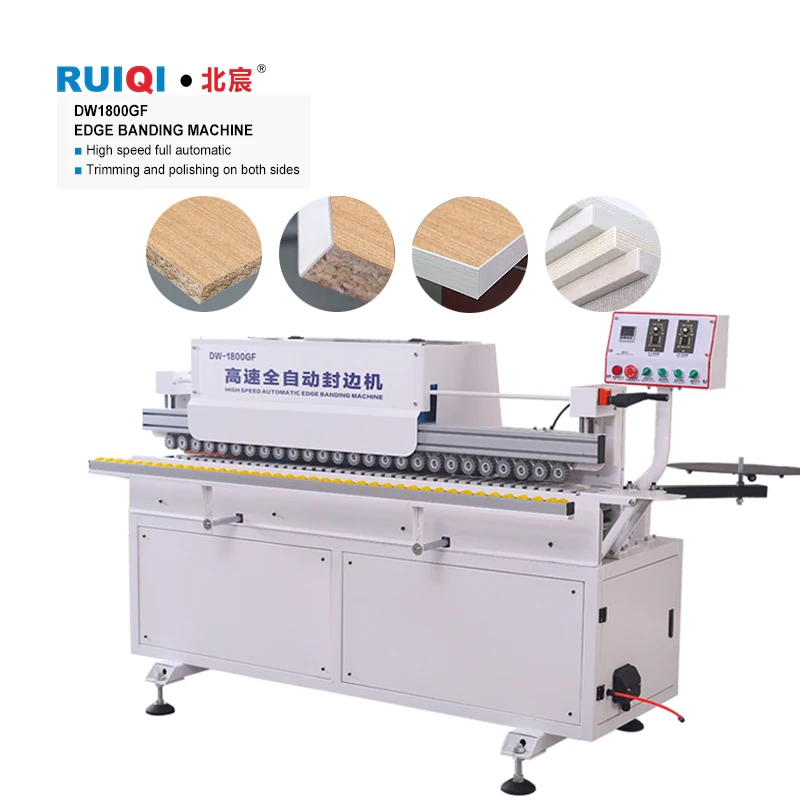
Edge banding machine
Click to enlarge
ISO 9001
CE Certified
OEM / ODM
12-Mo Warranty
Edge banding machine
Automatic Edge Banding Machine for Furniture Board – Process Application
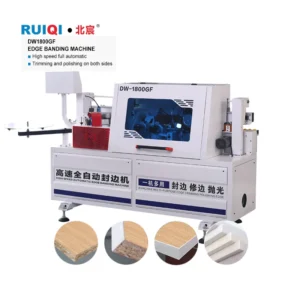
<p><strong>DW1800 Automatic Edge Banding Machine, 4.9KW, 0-14M/min Feed Speed, 0.3-3MM Edge Thickness</strong> — delivers uniform double-sided gluing and integrated trimming for MDF, particleboard, and plywood panels.</p> <ul> <li>Achieves clean edge finishes with flexible scraping and profile tracking for precise corner rounding</li> <li>Adjustable feed speed matches material density and edge type, ensuring consistent glue adhesion and trim quality across substrates</li> </ul> <p>Engineer-led configuration ensures voltage and control panel language match your facility requirements before shipment.</p>
100+
Countries
MOQ 1
Unit
15-25 Days
Lead Time
380V
Automatic Edge Banding
Double-Sided Gluing
DW1800
Edge Banding Machine
MDF Panel
Particleboard
Process Application
- Full OEM/ODM support -- custom logo, voltage (110V-440V), multilingual panels
- ISO 9001 & CE certified, 5 national patents, 60 professional engineers
- 12-month warranty, remote technical support & spare parts service
- Professional export packaging, customs clearance support, on-time delivery
Precision-Glued Edge Finishing — The DW1800 edge bander integrates double-sided adhesive application with flexible scraping and multi-stage trimming, tuned to your exact panel substrate and local power grid.
Technical Specifications
| Parameter | Value |
|---|---|
| Model | DW1800 |
| Product Type | Automatic Edge Banding Machine |
| Total Power | 4.9KW |
| Voltage | 380V/220V/415V |
| Feed Speed | 0-14M/min |
| Edge Banding Height | 0-50MM |
| Edge Banding Thickness | 0.3-3MM |
| Minimum Sheet Length | 20CM |
| Minimum Sheet Width | 10CM |
| Trimming Power/Speed | 800W*2 24000r/min |
| Polishing Power | 380W*2 |
| Air Source Pressure | 0.4-0.6Mpa |
| Glue Pot Capacity | 4000ml |
| Vacuum Power | 550W |
| Product Size | 22065125CM |
| Product Weight | 320KG |
| Standard Features | Double-sided gluing, top and bottom trimming, top and bottom polishing, front and rear alignment, flexible edge scraping, dust suction |
| Control Panel Language | Chinese and English (customizable to Spanish or other languages) |
| Standards | CE Compliant |
Application Suitability
| Application | Material or Output |
|---|---|
| Cabinet door and drawer front production | MDF and particleboard with PVC edge banding |
| Custom furniture panel edge banding | Plywood and solid wood panels with veneer strips |
| Commercial joinery and table tops | ABB boards and organic glass plates |
| Small-batch bespoke furniture components | Melamine-faced chipboard and laminate edging |
Why the Glue Line is the First Place Edge Quality Fails
Visible seams on assembled furniture almost always trace back to uncontrolled glue temperature or uneven adhesive transfer at the edge banding machine process application stage.
Production managers often blame the edge banding material when the real issue is how the adhesive was laid down. I have seen recycled particleboard edges shed particles so fast that a standard single-sided glue roller leaves starved patches, causing the band to lift weeks after assembly. The DW1800 addresses this by applying adhesive to both the panel edge and the banding strip simultaneously, which compensates for porous or inconsistent substrate surfaces. When you run a batch of doors where the grain direction changes, or switch from virgin MDF to a cheaper blended core, that double-sided gluing system becomes the difference between a clean seam and a visible fault line that ruins the finish [NEED_CITE: common edge banding adhesion failures on recycled particleboard].
Substrate Density and Glue Pot Temperature Control
The Edge Banding Machine Process Application depends heavily on matching glue temperature to the thermal mass of the panel. Denser materials like plywood or thick MDF pull heat away from the adhesive faster than lightweight particleboard, which can cause the bond to set before the banding is pressed firmly into place. The 4000ml glue pot on the DW1800 holds a substantial volume that helps maintain a stable thermal buffer during continuous runs. This thermal stability is critical when the ambient workshop temperature drops or when you pause between batches.
The Role of Trimming Speed in Corner Rounding Quality
Achieving a flush edge without chipping the laminate requires the trimming cutters to match the feed rate precisely. The DW1800 trimming stations operate at 24000r/min, which provides a high enough spindle speed to shear PVC and thin veneer cleanly, even as the feed speed varies from 0 to 14M/min. The flexible edge scraping station that follows the trimmers then removes the microscopic burr left behind, creating a softened radius that is comfortable to touch and less prone to chipping during transport and assembly.
Specifying for Panel Thickness and Downstream Assembly Tolerances
The relationship between edge banding height and the final assembled dimension is often overlooked during the Edge Banding Machine Process Application specification phase. The DW1800 handles banding heights from 0 to 50MM, which covers standard cabinet panels as well as thicker worktops and structural components. When the trimmed edge is not perfectly flush, it creates a step that interferes with hinge alignment or drawer runner installation down the line. The integrated top and bottom polishing stations remove any residual adhesive smear, ensuring the panel edge is dimensionally accurate and visually clean before it reaches the boring or assembly station [NEED_CITE: effect of edge banding tolerance on downstream CNC boring accuracy].
The Hidden Cost of Ignoring Voltage and Feed Rate Calibration
Ordering a machine without confirming the local three-phase voltage is a mistake that stalls commissioning before the first panel is even fed. A 380V motor running on a 415V supply will overheat and trip its thermal overload, while a 220V configuration pushed onto a higher grid can fail catastrophically. Beyond the electrical mismatch, failing to calibrate the 0-14M/min feed speed to your specific edge band thickness results in either starved glue lines at high speeds or excessive adhesive squeeze-out at slow speeds, both of which demand costly manual rework [NEED_CITE: industrial machinery voltage and frequency standards for export markets].
Why Sourcing the DW1800 from Ruiqi Woodwork
We approach the Edge Banding Machine Process Application from the perspective of the substrate behavior and final assembly quality, not just machine throughput. Every DW1800 is tested in-house with a four-stage QC protocol that includes running your specific panel material to verify glue line integrity and trimming accuracy before shipment. The control panel language is configured to match your operator’s needs, eliminating the commissioning delays caused by untranslated error messages. Furthermore, our engineering team provides a formal configuration proposal that cross-references your local power supply and production volume, ensuring the machine specification sheet aligns perfectly with your factory’s requirements.
Documentation & Verification
- CE declaration of conformity covering the DW1800 safety and electrical directives.
- Factory test record demonstrating edge banding results on your provided MDF or plywood samples.
- Electrical schematic confirming the exact 380V/220V/415V wiring configuration for your site.
- Operation and maintenance manual translated into the requested language for your production team.
- Detailed spare parts list with identifiers for the trimming cutters and glue pot components.
Installation, Commissioning & Support
- Requires a leveled floor pad to support the 320KG footprint and maintain trimming alignment.
- Dedicated 380V/220V/415V circuit breaker sizing verified against the 4.9KW total power draw.
- Air compressor setup regulated to 0.4-0.6Mpa to ensure consistent pressure for the gluing rollers.
- Initial calibration of the 24000r/min trimming heads matched to your specific PVC or veneer thickness.
- Operator training on adjusting the 0-14M/min feed speed for different panel densities and batch sizes.
- Scheduled cleaning protocol for the 4000ml glue pot to prevent adhesive carbonization during idle periods.
Configuring the DW1800 for Your Production Line
To ensure the DW1800 is configured for your specific Edge Banding Machine Process Application, we require details on your primary panel substrates and the exact edge banding materials you intend to use. Please also provide your facility’s local voltage and frequency, along with the control panel language preference for your operators. If possible, sending a sample of your most challenging board material allows us to conduct a pre-shipment test to verify adhesion and finish quality.
Frequently Asked Questions
Q: How does the DW1800 handle different edge banding materials on various substrates?
A: The DW1800 uses a double-sided gluing system that applies adhesive to both the panel edge and the banding strip. This is particularly effective on porous substrates like recycled particleboard, which tend to absorb glue quickly. The 24000r/min trimming speed and flexible scraping stations are then adjusted to handle the specific hardness of PVC or the fragility of wood veneer without chipping.
Q: What glue types are compatible with the 4000ml pot, and how is temperature controlled?
A: The 4000ml glue pot is designed for standard EVA hot-melt adhesives, which are the industry norm for furniture edge banding. Temperature control is managed via the main control panel, allowing operators to set the heat based on the specific adhesive manufacturer’s recommendations and the thermal conductivity of the panel material being processed, ensuring consistent viscosity and bond strength.
Q: How does the feed speed range affect edge finish quality and glue curing?
A: The variable feed speed from 0 to 14M/min allows the operator to balance throughput with adhesive open time. Running at slower speeds on dense materials like plywood gives the glue more contact time under the pressure rollers, while higher speeds are suitable for high-volume MDF runs. This flexibility ensures the adhesive cures properly before the trimming stations engage.
Q: Can the trimming and scraping stations be adjusted for specialized edge profiles?
A: The DW1800 is equipped with top and bottom trimming and flexible edge scraping stations that create a standard rounded, flush finish. While it is optimized for straight-edge contouring and corner rounding, the scraping blades can be fine-tuned to adjust the radius of the edge. For highly specialized profile shapes, the standard configuration focuses on achieving the tightest tolerance for assembly-ready components.
Technical Specifications
| Parameter | Value |
|---|---|
| Product Name | Automatic Edge Banding Machine for Furniture Board – Process Application |
| Category | Edge banding machine |
| Voltage Options | 110V / 220V / 380V / 440V (customizable) |
| Frequency | 50Hz / 60Hz (customizable) |
| Certification | ISO 9001, CE |
| MOQ | 1 Unit |
| Lead Time | 15-25 Working Days |
| Warranty | 12 Months |
| OEM / ODM | Available -- logo, color, panel language |
* Detailed technical specifications vary by model. Please contact us with your specific requirements for a complete datasheet.
Shipping & Export
-
Export Packaging
Heavy-duty wooden crate with foam padding and moisture protection
-
Shipping Methods
Sea freight (FCL/LCL), air freight, express -- we support all methods
-
Customs Support
Full documentation: CO, commercial invoice, packing list, HS code assistance
-
Port of Loading
Tianjin / Qingdao port, China -- 20 years export experience
OEM / ODM Services
-
Logo & Branding
Custom logo printing, color scheme, and nameplate engraving
-
Voltage Configuration
110V / 220V / 380V / 440V, 50Hz / 60Hz -- any region supported
-
Multilingual Panels
Control panels in English, Spanish, French, Arabic and more
-
Custom Specifications
Modified dimensions, accessories, or feature sets on request
Get a Quote
Request Product Inquiry
Fill in your details and we'll respond within 24 hours with pricing and availability.
Direct Contact
How It Works
-
1
Confirm requirements & budget
Tell us your factory scale and processing needs
-
2
Receive recommendation & quote
We match the right machine with full specs
-
3
Negotiate & place order
OEM terms, voltage, payment and delivery
-
4
Production & QC inspection
Multi-stage quality control by 60 engineers
-
5
Export packaging & shipment
Professional packing, customs clearance
-
6
After-sales support
12-month warranty, remote tech support
You May Also Like