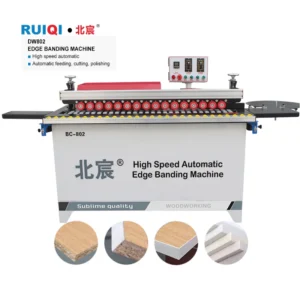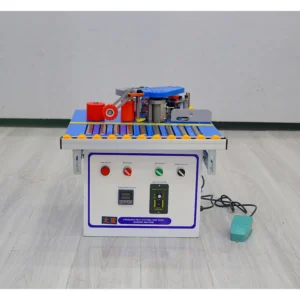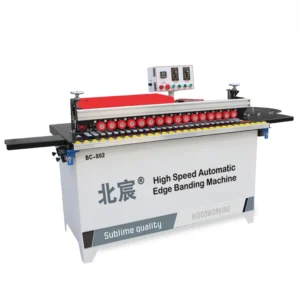
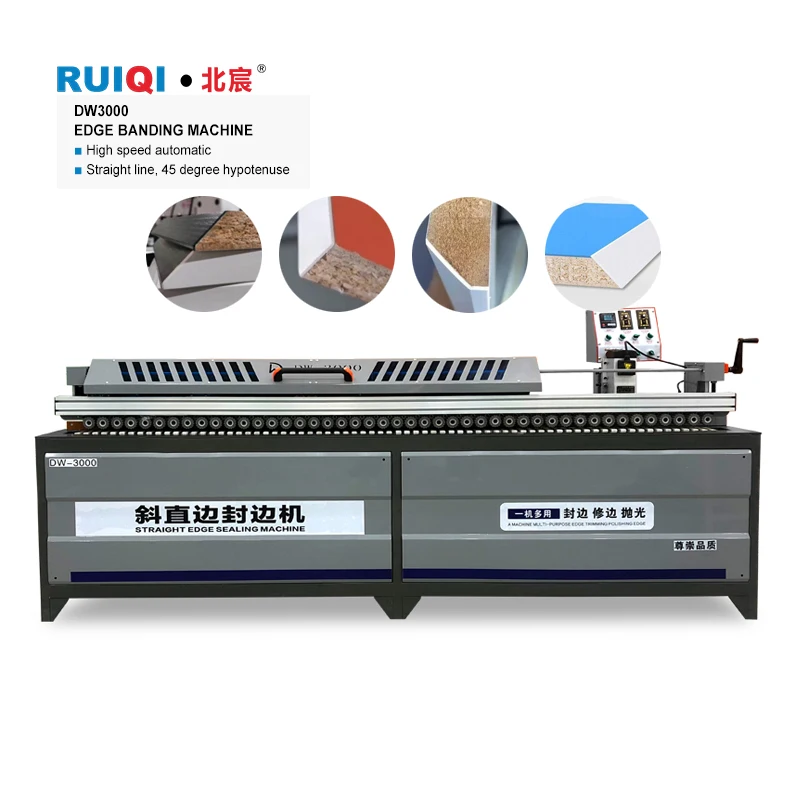
Edge banding machine
Click to enlarge
ISO 9001
CE Certified
OEM / ODM
12-Mo Warranty
Edge banding machine
Automatic Oblique Edge Banding Machine for MDF Panel – Process Quality
<p><strong>DW3000 Automatic Oblique Edge Banding Machine, 11KW, 0-12M/min Feed, 30-90° Angle</strong> — handles MDF, particleboard and plywood with pre-milling before glue application. Double heat guns maintain adhesive compliance across varying substrate densities, while 8 adjustable oblique pressure wheels tune contact force to edge profile. Three spindle trimming motors isolate rough, fine and profile cuts for clean finishing. Request factory test samples on your substrate before ordering.</p>
100+
Countries
MOQ 1
Unit
15-25 Days
Lead Time
11KW Motor
380V
DW3000
Edge Banding Machine
MDF Panel
Oblique Edge Banding
Plywood Panel
Process Quality
- Full OEM/ODM support -- custom logo, voltage (110V-440V), multilingual panels
- ISO 9001 & CE certified, 5 national patents, 60 professional engineers
- 12-month warranty, remote technical support & spare parts service
- Professional export packaging, customs clearance support, on-time delivery
In-House Precision Grinding — The DW3000 edge bander relies on factory-ground components and patented cutting mechanisms to hold tight tolerances through every trimming and polishing pass.
Technical Specifications
| Parameter | Value |
|---|---|
| Model | DW3000 |
| Product Type | Automatic Edge Banding Machine |
| Total Power | 11 kW |
| Pre-milling Motor | 2.2 kW |
| Heating Power | 2.2 kW × 2 |
| Edge Feeding Power | 160 W |
| Transmission Power | 180 W |
| Trimming Motor Power | 2.2 kW × 2 |
| Polishing Motor Power | 0.4 kW × 2 |
| Vacuum Power | 550 W |
| Voltage | 380 V / 415 V |
| Feed Speed | 0–12 m/min |
| Edge Banding Height | 0–50 mm |
| Edge Banding Thickness | 0.3–3 mm |
| Minimum Sheet Length | 30 cm |
| Minimum Sheet Width | 15 cm |
| Glue Pot Capacity | 4000 ml |
| Air Source Pressure | 0.5–0.7 MPa |
| Oblique Pressure Wheels | 8 groups, 30–90° adjustable |
| Trimming Configuration | 3 spindle motors |
| Feeding Belt | Double cylinder |
| Heat Gun | Double heat gun design |
| Control Panel Language | Chinese / English (customizable) |
| Overall Dimensions | 299 × 65 × 130 cm |
| Net Weight | 430 kg |
Application Suitability
| Application | Material or Output |
|---|---|
| Custom cabinet carcass edge finishing | MDF panels with PVC edge banding |
| Wardrobe and shelving panel edging | Particleboard with melamine or veneer strips |
| Plywood furniture component banding | Plywood edges with 0.3–3 mm banding material |
| Solid wood panel edge preparation | Solid wood panels requiring pre-milled edge cleaning |
| Mixed-substrate workshop production | MDF, particleboard, plywood running on a single line |
Why Glue Line Visibility Ruins Downstream Assembly and How the DW3000 Addresses It
A square, pre-milled edge and controlled heat across two guns keep adhesive transfer consistent before the first pressure wheel even touches the strip.
The most common complaint I hear from cabinet makers is not that the machine broke down — it is that some panels come off the line with visible glue lines while others look clean. The root cause is rarely the glue itself. Particleboard edges chip during sawing, leaving gaps that no amount of pressure can close. MDF behaves differently, soaking up heat unevenly depending on density. When a workshop runs both substrates through the same edge banding machine process application without adjusting pre-mill depth or gun temperature, the results drift panel to panel [NEED_CITE: substrate density variation and adhesive penetration in wood panel processing]. The DW3000 pairs a 2.2 kW pre-milling station with a double heat gun layout so the edge arrives flat and the adhesive stays compliant regardless of what the saw left behind.
Pre-Milling as the First Quality Gate
Before any adhesive contacts the panel, the 45-degree pre-milling station removes a thin layer from the board edge. This is where chipped saw cuts and minor surface defects get cleaned off. On particleboard, the pre-mill exposes a fresh, compact surface that gives the glue something uniform to bond with. On MDF, it strips the slightly compressed outer skin that sometimes resists adhesive penetration. Without this step, edge banding quality depends entirely on how cleanly the panel was cut upstream — and in a busy workshop, that cut quality varies all day long. The edge banding machine process application depends on this first station more than operators typically realize.
Pressure Wheel Tuning Across Edge Profiles
The 8 groups of oblique pressure wheels adjust from 30 to 90 degrees, which matters when a shop runs both straight-edge panels and contoured components. A stiff PVC strip on a flat cabinet side needs firm, evenly distributed pressure along its full height. A thin wood veneer on a curved shelf edge needs lighter, angled contact to avoid lifting or blistering [NEED_CITE: pressure distribution requirements for veneer versus PVC edge banding]. Having eight independently adjustable groups means the operator can bias pressure toward the top or bottom of the strip depending on the profile, rather than relying on a single blanket pressure setting that works for one material but not another.
Reading the Specs That Actually Affect Your Panels
The 11 kW total power allocation tells you where the engineering priority sits. With 2.2 kW dedicated to pre-milling and another 4.4 kW split across two heat guns, nearly half the machine’s electrical budget goes into preparing the edge and maintaining glue temperature. The trimming section uses two 2.2 kW spindle motors across three spindle positions, meaning rough trim, fine trim, and profile trimming each get a dedicated cutting pass rather than sharing a motor that switches between tasks. The 0–12 m/min feed speed range is wide enough to slow down for delicate veneer work and speed up for standard PVC runs on particleboard. Glue pot capacity at 4000 ml reduces refill frequency during long production runs, though the actual consumption rate depends on strip width and adhesive viscosity at the set temperature. Air supply at 0.5–0.7 MPa must be stable — pressure drops below this range directly affect the cylinder-driven feeding belt and pressure wheel actuation [NEED_CITE: pneumatic pressure stability requirements for edge banding machinery].
The Hidden Cost of Skipping Configuration Checks
I once spent two full days at a customer’s site because we confirmed their panel material after delivery rather than before. They ordered based on PVC performance, then switched to thin wood veneer for a premium kitchen line. Glue temperature, feed speed, and pressure wheel angles all needed recalibration — settings that work beautifully on PVC will scorch veneer or leave it lifting at the edges. The machine was not at fault. The configuration conversation happened too late. When a workshop buys a single unit without discussing substrate mix, edge material thickness, and local power supply, the machine arrives as a generic setup that performs well on one material and poorly on everything else [NEED_CITE: edge banding commissioning failures linked to substrate mismatch]. Voltage mismatch is another silent problem: a 380 V machine delivered to a facility running 220 V single-phase will not operate at all, and rewinding motors on-site is neither practical nor reliable.
Why Production Managers Source This Edge Bander Here
Every DW3000 leaves the factory with a pre-shipment test record run on the specific panel thickness and edge material the buyer confirmed during the quotation stage. The four-stage quality control process covers incoming material inspection through to final verification before crating, so the machine that arrives matches the specification sheet you signed off on. Voltage and control panel language are confirmed before production begins — not discovered after the crate is opened. The in-house manufacturing setup means component sourcing, precision grinding, and assembly happen under one roof, keeping tolerance accountability in a single facility. Engineer-led configuration recommendations ensure the station layout and motor allocation match the actual production mix rather than a default catalog specification.
Documentation & Verification
- CE declaration of conformity covering the DW3000 machinery safety requirements
- Factory test record on your specified panel thickness and edge material before dispatch
- Electrical schematic confirming voltage and frequency match your local supply
- Operation and maintenance manual in your confirmed control panel language
- Spare parts list with part numbers matching the as-built station configuration
Installation, Commissioning & Support
- 299 × 65 × 130 cm footprint requires a level concrete floor with clearance for panel infeed and outfeed
- 380 V / 415 V three-phase supply with a dedicated circuit rated for 11 kW continuous draw
- Machine ships partially assembled; pressure wheels and polishing hoods require on-site alignment
- First-run commissioning includes glue temperature calibration against your edge banding material
- Air line connection at 0.5–0.7 MPa with a dedicated regulator to isolate from other shop equipment
- Spare trimming blades and scraper inserts included for initial production period
What We Need to Configure Your Machine Correctly
Before quoting, we ask for the panel substrates you run most often, the edge banding material types and thickness range, and your workshop’s available voltage and phase. If you process both PVC and wood veneer, tell us the approximate volume split between them so we can recommend feed speed ranges and pressure wheel setups that cover both without constant recalibration. Confirming the control panel language at this stage avoids commissioning delays once the machine is on your floor.
Frequently Asked Questions
Q: How does pre-milling affect edge quality on particleboard versus MDF?
A: Particleboard edges tend to chip during sawing, leaving an uneven surface that creates gaps under the edge band. The pre-milling station removes this damaged layer, exposing a compact surface for consistent glue contact. MDF edges are smoother but have a compressed outer skin that can resist adhesive penetration. Pre-milling strips this skin, improving bond strength. Both substrates produce noticeably cleaner edge lines after pre-milling than without it.
Q: What edge banding materials and thicknesses does the DW3000 handle, and how does glue temperature differ between them?
A: The machine handles edge banding from 0.3 mm to 3 mm thick, covering PVC, melamine, and wood veneer strips. PVC typically runs at higher glue temperatures with faster feed speeds. Thin veneer requires lower temperatures and slower feeds to prevent scorching or lifting. The double heat gun design allows the operator to maintain stable adhesive viscosity across both material types by adjusting temperature per production run.
Q: How do the 8 oblique pressure wheels adjust for different panel edge profiles?
A: Each of the eight groups adjusts independently from 30 to 90 degrees. For flat cabinet sides with stiff PVC, operators set wheels closer to 90 degrees for direct downward pressure. For contoured edges or thin veneer, angling the wheels toward 30 degrees distributes pressure more gently along the strip height. This adjustability means one machine handles both straight and oblique edge banding without swapping pressure wheel assemblies.
Q: What air supply specification is needed and how does low pressure affect banding adhesion?
A: The DW3000 requires 0.5–0.7 MPa air pressure with a dedicated regulator. The double cylinder feeding belt and pneumatic pressure wheel actuators depend on stable pressure. If supply drops below 0.5 MPa, the feeding belt loses grip and pressure wheels apply inconsistent force, resulting in uneven glue transfer and visible lifting at the strip edges. A dedicated air line isolates the machine from pressure fluctuations caused by other workshop equipment cycling on and off.
Q: Can I run a sample test with my own panel stock and edge banding material before ordering?
A: Yes. The standard sales process includes a sample processing test using your actual panel substrate and edge banding material. This confirms glue adhesion quality, trimming finish, and polishing result on your specific material combination before order confirmation. Factory visits are also welcome if you prefer to observe the test run in person and discuss station configuration directly with the engineering team.
Technical Specifications
| Parameter | Value |
|---|---|
| Product Name | Automatic Oblique Edge Banding Machine for MDF Panel – Process Quality |
| Category | Edge banding machine |
| Voltage Options | 110V / 220V / 380V / 440V (customizable) |
| Frequency | 50Hz / 60Hz (customizable) |
| Certification | ISO 9001, CE |
| MOQ | 1 Unit |
| Lead Time | 15-25 Working Days |
| Warranty | 12 Months |
| OEM / ODM | Available -- logo, color, panel language |
* Detailed technical specifications vary by model. Please contact us with your specific requirements for a complete datasheet.
Shipping & Export
-
Export Packaging
Heavy-duty wooden crate with foam padding and moisture protection
-
Shipping Methods
Sea freight (FCL/LCL), air freight, express -- we support all methods
-
Customs Support
Full documentation: CO, commercial invoice, packing list, HS code assistance
-
Port of Loading
Tianjin / Qingdao port, China -- 20 years export experience
OEM / ODM Services
-
Logo & Branding
Custom logo printing, color scheme, and nameplate engraving
-
Voltage Configuration
110V / 220V / 380V / 440V, 50Hz / 60Hz -- any region supported
-
Multilingual Panels
Control panels in English, Spanish, French, Arabic and more
-
Custom Specifications
Modified dimensions, accessories, or feature sets on request
Get a Quote
Request Product Inquiry
Fill in your details and we'll respond within 24 hours with pricing and availability.
Direct Contact
How It Works
-
1
Confirm requirements & budget
Tell us your factory scale and processing needs
-
2
Receive recommendation & quote
We match the right machine with full specs
-
3
Negotiate & place order
OEM terms, voltage, payment and delivery
-
4
Production & QC inspection
Multi-stage quality control by 60 engineers
-
5
Export packaging & shipment
Professional packing, customs clearance
-
6
After-sales support
12-month warranty, remote tech support
You May Also Like