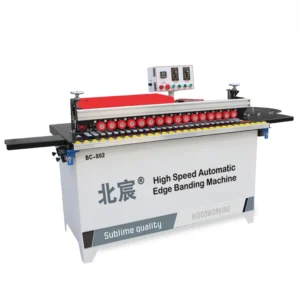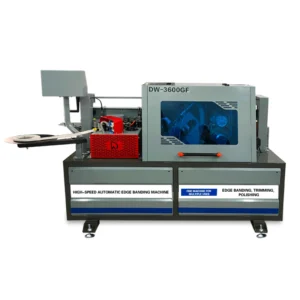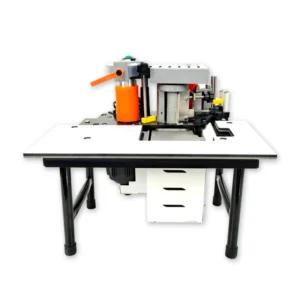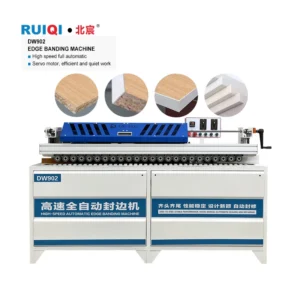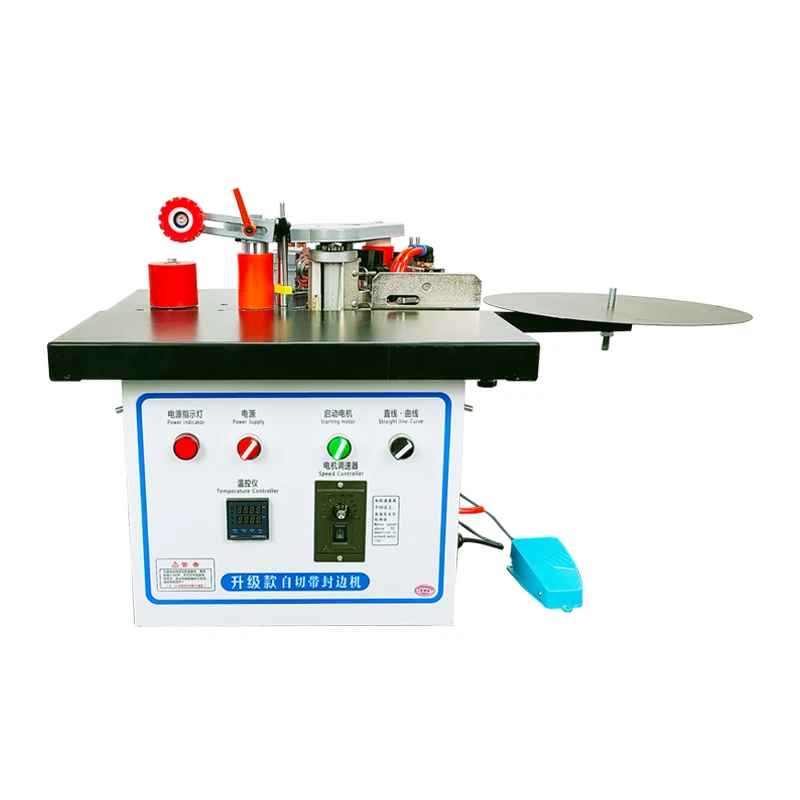
Edge banding machine
Click to enlarge
ISO 9001
CE Certified
OEM / ODM
12-Mo Warranty
Edge banding machine
Compact Portable Edge Banding Machine for MDF Plywood Small Workshop
<p><strong>Portable Edge Banding Machine, 1000W, 0.3–3mm Banding Thickness, 220V/380V</strong> — supports both curved and straight edge sealing on MDF, plywood and particleboard within a compact 50×50×47 cm footprint.</p> <ul> <li>Designed for small workshops and on-site furniture repair teams moving from hand-applied banding to repeatable machine-assisted edge quality</li> <li>Glue pot capacity of 1000 ml with adjustable temperature lets operators match substrate porosity and banding material — PVC, veneer or melamine — without visible glue lines on finished panels</li> <li>Air source pressure of 0.5–0.8 MPa ensures consistent feed during short-run batches</li> </ul>
100+
Countries
MOQ 1
Unit
15-25 Days
Lead Time
220V
Curved Edge Banding
Edge Banding Machine
MDF Plywood
Portable Edge Banding
Process Application
Small Workshop
ST-50
- Full OEM/ODM support -- custom logo, voltage (110V-440V), multilingual panels
- ISO 9001 & CE certified, 5 national patents, 60 professional engineers
- 12-month warranty, remote technical support & spare parts service
- Professional export packaging, customs clearance support, on-time delivery
In-house precision manufacturing — this portable edge banding unit is built with our patented cutting mechanisms and verified tolerance standards, giving small workshops access to the same quality controls used on our full production line equipment.
Technical Specifications
| Parameter | Value |
|---|---|
| Product Type | Portable Edge Banding Machine |
| Total Power | 1000W |
| Voltage & Frequency | 220V / 380V / customization available |
| Control System | Manual / Semi-automatic operation |
| Overall Dimensions (L×W×H) | 50 × 50 × 47 cm |
| Net Weight | 22 kg |
| Edge Banding Height Range | 0–50 mm |
| Edge Banding Thickness Range | 0.3–3 mm |
| Minimum Sheet Length | 25 cm |
| Minimum Sheet Width | 3 cm |
| Glue Pot Capacity | 1000 ml |
| Air Source Pressure | 0.5–0.8 MPa |
| Edge Trimming Power | 20W |
| Standard Features | Curved and straight edge banding |
| Language Options | Chinese, English, customizable to Spanish or other languages |
| Plug Options | EU, USA, AU, UK |
| Certifications | CE, ISO 9001 manufacturing facility |
Application Suitability
| Application | Material or Output |
|---|---|
| Small workshop cabinet edging | MDF and particleboard panels with PVC or melamine banding |
| Home decoration site touch-up | Plywood and ecological board for on-site furniture repair |
| Custom furniture short runs | Solid wood and veneer banding on shaped or linear profiles |
| Joinery prototyping | Mixed substrate samples with curved and straight edge profiles |
Why Substrate Density Matters More Than Machine Speed
The glue temperature and feed pressure that work perfectly on standard MDF will fail on high-density particleboard — and the difference is invisible until the banding peels off during assembly.
I learned this the hard way when a batch of high-glue-content MDF tore through our trimming cutters and left chipped edges across an entire production run of cabinet doors. The operator had set parameters based on the previous material batch, and the difference in resin density was enough to wreck the edge finish. With this portable edge banding machine, the manual feed rate lets operators feel the resistance change and adjust on the fly — something a fully automatic machine cannot do at production speed [NEED_CITE: substrate density variation effects on edge banding adhesion]. When you are running mixed batches in a small workshop, that tactile feedback becomes the difference between clean edges and scrap panels.
How the Woodworking Process Changes at Small Scale
When a workshop moves from hand-applied iron-on banding to a powered edge banding machine, the edge banding machine woodworking process application shifts from operator skill to parameter control. The 1000 ml glue pot on this unit holds enough adhesive for continuous small-batch runs, but the real advantage is the adjustable temperature range that lets you match the glue to the substrate. MDF absorbs heat differently than plywood, and the glue viscosity must match the porosity of the substrate edge to create a bond line that survives downstream machining.
Glue Line Visibility and Downstream Assembly Fit
The gap between a visible glue line and a clean edge often comes down to banding thickness selection against the panel profile. Running 0.3 mm PVC on a curved radius requires different pressure than 3 mm solid wood veneer on a straight edge, and this edge banding machine covers that full range within one setup. The curved-and-straight capability means operators do not need to swap machines or jigs when a cabinet run includes both radiused corners and linear stiles [NEED_CITE: edge banding thickness and substrate curvature compatibility standards]. That flexibility is what makes this unit practical for custom furniture shops where every batch brings a different edge profile.
Reading the Specs That Actually Affect Edge Quality
The 0.5–0.8 MPa air pressure requirement tells you what compressor you need on the floor — too low and the banding feed wheel loses grip, too high and you crush thin PVC against the panel edge. The 0.3–3 mm thickness range covers melamine paper, standard PVC, and thin wood veneer, which are the three materials most small workshops rotate between depending on the customer specification. The 50 mm maximum banding height accommodates standard 18 mm panel stock with trimming allowance, as well as thicker solid wood panels used in workbench and shelving applications. Glue pot capacity at 1000 ml means you can run a full batch of cabinet components without stopping to refill adhesive mid-operation, which matters when the hot melt starts to skin over in an open pot.
The Cost of Skipping Material Samples Before Configuration
Buying an edge banding machine without testing your actual panel stock is the most common mistake I see from small workshop owners. The substrate edge condition — whether it is clean-cut from a panel saw or torn from a scoring blade — determines the glue penetration and bond strength you will get on the finished panel. I have watched operators spend hours adjusting temperature and pressure on a machine that was never going to produce clean edges because the upstream cut quality was the real problem [NEED_CITE: upstream cut quality effects on edge banding adhesion]. Send a sample panel with your actual edge condition before the machine ships, so the glue temperature and feed pressure can be set against your material before the unit arrives on your floor.
Why This Workshop Sources from Our Production Floor
Our manufacturing process includes four-stage quality control with pre-shipment verification on every unit, including this portable model. The patented cutting mechanism in our full-size edge banders informs the trimming head design on this compact unit, giving you consistent edge finish quality at a smaller scale. Voltage customization from 220V to 380V means the machine arrives configured for your local supply rather than requiring a transformer on site. Every unit ships with operation documentation in your chosen language, so your operator can commission the machine without waiting for a technician visit. The curved-and-straight capability comes from the same engineering standards applied across our entire edge banding product family, so the edge quality matches what you would expect from larger equipment in our range.
Documentation & Verification
- Machine specification sheet confirming banding height and thickness range against your panel stock
- Electrical schematic and voltage confirmation matching your local 220V or 380V supply
- Operation and maintenance manual in your agreed language for operator commissioning
- Factory test record verifying glue pot heating and banding feed on your actual material samples
- CE declaration of conformity for import clearance in regulated markets
Installation, Commissioning & Support
- Dedicated 16A circuit required for the 1000W total power draw to prevent voltage drop during glue heating
- Compressor must deliver 0.5–0.8 MPa at the machine inlet — verify with a gauge before first run
- Unit arrives fully assembled at 50×50×47 cm footprint, requiring only a stable workbench surface
- First-run parameter setting should include glue temperature calibration against your specific banding material
- 1000 ml glue pot should be drained and cleaned if the machine sits unused beyond 48 hours to prevent adhesive carbonization
What to Include with Your Inquiry
To configure this portable edge banding machine for your workshop, share the panel materials you process most often — MDF, particleboard, plywood, or solid wood — along with the banding thickness and material type you plan to run. Confirm your local voltage and frequency, and specify the language needed for the operation manual and any control interface labeling. If you are processing curved profiles, send a sample panel with the tightest radius in your typical production so we can verify the banding feed path before the machine ships.
Frequently Asked Questions
Q: How does substrate material affect glue temperature and banding pressure settings?
A: MDF typically requires a lower glue temperature and moderate pressure because its porous edge absorbs adhesive readily. Plywood needs higher temperature and firmer pressure due to its denser, uneven edge surface from veneer layers. Particleboard falls between the two, but high-resin grades behave closer to plywood. Testing your actual panel stock before locking in parameters prevents weak bonds or glue squeeze-out on the finished edge.
Q: What edge banding materials and thicknesses are compatible with the 0.3–3 mm range?
A: The 0.3 mm end covers melamine paper and thin PVC used for budget cabinet work. Mid-range 0.4–1 mm PVC suits most standard furniture applications. The upper 1–3 mm range handles thicker PVC, ABS, and wood veneer banding for visible edges on premium joinery. Each material requires different glue temperature and feed pressure, which operators dial in based on the substrate and banding combination.
Q: How do I achieve consistent edge quality on curved profiles without delamination?
A: Curved profiles require slower manual feed speed and careful attention to the banding tension against the radius. The 0.5–0.8 MPa air pressure range maintains consistent feed wheel grip, but the operator must guide the panel to keep the banding flush against the curve. Pre-heating the banding material slightly improves flexibility on tight radii, and testing with scrap pieces before running production panels confirms the right technique.
Q: What compressor specification is needed for reliable banding feed?
A: The machine requires 0.5–0.8 MPa at the inlet connection. A standard workshop piston compressor rated for 8 bar or higher will maintain this pressure, but verify with a gauge at the machine end since pressure drops through long air lines or undersized fittings. Insufficient pressure causes the feed wheel to slip on the banding strip, resulting in uneven adhesive transfer and weak bonding along the edge.
Q: How does edge quality from this portable unit compare to a full-function automatic edge bander?
A: This portable unit produces acceptable edge quality for small-batch and on-site work, but it cannot match the trimming precision and feed consistency of a full automatic machine running continuous production volumes. The manual feed rate introduces variability that automatic feed systems eliminate. For workshops running high-volume cabinet production daily, a full-function edge bander provides the repeatable tolerance needed for tight assembly joints downstream.
Technical Specifications
| Parameter | Value |
|---|---|
| Product Name | Compact Portable Edge Banding Machine for MDF Plywood Small Workshop |
| Category | Edge banding machine |
| Voltage Options | 110V / 220V / 380V / 440V (customizable) |
| Frequency | 50Hz / 60Hz (customizable) |
| Certification | ISO 9001, CE |
| MOQ | 1 Unit |
| Lead Time | 15-25 Working Days |
| Warranty | 12 Months |
| OEM / ODM | Available -- logo, color, panel language |
* Detailed technical specifications vary by model. Please contact us with your specific requirements for a complete datasheet.
Shipping & Export
-
Export Packaging
Heavy-duty wooden crate with foam padding and moisture protection
-
Shipping Methods
Sea freight (FCL/LCL), air freight, express -- we support all methods
-
Customs Support
Full documentation: CO, commercial invoice, packing list, HS code assistance
-
Port of Loading
Tianjin / Qingdao port, China -- 20 years export experience
OEM / ODM Services
-
Logo & Branding
Custom logo printing, color scheme, and nameplate engraving
-
Voltage Configuration
110V / 220V / 380V / 440V, 50Hz / 60Hz -- any region supported
-
Multilingual Panels
Control panels in English, Spanish, French, Arabic and more
-
Custom Specifications
Modified dimensions, accessories, or feature sets on request
Get a Quote
Request Product Inquiry
Fill in your details and we'll respond within 24 hours with pricing and availability.
Direct Contact
How It Works
-
1
Confirm requirements & budget
Tell us your factory scale and processing needs
-
2
Receive recommendation & quote
We match the right machine with full specs
-
3
Negotiate & place order
OEM terms, voltage, payment and delivery
-
4
Production & QC inspection
Multi-stage quality control by 60 engineers
-
5
Export packaging & shipment
Professional packing, customs clearance
-
6
After-sales support
12-month warranty, remote tech support
You May Also Like