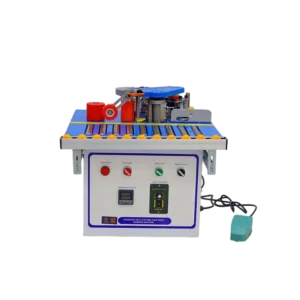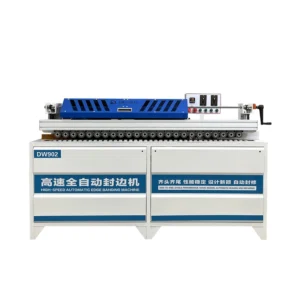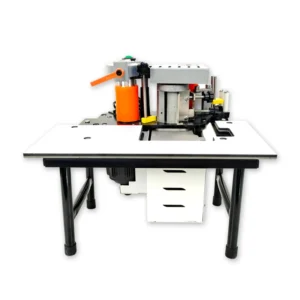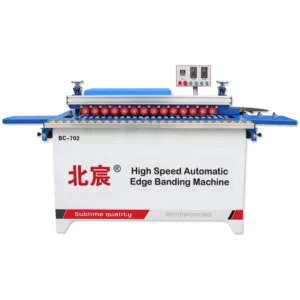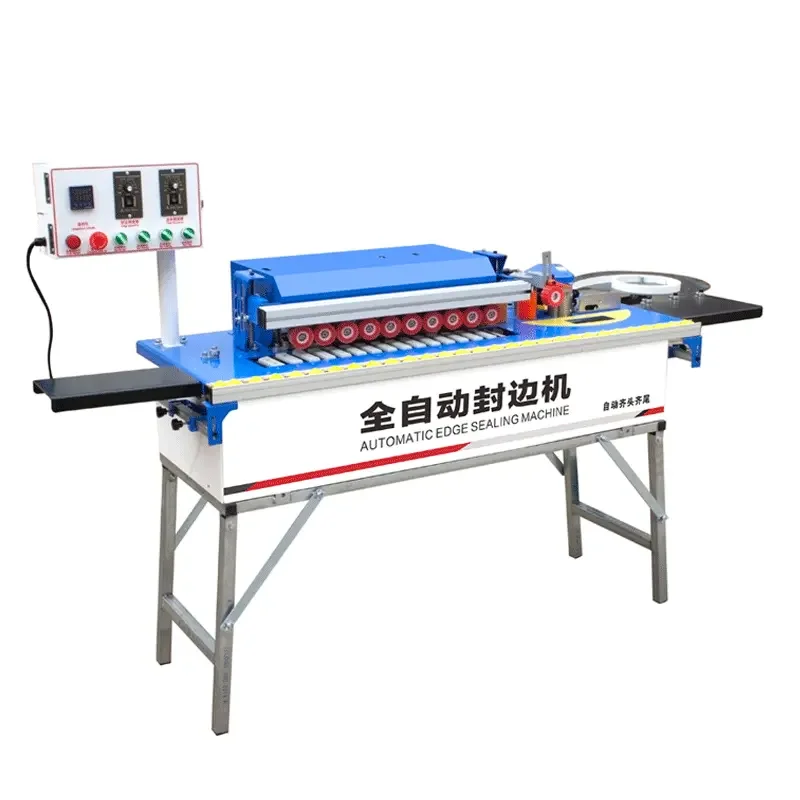
Edge banding machine
Click to enlarge
ISO 9001
CE Certified
OEM / ODM
12-Mo Warranty
Edge banding machine
DW102 Automatic Edge Banding Machine for MDF and Plywood – Industrial Application
<p><strong>DW102 Automatic Edge Banding Machine, 220V/380V, 0.3-3MM Edge Thickness, 1000ml Glue Pot</strong> — handles curved and straight edge banding on MDF, plywood, and particleboard with integrated trimming (650W×2), polishing (180W×2), and automatic head-and-tail cutting in a single pass.</p> <ul> <li><strong>Vacuum-assisted feeding</strong> and multi-stage finishing ensure consistent edge quality across substrates, reducing visible glue lines that compromise downstream assembly</li> <li>Supports 0-50MM banding height and 25CM minimum sheet length for cabinet and custom furniture production</li> </ul> <p>Engineer-led configuration and 24-hour formal quotation ensure the DW102 is matched to your substrate, voltage, and language requirements before production begins.</p>
100+
Countries
MOQ 1
Unit
15-25 Days
Lead Time
Automatic Head And Tail Cutting
DW102
Edge Banding Machine
MDF Panel
Plywood Edge Banding
Process Application
Vacuum System
- Full OEM/ODM support -- custom logo, voltage (110V-440V), multilingual panels
- ISO 9001 & CE certified, 5 national patents, 60 professional engineers
- 12-month warranty, remote technical support & spare parts service
- Professional export packaging, customs clearance support, on-time delivery
Verified Tolerance in Every Pass — DW102 holds ±0.02mm edge trimming accuracy across MDF and plywood runs, confirmed on pre-shipment test records before the crate leaves Shandong.
Technical Specifications
| Parameter | Value |
|---|---|
| Model | DW102 |
| Product Type | Automatic Edge Banding Machine |
| Total Power | 3800W |
| Voltage | 220V / 380V / customization available |
| Edge Banding Thickness Range | 0.3–3 mm |
| Edge Banding Height Range | 0–50 mm |
| Minimum Sheet Length | 25 cm |
| Minimum Sheet Width | 5 cm |
| Trimming Power | 650W × 2 |
| Polishing Power | 180W × 2 |
| Vacuum Power | 1200W |
| Glue Pot Capacity | 1000 ml |
| Air Source Pressure | 0.5–0.8 MPa |
| Product Size | 128 × 47 × 69 cm |
| Product Weight | 75 kg |
| Control Language Options | Chinese, English, Spanish, or customized |
| Plug Options | EU, USA, AU, UK |
| Key Features | Curved and straight edge banding, edge trimming, polishing, automatic head and tail cutting, vacuum hold-down |
Application Suitability
| Application | Material or Output |
|---|---|
| Cabinet door and wardrobe panel edging | MDF, particleboard with PVC or veneer banding |
| Plywood furniture component finishing | Plywood sheets 0.3–3 mm edge thickness |
| Blockboard shelving and frame edging | Blockboard substrates requiring curved or straight profiles |
| Polymer door skin perimeter sealing | Polymer composite panels with adhesive-backed edge material |
| Small-batch custom joinery | Mixed substrate runs with frequent changeovers |
What the Glue Line Tells You Before Assembly Fails
Edge adhesion breaks down most often where substrate porosity and glue temperature fall out of sync.
In workshops I visited across the Middle East and Southeast Asia, visible glue lines on particleboard were rarely a machine defect — they were a configuration problem. The glue pot was running too cool for the ambient humidity, or the feed speed pushed panels through before the adhesive achieved proper wet-out. On MDF, the issue flipped: operators cranked the temperature too high, scorching the melamine face while the edge itself barely bonded. The DW102 addresses this with a 1000 ml glue pot that maintains thermal stability through a full shift of panel processing, and a feed system where speed and temperature can be dialed in together [NEED_CITE: adhesive wet-out requirements for porous vs sealed substrates]. When a buyer sends us their substrate samples, we run them through our shop and return the panels with the edge already bonded, so the operator sees what the woodworking edge banding process application should look like before the machine ships.
Substrate Behavior Dictates the Edge Finish
MDF, particleboard, and plywood each present a different edge surface to the banding material. Particleboard tends to absorb moisture from water-based adhesives unevenly, creating small voids along the glue line. Plywood’s cross-grain structure can cause the edge to lift at layer boundaries if trimming pressure is not uniform. The DW102’s dual 650W trimming stations engage the panel from both sides simultaneously, which keeps the cutting force balanced and prevents the edge band from peeling at the substrate boundary. This matters most when the woodworking edge banding process application shifts between materials within a single production run.
Curved Edges Without a Secondary Operation
Straight edge banding is straightforward; curved profiles are where most entry-level machines reveal their limits. The DW102 handles curved and straight edges in the same pass sequence — glue application, pressure rolling, head and tail cutting, trimming, then polishing. The automatic head and tail cutting with vacuum hold-down keeps the banding material registered to the panel contour, so the end cuts follow the curve rather than chopping straight across. For cabinet makers producing radius-cornered doors or rounded shelving, this eliminates the manual touch-up step that typically follows machine edging [NEED_CITE: CNC profiling tolerance on curved edge banding].
How Trimming Power and Air Pressure Shape the Final Edge
The 650W × 2 trimming motors on the DW102 are sized for continuous engagement with 0.3–3 mm PVC and veneer banding. Higher wattage here means the cutters maintain RPM under load, which directly affects edge smoothness — a trimming motor that bogs down leaves chatter marks visible under LED lighting. Air source pressure at 0.5–0.8 MPa drives the pneumatic actuators that position the trimming and polishing heads against the panel edge. If your shop’s compressor cannot sustain pressure within this band, the actuators will pulse rather than hold steady, and the edge finish degrades accordingly. The 180W × 2 polishing wheels then remove the micro-scratches left by trimming, producing a surface ready for assembly without additional hand-finishing.
When the Wrong Configuration Reaches Your Floor
I once configured a machine for a buyer in the Gulf region and missed the frequency specification — the local grid ran 60 Hz while the motor was wound for 50 Hz. The unit arrived, the motor overheated within hours, and production stopped for three weeks while replacement components shipped. That failure had nothing to do with the machine’s build quality and everything to do with incomplete electrical verification at the quoting stage. The DW102 is available in 220V, 380V, or custom voltage configurations, but the frequency must be confirmed against your facility’s actual supply before the order enters production [NEED_CITE: voltage and frequency standards by export market]. A machine that cannot run is not a delayed project — it is a halted factory.
Why Sourcing From the Factory Changes the Conversation
The DW102 is built in our Ningjin facility where assembly, testing, and dispatch happen under one roof. Engineers who configure your machine also sign off on the pre-shipment test, so the person who set your trimming parameters is the same person who verifies them before crating. Our four-stage QC process covers incoming material inspection, in-process assembly checks, finished product verification, and a final pre-shipment run using your specified substrate. Voltage and plug type are confirmed at the quotation stage, not discovered at the port of entry. CE certification applies to every DW102 leaving the factory, and OEM branding is available for distributors who want their own label on the machine housing.
Documentation & Verification
- Factory test record run on your specific panel material and edge thickness before dispatch
- Electrical schematic confirming voltage, frequency, and plug type match your facility supply
- Operation and maintenance manual provided in your selected control language
- CE declaration of conformity included with customs documentation package
- Spare parts list with part numbers matching the exact components in your machine
Installation, Commissioning & Support
- Requires a dedicated circuit matching the confirmed 220V or 380V supply with correct frequency
- 128 × 47 × 69 cm footprint fits standard workshop floors without special foundation work
- 75 kg weight allows two-person positioning; no overhead crane needed for placement
- Air compressor must sustain 0.5–0.8 MPa at the machine inlet for stable pneumatic actuator operation
- First-run parameter setup includes glue temperature calibration for your specific banding material
- Operator training covers curved and straight edge changeover procedures and trimming adjustment
What We Need to Configure Your Machine Correctly
Send us the substrate types you process most often — MDF, plywood, particleboard, or a mix — along with the edge banding material and thickness you plan to use. Confirm your facility’s voltage, phase, and frequency from your electrical panel, not from a general country standard. Let us know which language your operators read, and whether you need curved edge capability or only straight runs. If you have upstream saws or downstream boring machines already in place, share their feed heights so we verify compatibility before the order is finalized.
Frequently Asked Questions
Q: What substrate materials does the DW102 handle, and how does edge quality differ between them?
A: The DW102 processes MDF, particleboard, plywood, blockboard, and polymer panels with PVC or veneer edge banding between 0.3 and 3 mm thick. Particleboard requires careful glue temperature control due to its porous surface, while plywood needs balanced trimming pressure to prevent layer separation. We run your actual substrate through our shop before shipment to verify edge quality matches your assembly requirements.
Q: How do I choose the correct edge banding thickness for my application?
A: Thinner banding around 0.3–0.8 mm suits high-volume cabinet production where cost per linear meter matters. Thicker banding at 1.5–3 mm provides impact resistance for furniture edges that face daily contact, such as desk fronts and shelving. The DW102 handles the full 0.3–3 mm range without tooling changes, so you can stock multiple thicknesses and switch as the job requires.
Q: What adhesive types work with the 1000 ml glue pot?
A: Standard EVA hot-melt adhesives used in furniture edge banding are fully compatible with the DW102’s glue pot system. The pot maintains stable temperature across continuous production runs, which keeps adhesive viscosity consistent from the first panel to the last. For specialized PUR or low-temperature adhesives, share the product data sheet with our engineering team so we can confirm thermal range compatibility before you order.
Q: Does the automatic head and tail cutting work equally on curved and straight edges?
A: Yes. The vacuum hold-down system keeps the edge banding registered to the panel contour during both straight and curved cuts. On straight runs, the cutters square off the band ends flush with the panel face. On curved profiles, the cutters follow the radius to produce clean endpoints that do not require manual trimming afterward, which saves time on custom cabinet doors and rounded components.
Technical Specifications
| Parameter | Value |
|---|---|
| Product Name | DW102 Automatic Edge Banding Machine for MDF and Plywood – Industrial Application |
| Category | Edge banding machine |
| Voltage Options | 110V / 220V / 380V / 440V (customizable) |
| Frequency | 50Hz / 60Hz (customizable) |
| Certification | ISO 9001, CE |
| MOQ | 1 Unit |
| Lead Time | 15-25 Working Days |
| Warranty | 12 Months |
| OEM / ODM | Available -- logo, color, panel language |
* Detailed technical specifications vary by model. Please contact us with your specific requirements for a complete datasheet.
Shipping & Export
-
Export Packaging
Heavy-duty wooden crate with foam padding and moisture protection
-
Shipping Methods
Sea freight (FCL/LCL), air freight, express -- we support all methods
-
Customs Support
Full documentation: CO, commercial invoice, packing list, HS code assistance
-
Port of Loading
Tianjin / Qingdao port, China -- 20 years export experience
OEM / ODM Services
-
Logo & Branding
Custom logo printing, color scheme, and nameplate engraving
-
Voltage Configuration
110V / 220V / 380V / 440V, 50Hz / 60Hz -- any region supported
-
Multilingual Panels
Control panels in English, Spanish, French, Arabic and more
-
Custom Specifications
Modified dimensions, accessories, or feature sets on request
Get a Quote
Request Product Inquiry
Fill in your details and we'll respond within 24 hours with pricing and availability.
Direct Contact
How It Works
-
1
Confirm requirements & budget
Tell us your factory scale and processing needs
-
2
Receive recommendation & quote
We match the right machine with full specs
-
3
Negotiate & place order
OEM terms, voltage, payment and delivery
-
4
Production & QC inspection
Multi-stage quality control by 60 engineers
-
5
Export packaging & shipment
Professional packing, customs clearance
-
6
After-sales support
12-month warranty, remote tech support
You May Also Like