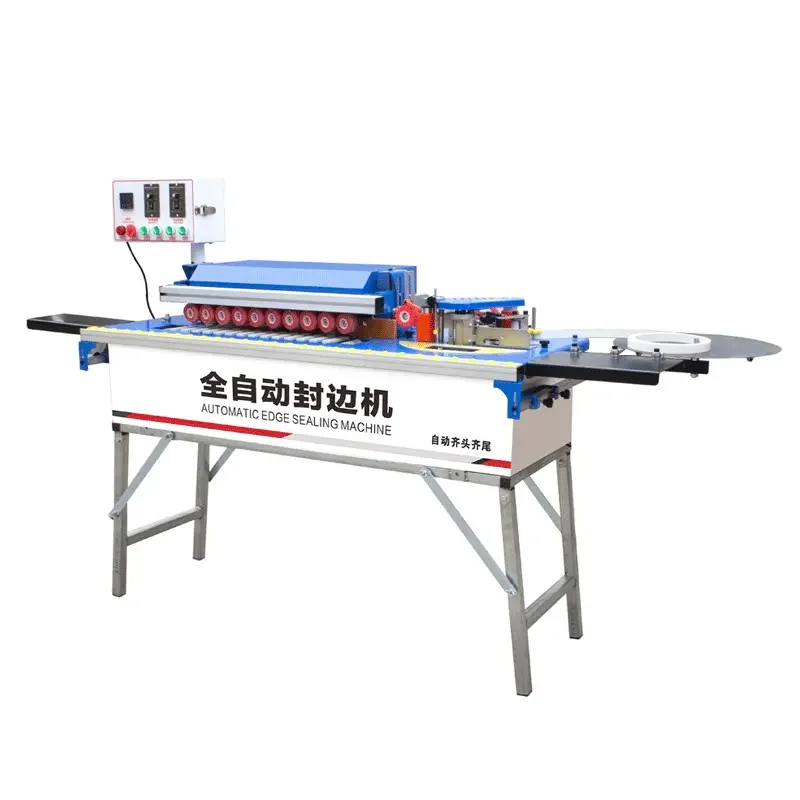
Edge banding machine
Click to enlarge
ISO 9001
CE Certified
OEM / ODM
12-Mo Warranty
Edge banding machine
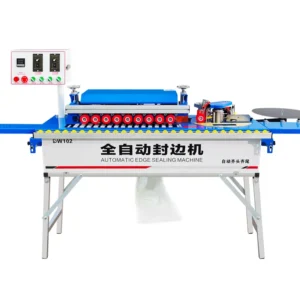
DW102 Edge Banding Machine for MDF Panel – Small WorkshopDW102 Automatic Mini Edge Banding Machine for MDF & Plywood – Small Workshop
<p><strong>DW102 Automatic Mini Edge Banding Machine, 3800W, 0.3–3mm Strip Thickness, 0–50mm Edge Height</strong> — handles both straight and curved edge banding with automatic head/tail cutting, dual 650W trimming and polishing stations.</p> <ul> <li>Glue distribution across MDF, particleboard and plywood evaluated for visible glue-line control and downstream assembly fit</li> <li>1000ml glue pot with vacuum hold-down supports consistent adhesion on porous substrates</li> <li>Trimming flushness and edge finish verifiable through pre-shipment sample testing on your actual panel material</li> </ul>
100+
Countries
MOQ 1
Unit
15-25 Days
Lead Time
220V 380V
DW102
Edge Banding Machine
MDF Panel
Plywood Processing
Process Application
Vacuum Hold Down
- Full OEM/ODM support -- custom logo, voltage (110V-440V), multilingual panels
- ISO 9001 & CE certified, 5 national patents, 60 professional engineers
- 12-month warranty, remote technical support & spare parts service
- Professional export packaging, customs clearance support, on-time delivery
Four-stage QC with pre-shipment verification — every DW102 runs your actual panel stock through glue, trim and polish before it leaves the floor, so edge quality is confirmed before you pay.
Technical Specifications
| Parameter | Value |
|---|---|
| Model | DW102 |
| Product Type | Automatic Mini Edge Banding Machine |
| Total Power | 3800W |
| Voltage | 220V / 380V / customizable |
| Trimming Power | 650W × 2 |
| Polishing Power | 180W × 2 |
| Edge Feed Power | 20W |
| Transmission Power | 60W |
| Vacuum Hold-down Power | 1200W |
| Air Source Pressure | 0.5–0.8 MPa |
| Glue Pot Capacity | 1000 ml |
| Edge Banding Height Range | 0–50 mm |
| Edge Banding Thickness Range | 0.3–3 mm |
| Minimum Sheet Length | 25 cm |
| Minimum Sheet Width | 5 cm |
| Standard Features | Curved & straight edge banding, edge trimming, polishing, automatic head & tail cutting, vacuum hold-down |
| Overall Dimensions (L×W×H) | 128 × 47 × 69 cm |
| Net Weight | 75 kg |
| Control Panel Language | Chinese & English default; other languages customizable |
| Plug Options | EU, USA, AU, UK |
| Assembly State | Fully assembled, wooden box packed |
Application Suitability
| Application | Material or Output |
|---|---|
| Cabinet door and drawer front edge finishing | MDF, particleboard with PVC or veneer strips |
| Curved panel components for custom furniture | Plywood, blockboard with 0.3–3 mm banding |
| Small-batch joinery production | Solid wood panels, polymer door panels |
| Workshop upgrading from manual banding | MDF, plywood, particleboard up to 50 mm edge height |
What Glue Lines on MDF Reveal About Your edge banding machine process and application
Substrate density and glue temperature must be matched before the first panel runs — not after a batch fails.
I spent a week in a Nairobi cabinet shop where fresh MDF produced clean edges all morning, then the owner switched to locally sourced recycled-core board. The surface was soft, full of voids, and the glue simply sat on top without penetrating. Every door panel showed visible glue seams and had to be reworked. That edge banding machine process and application gap between lab-grade MDF and real workshop stock is where most small shops lose money [NEED_CITE: substrate density variation in regional panel supply chains]. The DW102’s 1000 ml glue pot and vacuum hold-down address this by maintaining steady glue viscosity and pressing the strip firmly into porous surfaces, but the operator still needs to test the actual board before committing to a run.
How Curved and Straight Paths Share One Feed Mechanism
The DW102 handles both curved and straight edge banding in a single pass. The feed mechanism adjusts pressure and speed as the panel geometry changes, which matters when a cabinet door has a routed profile or a rounded corner. Curved sections tend to push the strip away from the substrate if feed pressure drops, leaving a gap at the glue line. This edge banding machine process and application capability lets a small workshop alternate between flat shelving and shaped components without swapping machines or retooling between jobs.
Glue Distribution and the Porous Substrate Problem
MDF and particleboard absorb glue at different rates. Dense MDF pulls adhesive into the fiber quickly, while low-density particleboard leaves excess glue on the surface where it squeezes out under the strip. The DW102’s glue pot holds 1000 ml, which keeps temperature stable across a batch of panels rather than cycling hot and cold as the reservoir empties and refills. The vacuum hold-down system at 1200W presses the banding strip into the substrate immediately after glue application, forcing adhesive into the fiber rather than letting it pool at the seam [NEED_CITE: vacuum hold-down effect on glue penetration in porous substrates].
Reading the Spec Sheet Against Your Production Reality
The dual 650W trimming stations handle head and tail cutting plus flush trimming in one pass, which directly affects whether the finished edge sits proud or recessed against the panel face. If trimming power is too low for the strip thickness, the cut tears rather than shears — common when running 3 mm PVC on a machine rated only for thinner stock. The 0.3–3 mm thickness range on this edge banding machine process and application setup covers standard PVC and wood veneer strips, but you should verify which end of that range your production concentrates on. The 0–50 mm height range suits most furniture panel thicknesses, though 50 mm stock requires the trimming cutters to engage fully across the strip face. Air pressure at 0.5–0.8 MPa drives the pneumatic actuators for trimming and polishing, so an unstable compressor will show up as inconsistent edge flushness from panel to panel.
The Cost of Skipping the Voltage Conversation
Machines quoted without confirming local voltage and frequency arrive at the dock unusable. A 380V unit shipped to a region with 220V single-phase supply will not start, and rewiring the motor and heating element is rarely straightforward. The DW102 supports 220V, 380V, and custom configurations, but the frequency — 50 Hz or 60 Hz — must also be locked in before production [NEED_CITE: voltage and frequency standards by export market]. Beyond the motor, the glue pot heater and vacuum motor are voltage-sensitive; running them on the wrong supply degrades glue temperature stability and hold-down pressure, which then appears as edge quality problems the operator blames on the strip material.
Why Procurement Should Start with a Substrate Test
The manufacturer runs in-house production with a four-stage QC sequence covering incoming material through pre-shipment verification. For the DW102, that final verification step includes a test run on the buyer’s actual panel stock when samples are provided. The patented cutting mechanisms behind the trimming stations hold tight tolerances, but those tolerances only matter if the glue line underneath is sound. Voltage, plug type, and control panel language are confirmed as standard customization, not afterthoughts. The full product family from entry-level to full-function means a workshop that outgrows the DW102 can move to a higher-capacity model without changing suppliers or retraining operators on a different control interface. An engineer-led configuration review produces a formal quotation addressing your substrate, strip material, and local power conditions.
Documentation & Verification
- Factory test record showing trim tolerance on your specific panel material and edge strip
- Electrical schematic confirming voltage, frequency, and plug type before dispatch
- Operation and maintenance manual written in your operator’s working language
- Spare parts list matched to the DW102 trimming and polishing consumables
- Packing photographs documenting assembly condition prior to crating
Installation, Commissioning & Support
- Requires a dedicated circuit matching confirmed voltage for the 3800W total load
- 128 × 47 × 69 cm footprint fits standard workshop aisles with room for panel staging
- Arrives fully assembled — position, connect power and 0.5–0.8 MPa air, then calibrate
- First-run tuning of glue temperature and vacuum pressure using your actual panel stock
- Trimming cutter and polishing wheel replacement schedule provided in the manual
What to Include in Your Inquiry
Send the specific panel materials you process — MDF brand, particleboard density, plywood core type — along with the edge strip material and thickness you plan to run. Confirm your workshop voltage and frequency so the electrical system is built correctly from the start. If you produce curved components, include the minimum radius and panel thickness so the feed mechanism can be verified against your geometry.
Frequently Asked Questions
Q: How does edge banding quality differ between MDF, particleboard and plywood on this machine?
A: MDF generally produces the cleanest glue line because its uniform density allows consistent adhesive penetration. Particleboard varies — low-density cores leave excess glue at the seam, while higher-density grades perform closer to MDF. Plywood’s layered structure can cause uneven absorption along the grain direction. Testing your actual board stock on the DW102 before production reveals which glue temperature and vacuum pressure settings each material requires.
Q: What glue type and temperature settings work best for PVC vs. veneer edge strips?
A: PVC strips typically use EVA hot-melt adhesive at temperatures matched to the strip thickness and ambient workshop conditions. Veneer strips are thinner and more heat-sensitive, requiring lower glue temperatures to prevent scorching or curling. The DW102’s 1000 ml glue pot maintains stable temperature across a batch. Your glue supplier should provide a recommended temperature window for each strip type, which the operator then fine-tunes during the test run.
Q: Can the DW102 maintain consistent trimming accuracy on curved edges as well as straight edges?
A: The feed mechanism adjusts to panel geometry, and the dual 650W trimming stations engage across both curved and straight paths. Consistency on curves depends on the minimum radius and strip thickness — tighter curves increase lateral force on the strip during trimming. Verifying curved-edge accuracy on your specific panel profile during the factory test confirms whether the DW102 meets your tolerance requirements before shipment.
Q: How do I verify the trimming tolerance before committing to a production run?
A: Request a factory test record documenting edge flushness measurements on panels processed with your actual substrate and strip material. The DW102 test run should include both straight and curved samples if your production requires both. Inspect the test panels for visible glue lines, trimming tear-out, and polishing finish. This verification step catches substrate-specific issues before the machine arrives at your workshop.
Q: What upstream and downstream process steps should I plan around this machine’s feed speed and output rate?
A: Upstream, panels must be cut to size with clean edges — ragged saw cuts compromise glue adhesion regardless of the bander’s capability. Downstream, trimmed and polished edges are ready for assembly or finishing without additional sanding. The DW102’s minimum sheet dimensions of 25 cm length and 5 cm width define the smallest component it can process, which affects how you sequence small parts through the workshop.
Technical Specifications
| Parameter | Value |
|---|---|
| Product Name | DW102 Edge Banding Machine for MDF Panel – Small WorkshopDW102 Automatic Mini Edge Banding Machine for MDF & Plywood – Small Workshop |
| Category | Edge banding machine |
| Voltage Options | 110V / 220V / 380V / 440V (customizable) |
| Frequency | 50Hz / 60Hz (customizable) |
| Certification | ISO 9001, CE |
| MOQ | 1 Unit |
| Lead Time | 15-25 Working Days |
| Warranty | 12 Months |
| OEM / ODM | Available -- logo, color, panel language |
* Detailed technical specifications vary by model. Please contact us with your specific requirements for a complete datasheet.
Shipping & Export
-
Export Packaging
Heavy-duty wooden crate with foam padding and moisture protection
-
Shipping Methods
Sea freight (FCL/LCL), air freight, express -- we support all methods
-
Customs Support
Full documentation: CO, commercial invoice, packing list, HS code assistance
-
Port of Loading
Tianjin / Qingdao port, China -- 20 years export experience
OEM / ODM Services
-
Logo & Branding
Custom logo printing, color scheme, and nameplate engraving
-
Voltage Configuration
110V / 220V / 380V / 440V, 50Hz / 60Hz -- any region supported
-
Multilingual Panels
Control panels in English, Spanish, French, Arabic and more
-
Custom Specifications
Modified dimensions, accessories, or feature sets on request
Get a Quote
Request Product Inquiry
Fill in your details and we'll respond within 24 hours with pricing and availability.
Direct Contact
How It Works
-
1
Confirm requirements & budget
Tell us your factory scale and processing needs
-
2
Receive recommendation & quote
We match the right machine with full specs
-
3
Negotiate & place order
OEM terms, voltage, payment and delivery
-
4
Production & QC inspection
Multi-stage quality control by 60 engineers
-
5
Export packaging & shipment
Professional packing, customs clearance
-
6
After-sales support
12-month warranty, remote tech support
You May Also Like