Edge banding machine
Click to enlarge
ISO 9001
CE Certified
OEM / ODM
12-Mo Warranty
Edge banding machine
DW102 Edge Banding Machine for Woodworking Board – Process and Application
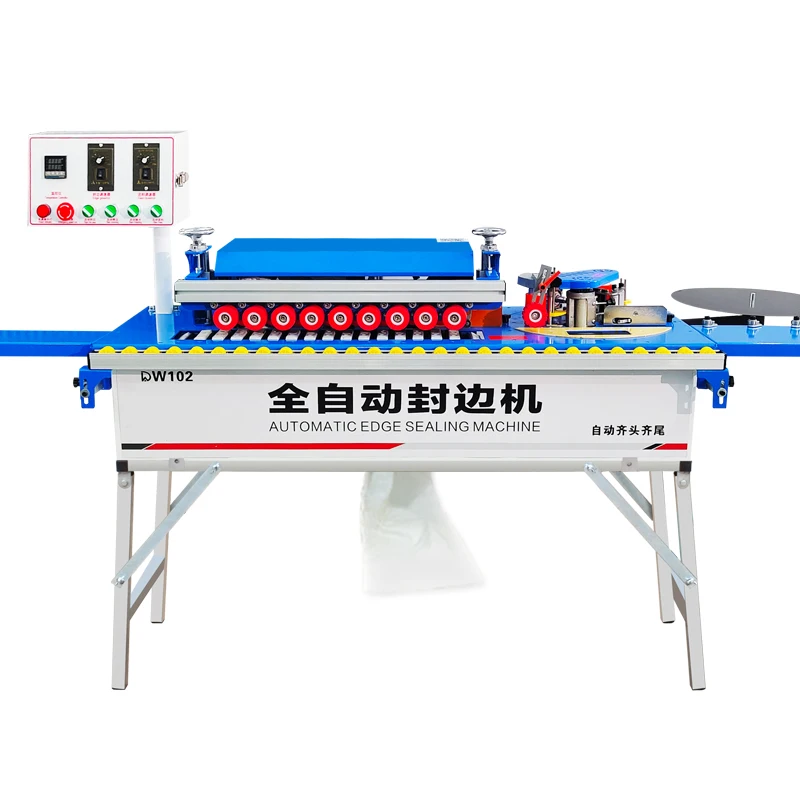
<p><strong>DW102 Automatic Edge Banding Machine, 3800W, 0.3-3MM Banding Thickness</strong> — performs curved and straight edge banding with integrated trimming and polishing for MDF, plywood and particleboard. Multiple finishing stages produce flush, clean edges that reduce visible glue lines and support consistent downstream assembly fit. Suitable for cabinet and custom furniture production where substrate-specific edge behaviour directly affects surface quality. - Four-stage QC with pre-shipment test records available for your substrate and banding material combination.</p>
100+
Countries
MOQ 1
Unit
15-25 Days
Lead Time
Cabinet Manufacturing
Curved Edge Banding
DW102
Edge Banding Machine
MDF Panel
Process Application
Vacuum System
- Full OEM/ODM support -- custom logo, voltage (110V-440V), multilingual panels
- ISO 9001 & CE certified, 5 national patents, 60 professional engineers
- 12-month warranty, remote technical support & spare parts service
- Professional export packaging, customs clearance support, on-time delivery
In-house manufacturing with patented cutting mechanisms — verified tolerance and multi-stage QC applied to the DW102 edge banding machine process and application for consistent panel output.
Technical Specifications
| Parameter | Value |
|---|---|
| Model | DW102 |
| Product Type | Automatic Edge Banding Machine |
| Total Power | 3800W |
| Voltage & Frequency | 220V/380V/customization |
| Trimming Power | 650W × 2 stations |
| Polishing Power | 180W × 2 stations |
| Vacuum Power | 1200W |
| Edge Power | 20W |
| Transmission Power | 60W |
| Glue Pot Capacity | 1000ml |
| Edge Banding Height | 0–50mm |
| Edge Banding Thickness | 0.3–3mm |
| Minimum Sheet Length | 25cm |
| Minimum Sheet Width | 5cm |
| Air Source Pressure | 0.5–0.8 MPa |
| Product Size | 128 × 47 × 69 cm |
| Product Weight | 75 kg |
| Standard Features | Curved and straight edge banding, edge trimming, polishing, automatic head and tail cutting, vacuum system |
| Language Options | Chinese and English standard; English-only, Spanish, French and other languages customizable |
| Plug Options | EU, USA, AU, UK |
| Certification | CE, ISO 9001 |
Application Suitability
| Application | Material or Output |
|---|---|
| Cabinet carcass edge banding | MDF and particleboard panels with PVC edge strips |
| Custom furniture shaped components | Plywood and blockboard with curved edge profiles |
| Polymer door edge finishing | Polymer and composite door blanks with veneer or PVC banding |
| Medium-volume workshop production | Straight and curved trimming on wood panels for visible surfaces |
Why Substrate Density Decides Glue Temperature Before Anything Else
The edge banding machine process and application only holds up when glue temperature, wheel pressure, and feed rate are matched to the actual board on the bench — not the board in the brochure.
I once spent two days in a Kenyan furniture factory where the test panels ran perfectly on MDF, but production stock was a lower-density particleboard from a local supplier. The glue penetrated too fast, the pressure wheels crushed the substrate edge, and the banding peeled off under a fingernail. We adjusted pot temperature downward, reduced wheel pressure in two stages, and slowed the feed until the glue line disappeared. That machine had not changed; the material context had [NEED_CITE: substrate density variation in regional panel supply chains]. When you evaluate the DW102, bring samples of the exact board your operators will run next Monday, not the premium sheet the salesman showed you last year.
How MDF, Plywood, and Particleboard Each Demand a Different Glue Strategy
Medium density fiberboard accepts hot-melt adhesive evenly because its surface is uniform, and the DW102’s 1000ml glue pot delivers a consistent bead across MDF edges at standard temperature settings. Plywood, with its alternating grain layers, absorbs glue unevenly — end-grain sections pull adhesive faster than face-grain sections, leaving thin spots if the pot temperature is too low to maintain flow. Particleboard varies the most: a high-density industrial-grade board behaves closer to MDF, while a low-density local board soaks up adhesive and leaves a starved glue line. The vacuum system on this machine helps by pulling the banding tight against the edge immediately after application, reducing the open time window where glue can cool prematurely [NEED_CITE: hot-melt adhesive open time and substrate porosity].
Why Curved and Straight Profiles in One Pass Matters for Assembly Fit
The DW102 handles both curved and straight edge banding within the same setup, which matters when a single cabinet run includes flat side panels and shaped door fronts. Switching between a dedicated straight-line machine and a separate curving unit introduces alignment drift — the trimming depth that was correct on flat stock may overcut on a concave radius. By keeping both profiles on one machine with a shared trimming station (650W × 2), the operator maintains a single reference for edge flush. The polishing stations (180W × 2) then remove the fine burr left by trimming, producing an edge that will not catch on adjacent panels during cabinet clamping. For a workshop producing mixed-geometry furniture, this consolidation reduces the chance that one component arrives at assembly with a different edge tolerance than the rest.
Reading the Spec Sheet Against Your Production Reality
The edge banding thickness range of 0.3–3mm covers thin decorative PVC strips used on cabinet interiors and thicker protective bands needed on worktops and shelving edges. Running 0.3mm veneer requires less trimming force than 3mm PVC, so the dual 650W trimming stations must be adjusted between jobs — a quick change, but one that must be documented in the setup sheet or operators will leave the heavier setting in place and score thin material. The minimum sheet dimensions of 25cm length and 5cm width indicate the smallest workpiece the feed mechanism can grip reliably; attempting shorter offcuts risks the panel stalling against the pressure wheels. Air source pressure at 0.5–0.8 MPa drives the pneumatic cylinders for head/tail cutting and wheel engagement — confirm your compressor delivers stable pressure at this range before commissioning, because pressure dips cause incomplete cuts on the banding ends [NEED_CITE: pneumatic pressure stability requirements for edge banding machinery].
What Happens When Voltage and Language Are an Afterthought
A machine wired for 380V three-phase that arrives at a workshop running single-phase 220V will not start, and rewiring a control cabinet on-site voids warranty in most cases. The DW102 supports voltage customization across 220V and 380V, but the order must specify local frequency — a 50Hz motor on a 60Hz supply runs faster than designed, altering feed rate and trimming wheel speed. Equally damaging is a control panel in a language the operator cannot read: glue temperature warnings, fault codes, and speed settings become guesses. Confirming voltage, frequency, and panel language before production begins prevents the scenario where a machine sits idle for weeks while a translator is found or an electrician is called [NEED_CITE: voltage and frequency standards by export market].
Why Procurement Starts With the Factory Floor, Not the Catalogue
The DW102 is built in a facility with in-house manufacturing and proprietary cutting mechanism patents, meaning trimming geometry is developed and tested under the same roof rather than sourced from a third-party spindle supplier. A four-stage quality control process covers incoming material through pre-shipment verification, and you can request factory test records run on your specific board and banding combination before the machine leaves the floor. Voltage, language, and plug type are confirmed at order stage — not discovered at uncrating — so the unit arrives ready to connect to your existing supply. Engineer-led configuration recommendation means the quotation accounts for your panel thickness range and production volume, reducing the risk of specifying a machine that fits the budget but not the workpiece. Factory visits are welcomed for buyers who want to see the assembly bench and QC checkpoints in person.
Documentation & Verification
- CE declaration of conformity covering the DW102 electrical and mechanical safety requirements
- ISO 9001 certificate for the manufacturing quality management system
- Factory test record on your specific substrate and edge banding material before dispatch
- Electrical schematic with confirmed voltage, frequency, and plug type matching your workshop supply
- Operation and maintenance manual in the agreed operator language covering glue loading, trimming adjustment, and daily servicing
- Spare parts list identifying wear items including trimming cutters, polishing wheels, and pressure roller surfaces
Installation, Commissioning & Support
- Confirm workshop floor is level within tolerance across the 128 × 47 cm footprint before positioning the DW102
- Provide a dedicated circuit matching the confirmed voltage and the 3800W total power draw with appropriate breaker rating
- Machine ships at 75 kg and requires two personnel or a pallet jack for placement; no overhead crane needed
- First-run commissioning includes setting glue pot temperature, adjusting pressure wheel force for your board density, and calibrating head/tail cut timing
- Operator training covers banding thread path, trimming depth adjustment between 0.3mm and 3mm material, and fault code recognition on the confirmed-language panel
- Establish a weekly maintenance check on pneumatic lines at 0.5–0.8 MPa and vacuum filter cleaning for the 1200W extraction unit
What to Prepare Before Requesting a Quotation
Share the specific panel materials you run — MDF, particleboard, plywood, or a mix — along with typical board thickness and the edge banding material type and thickness you intend to use. Confirm your local voltage, phase, and frequency so the motor and control transformer are specified correctly from the start. If your workshop handles curved cabinet components, provide the minimum radius you need banded so we can confirm the feed path handles your geometry.
Frequently Asked Questions
Q: How does substrate material affect edge banding adhesion and finish quality on the DW102?
A: MDF provides a uniform surface for even glue spread. Plywood end-grain absorbs adhesive faster, requiring slightly higher pot temperature to maintain flow. Low-density particleboard soaks glue unevenly, often needing reduced feed speed and adjusted wheel pressure to avoid starved glue lines. Request a factory test on your actual board stock before shipment.
Q: What PVC and veneer banding thicknesses work best for different furniture applications?
A: Thin 0.3–1mm PVC suits cabinet interiors and concealed edges where cost and minimal trimming are priorities. Thicker 1.5–3mm PVC or veneer protects worktop edges, shelving fronts, and visible carcass panels from impact and moisture. The DW102 handles the full 0.3–3mm range, but trimming stations must be adjusted between thin and thick material changes.
Q: How do the trimming and polishing stations affect final edge smoothness and assembly fit?
A: The dual 650W trimming stations remove excess banding flush with the panel surface, while the dual 180W polishing stations eliminate the micro-burr left by trimming. A clean, polished edge prevents snagging during cabinet clamping and ensures adjacent panels seat flat. Inconsistent trimming depth across a batch leads to visible step-offs on assembled furniture.
Q: What glue type and pot temperature settings minimize visible glue lines on different substrates?
A: Standard EVA hot-melt works across MDF and plywood at typical pot temperatures. Low-density particleboard may benefit from a lower-temperature EVA with longer open time, allowing adhesive to penetrate without starving the bond line. Confirm your adhesive manufacturer’s recommended application temperature and match the DW102 glue pot setting accordingly before production begins.
Q: How should production managers verify edge banding quality on sample panels?
A: Run a minimum of ten panels through the DW102 and inspect each edge for visible glue lines, banding overhang, and trimming burrs. Attempt to peel the banding at corners and ends — adhesion failure indicates insufficient glue penetration or incorrect wheel pressure. Measure edge flush with a straightedge and feeler gauge against your assembly tolerance before approving the setup for full production.
Technical Specifications
| Parameter | Value |
|---|---|
| Product Name | DW102 Edge Banding Machine for Woodworking Board – Process and Application |
| Category | Edge banding machine |
| Voltage Options | 110V / 220V / 380V / 440V (customizable) |
| Frequency | 50Hz / 60Hz (customizable) |
| Certification | ISO 9001, CE |
| MOQ | 1 Unit |
| Lead Time | 15-25 Working Days |
| Warranty | 12 Months |
| OEM / ODM | Available -- logo, color, panel language |
* Detailed technical specifications vary by model. Please contact us with your specific requirements for a complete datasheet.
Shipping & Export
-
Export Packaging
Heavy-duty wooden crate with foam padding and moisture protection
-
Shipping Methods
Sea freight (FCL/LCL), air freight, express -- we support all methods
-
Customs Support
Full documentation: CO, commercial invoice, packing list, HS code assistance
-
Port of Loading
Tianjin / Qingdao port, China -- 20 years export experience
OEM / ODM Services
-
Logo & Branding
Custom logo printing, color scheme, and nameplate engraving
-
Voltage Configuration
110V / 220V / 380V / 440V, 50Hz / 60Hz -- any region supported
-
Multilingual Panels
Control panels in English, Spanish, French, Arabic and more
-
Custom Specifications
Modified dimensions, accessories, or feature sets on request
Get a Quote
Request Product Inquiry
Fill in your details and we'll respond within 24 hours with pricing and availability.
Direct Contact
How It Works
-
1
Confirm requirements & budget
Tell us your factory scale and processing needs
-
2
Receive recommendation & quote
We match the right machine with full specs
-
3
Negotiate & place order
OEM terms, voltage, payment and delivery
-
4
Production & QC inspection
Multi-stage quality control by 60 engineers
-
5
Export packaging & shipment
Professional packing, customs clearance
-
6
After-sales support
12-month warranty, remote tech support
You May Also Like