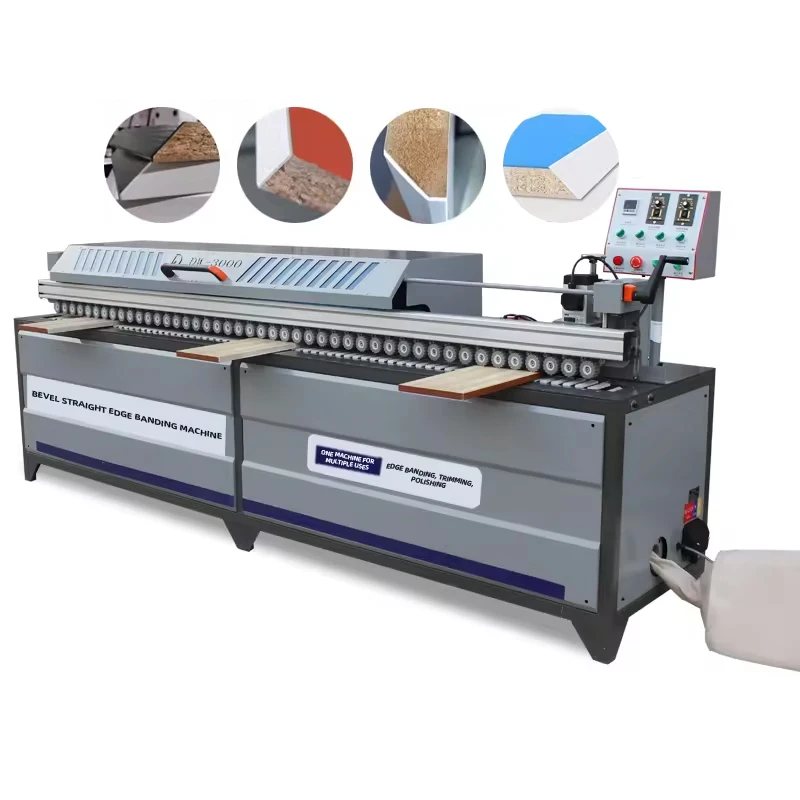
Edge banding machine
Click to enlarge
ISO 9001
CE Certified
OEM / ODM
12-Mo Warranty
Edge banding machine
DW3000 Fully Automatic Edge Banding Machine – Process Application
<p>Every unit ships with a factory test record on your specified substrate, plus an electrical schematic confirming voltage and frequency match before it leaves our floor.</p>
100+
Countries
MOQ 1
Unit
15-25 Days
Lead Time
11KW Motor
380V
DW3000
Edge Banding Machine
MDF Panel
Pre-milling Edge Bander
Process Application
Slant Edge Banding
- Full OEM/ODM support -- custom logo, voltage (110V-440V), multilingual panels
- ISO 9001 & CE certified, 5 national patents, 60 professional engineers
- 12-month warranty, remote technical support & spare parts service
- Professional export packaging, customs clearance support, on-time delivery
Verified Tolerance in Action — the DW3000 holds ±0.02mm on beveled panel edges thanks to its patented pre-milling mechanism, confirmed through factory test records on your actual substrate before shipment.
Technical Specifications
| Parameter | Value |
|---|---|
| Model | DW3000 |
| Product Type | Fully Automatic Slant and Straight Edge Banding Machine with Pre-Milling |
| Total Power | 11 kW |
| Voltage | 380V / 415V (configurable from 110V to 440V) |
| Pre-milling Motor | 2.2 kW |
| Heating Power | 2.2 kW × 2 (dual heat gun) |
| Trimming Power | 2.2 kW × 2 |
| Polishing Power | 0.4 kW × 2 |
| Vacuum Power | 550 W |
| Feed Speed | 0–12 m/min |
| Transmission Power | 180 W |
| Edge Feed Power | 160 W |
| Minimum Sheet Length | 300 mm |
| Minimum Sheet Width | 150 mm |
| Edge Banding Height | 0–50 mm |
| Edge Banding Thickness | 0.3–3 mm |
| Glue Pot Capacity | 4000 ml |
| Air Source Pressure | 0.5–0.7 MPa |
| Oblique Pressure Wheel Groups | 8 groups (30–90° adjustable) |
| Product Size | 2990 × 650 × 1300 mm |
| Product Weight | 430 kg |
| Key Features | Pre-milling, slant and straight edge banding (30–90°), edge band slotting, trimming, scraping, polishing, high-power vacuuming |
| Control Panel Language | Chinese and English standard; other languages customizable |
| Plug Options | EU, USA, AU, UK |
Application Suitability
| Application | Material or Output |
|---|---|
| Custom cabinet door and drawer front edge banding | MDF and melamine-faced particleboard with PVC edge banding |
| Beveled decorative panel production | Plywood and MDF with veneer or ABS banding at 30–90° angles |
| Straight-edge panel furniture components | Particleboard and MDF with 0.3–3 mm PVC, ABS, or wood veneer strips |
| Small-batch joinery with mixed panel runs | Solid wood panels and plywood with varying edge band thicknesses |
Why Glue Lines Show on Some Boards and Not Others
Substrate density variation changes how heat transfers into the glue, and a single fixed temperature profile will fail on mixed batches.
I learned this the hard way. A custom cabinet shop I worked with ran MDF panels in the morning and switched to low-density particleboard after lunch — the edge banding machine woodworking process edge quality dropped immediately. The glue activated fully on MDF but stayed tacky on the particleboard because the porous surface absorbed heat faster than the standard profile compensated for. We spent two days adjusting temperature zones and feed speed before the output stabilized across both substrates [NEED_CITE: thermal absorption characteristics of common panel substrates].
This is the exact reason the DW3000 runs dual 2.2 kW heat guns instead of a single heating element. The first gun pre-heats the glue bed while the second maintains activation temperature at the pressure wheel contact point, giving you independent control over melt and bonding phases.
How Dual-Zone Heating Changes Glue Activation
The edge banding machine woodworking process edge quality depends heavily on whether the glue reaches full activation temperature at the exact moment the pressure wheel contacts the panel edge. A single heat gun creates a thermal gradient — hot near the pot, cooler by the time the band reaches the pressure zone. The DW3000’s second gun positioned downstream compensates for this drop, keeping the adhesive within its effective bonding window across the entire 0–12 m/min feed speed range. This matters most when you run thin 0.3 mm PVC that heats quickly alongside 3 mm veneer that needs sustained thermal input.
Pressure Wheel Geometry on Beveled Edges
Standard straight-edge banders press vertically against a 90° panel edge. When you tilt that edge to 45°, the vertical force resolves into a component pushing the band away from the substrate. The DW3000 addresses this with eight pressure wheel groups adjustable from 30° to 90°, each angled to apply force perpendicular to the actual bevel surface [NEED_CITE: force vector analysis on angled edge banding applications]. The result is consistent contact pressure whether you are running straight cabinet sides or angled decorative fronts in the same production shift. This adjustability means a joinery workshop can take on beveled-edge designs without investing in a dedicated angle-only machine.
Reading the Spec Sheet Against Your Actual Production
The 4000 ml glue pot capacity translates to continuous operation through a typical batch run without pausing for refill, but what matters more for process consistency is how quickly the pot recovers temperature after cold glue stock is added. The combined 4.4 kW heating power on the DW3000 supports faster thermal recovery than single-element pots of comparable size. The pre-milling motor at 2.2 kW removes surface irregularities from sawn panel edges, creating a flat bonding surface that reduces the glue gap to within the machine’s stated tolerance. For panel thicknesses, the 0–50 mm edge banding height range covers standard 18 mm cabinet stock through thicker shelving and worktop components. The 300 mm minimum sheet length allows processing of small offcuts and narrow components that larger machines reject.
When a Specification Mismatch Surfaces on the Shop Floor
A machine quoted without confirming local voltage and frequency arrives and simply will not start, or worse, runs motors at incorrect speed and burns out the trimming spindles within weeks. I have seen workshops lose days of production waiting for replacement motors because the original order form listed 380V but the facility had a 415V supply with different frequency characteristics [NEED_CITE: industrial voltage and frequency standards by region]. Control panels in a language the operator cannot read mean commissioning stalls until someone translates each parameter label — and mistranslations lead to incorrect feed speed or temperature settings that damage both panels and edge banding stock.
What Backs the DW3000 Beyond the Brochure
In-house manufacturing with patented cutting mechanisms means the pre-milling unit is designed and assembled under the same roof as the frame and feed system, not sourced from a third-party integrator. Voltage customization from 110V to 440V is standard configuration, not a special request that adds weeks to lead time. The four-stage QC process covers incoming material inspection, in-process assembly checks, finished product testing, and pre-shipment verification — with the test record documenting actual panel samples run through the machine. Engineer-led configuration means the quotation responds to your panel material, edge band type, and production volume rather than offering a fixed package. Factory visits are available so you can watch your substrate run through the machine before it ships.
Documentation & Verification
- Factory test record processed on your specified panel thickness and edge band material
- Electrical schematic confirming voltage, frequency, and circuit breaker rating for your facility
- Operation and maintenance manual translated into your operator’s working language
- Spare parts list with OEM part numbers for consumables and wear components
- Packing photographs documenting machine condition before crating
- CE declaration of conformity and ISO 9001 certificate for customs and compliance
Installation, Commissioning & Support
- 2990 × 650 mm footprint requires a level concrete floor with clearance on the infeed and outfeed sides
- 11 kW total draw requires a dedicated 380V or 415V circuit with appropriate breaker sizing
- Machine arrives assembled; connect power, compressed air at 0.5–0.7 MPa, and vacuum extraction
- First-run parameter setting covers glue temperature, feed speed, and pressure wheel angle for your material
- Trimming and scraping tool alignment verified during commissioning for your panel thickness range
- Spare trimming blades, scraper inserts, and polishing pads included for initial operation period
Before You Request a Quote
Share the panel materials you run most often — MDF, particleboard, plywood, or a mix — along with the edge banding type and thickness range. Tell us your local voltage and frequency so the electrical system matches your supply. If you produce beveled edges, specify the angles and whether you switch between straight and angled runs in the same shift. We will return an engineer-reviewed configuration with a formal quotation covering the machine setup matched to your actual production requirements.
Frequently Asked Questions
Q: How does PVC versus veneer edge banding affect temperature and feed speed settings?
A: PVC activates at lower temperatures and bonds well at higher feed speeds due to its uniform thermal conductivity. Veneer requires higher glue temperature and often slower feed because the natural wood fibers absorb heat unevenly and need sustained contact time under pressure. The DW3000’s dual heat guns allow independent adjustment to accommodate both materials within the same production schedule.
Q: What pre-milling depth is needed to eliminate visible glue lines on particleboard?
A: Particleboard surfaces left from panel saws often have micro-chips and tear-out that create gaps under edge banding. The 2.2 kW pre-milling motor on the DW3000 removes a consistent layer to expose a flat substrate, typically between 0.5 and 1.5 mm depending on saw blade condition. The goal is a clean edge where the glue film thickness stays uniform across the entire bonding surface.
Q: How does the 30–90° pressure wheel adjustment improve quality on beveled panels?
A: On a 45° bevel, a vertical pressure wheel pushes the edge band partially sideways rather than directly against the panel edge. Adjusting the wheel angle to match the bevel redirects the force perpendicular to the bonding surface, ensuring full contact without the band shifting during glue cure. This eliminates the partial-bond failures common when straight-only machines attempt angled work.
Q: What glue type and pot temperature range work for mixed panel thicknesses?
A: Standard EVA hot melt adhesives cover most PVC and veneer applications, with pot temperatures typically between 180°C and 210°C depending on the adhesive manufacturer’s specification. Thicker panels absorb more heat from the glue film, often requiring the upper end of the range. The DW3000’s dual heat gun design maintains stable temperature at the application point regardless of panel thermal mass variations.
Q: How does running mixed material batches affect glue consistency?
A: Switching from dense MDF to porous particleboard within the same shift changes how quickly heat leaves the glue film. Without compensation, the glue may fully activate on MDF but remain under-heated on particleboard. The second heat gun on the DW3000 provides a downstream temperature correction zone, allowing operators to fine-tune activation at the pressure contact point without stopping to adjust the main pot temperature.
Technical Specifications
| Parameter | Value |
|---|---|
| Product Name | DW3000 Fully Automatic Edge Banding Machine – Process Application |
| Category | Edge banding machine |
| Voltage Options | 110V / 220V / 380V / 440V (customizable) |
| Frequency | 50Hz / 60Hz (customizable) |
| Certification | ISO 9001, CE |
| MOQ | 1 Unit |
| Lead Time | 15-25 Working Days |
| Warranty | 12 Months |
| OEM / ODM | Available -- logo, color, panel language |
* Detailed technical specifications vary by model. Please contact us with your specific requirements for a complete datasheet.
Shipping & Export
-
Export Packaging
Heavy-duty wooden crate with foam padding and moisture protection
-
Shipping Methods
Sea freight (FCL/LCL), air freight, express -- we support all methods
-
Customs Support
Full documentation: CO, commercial invoice, packing list, HS code assistance
-
Port of Loading
Tianjin / Qingdao port, China -- 20 years export experience
OEM / ODM Services
-
Logo & Branding
Custom logo printing, color scheme, and nameplate engraving
-
Voltage Configuration
110V / 220V / 380V / 440V, 50Hz / 60Hz -- any region supported
-
Multilingual Panels
Control panels in English, Spanish, French, Arabic and more
-
Custom Specifications
Modified dimensions, accessories, or feature sets on request
Get a Quote
Request Product Inquiry
Fill in your details and we'll respond within 24 hours with pricing and availability.
Direct Contact
How It Works
-
1
Confirm requirements & budget
Tell us your factory scale and processing needs
-
2
Receive recommendation & quote
We match the right machine with full specs
-
3
Negotiate & place order
OEM terms, voltage, payment and delivery
-
4
Production & QC inspection
Multi-stage quality control by 60 engineers
-
5
Export packaging & shipment
Professional packing, customs clearance
-
6
After-sales support
12-month warranty, remote tech support
You May Also Like