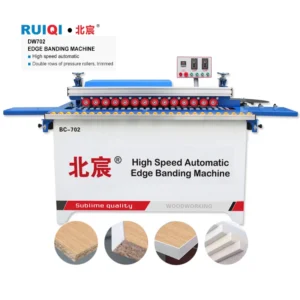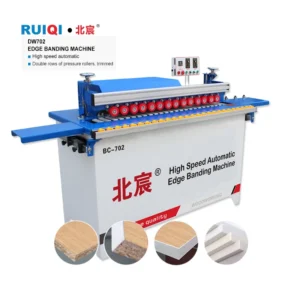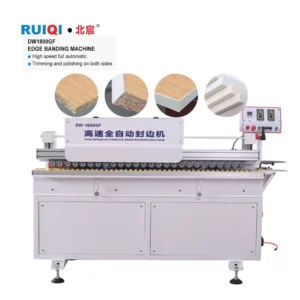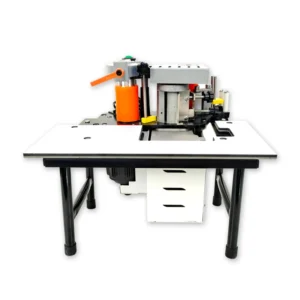
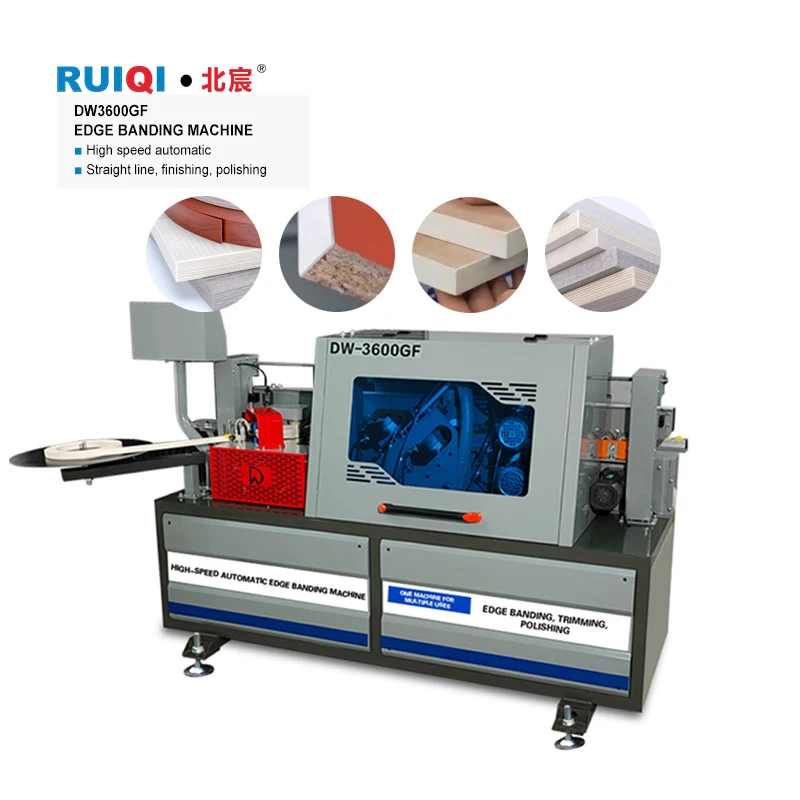
Edge banding machine
Click to enlarge
ISO 9001
CE Certified
OEM / ODM
12-Mo Warranty
Edge banding machine
DW3600 Woodworking MDF Board Automatic Edge Banding Machine – Process Guide
<p><strong>DW-3600GF Automatic Edge Banding Machine, 380V, 4.9kW Total Power, 0–14 m/min Feed Speed</strong> — engineered for consistent glue adhesion across MDF and melamine substrates.</p> <ul> <li>Six-function station sequence: gluing → trimming → front/rear trimming → scraping → polishing → vacuuming</li> <li>Trimming motors 800W × 2 at 24000 r/min deliver clean flush cuts on PVC banding 0.3–3 mm thick</li> <li>Edge band height range 0–50 mm, minimum panel length 200 mm</li> </ul> <p>Substrate behaviour and glue line visibility depend on matching feed speed to panel density — this unit lets operators dial in 0–14 m/min for different MDF and melamine-faced boards, reducing visible seams that compromise cabinet door and carcass finish.</p> <p>Request a sample processing test on your actual stock to verify edge quality before order confirmation — our four-stage QC with pre-shipment verification ensures the machine you receive matches the test result.</p>
100+
Countries
MOQ 1
Unit
15-25 Days
Lead Time
380V
Automatic PVC Edge Banding
DW3600GF
Edge Banding Machine
MDF Board
Melamine Board
Process And Application
- Full OEM/ODM support -- custom logo, voltage (110V-440V), multilingual panels
- ISO 9001 & CE certified, 5 national patents, 60 professional engineers
- 12-month warranty, remote technical support & spare parts service
- Professional export packaging, customs clearance support, on-time delivery
Verified Tolerance in Every Cut — The DW-3600GF maintains edge trimming precision through proprietary cutting mechanisms tested across MDF and melamine substrates before dispatch.
Technical Specifications
| Parameter | Value |
|---|---|
| Model | DW-3600GF |
| Product Type | Automatic PVC Edge Banding Machine |
| Voltage & Frequency | 380V, Three-phase Four-wire (frequency 50Hz/60Hz basis to be confirmed) |
| Total Power | 4.9kW |
| Edge Banding Power | 160W |
| Transmission Power | 180W |
| Trimming Power | 800W × 2 |
| Polishing Power | 400W × 2 |
| Trimming Speed | 24000 r/min |
| Feed Speed | 0–14 m/min |
| Overall Dimensions (L×W×H) | 2200 × 650 × 1250 mm |
| Net Weight | 320 kg |
| Edge Banding Type | Straight edge banding |
| Edge Band Height Range | 0–50 mm |
| Edge Band Thickness Range | 0.3–3 mm |
| Minimum Panel Length | 200 mm |
| Air Supply Requirement | 0.4–0.6 MPa |
| Standard Functions | Gluing, Trimming, Front and Rear Trimming, Scraping, Polishing, Vacuuming |
| Language Options | Chinese and English (customizable to Spanish or other languages) |
| Plug Options | EU, USA, AU, UK |
| Assembly State | Fully assembled |
Application Suitability
| Application | Material or Output |
|---|---|
| Cabinet door and carcass edge finishing | MDF board with melamine or PVC lamination |
| Custom furniture component production | Melamine-faced particleboard panels |
| Joinery workshop batch processing | Plywood and solid wood panels with PVC edge banding |
| Small-batch panel fabrication | Mixed substrate furniture parts requiring clean edge transitions |
Why Glue Lines Show Up Even When the Sample Looked Perfect
Substrate density and surface porosity change how hot-melt adhesive activates and bonds.
I remember a custom cabinet maker who ran standard PVC edge banding through a trial without issues, then switched to melamine paper banding for the actual production run. The glue temperature that worked on PVC left visible lines on melamine because the activation threshold differed. Feed speed that produced clean results on dense MDF pulled adhesive away too quickly on porous particleboard. The woodworking edge banding process and application depends entirely on matching machine parameters to the exact material combination you intend to run, not the sample that happened to look good in the showroom [NEED_CITE: hot-melt adhesive activation temperatures by banding material type].
How the Six-Station Sequence Addresses Substrate Variation
This woodworking edge banding process and application begins with gluing and ends with vacuuming, passing through trimming, front and rear trimming, scraping, and polishing in a single pass. Each station removes a specific failure mode: rough trimming leaves excess material, front and rear trimming cleans the panel ends, scraping eliminates the micro-ridge that trimming motors leave behind, and polishing restores the surface finish. Skipping any station means the operator must compensate manually downstream, which introduces inconsistency across batches.
Feed Speed as a Process Variable, Not Just a Throughput Dial
The 0–14 m/min feed range allows operators to slow the line when running porous substrates that need longer glue contact time, or speed up when processing dense MDF that bonds quickly. Running every job at maximum speed is a common mistake in small workshops trying to meet delivery deadlines. The result is adhesive that has not fully wetted the substrate surface before the banding material presses against it, producing the exact visible glue line that causes customer rejections [NEED_CITE: adhesive wetting time requirements for porous versus dense substrates].
Reading the Specification Sheet Against Your Actual Production Needs
The 800W × 2 trimming motors running at 24000 r/min provide sufficient cutting energy for PVC and melamine banding up to 3 mm thick, but solid wood veneer banding at the upper thickness range may require reduced feed speed to prevent tear-out. The 0.4–0.6 MPa air supply requirement drives the pneumatic pressure rollers that maintain consistent banding contact during glue curing — insufficient compressor capacity causes intermittent bonding failures that appear random and are difficult to diagnose. The 4.9kW total power draw means this machine runs on a standard workshop circuit without requiring dedicated high-capacity supply, which matters when planning equipment layout in a constrained space.
What Happens When Machine Capacity and Production Volume Mismatch
Entry-level machines sold into production volumes they were never designed for develop premature wear on guide rails and pressure rollers, producing edge quality degradation that operators compensate for by increasing trimming depth — which then removes too much banding material on thinner substrates. The visible symptom is inconsistent edge profiles within the same batch, where some panels show clean transitions and others show banding material that sits proud of the panel surface or recesses below it. This inconsistency reaches the assembly floor, where cabinet boxes do not square properly because edge dimensions vary by fractions of a millimeter across the batch [NEED_CITE: edge banding tolerance requirements for cabinet assembly fit].
Why Procurement from a Manufacturing Source Matters for This Machine Class
The DW-3600GF ships fully assembled with a wooden box enclosure, meaning the machine arrives in operational condition rather than requiring on-site mechanical assembly that introduces alignment errors. Voltage and plug configuration are confirmed before production rather than assumed, preventing the situation where a machine arrives with a 380V three-phase connection in a workshop that only has single-phase supply available. The control panel language is set to the operator’s requirement during factory configuration, so commissioning does not stall while someone translates parameter labels. Sample processing tests on the buyer’s actual panel stock verify glue line quality before the order enters production. The four-stage quality control process includes pre-shipment verification that the machine produces acceptable results on the specified substrate and banding material combination.
Documentation & Verification
- CE declaration of conformity confirming machinery directive compliance for this edge bander class
- Machine specification sheet listing confirmed voltage, frequency, and panel thickness capacity
- Electrical schematic showing circuit protection requirements for the 4.9kW total power draw
- Factory test record demonstrating edge finish quality on your specified MDF or melamine substrate
- Operation and maintenance manual in the agreed language covering glue temperature adjustment procedures
- Spare parts list identifying consumable trimming blades and polishing wheels by part number
Installation, Commissioning & Support
- Requires level concrete floor capable of supporting 320 kg static load plus dynamic vibration during trimming operations
- Dedicated 380V three-phase circuit with appropriate breaker rating for the 4.9kW total power specification
- Arrives fully assembled requiring only electrical connection, air supply hookup, and leveling adjustment
- First-run commissioning includes glue pot temperature calibration for your specific banding material and substrate combination
- Operator training covers feed speed selection logic for different panel densities and edge band thicknesses
- Consumable spare parts include trimming blades rated for the 24000 r/min motor speed and polishing wheels
What We Need to Configure This Machine for Your Workshop
Provide the specific panel substrates you process most frequently — MDF, melamine-faced particleboard, plywood, or a mix — along with the edge banding materials and thicknesses you run. Confirm your workshop’s available voltage and phase configuration so the electrical system matches your supply. Let us know the control panel language your operators require and whether you want to send sample panels for a pre-production edge banding test to verify glue line quality before the machine enters build.
Frequently Asked Questions
Q: How does glue pot temperature affect adhesion on MDF versus melamine substrates?
A: MDF is more porous and absorbs heat from the adhesive quickly, often requiring higher glue pot temperatures to maintain proper wetting. Melamine surfaces are denser and retain heat longer, so excessive temperature can cause the adhesive to skin over before bonding completes. The DW-3600GF allows temperature adjustment, but the optimal setting depends on your specific substrate and banding material combination. Request a sample processing test on your actual stock to establish the correct baseline before production begins.
Q: What edge banding materials are compatible with this station configuration?
A: The six-station sequence handles PVC edge banding from 0.3 mm to 3 mm thickness, which covers most standard furniture applications. Melamine paper banding also runs through this configuration, though glue temperature and feed speed require adjustment compared to PVC settings. Wood veneer banding at the upper thickness range may need reduced feed speed to prevent tear-out during trimming. Confirm your intended banding materials before ordering so the factory can verify compatibility during pre-shipment testing.
Q: How does feed speed selection influence glue line quality on different panel densities?
A: Higher feed speed reduces the time adhesive has to wet the substrate surface before pressure rollers apply the banding material. On dense MDF this may still produce acceptable bonds, but porous particleboard needs longer contact time for the adhesive to penetrate surface irregularities. The 0–14 m/min range lets operators match speed to substrate, but running every job at maximum speed to meet output targets is a frequent cause of visible glue lines. Dial in speed based on edge quality inspection, not throughput pressure.
Q: What downstream assembly issues arise from inconsistent edge trimming?
A: When trimming leaves banding material proud of the panel surface or recesses below it, cabinet components do not fit flush during assembly. Doors may not close evenly, drawer fronts show visible gaps, and carcass joints fail to square properly. These issues trace back to worn trimming blades, incorrect trimming depth settings, or feed speed that causes the trimming motors to chatter rather than cut cleanly. The 24000 r/min trimming motors on the DW-3600GF address this when maintained with sharp blades and correct parameter settings.
Q: Can I send sample panels for a pre-production edge banding test before ordering?
A: Yes, sending your actual MDF, melamine, or plywood stock allows the factory to run the DW-3600GF with your specific edge banding material and verify glue line visibility, trimming quality, and final edge finish. This test establishes the baseline parameters — glue temperature, feed speed, trimming depth — that ship with the machine documentation. It also confirms that the machine’s panel thickness capacity matches your production requirements before the order enters manufacturing.
Technical Specifications
| Parameter | Value |
|---|---|
| Product Name | DW3600 Woodworking MDF Board Automatic Edge Banding Machine – Process Guide |
| Category | Edge banding machine |
| Voltage Options | 110V / 220V / 380V / 440V (customizable) |
| Frequency | 50Hz / 60Hz (customizable) |
| Certification | ISO 9001, CE |
| MOQ | 1 Unit |
| Lead Time | 15-25 Working Days |
| Warranty | 12 Months |
| OEM / ODM | Available -- logo, color, panel language |
* Detailed technical specifications vary by model. Please contact us with your specific requirements for a complete datasheet.
Shipping & Export
-
Export Packaging
Heavy-duty wooden crate with foam padding and moisture protection
-
Shipping Methods
Sea freight (FCL/LCL), air freight, express -- we support all methods
-
Customs Support
Full documentation: CO, commercial invoice, packing list, HS code assistance
-
Port of Loading
Tianjin / Qingdao port, China -- 20 years export experience
OEM / ODM Services
-
Logo & Branding
Custom logo printing, color scheme, and nameplate engraving
-
Voltage Configuration
110V / 220V / 380V / 440V, 50Hz / 60Hz -- any region supported
-
Multilingual Panels
Control panels in English, Spanish, French, Arabic and more
-
Custom Specifications
Modified dimensions, accessories, or feature sets on request
Get a Quote
Request Product Inquiry
Fill in your details and we'll respond within 24 hours with pricing and availability.
Direct Contact
How It Works
-
1
Confirm requirements & budget
Tell us your factory scale and processing needs
-
2
Receive recommendation & quote
We match the right machine with full specs
-
3
Negotiate & place order
OEM terms, voltage, payment and delivery
-
4
Production & QC inspection
Multi-stage quality control by 60 engineers
-
5
Export packaging & shipment
Professional packing, customs clearance
-
6
After-sales support
12-month warranty, remote tech support
You May Also Like