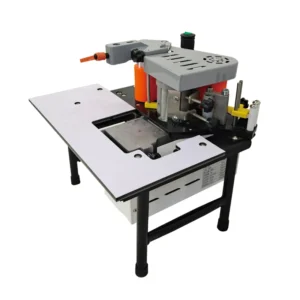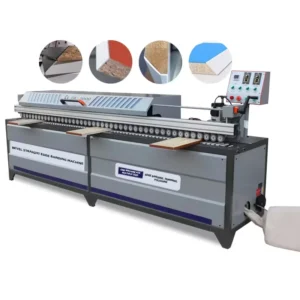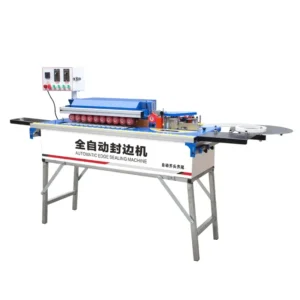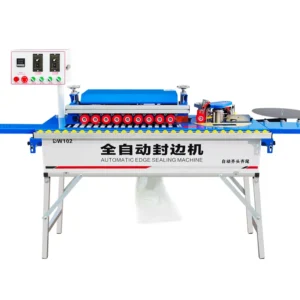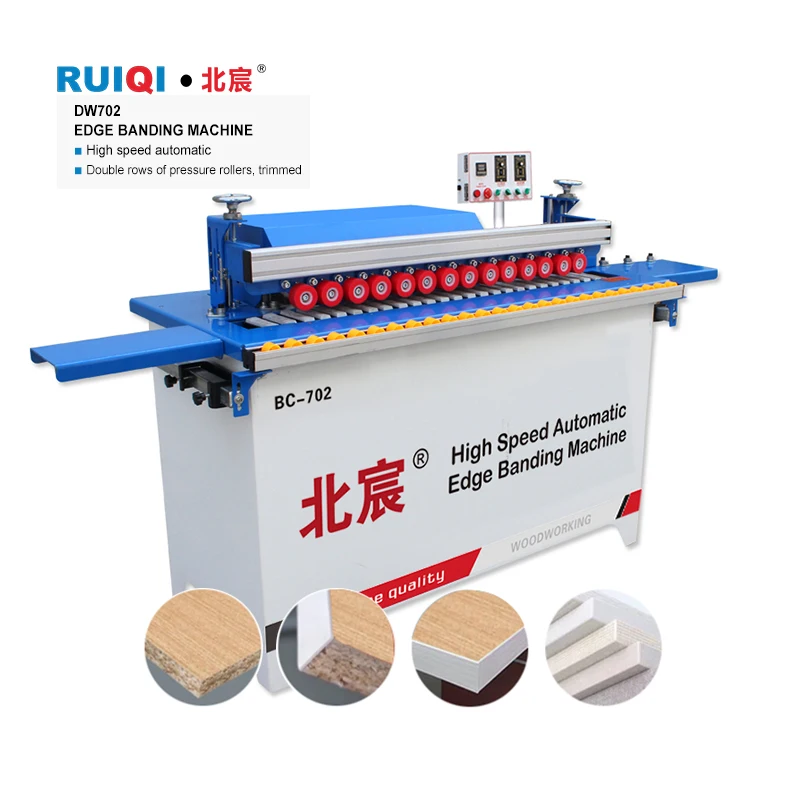
Edge banding machine
Click to enlarge
ISO 9001
CE Certified
OEM / ODM
12-Mo Warranty
Edge banding machine
Edge Banding Machine for Woodworking Furniture – Technical Guide
<p>Four-stage QC with pre-shipment verification, engineer-led configuration recommendation and full OEM capability.</p>
100+
Countries
MOQ 1
Unit
15-25 Days
Lead Time
Automatic Edge Banding Machine
Automatic Head And Tail Cutting
DW702
Furniture Factory
MDF Panel
Plywood Panel
Process And Application Guide
Vacuum Assisted Feeding
- Full OEM/ODM support -- custom logo, voltage (110V-440V), multilingual panels
- ISO 9001 & CE certified, 5 national patents, 60 professional engineers
- 12-month warranty, remote technical support & spare parts service
- Professional export packaging, customs clearance support, on-time delivery
Integrated Edge Finishing — DW702 performs gluing, trimming and polishing in one continuous pass, directly addressing visible glue lines on particleboard and MDF substrates common in custom cabinet shops.
Technical Specifications
| Parameter | Value |
|---|---|
| Model | DW702 |
| Product Type | Automatic Edge Banding Machine |
| Total Power | 3800W |
| Voltage Options | 220V / 380V / customization available |
| Edge Trimming Power | 800W × 2 |
| Polishing Power | 180W × 2 |
| Vacuum Power | 1200W |
| Transmission Power | 140W |
| Glue Pot Capacity | 1000 ml |
| Air Source Pressure | 0.4–0.8 MPa |
| Edge Banding Thickness Range | 0.3–3 mm |
| Edge Banding Height Range | 0–50 mm |
| Minimum Sheet Length | 250 mm |
| Minimum Sheet Width | 100 mm |
| Overall Dimensions (L×W×H) | 1200 × 550 × 1100 mm |
| Net Weight | 105 kg |
| Control Language Options | Chinese + English standard; single-language customization available (English, Spanish, others) |
| Key Features | Edge banding, trimming, polishing, automatic head-and-tail cutting, vacuum-assisted feeding |
| Feed Speed | (basis to be confirmed) |
| Panel Thickness Range | (basis to be confirmed) |
| Tolerance | (basis to be confirmed) |
| Assembly State | Fully assembled, ready to operate |
Application Suitability
| Application | Material or Output |
|---|---|
| Cabinet door edge finishing | MDF and particleboard with PVC or melamine edge banding (0.3–3 mm) |
| Custom wardrobe panel sealing | Plywood and blockboard with veneer strip materials |
| Secondary rework line | Short-run panels requiring precise trimming on polymer or solid wood edges |
| Small workshop transition | Replacing hand-applied iron-on banding with consistent machine-applied finish |
| Compact production cell | Joinery shops with limited floor space producing melamine-faced chipboard cabinets |
Why Glue Line Visibility Decides Whether a Cabinet Door Passes Inspection
Edge adhesion failures on porous substrates trace back to glue application consistency and feed stability during the bonding phase, not operator skill.
In my years servicing furniture workshops across eastern China, the same complaint surfaces repeatedly: particleboard cabinet doors arrive at the assembly bench with visible glue seepage or hairline gaps along the trimmed edge. The operator blames the glue; the shop owner blames the operator. The real cause usually sits in how steadily the panel travels past the glue roller and how well the trimming unit follows the substrate contour. When an automatic edge banding machine feeds the panel with vacuum-assisted traction rather than simple roller pressure, lateral drift drops and the glue film stays uniform across the entire edge profile [NEED_CITE: substrate porosity and glue absorption rates on particleboard versus MDF].
How Substrate Porosity Changes the Glue Film Requirement
MDF absorbs adhesive differently from particleboard, and plywood end-grain behaves differently again. The DW702’s 1000 ml glue pot maintains thermal mass across continuous runs, keeping the adhesive viscosity stable as the machine transitions between substrate types. When a workshop switches from melamine-faced MDF to raw particleboard mid-shift, the glue temperature must hold steady to prevent the film from thickening on more porous surfaces. This automatic edge banding machine addresses that transition by keeping the thermal reservoir large enough to buffer short-run variability without requiring a manual temperature adjustment between batches.
End-Grain Sealing and the Head-and-Tail Cut
The leading and trailing edges of any panel are where edge banding failures concentrate. Fibers at the cut ends absorb glue unevenly, and standard trimming often leaves a slight overhang that catches during assembly. The DW702 performs automatic head-and-tail cutting before the main trimming stations engage, squaring the banding material flush to the panel ends. This step matters most on plywood and blockboard, where end-grain exposure invites moisture ingress that lifts the banding weeks after delivery [NEED_CITE: moisture cycling effects on edge adhesion in humid climates]. Cabinet makers producing for export markets with seasonal humidity swings see the difference when returned goods show delaminated edges on panels that passed visual inspection at the factory.
Reading the Specifications Against Your Production Reality
The 3800W total power draw across all stations tells a workshop electrician what dedicated circuit capacity to prepare before the machine arrives. At 1200W vacuum power alone, the system demands clean, stable airflow to hold panels firmly against the fence — a requirement that becomes critical when processing thin 3 mm stock that tends to lift under trimming pressure. The 0.3–3 mm edge banding thickness range covers the full spectrum from thin melamine tape for carcass panels up to 3 mm PVC for high-wear cabinet doors. However, the relationship between banding thickness and trimming power matters: the 800W × 2 trimming motors handle the harder PVC and ABS materials without bogging down, maintaining cut quality that directly influences the visible edge radius on finished furniture. The 1200 × 550 × 1100 mm footprint means this unit fits against a wall in a small workshop, but operators must leave clearance on the infeed and outfeed sides for panels up to the maximum supported length.
The Hidden Cost of Skipping a Substrate Test
Ordering an automatic edge banding machine on specifications alone, without running a test on your actual substrate, leads to discovering adhesion problems only after production begins. I have seen workshops receive equipment rated for MDF that struggles with the resin content in their local particleboard, producing a glue line that passes visual check but fails pull-off testing. The trimming stations may handle 3 mm PVC cleanly but leave micro-chatter on thinner veneer if the feed speed does not match the cutter engagement angle [NEED_CITE: cutter geometry and feed rate interaction on thin edge materials]. These mismatches surface as warranty returns from end customers, months after the machine has been paid for and the installation team has left.
What Manufacturing Depth Means for Your Next Spare Part
Sourcing from a manufacturer that controls its own cutting mechanism patents rather than assembling bought-in components changes the spare parts conversation. When a trimming cutter wears after months of processing abrasive particleboard, replacement availability depends on whether the factory machines its own tooling or orders from a third-party supplier with its own lead times. The DW702 is backed by a four-stage quality control process covering incoming material through pre-shipment verification, which reduces the chance that a tolerance drift in the feed mechanism shows up as inconsistent edge quality at your assembly bench. Voltage customization from 220V to 380V, confirmed before production begins, prevents the scenario where a machine arrives wired for a supply standard that does not match your workshop’s three-phase installation [NEED_CITE: industrial voltage standards and frequency requirements by region]. Single-language control panel configuration in the operator’s native tongue eliminates the commissioning delay that occurs when the setup menu is readable only by the engineer who installed the machine.
Documentation & Verification
- Machine specification sheet listing confirmed edge thickness range and panel dimension limits for your substrate
- Electrical schematic with voltage and frequency matched to your workshop supply before production
- Factory test record showing trimmed edge finish on your actual MDF, plywood or particleboard sample
- Operation and maintenance manual in the agreed operator language with illustrated troubleshooting section
- Spare parts list identifying wear components with part numbers for direct reorder
Installation, Commissioning & Support
- Prepare a dedicated circuit matching the 3800W total power draw with appropriate breaker rating for continuous operation
- Allow clearance beyond the 1200 mm machine length for infeed and outfeed of panels exceeding minimum 250 mm dimension
- Confirm air compressor delivers stable 0.4–0.8 MPa pressure to the 1200W vacuum system for consistent panel holding
- Verify control panel language matches operator capability before first glue pot heat-up cycle begins
- Schedule initial trimming station alignment check after first 48 hours of production on your specific banding material
- Establish routine glue pot cleaning interval based on your adhesive type to prevent residue buildup in the 1000 ml reservoir
Before You Request a Quotation
Provide your primary substrate type and thickness range, the edge banding materials and thicknesses you run most often, and your workshop’s available voltage and phase configuration. If you produce a mix of cabinet carcass panels and finished doors on different materials, note the changeover frequency so the engineering team can confirm whether the glue pot capacity and trimming setup suit your batch pattern. For workshops transitioning from manual banding, specify your current daily panel count so the feed speed recommendation matches your actual throughput requirement rather than a theoretical maximum.
Frequently Asked Questions
Q: How does glue pot temperature affect edge bonding differently on MDF versus particleboard?
A: MDF’s uniform density allows consistent glue absorption at standard temperatures, while particleboard’s varied chip structure absorbs adhesive unevenly. The DW702’s 1000 ml glue pot maintains thermal stability across both substrates, preventing the temperature drop that causes thick, visible glue lines when processing porous particleboard continuously. Operators should request a test on their specific board grade to confirm optimal temperature settings before committing to production parameters.
Q: What edge banding materials and thicknesses does this machine handle reliably?
A: The DW702 processes PVC, melamine and veneer edge banding from 0.3 mm to 3 mm thickness within a 0–50 mm height range. The dual 800W trimming motors maintain cut quality on rigid PVC and ABS, while the polishing stations produce the smooth edge radius required for visible cabinet door surfaces. Thinner veneer materials require feed speed confirmation to prevent chatter marks during trimming.
Q: Why do visible glue lines appear on some substrates even with machine application?
A: Visible glue lines result from uneven adhesive absorption on porous substrates combined with lateral panel drift during the bonding phase. The DW702’s vacuum-assisted feed system reduces lateral movement, maintaining uniform glue film thickness across the entire edge. On particleboard with high resin content, glue formulation and temperature must be matched to the specific board grade to prevent seepage that becomes visible after trimming.
Q: How does single-pass trimming and polishing affect the final edge feel?
A: The combined trimming and polishing sequence in one pass produces the rounded edge profile that end customers feel when opening cabinet doors. The 180W × 2 polishing stations smooth the trimmed PVC or veneer surface, eliminating the sharp arris left by trimming alone. This single-pass approach maintains consistency across production batches, which matters when replacement doors must match existing installed cabinetry.
Q: Can the control panel language be configured for local operators?
A: The DW702 ships with Chinese and English as standard, with single-language customization available in Spanish and other languages. Confirming the operator’s working language before production prevents commissioning delays that occur when setup menus and fault codes are unreadable on the shop floor. This configuration is verified during the specification confirmation stage before the machine enters production.
Technical Specifications
| Parameter | Value |
|---|---|
| Product Name | Edge Banding Machine for Woodworking Furniture – Technical Guide |
| Category | Edge banding machine |
| Voltage Options | 110V / 220V / 380V / 440V (customizable) |
| Frequency | 50Hz / 60Hz (customizable) |
| Certification | ISO 9001, CE |
| MOQ | 1 Unit |
| Lead Time | 15-25 Working Days |
| Warranty | 12 Months |
| OEM / ODM | Available -- logo, color, panel language |
* Detailed technical specifications vary by model. Please contact us with your specific requirements for a complete datasheet.
Shipping & Export
-
Export Packaging
Heavy-duty wooden crate with foam padding and moisture protection
-
Shipping Methods
Sea freight (FCL/LCL), air freight, express -- we support all methods
-
Customs Support
Full documentation: CO, commercial invoice, packing list, HS code assistance
-
Port of Loading
Tianjin / Qingdao port, China -- 20 years export experience
OEM / ODM Services
-
Logo & Branding
Custom logo printing, color scheme, and nameplate engraving
-
Voltage Configuration
110V / 220V / 380V / 440V, 50Hz / 60Hz -- any region supported
-
Multilingual Panels
Control panels in English, Spanish, French, Arabic and more
-
Custom Specifications
Modified dimensions, accessories, or feature sets on request
Get a Quote
Request Product Inquiry
Fill in your details and we'll respond within 24 hours with pricing and availability.
Direct Contact
How It Works
-
1
Confirm requirements & budget
Tell us your factory scale and processing needs
-
2
Receive recommendation & quote
We match the right machine with full specs
-
3
Negotiate & place order
OEM terms, voltage, payment and delivery
-
4
Production & QC inspection
Multi-stage quality control by 60 engineers
-
5
Export packaging & shipment
Professional packing, customs clearance
-
6
After-sales support
12-month warranty, remote tech support
You May Also Like