Edge banding machine
Click to enlarge
ISO 9001
CE Certified
OEM / ODM
12-Mo Warranty
Edge banding machine
Furniture Manufacturing Edge Banding Machine – Industrial Application
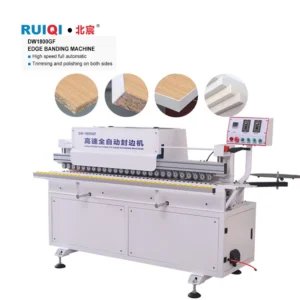
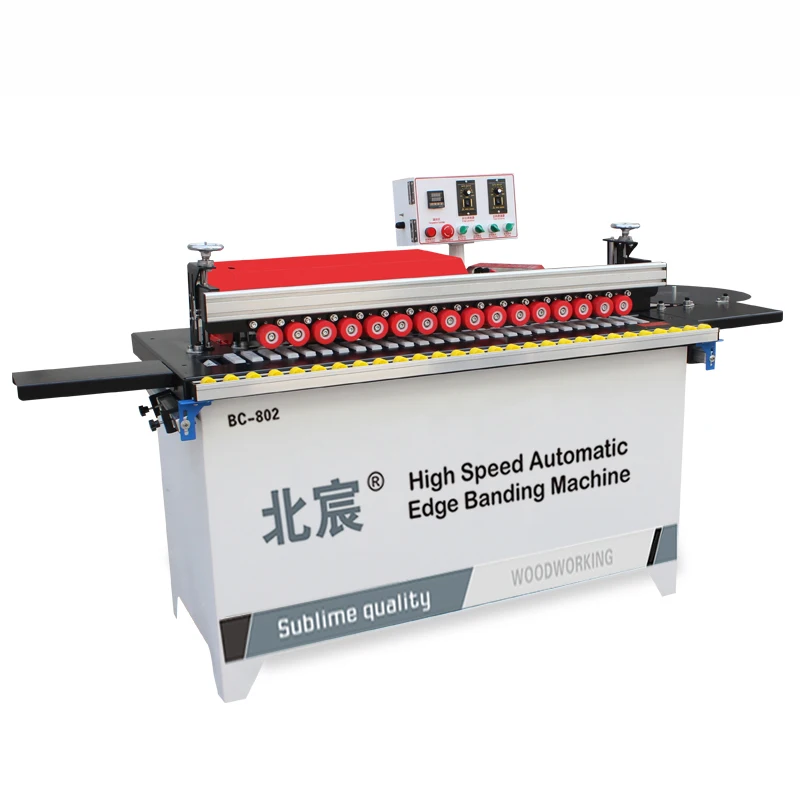
<p><strong>DW802 Automatic Edge Banding Machine, 4200W, 0.3–3mm Banding Thickness, 220V/380V</strong> — delivers consistent edge sealing across MDF, particleboard, plywood and solid wood panels with integrated trimming and polishing stations.</p> <ul> <li>4000ml glue pot supports continuous multi-panel runs without frequent refill interruptions</li> <li>Silica gel conveyor belt with integrated pressure beam ensures stable transport without surface scratching</li> <li>Automatic head and tail cutting with dual 800W trimming stations produces clean end-finish on varied board thicknesses</li> <li>Dual 180W polishing stations refine edge surfaces before panels enter downstream assembly</li> </ul> <p>Engineer-led configuration recommendation with formal quotation within 24 hours, backed by four-stage QC and pre-shipment test records for your specific substrate and banding material.</p>
100+
Countries
MOQ 1
Unit
15-25 Days
Lead Time
4000ml Glue Pot
Automatic Head And Tail Cutting
DW802
Edge Banding Machine
Furniture Factory
MDF Panel
Process Application
- Full OEM/ODM support -- custom logo, voltage (110V-440V), multilingual panels
- ISO 9001 & CE certified, 5 national patents, 60 professional engineers
- 12-month warranty, remote technical support & spare parts service
- Professional export packaging, customs clearance support, on-time delivery
Verified tolerance — every DW802 unit undergoes a four-stage QC ending with pre-shipment sample runs on your chosen substrate, so glue line consistency is confirmed before the crate leaves Shandong.
Technical Specifications
| Parameter | Value |
|---|---|
| Model | DW802 |
| Product Type | Automatic Edge Banding Machine |
| Total Power | 4200W |
| Voltage | 220V / 380V / customization |
| Edge Banding Thickness | 0.3–3 mm |
| Edge Banding Height | 0–50 mm |
| Minimum Sheet Length | 250 mm |
| Minimum Sheet Width | 100 mm |
| Glue Pot Capacity | 4000 ml |
| Trimming Power | 800W × 2 |
| Polishing Power | 180W × 2 |
| Vacuum Power | 1200W |
| Air Source Pressure | 0.4–0.8 MPa |
| Conveyor Belt | Silica gel with integrated pressure beam |
| Key Features | Edge banding, trimming, polishing, automatic head and tail cutting, vacuum hold-down |
| Language Options | Chinese and English standard; Spanish or other languages customizable |
| Plug Options | EU, USA, AU, UK |
| Assembly State | Fully assembled |
| Overall Dimensions | 1300 × 600 × 950 mm |
| Net Weight | 135 kg |
| Standards | CE, ISO 9001 |
Application Suitability
| Application | Material or Output |
|---|---|
| Cabinet panel edge sealing | MDF and particleboard with PVC or melamine banding |
| Custom furniture component finishing | Ecological board and plywood with veneer or PVC edge band |
| Home decoration panel processing | Solid wood board requiring glue temperature sensitivity control |
| Small-batch mixed-substrate production | Multiple board types in a single run with banding changeover |
Why Glue Lines Show Up After the Panel Leaves Your Workshop
Substrate porosity dictates glue penetration, and a single temperature setting will not cover MDF, particleboard, and plywood on the same shift.
The most common edge banding machine process application complaint I hear from production managers is visible glue lines that only appear once the panels reach the assembly bench. MDF absorbs hot melt quickly, leaving a thin bond line. Particleboard, being more porous and uneven, demands higher glue temperature and slower feed to achieve full wetting. Plywood veneer faces are smoother but prone to delamination if the pressure beam is too aggressive. When operators run all three at the same setting, one substrate always suffers [NEED_CITE: substrate porosity and hot melt adhesion behaviour in wood panel processing].
How Substrate Behaviour Drives the Edge Banding Process
Every edge banding machine process application starts at the glue pot. The DW802 carries a 4000 ml capacity, which allows continuous panel runs without stopping to refill mid-batch. When you switch from PVC banding on MDF to real wood veneer on plywood, the operator adjusts the pot temperature and feed speed to match the thermal mass of the new banding material. Thicker veneer absorbs heat faster from the glue film, so the pot must run hotter to maintain a consistent bond line at the point of contact.
Glue Line Quality and Its Effect on Downstream Assembly
A panel with a 0.5 mm excess glue bead will not sit flush in a cabinet carcass during dowel or confirmat screw assembly. The dual 800W trimming stations on the DW802 remove the banding overhang at both ends, while the dual 180W polishing stations refine the edge surface before the panel leaves the machine. In practice, this means the panel edges that arrive at the drilling station are clean enough for accurate fitting without a secondary pass on a hand router [NEED_CITE: edge trimming tolerance and furniture assembly fitting accuracy].
Reading the Specs That Actually Matter on the Shop Floor
The 0.3–3 mm edge banding thickness range covers the PVC, melamine, and veneer strips most custom furniture workshops stock. If you frequently run 0.4 mm PVC on particleboard shelving and 2 mm solid wood lipping on cabinet doors, the DW802 handles both without a tooling change. The silica gel conveyor belt grips panel surfaces without marring pre-finished faces, which matters when you are edge-banding pre-laminated board that cannot be sanded afterward. Air pressure between 0.4 and 0.8 MPa feeds the pneumatic cylinders that control the pressure beam and trimming actuators; pressure below this range causes uneven trimming depth and visible chatter marks on the banding edge.
What Happens When You Ignore Voltage and Air Supply
A machine specified for 380V three-phase arriving at a workshop running only 220V single-phase will not start, and the motor windings can overheat before the breaker trips. Equally, an undersized compressor that cannot sustain 0.4 MPa under continuous cycling will cause the trimming heads to stutter mid-cut, leaving ragged banding ends that require hand finishing. These are the failures I have seen edge banders of this class produce when the utility and pneumatic specifications were never confirmed before shipping [NEED_CITE: industrial compressed air requirements for pneumatic woodworking machinery].
What Sets This Machine Apart at the Production Level
The integrated pressure beam distributes clamping force evenly across the panel width, preventing the edge lift that separate roller systems sometimes leave on narrow stock. The fully assembled delivery state means the machine is tested under power before crating, so your operator is not troubleshooting mechanical alignment on the first day. Voltage and plug configuration are confirmed in writing before production begins, matching your workshop supply from 220V single-phase up to 380V three-phase. A factory test record with your specific board and banding material accompanies each unit, providing a documented baseline for glue line quality before the machine ships.
Documentation & Verification
- CE declaration of conformity referencing the DW802 model and tested configuration
- Electrical schematic confirming your ordered voltage and plug type
- Factory test record showing edge-banded sample panels in your substrate and banding material
- Operation and maintenance manual in your operator’s agreed language
- Spare parts list with wear-item part numbers for the trimming and polishing stations
Installation, Commissioning & Support
- Requires a level concrete floor and a dedicated 220V or 380V circuit matching the confirmed voltage order
- Arrives fully assembled at 135 kg; position with clearance on the infeed and outfeed sides for panel handling
- First-power commissioning includes glue pot temperature calibration and trimming depth adjustment on your stock material
- Air supply must deliver 0.4–0.8 MPa from a compressor with adequate reservoir capacity for continuous cycling
- Operator training covers banding changeover, glue pot cleaning interval, and silica gel belt inspection
Before You Request a Quote
Send the specific board types, thicknesses, and banding materials you run most often so the glue pot temperature range and trimming tooling can be matched to your production mix. Confirm your workshop voltage and frequency, available compressed air capacity, and the language your operators read on the control panel. If you are replacing a manual edge banding process or adding capacity to an existing line, note the upstream saw or CNC router model so feed height and throughput can be aligned [NEED_CITE: production line throughput matching between woodworking stations].
Frequently Asked Questions
Q: How does substrate type affect glue temperature and feed speed on this edge banding machine?
A: MDF is dense and absorbs glue slowly, so a moderate pot temperature with standard feed speed works well. Particleboard is more porous and needs higher temperature to ensure full wetting. Plywood veneer faces are smoother but heat-sensitive, requiring careful balance. The 4000 ml glue pot on the DW802 allows continuous adjustment across substrate changeovers without frequent refill stops.
Q: Which banding materials work within the 0.3–3 mm thickness range?
A: PVC, melamine, ABS, and natural wood veneer strips all fall within this range. Thinner PVC around 0.4 mm is common for cabinet shelving edges, while 2 mm solid wood lipping suits visible door and drawer fronts. The dual trimming and polishing stations handle the full thickness spectrum, producing a clean edge ready for assembly on each material type.
Q: How does edge quality from this machine affect panel assembly accuracy?
A: Visible glue lines or banding overhang prevent panels from seating flush in dowel or confirmat joints. The automatic head and tail cutting removes end overhang, while the polishing stations refine the trimmed edge. Panels leaving the DW802 with clean edges fit accurately during assembly, reducing rework at the fitting bench.
Q: What happens if compressed air pressure drops below 0.4 MPa?
A: The pneumatic cylinders controlling the pressure beam and trimming actuators lose force, causing uneven clamping and inconsistent trimming depth. This results in chatter marks on the banding edge and potential panel slippage during feed. A compressor with sufficient reservoir capacity and a regulator set within the 0.4–0.8 MPa range prevents these issues during continuous operation.
Q: How can I verify glue line quality before committing to a production order?
A: Request a factory test record that documents edge-banded sample panels processed on the exact substrate and banding material you use. This record confirms glue temperature, feed speed, and visual bond line quality under controlled conditions. The samples can be shipped with the machine so your production team has a verified baseline for comparison during commissioning.
Technical Specifications
| Parameter | Value |
|---|---|
| Product Name | Furniture Manufacturing Edge Banding Machine – Industrial Application |
| Category | Edge banding machine |
| Voltage Options | 110V / 220V / 380V / 440V (customizable) |
| Frequency | 50Hz / 60Hz (customizable) |
| Certification | ISO 9001, CE |
| MOQ | 1 Unit |
| Lead Time | 15-25 Working Days |
| Warranty | 12 Months |
| OEM / ODM | Available -- logo, color, panel language |
* Detailed technical specifications vary by model. Please contact us with your specific requirements for a complete datasheet.
Shipping & Export
-
Export Packaging
Heavy-duty wooden crate with foam padding and moisture protection
-
Shipping Methods
Sea freight (FCL/LCL), air freight, express -- we support all methods
-
Customs Support
Full documentation: CO, commercial invoice, packing list, HS code assistance
-
Port of Loading
Tianjin / Qingdao port, China -- 20 years export experience
OEM / ODM Services
-
Logo & Branding
Custom logo printing, color scheme, and nameplate engraving
-
Voltage Configuration
110V / 220V / 380V / 440V, 50Hz / 60Hz -- any region supported
-
Multilingual Panels
Control panels in English, Spanish, French, Arabic and more
-
Custom Specifications
Modified dimensions, accessories, or feature sets on request
Get a Quote
Request Product Inquiry
Fill in your details and we'll respond within 24 hours with pricing and availability.
Direct Contact
How It Works
-
1
Confirm requirements & budget
Tell us your factory scale and processing needs
-
2
Receive recommendation & quote
We match the right machine with full specs
-
3
Negotiate & place order
OEM terms, voltage, payment and delivery
-
4
Production & QC inspection
Multi-stage quality control by 60 engineers
-
5
Export packaging & shipment
Professional packing, customs clearance
-
6
After-sales support
12-month warranty, remote tech support
You May Also Like