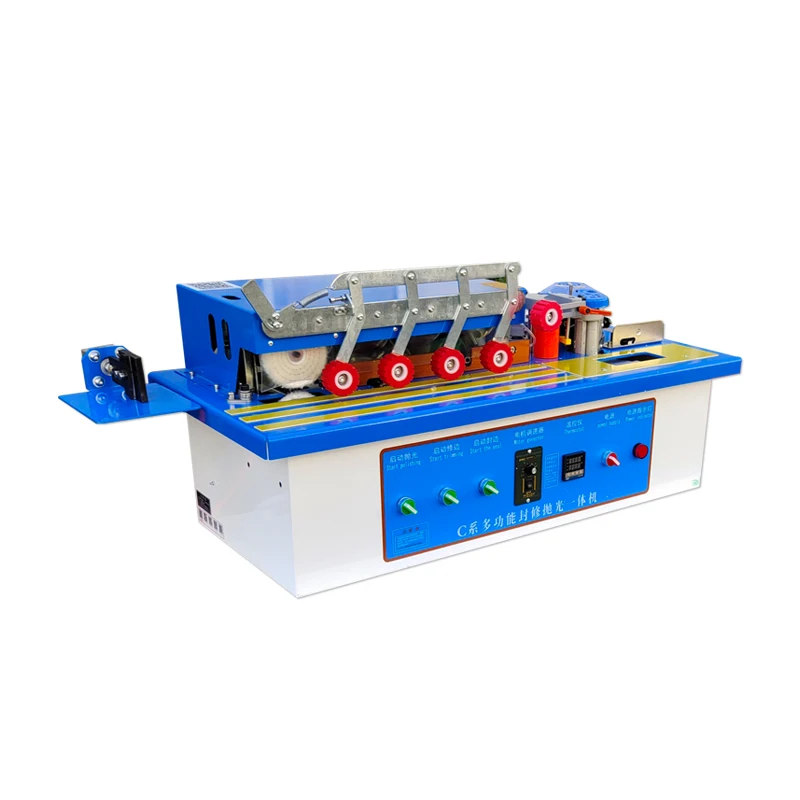
Edge banding machine
Click to enlarge
ISO 9001
CE Certified
OEM / ODM
12-Mo Warranty
Edge banding machine
FX-20 Edge Banding Machine for MDF Panel – Custom Furniture Production
<p><strong>FX-20 Manual Portable Edge Banding Machine, 2500W, 0.3-3MM Edge Thickness, 0-50MM Panel Height</strong> — handles curved and straight edge sealing on MDF, particleboard, plywood, and solid wood panels with a 1000ml glue pot for continuous operation.</p> <ul> <li>Trimming and polishing stations deliver consistent edge finish across substrate types, minimizing visible glue lines that disrupt downstream assembly</li> <li>Air source pressure at 0.5-0.8Mpa ensures uniform glue application on both curved profiles and straight edges</li> </ul> <p>Sample processing tests with your actual panel materials verify edge quality before shipment, backed by four-stage QC and pre-shipment verification records.</p>
100+
Countries
MOQ 1
Unit
15-25 Days
Lead Time
220V
Curved Edge Banding
Edge Banding Machine
Furniture Factory
FX-20
MDF Panel
Portable Edge Banding
Process Application
- Full OEM/ODM support -- custom logo, voltage (110V-440V), multilingual panels
- ISO 9001 & CE certified, 5 national patents, 60 professional engineers
- 12-month warranty, remote technical support & spare parts service
- Professional export packaging, customs clearance support, on-time delivery
Proven Edge Quality — Four-stage QC with pre-shipment test runs on buyer-supplied panel samples ensures the FX-20 delivers consistent banding results before leaving the factory floor.
Technical Specifications
| Parameter | Value |
|---|---|
| Model | FX-20 |
| Product Type | Manual Portable Edge Banding Machine |
| Total Power | 2500W |
| Voltage | 220V/380V/customization |
| Edge Banding Height | 0-50MM |
| Edge Banding Thickness | 0.3-3MM |
| Minimum Sheet Length | 25CM |
| Minimum Sheet Width | 10CM |
| Trimming Power | 650W×2 |
| Polishing Power | 180W×2 |
| Edge Power | 20W |
| Glue Pot Capacity | 1000ml |
| Air Source Pressure | 0.5-0.8Mpa |
| Product Size | 100×46×41CM |
| Product Weight | 44KG |
| Key Features | Curved and straight edge banding, trimming, polishing, manual push plate |
| Language Options | Chinese, English, Spanish, or customized |
| Plug Options | EU, USA, AU, UK |
Application Suitability
| Application | Material or Output |
|---|---|
| Custom cabinet door edge sealing | MDF and particleboard with PVC or melamine banding |
| Curved furniture component finishing | Plywood and ecological board with veneer or ABS strips |
| Small workshop panel processing | Solid wood board edge preparation for joinery assembly |
| On-site home decoration production | Portable edge banding for fitted wardrobes and shelving |
Why Glue Lines Appear on Recycled Particleboard — and What the Woodworking Process Edge Banding Machine Can Do About It
Substrate surface flatness determines edge quality more than any machine setting.
I spent years on the assembly floor before moving into technical support, and the most frustrating calls always came back to one thing: the board itself. Recycled particleboard often carries surface irregularities that no amount of pressure roller adjustment can compensate for. When a buyer switches from virgin MDF to a cheaper substrate without running sample tests first, visible glue lines appear along the banding seam. The woodworking process edge banding machine applies adhesive uniformly, but if the panel edge has voids or uneven density, the bond fails locally. This is exactly why we ask for sample boards before shipping [NEED_CITE: substrate density variation and adhesive bond failure in panel processing].
How Substrate Behavior Changes the Banding Process
Different board materials respond to heat, pressure, and adhesive chemistry in distinct ways. MDF offers a dense, uniform edge that accepts hot melt glue readily, producing clean seams across the 0-50MM height range of the FX-20. Particleboard, especially recycled grades, absorbs adhesive unevenly and requires careful temperature management to prevent glue starvation at the bond line. The 1000ml glue pot maintains thermal stability during continuous runs, which matters when switching between board types mid-shift.
Curved Versus Straight Edge Dynamics
Straight edge banding relies on consistent feed pressure from the manual push plate, and operators develop a rhythm that produces repeatable results. Curved edges introduce variable contact geometry where the banding strip must conform to changing radii. The FX-20 handles both profiles within a single setup, but the operator must slow the feed rate on tighter curves to allow the adhesive adequate open time. Air source pressure between 0.5-0.8Mpa drives the trimming and polishing stations, and maintaining stable pressure ensures clean edge removal without gouging the banding material [NEED_CITE: pneumatic pressure stability requirements for edge trimming operations].
Reading the Spec Sheet Against Your Actual Production Needs
The 0.3-3MM edge banding thickness range covers standard PVC, ABS, and veneer strips used in custom furniture production. Thicker banding within that range demands more from the trimming station — the dual 650W trimming motors handle the load, but blade condition becomes critical when running 3MM material all day. The 0-50MM edge banding height accommodates everything from thin shelving to thick countertop panels, though operators should note that maximum height combined with maximum thickness pushes the trimming mechanism to its working limits. Minimum sheet dimensions of 25CM length and 10CM width define the smallest workpiece the machine can physically grip and feed through the stations.
The Cost of Skipping the Sample Test
Buying a portable edge bander without running your actual board stock through it first is the most common mistake I see from small workshops scaling up from hand application. The machine arrives, looks correct on paper, and then produces visible glue lines on the specific particleboard grade sourced locally. By then the machine is already on the workshop floor, and return shipping is nobody’s preferred outcome. Some buyers discover that their edge banding material — perhaps a thin veneer from a regional supplier — requires different glue pot temperatures than the standard PVC settings. These mismatches surface only during production [NEED_CITE: edge banding material compatibility and adhesive temperature requirements].
Why Procurement Through This Channel Works
Every FX-20 undergoes pre-shipment testing with the buyer’s actual panel samples, so substrate-specific issues surface before the machine leaves Shandong. Voltage configuration is confirmed against the destination market’s electrical standards — 220V, 380V, or custom frequency — preventing the situation where equipment arrives unusable. Control panel language is set before dispatch, whether that means English, Spanish, or another specified language, so operators can begin commissioning immediately. The four-stage quality control process covers incoming component inspection through final verification, and each machine ships with a complete factory test record documenting performance on the buyer’s specified material range.
Documentation & Verification
- CE declaration of conformity matching the FX-20 configuration as shipped
- Factory test record on buyer-supplied panel thickness and edge banding material
- Electrical schematic confirming voltage and frequency for destination market
- Operation manual in agreed language covering curved and straight edge procedures
- Spare parts list with trimming blade and polishing pad specifications
Installation, Commissioning & Support
- 220V/380V power requirement with dedicated circuit matching confirmed voltage specification
- 0.5-0.8Mpa compressed air supply needed for trimming and polishing station operation
- 100×46×41CM footprint fits standard workshop benches; arrives fully assembled at 44KG
- First-run calibration on buyer’s actual panel stock and edge banding material during commissioning
- Trimming blade replacement schedule based on banding thickness within 0.3-3MM range
- Glue pot cleaning procedure after each production run to prevent adhesive carbonization
What We Need to Configure the Right Setup
Send us samples of the board materials you actually run — MDF, particleboard, plywood, or solid wood — along with the specific edge banding strips from your current supplier. Confirm your workshop voltage and frequency, the control panel language your operators need, and whether your production involves predominantly curved or straight edge work. If your panels fall near the minimum or maximum dimensions in the specification range, let us know so we can verify feed clearance during the pre-shipment test.
Frequently Asked Questions
Q: How does substrate type affect glue selection and edge quality on this machine?
A: MDF edges are dense and uniform, accepting standard hot melt adhesive cleanly. Recycled particleboard has variable density that causes uneven absorption, often requiring higher glue pot temperatures and adjusted feed rates. Solid wood edges need careful temperature control to prevent adhesive squeeze-out along the grain. Running sample panels before production confirms the correct settings for your specific substrate.
Q: Which edge banding materials work within the 0.3-3MM thickness range?
A: Standard PVC strips from 0.4MM to 2MM cover most custom furniture applications. ABS banding within the same range processes similarly with minor temperature adjustment. Wood veneer strips require lower glue temperatures to prevent scorching. The dual 650W trimming motors handle the full thickness range, though blade wear accelerates noticeably when running 3MM material continuously throughout a production shift.
Q: How does curved edge banding change feed rate and glue application?
A: Straight edges allow consistent manual feed speed across the workpiece length. Curved profiles require slower feed rates, particularly on tight radii, to maintain adequate adhesive contact time and prevent the banding strip from lifting at the curve apex. The air-driven trimming station follows the contour, but operators should verify trimming quality on sample curves before committing to a production batch.
Q: What assembly problems arise from inconsistent edge trimming?
A: Poorly trimmed edges leave raised banding material that interferes with panel-to-panel joints during cabinet assembly. Gaps appear at corner connections when adjacent panels do not sit flush. The FX-20 dual polishing stations at 180W each address surface finish, but the primary trimming accuracy depends on stable pneumatic pressure and blade condition throughout the production run.
Q: How should I match edge banding thickness to my panel edge preparation?
A: Panel edges must be clean-cut and free of tear-out before banding begins. Thicker banding materials in the 2-3MM range forgive minor edge imperfections but require more aggressive trimming afterward. Thinner strips around 0.3-0.5MM demand cleaner panel edges since they conform tightly to the substrate profile. Running your specific panel-and-banding combination during the pre-shipment test confirms compatibility.
Technical Specifications
| Parameter | Value |
|---|---|
| Product Name | FX-20 Edge Banding Machine for MDF Panel – Custom Furniture Production |
| Category | Edge banding machine |
| Voltage Options | 110V / 220V / 380V / 440V (customizable) |
| Frequency | 50Hz / 60Hz (customizable) |
| Certification | ISO 9001, CE |
| MOQ | 1 Unit |
| Lead Time | 15-25 Working Days |
| Warranty | 12 Months |
| OEM / ODM | Available -- logo, color, panel language |
* Detailed technical specifications vary by model. Please contact us with your specific requirements for a complete datasheet.
Shipping & Export
-
Export Packaging
Heavy-duty wooden crate with foam padding and moisture protection
-
Shipping Methods
Sea freight (FCL/LCL), air freight, express -- we support all methods
-
Customs Support
Full documentation: CO, commercial invoice, packing list, HS code assistance
-
Port of Loading
Tianjin / Qingdao port, China -- 20 years export experience
OEM / ODM Services
-
Logo & Branding
Custom logo printing, color scheme, and nameplate engraving
-
Voltage Configuration
110V / 220V / 380V / 440V, 50Hz / 60Hz -- any region supported
-
Multilingual Panels
Control panels in English, Spanish, French, Arabic and more
-
Custom Specifications
Modified dimensions, accessories, or feature sets on request
Get a Quote
Request Product Inquiry
Fill in your details and we'll respond within 24 hours with pricing and availability.
Direct Contact
How It Works
-
1
Confirm requirements & budget
Tell us your factory scale and processing needs
-
2
Receive recommendation & quote
We match the right machine with full specs
-
3
Negotiate & place order
OEM terms, voltage, payment and delivery
-
4
Production & QC inspection
Multi-stage quality control by 60 engineers
-
5
Export packaging & shipment
Professional packing, customs clearance
-
6
After-sales support
12-month warranty, remote tech support
You May Also Like