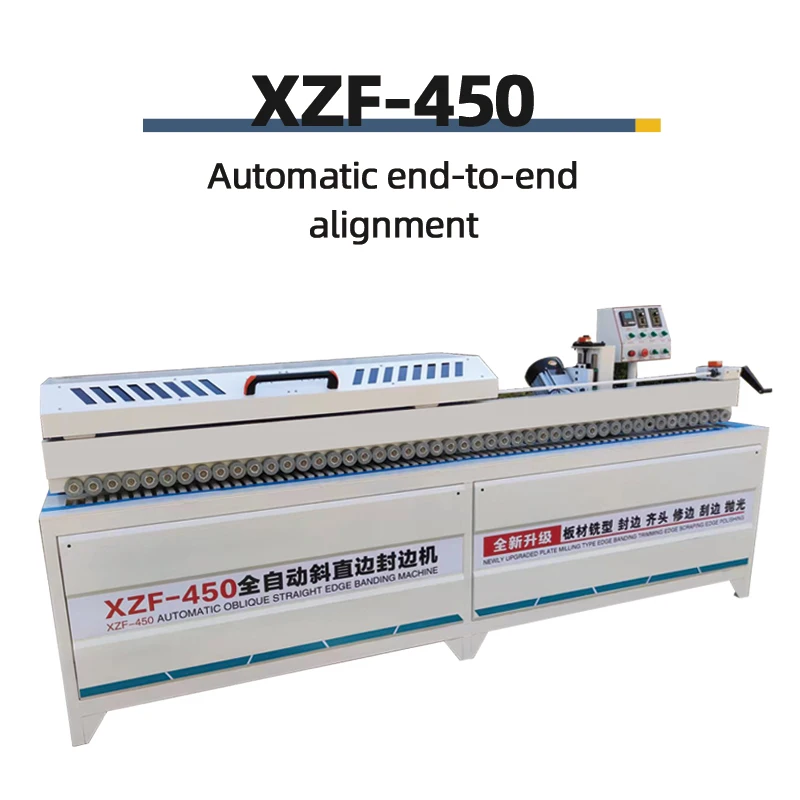
Edge banding machine
Click to enlarge
ISO 9001
CE Certified
OEM / ODM
12-Mo Warranty
Edge banding machine
Industrial Edge Banding Machine for Plywood Woodworking
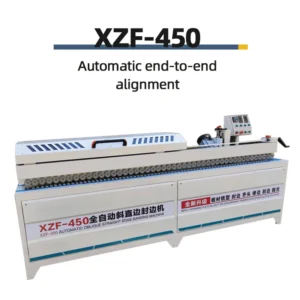
<p><strong>XZF450 Automatic Edge Banding Machine, 9.5KW, 0–12m/min Feed</strong> — handles pre-milling through dual polishing for MDF, plywood and particleboard panels up to 50mm edge height and 0.3–3mm banding thickness.</p> <ul> <li>4KW pre-milling removes saw marks before gluing, improving adhesion on porous substrates</li> <li>30/45/60° bevel banding supports contemporary furniture profiles beyond standard straight edges</li> <li>Integrated scraping and dual 0.4KW polishing stations deliver assembly-ready edges without hand-finishing</li> </ul> <p>Engineer-led configuration with formal quotation within 24 hours and sample processing tests available before order commitment.</p>
100+
Countries
MOQ 1
Unit
15-25 Days
Lead Time
380V
Edge Banding Machine
Furniture Factory
Plywood Panel
Pre-milling
Process Application
XZF450
- Full OEM/ODM support -- custom logo, voltage (110V-440V), multilingual panels
- ISO 9001 & CE certified, 5 national patents, 60 professional engineers
- 12-month warranty, remote technical support & spare parts service
- Professional export packaging, customs clearance support, on-time delivery
Engineer-led configuration — every XZF450 proposal begins with your actual panel material and edge banding stock, not a generic catalogue quote.
Technical Specifications
| Parameter | Value |
|---|---|
| Product Type | Automatic Edge Banding Machine |
| Model | XZF450 |
| Total Power | 9.5 kW |
| Voltage | 380V / 415V (frequency to be confirmed per destination market) |
| Feed Speed | 0–12 m/min |
| Edge Banding Thickness | 0.3–3 mm |
| Edge Banding Height | 0–50 mm |
| Minimum Sheet Length | 30 cm |
| Minimum Sheet Width | 15 cm |
| Pre-milling Motor | 4 kW |
| Trimming Power | 2.2 kW × 2 |
| Polishing Power | 0.4 kW × 2 |
| Glue Pot Capacity | 4000 ml |
| Air Source Pressure | 0.5–0.7 MPa |
| Vacuum Power | 550 W |
| Transmission Power | 180 W |
| Edge Power | 0.16 kW |
| Machine Dimensions | 300 × 65 × 135 cm |
| Machine Weight | 430 kg |
| Language Options | Chinese, English (customizable to Spanish or other languages) |
| Plug Options | EU, USA, AU, UK |
| Key Features | Pre-milling, 30°/45°/60° bevel banding, trimming, scraping, dual polishing, high-power vacuum extraction |
Application Suitability
| Application | Material or Output |
|---|---|
| Cabinet door and carcass production | MDF, melamine-faced particleboard with PVC or ABS edge banding |
| Plywood furniture and shelving | Plywood panels with veneer or PVC banding, pre-milled for glue adhesion |
| Solid wood door and panel edging | Solid wood boards and blockboard with 0.3–3 mm banding stock |
| Polymer and composite door manufacturing | Polymer door blanks requiring full contour edge finishing |
| Custom joinery scaling to automation | Mixed substrate batches transitioning from manual to machine-applied edge banding |
Why Substrate Choice Decides Your Edge Banding Machine Process Application
The board you actually run determines whether any edge bander produces a clean glue line — not the machine’s sticker tolerance.
I once set up an automatic edge bander for a plywood factory that ran perfectly on standard test sheets. When the client switched to recycled-core boards with significant thickness variation, the glue line became inconsistent and we spent two days re-tuning feed pressure, glue temperature, and pre-mill depth to stabilize output. That is the gap between a catalogue demonstration and real production [NEED_CITE: substrate thickness tolerance impact on edge banding adhesion]. The XZF450 addresses this with a 4 kW pre-milling station that removes saw marks and surface irregularities before glue reaches the panel edge, giving the adhesive a fresh, flat bonding surface regardless of upstream cutting quality.
Pre-Milling as the Foundation of Edge Quality
The edge banding machine process application starts before any adhesive is applied. The XZF450’s 4 kW pre-milling cutter removes up to a few millimeters of material from the panel edge, eliminating tear-out from panel saws and correcting minor thickness deviation left by upstream sizing. On porous substrates like particleboard and MDF, this fresh-cut surface allows the hot-melt adhesive to penetrate evenly rather than filling voids left by dull saw blades. For plywood with alternating grain direction in each veneer layer, pre-milling prevents the cross-grain splintering that causes visible gaps under thin PVC banding.
Bevel Capability Beyond Standard 90-Degree Edges
Most furniture edge banding runs at a square profile, but contemporary cabinet and door designs increasingly call for chamfered edges at 30°, 45°, or 60°. The XZF450 handles all three angles within the same workflow, applying banding material to a beveled substrate and trimming it flush in a single pass. This eliminates a secondary routing or hand-sanding step that would otherwise bottleneck output on contoured components. The practical implication is that a workshop producing both standard carcass panels and angled decorative fronts does not need a second machine or a manual finishing station [NEED_CITE: bevel edge banding applications in modern furniture design].
How Feed Speed and Trimming Power Shape Daily Output
The variable feed speed range of 0–12 m/min lets operators match throughput to the substrate and banding combination in use. Running 3 mm ABS on thick MDF at the upper end of the feed range demands that the dual 2.2 kW trimming motors keep pace without chatter, which directly affects whether the trimmed edge shows micro-scorch marks or a clean finish. The two 0.4 kW polishing wheels then remove residual adhesive smear and produce a surface ready for packing or assembly. On thinner 0.4 mm PVC over particleboard, the same machine runs at higher feed speed because trimming load is lower and polish dwell time remains adequate. The scraper station between trim and polish removes the rounding bead left by the trim cutters, so the final profile matches the banding’s original surface texture rather than showing a visible transition line.
The Cost of Skipping the Voltage and Air Supply Conversation
Machines arrive at a workshop, get uncrated, and then sit idle because the local supply is 60 Hz while the motor nameplate reads 50 Hz — or the compressed air line delivers 0.4 MPa when the machine requires a minimum of 0.5 MPa for the pressure rollers to seat banding firmly. The XZF450 requires 380V/415V three-phase power and 0.5–0.7 MPa clean, dry air. Neither requirement is unusual for industrial equipment, but confirming frequency and air compressor capacity before the machine ships prevents weeks of downtime [NEED_CITE: voltage and frequency standards by export market]. A 550 W vacuum extraction port also needs connection to a dust collection system rated for continuous fine-particle capture, since edge trimming generates both coarse PVC chips and fine MDF dust that can settle on the glue roller and degrade adhesion over a shift.
Why Procurement Starts with the Process, Not the Price Tag
The manufacturing facility behind the XZF450 maintains in-house production with patented cutting mechanisms and verified tolerance across each unit. A four-stage QC protocol — incoming material, in-process, finished product, and pre-shipment verification — runs on every machine before it is crated. Voltage, language, and specification customization are treated as standard configuration steps rather than special requests. The engineer-led workflow means your factory’s actual panel stock, edge banding material, and production volume drive the quotation, with a formal proposal typically returned within 24 hours. Factory visits for sample processing tests are welcomed so you can see your own material run through the machine before committing.
Documentation & Verification
- CE declaration of conformity covering the XZF450 mechanical and electrical safety scope
- ISO 9001 certificate for the manufacturing quality management system
- Electrical schematic with confirmed voltage and plug type for your facility
- Factory test record using your specified panel material and edge banding stock
- Operation and maintenance manual in your chosen control panel language
- Spare parts list with part numbers matching the as-built machine configuration
Installation, Commissioning & Support
- 300 × 65 × 135 cm footprint requires a level floor with clearance on the infeed and outfeed sides for panel handling
- Dedicated 380V/415V circuit sized for the 9.5 kW total load, with frequency confirmed before dispatch
- 430 kg machine weight arrives on a pallet; positioning requires a forklift with minimum 500 kg capacity
- First-run commissioning includes glue pot temperature mapping for your specific hot-melt adhesive
- Compressed air line at 0.5–0.7 MPa must include a moisture trap to protect pneumatic pressure rollers
- Operator training covers feed speed selection, trimming depth adjustment, and daily glue pot cleaning procedures
What to Include in Your Inquiry
Provide the specific panel materials you run (MDF, plywood, particleboard, or solid wood), typical board thickness range, and the edge banding type and thickness you intend to use. Confirm your workshop’s voltage, frequency, and available compressed air capacity so the electrical and pneumatic configuration matches your site conditions. If you need the control panel in a language other than Chinese or English, state your requirement and whether you plan to send sample material for a pre-shipment processing test.
Frequently Asked Questions
Q: How does the pre-milling stage affect edge quality on different substrates like MDF versus plywood?
A: Pre-milling removes the damaged surface layer left by panel saws. On MDF this exposes a uniform fiber surface for consistent glue penetration. On plywood, where alternating grain layers cause tear-out, the 4 kW pre-mill cutter produces a clean cross-section so the adhesive bonds evenly across all veneer plies without voids under the banding.
Q: What edge banding materials are compatible with the 0.3–3 mm thickness range?
A: The XZF450 handles thin PVC foil at 0.3 mm, standard PVC and ABS in the 1–2 mm range used for cabinet carcasses, and thick veneer or solid wood banding up to 3 mm. The glue pot, pressure roller, and trimming stations accommodate the full range without mechanical changeover between thickness extremes.
Q: How do I match feed speed to my substrate type and glue curing requirements?
A: Dense substrates like MDF allow higher feed speeds because the panel edge is stable under the pressure rollers. Porous or uneven substrates like recycled-core particleboard benefit from slower feed rates to ensure adequate glue contact time. The variable 0–12 m/min range lets you set speed per job rather than running one fixed rate.
Q: What compressed air volume and dust extraction capacity does this machine require?
A: The machine operates at 0.5–0.7 MPa air pressure to actuate pneumatic pressure rollers and trimming cylinders. A moisture filter on the air line is necessary to prevent water contamination of pneumatic seals. The 550 W vacuum port connects to your existing central dust extraction system for continuous chip and fine dust removal during trimming.
Q: Can I run a sample test with my own panel stock and edge banding before placing an order?
A: Yes. Send your actual panel material and edge banding stock to the factory for a processing trial. The test verifies glue line appearance, trimming finish, and polish quality on your specific substrate combination, and results are documented in a test record included with the shipment.
Technical Specifications
| Parameter | Value |
|---|---|
| Product Name | Industrial Edge Banding Machine for Plywood Woodworking |
| Category | Edge banding machine |
| Voltage Options | 110V / 220V / 380V / 440V (customizable) |
| Frequency | 50Hz / 60Hz (customizable) |
| Certification | ISO 9001, CE |
| MOQ | 1 Unit |
| Lead Time | 15-25 Working Days |
| Warranty | 12 Months |
| OEM / ODM | Available -- logo, color, panel language |
* Detailed technical specifications vary by model. Please contact us with your specific requirements for a complete datasheet.
Shipping & Export
-
Export Packaging
Heavy-duty wooden crate with foam padding and moisture protection
-
Shipping Methods
Sea freight (FCL/LCL), air freight, express -- we support all methods
-
Customs Support
Full documentation: CO, commercial invoice, packing list, HS code assistance
-
Port of Loading
Tianjin / Qingdao port, China -- 20 years export experience
OEM / ODM Services
-
Logo & Branding
Custom logo printing, color scheme, and nameplate engraving
-
Voltage Configuration
110V / 220V / 380V / 440V, 50Hz / 60Hz -- any region supported
-
Multilingual Panels
Control panels in English, Spanish, French, Arabic and more
-
Custom Specifications
Modified dimensions, accessories, or feature sets on request
Get a Quote
Request Product Inquiry
Fill in your details and we'll respond within 24 hours with pricing and availability.
Direct Contact
How It Works
-
1
Confirm requirements & budget
Tell us your factory scale and processing needs
-
2
Receive recommendation & quote
We match the right machine with full specs
-
3
Negotiate & place order
OEM terms, voltage, payment and delivery
-
4
Production & QC inspection
Multi-stage quality control by 60 engineers
-
5
Export packaging & shipment
Professional packing, customs clearance
-
6
After-sales support
12-month warranty, remote tech support
You May Also Like