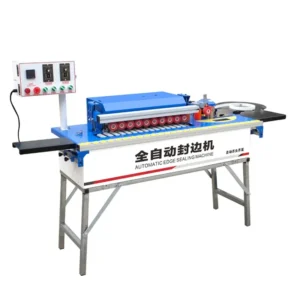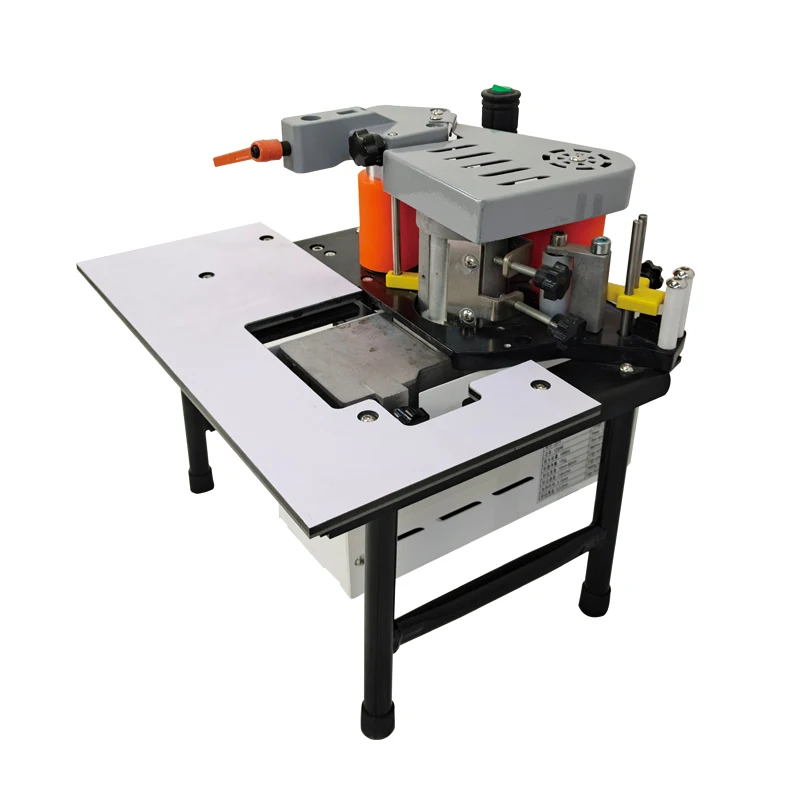
Edge banding machine
Click to enlarge
ISO 9001
CE Certified
OEM / ODM
12-Mo Warranty
Edge banding machine
Portable Edge Bander DW400 for Curved and Straight Edges – Small Workshop
<p><strong>DW400 Portable Edge Banding Machine, 1000W, 0.3-3mm Tape Thickness, Straight & Curved Edge</strong> — applies PVC, ABS, melamine and veneer tape to panel edges from 25cm length, covering MDF, plywood, particleboard and solid wood substrates.</p> <p>The glue behaviour on different substrates directly affects visible glue lines and downstream assembly fit. This unit handles both straight and curved profiles with 0.5-0.8Mpa air pressure for consistent bonding, while the 1000ml glue pot supports continuous runs without frequent refills in small workshop conditions.</p> <ul> <li>Voltage confirmed to local grid before dispatch, avoiding commissioning delays</li> <li>Factory test record with actual edge samples provided for quality verification</li> <li>Operation manual delivered in agreed language to match operator skill level</li> </ul>
100+
Countries
MOQ 1
Unit
15-25 Days
Lead Time
220V 380V
Curved And Straight Edge
DW400
Edge Banding Machine
MDF Panel
Portable Edge Bander
Process Application
ST-30
- Full OEM/ODM support -- custom logo, voltage (110V-440V), multilingual panels
- ISO 9001 & CE certified, 5 national patents, 60 professional engineers
- 12-month warranty, remote technical support & spare parts service
- Professional export packaging, customs clearance support, on-time delivery
Voltage-ready portable banding — the DW400 ships with confirmed 220V/380V wiring and region-specific plugs so it runs on day one, not three weeks later.
Technical Specifications
| Parameter | Value |
|---|---|
| Model | DW400 |
| Product Type | Portable Edge Banding Machine |
| Total Power | 1000W |
| Voltage & Frequency | 220V / 380V / customization available |
| Edge Banding Thickness Range | 0.3–3 mm |
| Edge Banding Height Range | 0–50 mm |
| Minimum Sheet Length | 25 cm |
| Minimum Sheet Width | 3 cm |
| Glue Pot Capacity | 1000 ml |
| Edge Trimming Power | 20W |
| Air Source Pressure | 0.5–0.8 MPa |
| Suitable Edge Materials | ABS, PVC, Melamine, Veneer |
| Edge Type Capability | Straight and curved edges |
| Product Dimensions | 38 × 35 × 35 cm |
| Net Weight | 12 kg |
| Plug Options | EU, USA, AU, UK |
| Language Options | Chinese, English (customizable to Spanish or other languages) |
Application Suitability
| Application | Material or Output |
|---|---|
| Custom cabinet door edging | MDF and plywood panels with PVC or ABS tape |
| Curved shelving and radius components | Shaped particleboard with melamine or veneer banding |
| On-site interior fit-out trimming | Pre-cut solid wood panels requiring field edge finishing |
| Small-batch bespoke furniture | Mixed substrate runs switching between straight and curved profiles |
| Prototype and sample workshop work | Short-run edge banding on varied board thicknesses |
Why Voltage Confirmation Must Precede the Purchase Order
A portable edge banding machine process application fails before the glue ever melts if the incoming supply does not match the motor winding.
I once watched a workshop in Dongguan take delivery of a compact edge bander only to discover the 380V three-phase supply at their bench did not match the machine wired for 220V single-phase. The unit sat silent for nearly three weeks while a transformer was sourced and the wiring reconfigured. The entire assembly line stalled because one confirmation step was skipped during ordering [NEED_CITE: voltage and frequency standards by export market]. With the DW400, the voltage and plug specification is locked at quotation stage so the machine arrives electrically matched to the workshop socket.
How Glue Behaviour Shifts Between PVC and Veneer
The 1000 ml glue pot on the DW400 holds enough adhesive for sustained runs, yet the thermal demand differs sharply between materials. PVC and ABS tapes tolerate a broader temperature window and bond quickly on MDF or particleboard surfaces. Veneer, however, absorbs heat faster and requires a slightly higher pot temperature plus slower feed speed to avoid starved glue joints. When operators run both materials in the same shift without adjusting the thermostat, visible glue lines appear on the veneer pieces while the PVC pieces look acceptable. This portable edge banding machine process application demands that the operator treat each material change as a mini setup event rather than a simple tape swap.
Straight and Curved Edges Without Changing Machines
Small custom furniture shops frequently produce radius cabinet doors, rounded shelf ends, and contoured desktops alongside standard rectangular panels. The DW400 handles both profiles within a single workstation, eliminating the need for a separate curved-edge fixture. The operator guides the panel along the glue roller for straight runs and rotates the workpiece against the band for curved sections. Consistent air pressure between 0.5 and 0.8 MPa keeps the tape pressed firmly against the substrate across both geometries [NEED_CITE: CE machinery directive requirements for pneumatic systems on portable woodworking equipment]. When pressure drops below threshold, curved sections show the first signs of lifting because centrifugal contact force is lower than on flat edges.
Reading the Specifications That Actually Affect Output Quality
Edge banding thickness range of 0.3–3 mm covers the mainstream PVC and ABS tapes used in cabinetry, as well as thin veneer strips for higher-end furniture. Running 3 mm PVC on a particleboard core requires adequate glue open time; the 1000 ml pot helps sustain thermal mass so temperature does not sag during longer runs. The 0–50 mm height range accommodates standard 18 mm board plus oversized 25 mm worktops and thicker solid-wood panels. Net weight of 12 kg keeps the unit benchtop-portable, yet light enough that operators must clamp or anchor the base during aggressive curved-edge feeding to prevent drift. Plug options spanning EU, USA, AU, and UK formats reduce the dependency on travel adapters that can overheat under continuous 1000W draw [NEED_CITE: international plug and socket standards for industrial equipment].
The Cost of Skipping the Air Supply Check
Buyers often focus on electrical voltage and overlook the pneumatic requirement entirely. The DW400 needs a stable 0.5–0.8 MPa supply to maintain tape-to-panel contact pressure. Workshops that connect the machine to an undersized compressor or share a line with pneumatic nailers experience pressure dips that translate into intermittent bond failure. Curved edges fail first because they rely on continuous lateral force. The resulting rework — stripping tape, re-gluing, re-trimming — consumes far more labour time than sizing the compressor correctly at the start [NEED_CITE: compressed air system sizing guidelines for small woodworking workshops]. Matching the air source to the machine specification avoids a pattern of mystery bond failures that operators blame on glue quality.
What Sets This Procurement Path Apart
In-house manufacturing means the DW400 leaves the same facility where its cutting and glue-application mechanisms were developed, reducing the gap between engineering intent and finished assembly. A four-stage quality control sequence — incoming material, in-process, finished product, and pre-shipment verification — catches tolerance drift before the crate closes. Voltage, language, and plug customization are treated as standard line items rather than special engineering requests, so a buyer in South America can specify Spanish-language controls and a USA-format plug within the same order. The manufacturer provides engineer-led configuration recommendations with formal quotation turnaround within 24 hours, ensuring that the portable edge banding machine process application is matched to the buyer’s actual substrate mix and production rhythm [NEED_CITE: ISO 9001 quality management requirements for pre-shipment inspection]. Factory visits are welcomed for buyers who want to witness test runs on their own panel stock before committing to a production order.
Documentation & Verification
- CE declaration of conformity covering portable woodworking machinery safety requirements
- ISO 9001 certificate confirming the quality management system behind the DW400 build
- Machine specification sheet detailing DW400 power, voltage, and dimensional data
- Electrical schematic with confirmed voltage wiring diagram for the ordered configuration
- Factory test record using buyer-supplied panel thickness and edge tape before dispatch
- Operation and maintenance manual in the agreed language with spare parts list included
Installation, Commissioning & Support
- Benchtop footprint of 38 × 35 × 35 cm requires a stable work surface rated for at least 30 kg
- Dedicated 220V or 380V circuit with correct plug format must be installed before machine arrival
- Unit arrives fully assembled; operator connects air hose and power cable only
- First-run glue temperature calibration performed on buyer’s actual PVC or veneer tape sample
- Multilingual control panel ensures the operator reads settings without translation delays
- 1000 ml glue pot requires scheduled cleaning cycle to prevent cured adhesive blocking the roller
What to Include in Your Inquiry
Provide the primary substrate types and thicknesses your workshop processes most often, along with the edge banding materials you intend to run. Confirm the local voltage, frequency, and available plug format at the installation point. If curved panels form a significant share of your output, describe the typical radius range so the engineer can advise on feed technique and air pressure settings for reliable adhesion.
Frequently Asked Questions
Q: Does the DW400 produce different glue-line visibility on MDF compared to particleboard?
A: MDF’s finer surface texture generally yields a cleaner bond line because the adhesive spreads more uniformly across the dense fibre face. Particleboard has a more open surface structure that can absorb glue unevenly, sometimes leaving a slightly thicker visible seam. Adjusting pot temperature upward by a small increment and maintaining consistent air pressure across both substrates helps equalise the finish quality between them.
Q: How do PVC, ABS, and veneer tapes differ in temperature and feed requirements?
A: PVC and ABS tolerate a wider glue temperature range and bond reliably at standard feed speeds. Veneer absorbs heat rapidly and demands a higher pot setting plus a slower feed to prevent adhesive starvation along the bond line. Switching between these materials in the same production run requires a deliberate pause to reset the thermostat rather than treating it as a simple tape changeover.
Q: What technique ensures consistent quality when switching between straight and curved edges?
A: Straight edges benefit from a steady linear feed where panel weight assists contact pressure. Curved edges require the operator to rotate the workpiece against the band while maintaining lateral support. Keeping the air supply between 0.5 and 0.8 MPa ensures consistent pressing force in both modes, though curved sections demand greater operator attention to avoid lifting at the tangent points.
Q: What happens when air pressure falls below the recommended 0.5 MPa minimum?
A: Insufficient pneumatic pressure reduces the force pressing the edge tape against the panel, resulting in partial bond contact. Curved edges show failure first because they depend on continuous lateral pressure to counteract the natural spring-back of the tape. Operators may notice tape lifting at radius points while straight sections appear acceptable, creating an intermittent defect pattern that is difficult to trace back to the air supply.
Q: When should a workshop consider moving beyond a portable edge bander?
A: A portable unit suits low-volume custom work, prototype runs, and on-site fit-out tasks where flexibility matters more than throughput. When daily edging volume grows to the point where operators spend most of their shift on the machine and rework rates climb from fatigue, a semi-automatic or fully automatic line becomes appropriate. The transition point varies by workshop, but sustained full-day operation on a portable unit signals that production demand has outpaced the equipment class.
Technical Specifications
| Parameter | Value |
|---|---|
| Product Name | Portable Edge Bander DW400 for Curved and Straight Edges – Small Workshop |
| Category | Edge banding machine |
| Voltage Options | 110V / 220V / 380V / 440V (customizable) |
| Frequency | 50Hz / 60Hz (customizable) |
| Certification | ISO 9001, CE |
| MOQ | 1 Unit |
| Lead Time | 15-25 Working Days |
| Warranty | 12 Months |
| OEM / ODM | Available -- logo, color, panel language |
* Detailed technical specifications vary by model. Please contact us with your specific requirements for a complete datasheet.
Shipping & Export
-
Export Packaging
Heavy-duty wooden crate with foam padding and moisture protection
-
Shipping Methods
Sea freight (FCL/LCL), air freight, express -- we support all methods
-
Customs Support
Full documentation: CO, commercial invoice, packing list, HS code assistance
-
Port of Loading
Tianjin / Qingdao port, China -- 20 years export experience
OEM / ODM Services
-
Logo & Branding
Custom logo printing, color scheme, and nameplate engraving
-
Voltage Configuration
110V / 220V / 380V / 440V, 50Hz / 60Hz -- any region supported
-
Multilingual Panels
Control panels in English, Spanish, French, Arabic and more
-
Custom Specifications
Modified dimensions, accessories, or feature sets on request
Get a Quote
Request Product Inquiry
Fill in your details and we'll respond within 24 hours with pricing and availability.
Direct Contact
How It Works
-
1
Confirm requirements & budget
Tell us your factory scale and processing needs
-
2
Receive recommendation & quote
We match the right machine with full specs
-
3
Negotiate & place order
OEM terms, voltage, payment and delivery
-
4
Production & QC inspection
Multi-stage quality control by 60 engineers
-
5
Export packaging & shipment
Professional packing, customs clearance
-
6
After-sales support
12-month warranty, remote tech support
You May Also Like