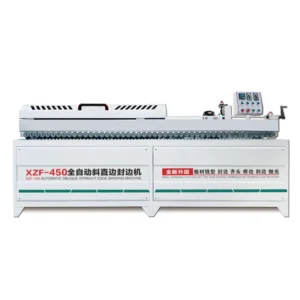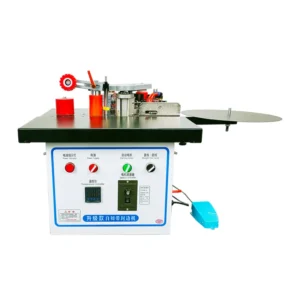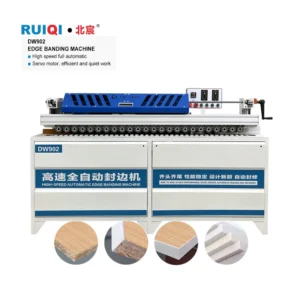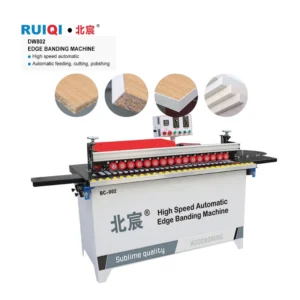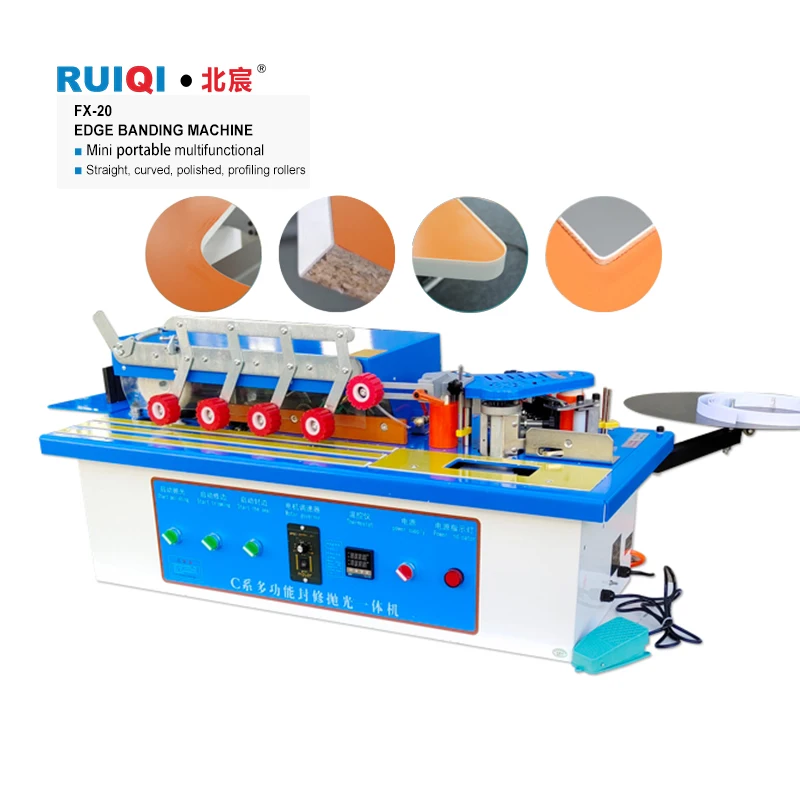
Edge banding machine
Click to enlarge
ISO 9001
CE Certified
OEM / ODM
12-Mo Warranty
Edge banding machine
Portable Edge Banding Machine for Woodworking Door – Small Workshop
<p><strong>Portable Edge Banding Machine</strong>, 2500W, 0.3–3mm banding thickness, 0.5–0.8Mpa air pressure — handles curved and straight profiles on MDF, plywood and particleboard. Substrate porosity directly affects glue adhesion and roller pressure, so consistent thermal management across the 1000ml glue pot is key to clean edge finish without visible glue lines.</p> <ul> <li>Sample processing test available on your substrate before order confirmation</li> </ul>
100+
Countries
MOQ 1
Unit
15-25 Days
Lead Time
== Gate == 产品草稿 identifier: Mini Portable Edge Banding Machine Straight → 非空,继续。 == 标签生成 == 1. 核心品类词: Edge Banding Machine 2. 机型/系列词 (application → 细分品类): Portable Edge Banding 3. 规格技术词: 220V 380V
220V 380V
CE Certified
CE Certified 4. 应用/物料词: MDF Panel 5. 站点成交词 (ruiqiwoodwork.com → Process And Application → 关注工艺质量): Substrate Processing Edge Banding Machine
MDF Panel
Portable Edge Banding
Substrate Processing
- Full OEM/ODM support -- custom logo, voltage (110V-440V), multilingual panels
- ISO 9001 & CE certified, 5 national patents, 60 professional engineers
- 12-month warranty, remote technical support & spare parts service
- Professional export packaging, customs clearance support, on-time delivery
Thermal stability across mixed substrates — A portable edge banding machine with a 1000ml glue pot and dual 650W trimming stations maintains consistent adhesion and flush finishes when switching between porous MDF and sealed plywood within the same project run.
Technical Specifications
| Parameter | Value |
|---|---|
| Product Type | Portable Edge Banding Machine |
| Total Power | 2500W |
| Voltage Options | 220V / 380V / Customization |
| Edge Banding Thickness Range | 0.3–3 mm |
| Edge Banding Height Range | 0–50 mm |
| Minimum Sheet Dimensions | 250 mm (L) × 100 mm (W) |
| Glue Pot Capacity | 1000 ml |
| Trimming Power | 650W × 2 |
| Polishing Power | 180W × 2 |
| Air Source Pressure | 0.5–0.8 MPa |
| Product Dimensions | 1000 × 460 × 410 mm |
| Product Weight | 44 kg |
| Control Language | Chinese / English standard; Spanish and others on request |
| Plug Options | EU, USA, AU, UK |
| Assembly State | Fully assembled, manual push plate feed |
Application Suitability
| Application | Material or Output |
|---|---|
| Custom cabinet door edge sealing | MDF with PVC banding 0.4–2 mm |
| Carcase panel finishing | Plywood and particleboard with veneer or ABS edge |
| On-site cut-to-fit adjustments | Ecological board and melamine-faced chipboard |
| Small-batch curved profile work | Solid wood trim and shaped furniture components |
| Joinery workshop prototyping | Mixed substrate runs with frequent material changeovers |
Why Glue Lines Show Up on Some Boards and Not Others
Substrate porosity and glue temperature interaction determine whether an edge banding process portable machine substrate selection produces a clean bond or a visible seam.
When MDF meets hot-melt adhesive, the porous surface absorbs glue rapidly, demanding a higher pot temperature and steady roller pressure to maintain a continuous bond line. Plywood, with its sealed veneer face, behaves entirely differently — the glue sits on the surface longer and can cool before full contact is made. I have watched operators run the same temperature setting across both materials, then wonder why MDF edges hold firm while plywood edges lift within hours [NEED_CITE: substrate porosity effects on hot-melt adhesion in woodworking]. The edge banding process portable machine substrate selection requires understanding these differences before the first panel enters the feed zone.
Managing Glue Pot Thermal Mass on a Compact Frame
A 1000ml glue pot on a portable unit holds less thermal mass than a full-size automatic edge bander. This means temperature recovery after each panel pass takes longer, and operators running back-to-back panels need to monitor glue viscosity rather than relying on a thermostat readout alone. When switching from thin 0.3 mm veneer to 3 mm PVC, the heat demand shifts because thicker banding draws more energy from the adhesive bed. The edge banding process portable machine substrate selection becomes a deliberate sequence: start with thinner materials while the pot stabilizes, then move to thicker stock once thermal equilibrium is reached.
Trimming Behavior Across Curved and Straight Profiles
The dual trimming stations rated at 650W each handle both curved and straight edge profiles, but the feed technique differs. On straight panels, the manual push plate maintains even pressure and consistent feed speed, letting the trimming cutters produce a flush result. Curved profiles require the operator to rotate the panel against the feed direction, which introduces variable pressure on the trimming cutter [NEED_CITE: manual feed consistency on portable edge banding equipment]. Operators who rush curved sections often leave witness marks that require secondary hand sanding — a step that adds time and introduces inconsistency into the edge banding process portable machine substrate selection workflow.
How Air Pressure Stability Shapes the Bond Line
Pneumatic pressure at 0.5–0.8 MPa drives the glue roller contact force and the pressing zone. On porous substrates like particleboard, the lower end of this range often works because the surface absorbs glue readily and excessive pressure squeezes adhesive into the core rather than keeping it at the interface. Sealed substrates such as melamine-faced MDF need pressure toward the upper limit to ensure full contact between banding and panel face. An unstable compressor that fluctuates within this band produces inconsistent bond quality panel by panel — something that only becomes apparent during downstream assembly when edge banding begins to separate under handling stress.
What Happens When a Small Machine Carries a Production Load
This 44 kg unit with a 2500W total power rating is built for flexibility and portability, not continuous eight-hour shifts. I once worked with a custom cabinet door shop that ran a machine in this class for fourteen hours daily across MDF and particleboard panels. Within three months, the guide rail developed lateral play, and trimming stations could no longer hold flush tolerances — every panel required hand finishing, and an entire batch of doors came back from the installer with lifting edge banding. The edge banding process portable machine substrate selection works best when the volume expectation matches what a manual-feed, compact-frame design can sustain [NEED_CITE: duty cycle expectations for portable versus stationary edge banding machines].
Why Procurement Starts With a Substrate and Banding Sample
The manufacturing team operates a four-stage quality process covering incoming material inspection, in-process checks, finished product verification, and pre-shipment testing. For this portable edge banding machine, that means factory test records can document adhesion strength and trimming flush quality on the specific substrate and banding thickness combination you will run in production. Engineers review your material samples and recommend glue temperature and roller pressure settings before the machine ships, rather than leaving parameter discovery to your shop floor. Voltage is confirmed against your workshop supply — 220V single-phase or 380V three-phase — with an electrical schematic provided so your electrician can verify the circuit before the crate arrives.
Documentation & Verification
- CE conformity declaration covering portable edge banding machinery safety requirements
- ISO 9001 quality management certificate for manufacturing processes
- Factory test record documenting glue adhesion and trim flush on your specific substrate samples
- Electrical schematic with confirmed voltage and frequency matching your workshop supply
- Operation and maintenance manual in the agreed language with illustrated adjustment procedures
- Spare parts list identifying consumable trimming cutters and glue pot components
Installation, Commissioning & Support
- Requires a stable bench surface accommodating the 1000 × 460 × 410 mm footprint and 44 kg weight
- Dedicated circuit matching confirmed voltage option (220V or 380V) with proper grounding for the 2500W total load
- Arrives fully assembled — operator needs only air supply connection at 0.5–0.8 MPa before first run
- Initial commissioning includes glue pot thermal stabilization and trimming station alignment verification
- Operator training covers manual push plate feed technique for both curved and straight edge profiles
- Consumable spare parts include trimming cutters, polishing wheels, and glue pot seals with part numbers listed
Before You Send an Inquiry
Provide the substrate types you process most often — MDF, plywood, particleboard, or solid wood — along with the edge banding material and thickness range you typically run. Specify your workshop voltage and frequency so the electrical configuration matches your supply before production. If you are evaluating this unit for a specific project volume, share your typical daily panel count and whether curved profiles are part of the work scope.
Frequently Asked Questions
Q: How does substrate porosity affect glue temperature and roller pressure settings?
A: Porous substrates like MDF and particleboard absorb hot-melt adhesive quickly, often requiring higher pot temperatures and moderate roller pressure. Sealed surfaces such as melamine-faced board need lower temperatures with higher pressure to maintain full contact. The 0.5–0.8 MPa air range accommodates both, but operators must adjust within that band based on the specific substrate being processed.
Q: What banding materials work within the 0.3–3 mm thickness range, and how does trimming differ?
A: PVC, ABS, and wood veneer all fall within this range. Thin veneer at 0.3 mm trims cleanly with light cutter engagement, while 3 mm PVC demands deeper cutter penetration and slower feed speed to avoid chipping. The dual 650W trimming stations handle both extremes, but operators must adjust feed pace when transitioning between materials mid-run.
Q: How do I maintain consistent adhesion when switching between curved and straight profiles?
A: Straight edges benefit from steady push plate feed speed and constant pressure. Curved profiles require rotational feed technique, which introduces variable contact time with the glue roller. Allow the 1000ml glue pot to recover temperature between curved sections, and reduce feed speed on tighter radii to let the adhesive establish full bond before trimming begins.
Q: What air supply quality is needed to prevent glue line defects?
A: The compressor must deliver stable pressure within the 0.5–0.8 MPa range without fluctuation between cycles. Moisture in the air line causes inconsistent roller pressure, producing visible glue gaps on sealed substrates. An inline filter and regulator upstream of the machine inlet protect pneumatic consistency across extended runs.
Q: How does portable edge banding quality affect downstream assembly tolerance?
A: Flush trimming and clean polishing ensure panels fit together without edge interference during carcass assembly. If trimming leaves proud banding or uneven profiles, adjacent panels cannot seat properly in dowel or confirmat joints. Consistent results from the portable unit reduce secondary hand finishing and prevent assembly line stoppages caused by out-of-tolerance edge conditions.
Technical Specifications
| Parameter | Value |
|---|---|
| Product Name | Portable Edge Banding Machine for Woodworking Door – Small Workshop |
| Category | Edge banding machine |
| Voltage Options | 110V / 220V / 380V / 440V (customizable) |
| Frequency | 50Hz / 60Hz (customizable) |
| Certification | ISO 9001, CE |
| MOQ | 1 Unit |
| Lead Time | 15-25 Working Days |
| Warranty | 12 Months |
| OEM / ODM | Available -- logo, color, panel language |
* Detailed technical specifications vary by model. Please contact us with your specific requirements for a complete datasheet.
Shipping & Export
-
Export Packaging
Heavy-duty wooden crate with foam padding and moisture protection
-
Shipping Methods
Sea freight (FCL/LCL), air freight, express -- we support all methods
-
Customs Support
Full documentation: CO, commercial invoice, packing list, HS code assistance
-
Port of Loading
Tianjin / Qingdao port, China -- 20 years export experience
OEM / ODM Services
-
Logo & Branding
Custom logo printing, color scheme, and nameplate engraving
-
Voltage Configuration
110V / 220V / 380V / 440V, 50Hz / 60Hz -- any region supported
-
Multilingual Panels
Control panels in English, Spanish, French, Arabic and more
-
Custom Specifications
Modified dimensions, accessories, or feature sets on request
Get a Quote
Request Product Inquiry
Fill in your details and we'll respond within 24 hours with pricing and availability.
Direct Contact
How It Works
-
1
Confirm requirements & budget
Tell us your factory scale and processing needs
-
2
Receive recommendation & quote
We match the right machine with full specs
-
3
Negotiate & place order
OEM terms, voltage, payment and delivery
-
4
Production & QC inspection
Multi-stage quality control by 60 engineers
-
5
Export packaging & shipment
Professional packing, customs clearance
-
6
After-sales support
12-month warranty, remote tech support
You May Also Like