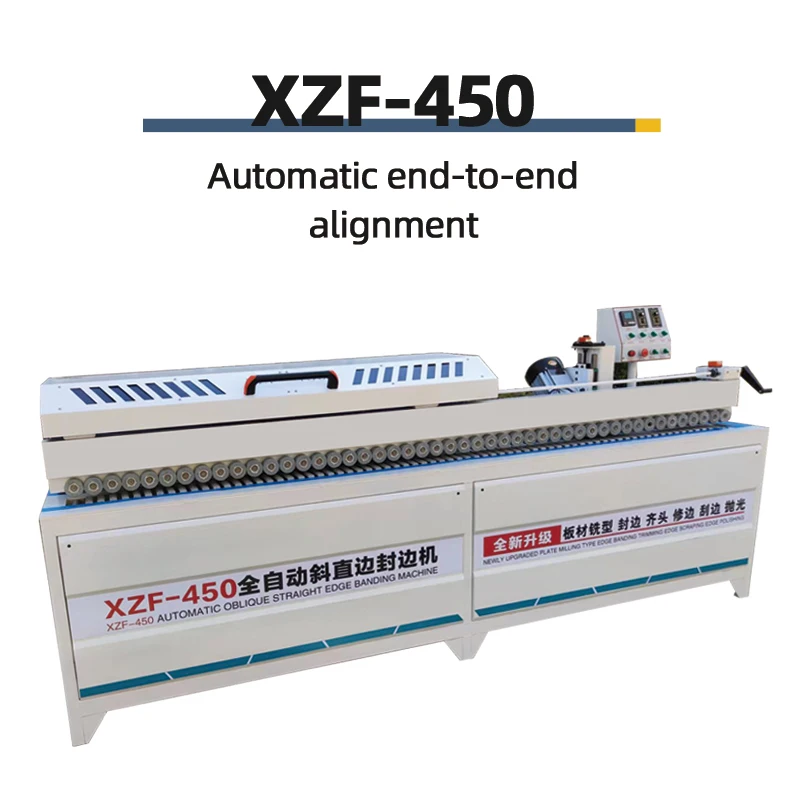
Edge banding machine
Click to enlarge
ISO 9001
CE Certified
OEM / ODM
12-Mo Warranty
Edge banding machine
Veneer Splicing Trimmer 45 Degree Edge Banding Machine | Process Guide
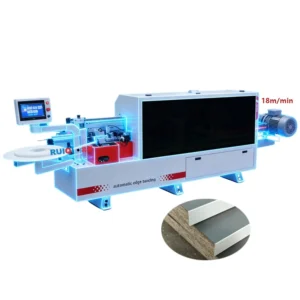
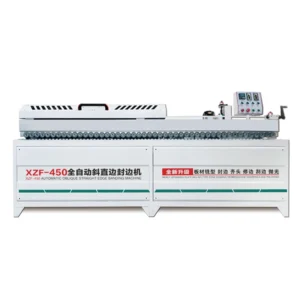
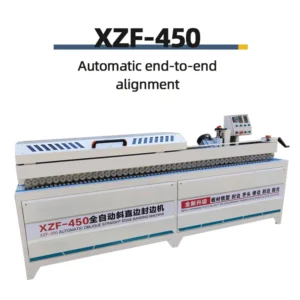
<p><strong>XZF-450 45 Degree Edge Banding Machine, 9.5KW, 0-12M/min Feed Speed</strong> — engineered for workshops handling diverse edge profiles and mixed substrates.</p> <ul> <li>Covers pre-milling through multi-angle trimming (30°/45°/60°), scraping and polishing in one automated pass</li> <li>4KW pre-milling motor delivers clean, square panel edges before gluing, reducing visible glue lines on MDF and particleboard</li> <li>Processes edge banding thickness 0.3–3mm across panel heights up to 50mm</li> <li>Dual trimming motors (2.2KW×2) and dual polishing motors (0.4KW×2) ensure consistent edge finishing</li> </ul> <p>Voltage customization from 110V to 440V and multilingual control panels available — supported by four-stage QC with pre-shipment verification and factory test records tailored to your substrate.</p>
100+
Countries
MOQ 1
Unit
15-25 Days
Lead Time
45 Degree Automatic
Edge Banding Machine
Furniture Factory
MDF Panel
Multi-angle Trimming
Pre-milling Motor
Process And Application
XZF-450
- Full OEM/ODM support -- custom logo, voltage (110V-440V), multilingual panels
- ISO 9001 & CE certified, 5 national patents, 60 professional engineers
- 12-month warranty, remote technical support & spare parts service
- Professional export packaging, customs clearance support, on-time delivery
Voltage, language and specification customization as standard — the XZF450 45 Degree Automatic Edge Banding Machine is configured with confirmed voltage, multilingual control panels, and tested against the buyer’s actual substrate before dispatch.
Technical Specifications
| Parameter | Value |
|---|---|
| Model | XZF-450 |
| Product Type | 45 Degree Automatic Edge Banding Machine |
| Total Power | 9.5 kW |
| Voltage | 380V/415V (configurable from 110V to 440V) |
| Pre-milled Motor | 4 kW |
| Trimming Power | 2.2 kW × 2 |
| Polishing Power | 0.4 kW × 2 |
| Vacuum Power | 550 W |
| Transmission Power | 180 W |
| Feed Speed | 0–12 m/min |
| Glue Pot Capacity | 4000 ml |
| Edge Banding Height | 0–50 mm |
| Edge Banding Thickness | 0.3–3 mm |
| Minimum Sheet Length | 30 cm |
| Minimum Sheet Width | 15 cm |
| Air Source Pressure | 0.5–0.7 MPa |
| Overall Dimensions (L×W×H) | 300 × 65 × 135 cm |
| Net Weight | 430 kg |
| Standard Features | Pre-milling, 30°/45°/60° edge banding, trimming, scraping, polishing, high-power vacuuming |
| Language Options | Chinese and English (customizable to Spanish or other languages) |
| Certification | CE |
Application Suitability
| Application | Material or Output |
|---|---|
| Cabinet door 45° mitre edge banding | MDF and melamine-faced chipboard |
| Custom furniture profiling | Plywood and blockboard with PVC or veneer banding |
| Panel processing for polymer doors | Polymer composite substrates with 0.3–3 mm edge material |
| Mixed-substrate production runs | Particleboard, solid wood panels and MDF on the same line |
| Medium-volume furniture manufacturing | Boards requiring both 90° straight and 45° angled edge profiles |
Why Visible Glue Lines Keep Appearing on Particleboard and MDF
Substrate variation at the panel edge is the primary cause — and pre-milling is the process step that addresses it before glue ever touches the board.
When particleboard or MDF arrives from the panel saw, the cut edge is rarely perfectly square. Micro-chipping along the edge creates tiny gaps where glue pools or fails to bond evenly. Operators often blame the adhesive or the glue pot temperature, but the problem originates upstream. The edge banding machine process and application depends heavily on the condition of the panel edge entering the gluing station. I have watched workshops spend weeks adjusting feed speed and temperature on this class of machine, only to discover that adding a proper pre-milling pass eliminated the inconsistency they had been chasing. [NEED_CITE: substrate edge preparation standards for automated edge banding]
How Pre-Milling Changes the Edge Quality Equation
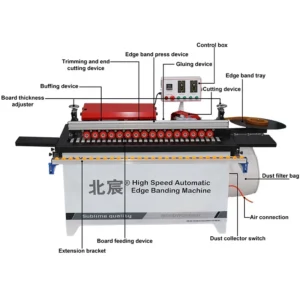
The 4 kW pre-milling motor on the XZF-450 removes a thin layer from the panel edge immediately before the gluing station. This produces a fresh, square surface free of saw marks and micro-fractures. For MDF and particleboard, where the core material tends to crumble at the cut line, this step is what separates a clean glue line from one that shows under light. The edge banding machine process and application relies on this first station to set the tolerance for every downstream operation.
Multi-Angle Profiling Without Swapping Machines
Most workshops producing high-end cabinet fronts need 45-degree mitred edges alongside standard 90-degree straight edges. Running both profiles typically requires either two separate machines or time-consuming tooling changeovers. The XZF-450 handles 30°, 45°, and 60° profiling within a single automated pass. The trimming section — powered by dual 2.2 kW motors — shapes the edge banding material to match the selected angle, and the dual 0.4 kW polishing motors finish the surface in the same run. This reduces handling and keeps batch consistency tight across a full kitchen run. [NEED_CITE: profiling tolerance requirements for mitred cabinet joints]
Reading the Specification Sheet Against Your Production Reality
The 0–12 m/min feed speed range matters because different substrates demand different throughput rates. Running MDF at the upper end of the range can cause the glue to cool before full adhesion sets, especially in colder workshops. Dropping the speed gives the 4000 ml glue pot time to maintain stable temperature contact with the panel edge. Edge banding thickness from 0.3 mm to 3 mm covers everything from thin PVC foil for budget cabinet interiors to thick veneer strips for visible furniture edges. The minimum sheet dimensions of 30 cm by 15 cm determine how small an offcut can be processed — relevant when nesting layouts produce narrow filler panels. Air source pressure between 0.5 and 0.7 MPa must be maintained consistently; pressure drops cause the pneumatic trimming and scraping units to lose precision mid-cycle.
What Happens When Voltage and Language Are an Afterthought
Equipment arrives at the workshop, gets uncrated, and the operator reaches for the control panel — only to find every label in a language they cannot read. Commissioning stalls while someone searches for a translation. In other cases, the machine is wired to a local supply that does not match the motor rating, and the pre-milling station trips its breaker under load. These are not equipment defects; they are specification failures that happen when voltage and control panel language are not confirmed before production. I have seen edge banding machines of this class sit idle for weeks because the buyer and seller never aligned on whether the workshop ran 380V at 50 Hz or 415V at 60 Hz. [NEED_CITE: voltage and frequency standards by export market]
Why This Machine Fits a Process-Oriented Purchase
The XZF-450 is built around an in-house manufactured cutting mechanism with a proprietary design that targets ±0.02 mm tolerance on trimming output. Every unit passes through four stages of quality control — incoming material inspection, in-process checks, finished product verification, and pre-shipment testing — so the edge quality you see during a factory visit is the quality that ships. Voltage is confirmed against your facility supply before the machine enters production, and the control panel language is set to match your operators. Engineer-led configuration ensures the machine is matched to your actual substrates and edge materials rather than a generic catalogue specification. A formal quotation with full specification confirmation is typically provided within 24 hours of receiving your processing requirements.
Documentation & Verification
- CE declaration of conformity for the XZF-450 edge banding unit
- Factory test record on your specific panel thickness and edge banding material before dispatch
- Electrical schematic confirming voltage, frequency and circuit protection for your facility
- Operation and maintenance manual in the agreed operator language with illustrated troubleshooting
- Spare parts list identifying consumable trimmer blades, scraper inserts and polishing wheels
Installation, Commissioning & Support
- Requires a level floor pad supporting 430 kg static load across the 300 cm machine length
- Dedicated 380V/415V three-phase circuit with breaker rated for the 9.5 kW total draw
- Arrives partially assembled; pre-milling and polishing stations require final alignment on site
- First-run commissioning includes glue pot temperature mapping against your edge banding material
- Trimming and scraping pneumatic lines need 0.5–0.7 MPa clean dry air from a dedicated regulator
- Operator training covers feed speed adjustment for different substrate and banding thickness combinations
Preparing Your Enquiry
Send a sample of the actual board material and edge banding strip you plan to run so the machine can be tested against your production conditions before quotation. Confirm your workshop voltage, frequency and available floor space alongside the XZF-450 footprint. Specify the operator language for the control panel and whether your production requires 45-degree profiling, straight-edge banding, or both in the same batch.
Frequently Asked Questions
Q: How does pre-milling affect edge quality on MDF compared to plywood?
A: MDF cores are more prone to micro-chipping at the saw cut, leaving an uneven surface that causes visible glue lines. The 4 kW pre-milling station removes this damaged layer, producing a clean square edge. Plywood, with its cross-grain veneer structure, tends to cut more cleanly, but pre-milling still removes tear-out on the outer plies and improves glue contact uniformity across both substrates.
Q: What glue and edge banding materials work with the 4000 ml glue pot?
A: The glue pot is designed for standard EVA hot-melt adhesives commonly used in furniture edge banding. Compatible banding materials include PVC strips from 0.3 mm to 3 mm thickness, melamine foil, ABS edging, and natural or engineered wood veneer. Specific glue temperature settings should be matched to your banding material supplier’s recommendation for optimal adhesion.
Q: How should feed speed be adjusted for different panel thicknesses?
A: Thicker edge banding materials near the 3 mm upper limit generally require slower feed speeds to allow adequate glue contact time and cooling before the trimming station. Thin PVC at 0.3 mm can be run closer to the 12 m/min maximum. The key variable is glue open time relative to workshop ambient temperature — colder environments need slower feeds regardless of banding thickness.
Q: Can the XZF-450 handle both straight and 45-degree edges in one production run?
A: Yes. The machine supports 30°, 45° and 60° profiling alongside standard 90° straight-edge banding. Switching between angles within a batch requires operator adjustment at the control panel. For high-mix production where angle changes occur frequently between boards, confirming the changeover procedure during commissioning helps operators maintain throughput without sacrificing edge accuracy.
Technical Specifications
| Parameter | Value |
|---|---|
| Product Name | Veneer Splicing Trimmer 45 Degree Edge Banding Machine | Process Guide |
| Category | Edge banding machine |
| Voltage Options | 110V / 220V / 380V / 440V (customizable) |
| Frequency | 50Hz / 60Hz (customizable) |
| Certification | ISO 9001, CE |
| MOQ | 1 Unit |
| Lead Time | 15-25 Working Days |
| Warranty | 12 Months |
| OEM / ODM | Available -- logo, color, panel language |
* Detailed technical specifications vary by model. Please contact us with your specific requirements for a complete datasheet.
Shipping & Export
-
Export Packaging
Heavy-duty wooden crate with foam padding and moisture protection
-
Shipping Methods
Sea freight (FCL/LCL), air freight, express -- we support all methods
-
Customs Support
Full documentation: CO, commercial invoice, packing list, HS code assistance
-
Port of Loading
Tianjin / Qingdao port, China -- 20 years export experience
OEM / ODM Services
-
Logo & Branding
Custom logo printing, color scheme, and nameplate engraving
-
Voltage Configuration
110V / 220V / 380V / 440V, 50Hz / 60Hz -- any region supported
-
Multilingual Panels
Control panels in English, Spanish, French, Arabic and more
-
Custom Specifications
Modified dimensions, accessories, or feature sets on request
Get a Quote
Request Product Inquiry
Fill in your details and we'll respond within 24 hours with pricing and availability.
Direct Contact
How It Works
-
1
Confirm requirements & budget
Tell us your factory scale and processing needs
-
2
Receive recommendation & quote
We match the right machine with full specs
-
3
Negotiate & place order
OEM terms, voltage, payment and delivery
-
4
Production & QC inspection
Multi-stage quality control by 60 engineers
-
5
Export packaging & shipment
Professional packing, customs clearance
-
6
After-sales support
12-month warranty, remote tech support
You May Also Like