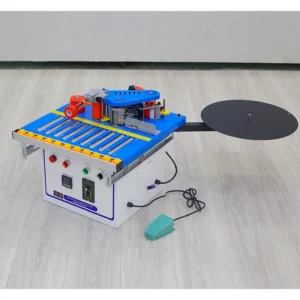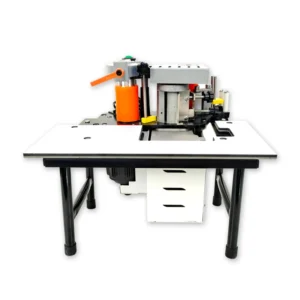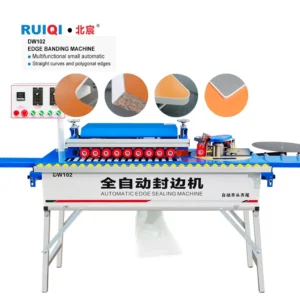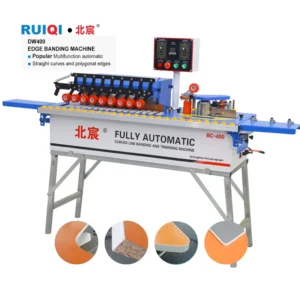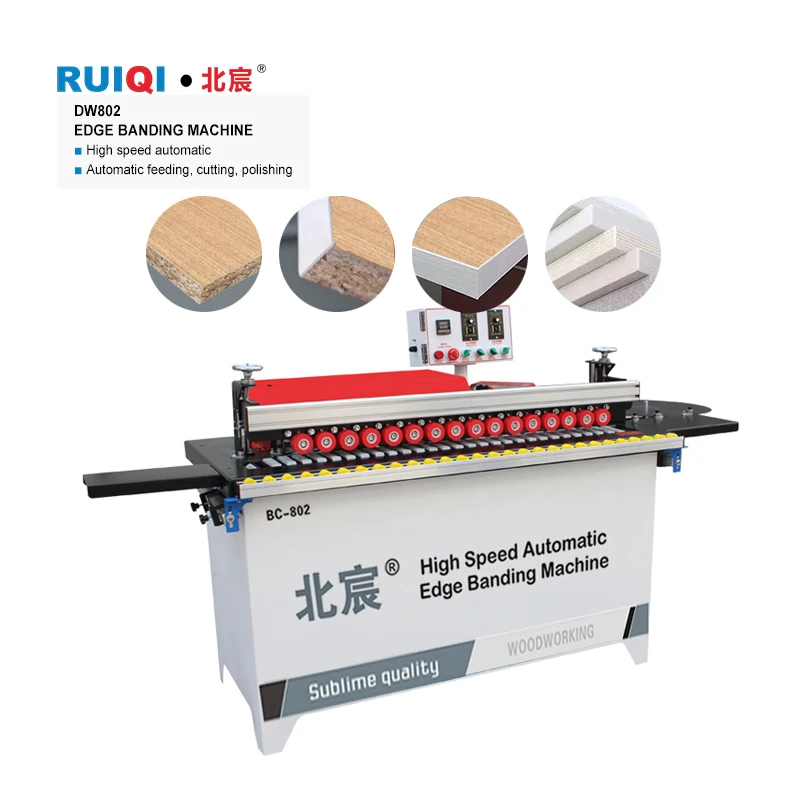
Edge banding machine
Click to enlarge
ISO 9001
CE Certified
OEM / ODM
12-Mo Warranty
Edge banding machine
Wood Based Panels Edge Banding Machine – Industrial Application
<p><strong>DW802 Automatic Edge Banding Machine, 4200W, 220V/380V, 0.3-3mm Edge Thickness</strong> — processes MDF, particleboard, plywood, ecological board and solid wood panels through integrated gluing, trimming and polishing stations in a single pass.</p> <ul> <li>4000ml glue pot capacity supports continuous runs with stable temperature for consistent glue line control</li> <li>Dual 800W trimming motors and dual 180W polishing stations deliver clean edge finish suitable for visible furniture surfaces</li> <li>Silica gel conveyor belt with pressure beam minimises surface scratching across panel materials</li> <li>Engineer-led configuration available with formal quotation and sample processing test on your specific substrate before order confirmation</li> </ul>
100+
Countries
MOQ 1
Unit
15-25 Days
Lead Time
380V
Automatic Edge Banding Machine
DW802
Furniture Factory
MDF Panel
Particleboard
Process And Application
Vacuum Pressing
- Full OEM/ODM support -- custom logo, voltage (110V-440V), multilingual panels
- ISO 9001 & CE certified, 5 national patents, 60 professional engineers
- 12-month warranty, remote technical support & spare parts service
- Professional export packaging, customs clearance support, on-time delivery
Precision-Ground Components — verified through multi-stage inspection across the DW802 assembly to maintain consistent edge sealing quality on varied panel substrates.
Technical Specifications
| Parameter | Value |
|---|---|
| Model | DW802 |
| Product Type | Automatic Edge Banding Machine |
| Total Power | 4200W |
| Voltage | 220V/380V/customization (frequency not stated in source) |
| Edge Banding Height Range | 0–50mm |
| Edge Banding Thickness Range | 0.3–3mm |
| Minimum Sheet Length | 25cm |
| Minimum Sheet Width | 10cm |
| Glue Pot Capacity | 4000ml |
| Edge Feed Motor Power | 140W |
| Transmission Motor Power | 140W |
| Trimming Motor Power | 800W × 2 |
| Polishing Motor Power | 180W × 2 |
| Vacuum Power | 1200W |
| Air Source Pressure | 0.4–0.8 MPa |
| Overall Dimensions (L×W×H) | 130×60×95 cm |
| Net Weight | 135 kg |
| Key Features | Edge banding, trimming, polishing, automatic head and tail cutting, vacuum system |
| Language Options | Chinese, English; other languages available on request |
| Plug Options | EU, USA, AU, UK |
| Feed Speed | (basis to be confirmed) |
| Panel Thickness Range | (basis to be confirmed) |
| Tolerance | (basis to be confirmed) |
| Control System | (basis to be confirmed) |
Application Suitability
| Application | Material or Output |
|---|---|
| Custom cabinet door and carcass production | MDF and particleboard with PVC or melamine edge banding |
| Home decoration joinery and shelving | Ecological board and plywood with veneer or PVC banding |
| Small-scale furniture component processing | Solid wood panels requiring trimmed and polished visible edges |
| Workshop transition from manual to mechanised sealing | Mixed substrate runs across MDF, particleboard and plywood |
Why Substrate Choice Decides Your Edge Banding Machine Process and Application Outcome
The panel material you feed determines whether the glue line disappears or stays visible on the finished piece.
Edge banding quality inconsistent across panel materials, with visible glue lines on some substrates — this is the single most common complaint I hear when visiting workshops that just installed new equipment. The operator follows the manual, sets the standard temperature, feeds MDF on Monday and particleboard on Tuesday, and gets two completely different results. Particleboard’s porous surface absorbs glue differently than MDF’s dense fibre structure, and plywood’s layered grain creates uneven adhesion zones along the edge. [NEED_CITE: substrate porosity and hot melt adhesive penetration in panel processing] What works on ecological board at one temperature produces starved joints on raw particleboard three degrees lower.
How the DW802 Glue System Manages Mixed Substrate Runs
The 4000ml glue pot on this edge banding machine process and application setup maintains thermal mass across longer runs, reducing the temperature swing that typically occurs when the pot refills mid-batch. A smaller pot cools faster between panels, and the first centimetres of banding after a refill often show weaker adhesion. The integrated pressure beam with silica gel conveyor belt keeps the panel flat against the glue roller regardless of whether the substrate is 18mm MDF or thinner plywood, maintaining uniform contact pressure through the critical bonding zone.
Trimming and Polishing Across Different Edge Banding Materials
The dual 800W trimming motors handle the full 0.3–3mm thickness range specified for this machine, cutting through rigid PVC and flexible melamine without requiring manual speed changes between materials. The automatic head and tail cutting stations remove overhang before the trimming pass, preventing the tear-out that occurs when a trimming cutter hits a full-thickness leading edge. The two 180W polishing stations then address the micro-scratches left by trimming — an essential step when veneer banding on solid wood panels needs a smooth, grain-aligned finish rather than a machined surface. [NEED_CITE: edge banding trimming and polishing sequence for furniture-grade panel edges]
Reading the Numbers That Actually Affect Your Output
The 4200W total power budget allocates across seven distinct work stations — edge feed, transmission, two trimming motors, two polishing motors, and the vacuum system. The vacuum at 1200W serves to hold lightweight panels and small offcuts stable through the feed path, which matters when your minimum sheet size is 25cm by 10cm. The air source pressure range of 0.4–0.8 MPa drives the pneumatic actuators for head and tail cutting and pressure beam adjustment; below 0.4 MPa the cutters may not fully engage, leaving ragged ends on thicker banding material. The overall footprint of 130×60×95 cm means this machine fits a compact workshop layout, but the 135 kg net weight requires a level, stable floor to prevent vibration from affecting trim accuracy during operation.
What Happens When You Ignore the Material Question
I once spent three days in a Lagos panel factory where the line kept producing rejects — edge banding peeling off recycled particleboard within hours of pressing. The machine was fine. The problem was that the recycled material had inconsistent density, and the standard glue temperature created either starved joints on dense zones or squeeze-out on soft zones. We adjusted the glue pot temperature in small increments and changed the pressure beam setting until the bond held across the full sheet. That factory lost an entire production batch before anyone asked what material was actually running through the machine. The edge banding machine process and application only works when the setup matches your specific substrate, not a generic recommendation from a catalogue. [NEED_CITE: recycled panel material density variation and adhesive bonding challenges]
Why Procurement Verification Matters at This Level
The DW802 is built through in-house manufacturing with proprietary cutting mechanisms and verified tolerance checks at each production stage. Four-stage QC covers incoming material inspection, in-process assembly verification, finished product testing, and pre-shipment validation before the machine leaves the facility. Voltage customisation from 220V to 380V is confirmed against your facility supply before production begins, preventing the situation where a machine arrives wired for a grid you do not have. The engineering team provides configuration recommendations based on your panel material and production volume, with a formal quotation issued within 24 hours. Factory visits are welcomed so you can see the assembly process and run sample panels on the exact substrate you plan to process.
Documentation & Verification
- CE declaration of conformity covering the DW802 electrical and mechanical safety requirements
- Machine specification sheet listing confirmed feed speed, panel thickness range and tolerance values
- Electrical schematic with voltage and frequency matched to your facility before dispatch
- Factory test record using your specified panel substrate and edge banding material
- Operation and maintenance manual provided in your agreed language for operator comprehension
- Spare parts list identifying consumable components and recommended replacement intervals
Installation, Commissioning & Support
- Requires a level floor pad to prevent vibration affecting trim accuracy at 135 kg operating weight
- Dedicated electrical circuit sized for 4200W total load with voltage confirmed pre-shipment
- Arrives as a single integrated unit at 130×60×95 cm, positioned and connected on arrival
- First-run calibration of glue temperature and pressure beam for your specific substrate and banding material
- Operator training on control panel functions in the agreed language before independent production begins
- Pneumatic supply connection at 0.4–0.8 MPa for actuator and head/tail cutting system commissioning
Before You Send an Inquiry
Provide the specific panel substrates you process — MDF, particleboard, plywood, ecological board or solid wood — along with the edge banding material type and thickness you intend to use. Confirm your facility voltage and frequency, and specify the language your operators need on the control panel. If you have existing upstream or downstream equipment, share the feed height and throughput so the configuration aligns with your line. Request a sample processing test on your material before committing to production volumes.
Frequently Asked Questions
Q: Which substrates produce the best edge sealing results, and how does glue line visibility vary between MDF, particleboard and plywood?
A: MDF typically delivers the cleanest edge sealing result due to its uniform fibre density and smooth cut surface. Particleboard requires careful glue temperature management because its porous structure absorbs adhesive unevenly, sometimes leaving visible glue lines if the temperature is too low. Plywood edges show grain variation that can create minor adhesion differences along the banding length. Request a factory test on your specific substrate to evaluate the actual finish before ordering.
Q: How do edge banding material type and thickness affect trimming station setup and polishing finish?
A: Thin PVC at 0.3mm trims cleanly with minimal motor load, while rigid 3mm banding demands the full 800W trimming motor capacity for a flush cut. Melamine banding tends to chip if the trimming cutter is dull, requiring sharper tooling and more frequent replacement. Veneer banding needs the polishing stations to blend the trimmed edge with the natural grain pattern. Each material within the 0.3–3mm range requires specific trimming parameters for optimal output quality.
Q: What glue type and temperature range are recommended for different panel substrates on this machine?
A: Standard EVA hot melt adhesive covers most MDF and particleboard applications within typical workshop temperature ranges. Ecological board with melamine surfaces may require higher glue temperature for adequate penetration, while plywood edges benefit from slightly lower temperature to prevent squeeze-out on porous grain zones. The 4000ml glue pot maintains stable temperature across runs. Confirm the specific glue type and temperature for your substrate during the sample testing phase.
Q: How does minimum sheet size of 25cm by 10cm affect workflow for small cabinet components?
A: The 25cm minimum length and 10cm minimum width allow processing of drawer sides, narrow shelving strips and small offcuts that larger machines cannot handle. The 1200W vacuum system helps stabilise these smaller panels through the feed path, preventing drift that causes misaligned banding. Operators should batch similar small components together to maintain consistent feed rhythm and glue temperature across the production run.
Technical Specifications
| Parameter | Value |
|---|---|
| Product Name | Wood Based Panels Edge Banding Machine – Industrial Application |
| Category | Edge banding machine |
| Voltage Options | 110V / 220V / 380V / 440V (customizable) |
| Frequency | 50Hz / 60Hz (customizable) |
| Certification | ISO 9001, CE |
| MOQ | 1 Unit |
| Lead Time | 15-25 Working Days |
| Warranty | 12 Months |
| OEM / ODM | Available -- logo, color, panel language |
* Detailed technical specifications vary by model. Please contact us with your specific requirements for a complete datasheet.
Shipping & Export
-
Export Packaging
Heavy-duty wooden crate with foam padding and moisture protection
-
Shipping Methods
Sea freight (FCL/LCL), air freight, express -- we support all methods
-
Customs Support
Full documentation: CO, commercial invoice, packing list, HS code assistance
-
Port of Loading
Tianjin / Qingdao port, China -- 20 years export experience
OEM / ODM Services
-
Logo & Branding
Custom logo printing, color scheme, and nameplate engraving
-
Voltage Configuration
110V / 220V / 380V / 440V, 50Hz / 60Hz -- any region supported
-
Multilingual Panels
Control panels in English, Spanish, French, Arabic and more
-
Custom Specifications
Modified dimensions, accessories, or feature sets on request
Get a Quote
Request Product Inquiry
Fill in your details and we'll respond within 24 hours with pricing and availability.
Direct Contact
How It Works
-
1
Confirm requirements & budget
Tell us your factory scale and processing needs
-
2
Receive recommendation & quote
We match the right machine with full specs
-
3
Negotiate & place order
OEM terms, voltage, payment and delivery
-
4
Production & QC inspection
Multi-stage quality control by 60 engineers
-
5
Export packaging & shipment
Professional packing, customs clearance
-
6
After-sales support
12-month warranty, remote tech support
You May Also Like