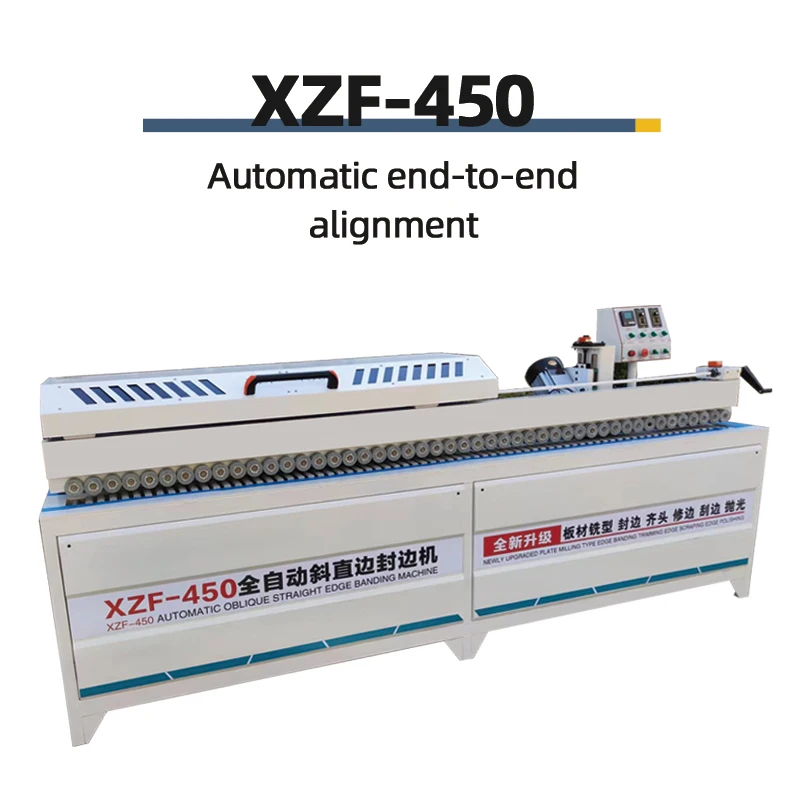
Edge banding machine
Click to enlarge
ISO 9001
CE Certified
OEM / ODM
12-Mo Warranty
Edge banding machine
Wood Edgebanding Machine 45° Corner Trimming – Process Application
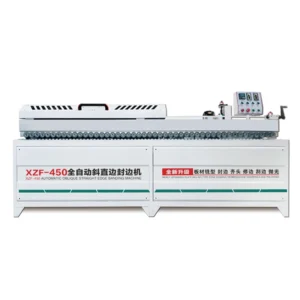
<p><strong>XZF450 Automatic Edge Banding Machine, 9.5 kW, 0-12 m/min Feed Speed</strong> — delivers full edge finishing from pre-milling through polishing, with 30°/45°/60°/90° multi-angle trimming capability.</p> <ul> <li>4 kW pre-milling removes saw marks for clean glue lines on MDF, particleboard and plywood</li> <li>Handles 0.3–3 mm PVC, veneer and solid wood banding across 150 mm minimum panel width</li> <li>Seven-stage process ensures repeatable edge profiles for cabinet and furniture assembly</li> </ul> <p>Verified by four-stage QC with pre-shipment test records available for your specific substrate and voltage confirmation.</p>
100+
Countries
MOQ 1
Unit
15-25 Days
Lead Time
45° Corner Trimming
Automatic Feeding
Edge Banding Machine
Furniture Factory
MDF Panel
Pre-milling
Process Application
XZF450
- Full OEM/ODM support -- custom logo, voltage (110V-440V), multilingual panels
- ISO 9001 & CE certified, 5 national patents, 60 professional engineers
- 12-month warranty, remote technical support & spare parts service
- Professional export packaging, customs clearance support, on-time delivery
Verified Tolerance & Process Control — Proprietary cutting mechanism patents and multi-stage inspection ensure the XZF-450 maintains edge finishing accuracy across MDF, plywood, and particleboard substrates throughout long production runs.
Technical Specifications
| Parameter | Value |
|---|---|
| Model | XZF-450 |
| Product Type | Automatic Edge Banding Machine |
| Total Power | 9.5 kW |
| Voltage | 380V/415V |
| Pre-milling Motor | 4 kW |
| Trimming Power | 2.2 kW × 2 |
| Polishing Power | 0.4 kW × 2 |
| Edge Feeding Power | 0.16 kW |
| Transmission Power | 180 W |
| Vacuum Power | 550 W |
| Feed Speed | 0–12 m/min |
| Edge Banding Height | 0–50 mm |
| Edge Banding Thickness | 0.3–3 mm |
| Minimum Sheet Length | 300 mm |
| Minimum Sheet Width | 150 mm |
| Glue Pot Capacity | 4000 ml |
| Air Source Pressure | 0.5–0.7 MPa |
| Edge Banding Angle Capability | 30° / 45° / 60° / 90° straight edge |
| Standard Functions | Pre-milling, gluing, end trimming, rough trimming, fine trimming, scraping, polishing, dust extraction |
| Overall Dimensions (L×W×H) | 3000 × 650 × 1350 mm |
| Net Weight | 430 kg |
| Control Panel Language | Chinese and English (customizable to Spanish, French, or other languages on request) |
| Plug Options | EU, USA, AU, UK |
| Assembly State | Fully assembled, ready for installation |
| Standards | CE, ISO 9001 |
Application Suitability
| Application | Material or Output |
|---|---|
| Custom cabinet door and carcass edge finishing | Melamine-faced MDF with 45° bevel edge banding |
| Wardrobe panel and shelving straight-edge processing | Particleboard and plywood, 0.4–2 mm PVC banding |
| Polymer and composite door manufacturing | Polymer panels requiring angled and straight edge sealing |
| Table top and case goods edge finishing | Solid wood panels with veneer or ABS edge banding up to 3 mm |
| Medium-volume workshop panel lines | Mixed MDF, blockboard, and melamine board batches |
Why the Voltage Question Should Come Before the Price on Any Automatic Edge Banding Machine Process Application
Confirming your workshop supply voltage before specifying an edge bander prevents multi-week production standstalls that no specification sheet can recover from.
I have watched an entire cabinet line sit idle for over twenty days because a 380V three-phase machine arrived at a facility running 415V. The transformer took weeks to source and ship, and every downstream station — boring, assembly, finishing — was blocked by panels that never got edged. The XZF-450 supports both 380V and 415V configurations, but the correct setting must be locked in at order stage, not discovered at unpacking. This is why we request a photo of your electrical cabinet before issuing the formal quotation. [NEED_CITE: voltage and frequency standards by export market]
How Pre-Milling Eliminates the Visible Glue Line Problem
The 4 kW pre-milling motor on the XZF-450 removes saw marks and surface waviness from the panel edge before any adhesive contacts the substrate. On porous materials like particleboard and MDF, an unmilled edge leaves micro-gaps that fill with excess glue, creating a visible seam that customers spot immediately on finished cabinet doors. Pre-milling produces a flat bonding surface so the hot-melt adhesive spreads in a thin, uniform film. This single stage accounts for most of the difference between an edge that looks painted on and one that looks factory-pressed.
Multi-Angle Trimming in a Single Pass
The XZF-450 handles 30°, 45°, 60°, and 90° edge banding angles without requiring a secondary routing station. For custom furniture production, bevelled edges on melamine-faced MDF doors are a recurring requirement that normally demands a separate CNC operation after straight edge banding. By integrating angled trimming into the automatic edge banding machine process application, the XZF-450 lets a production manager route bevel-panel jobs through one machine, reducing handling, work-in-progress queue time, and cumulative tolerance stack-up between stations. [NEED_CITE: CE machinery directive requirements for industrial equipment]
Reading the Spec Sheet Against Your Actual Substrates
Feed speed on this model ranges from 0 to 12 m/min, but the practical speed depends on the edge banding thickness and substrate density you run. At 3 mm solid wood veneer on dense MDF, a slower feed allows the glue pot — with its 4000 ml capacity — to maintain thermal stability and deliver consistent adhesive transfer. The trimming stations (2.2 kW each) carry enough power to cleanly shear thicker banding without chipping, while the fine trimming and scraping stages progressively refine the edge profile. Polishing (0.4 kW × 2) removes residual adhesive film. For plywood edges, the pre-milling stage is especially important because veneer core variations create uneven surfaces that compromise bond strength if left uncorrected. Dust extraction (550 W vacuum) keeps the glue pot and trimming zone clear of substrate particles that would otherwise embed in the adhesive layer.
The Hidden Cost of Skipping Configuration Verification
When edge banding machines arrive with control panels in a language the operator cannot read, commissioning stalls until someone translates the interface or waits for a replacement HMI. The XZF-450 ships with Chinese and English as standard, but Spanish, French, or other languages must be specified at order confirmation — not after the crate is opened. Similarly, purchasing a single machine without confirming feed height compatibility against your existing panel saw or boring machine creates a throughput bottleneck that no amount of speed adjustment can fix. These mismatches are the most common cause of line imbalance in workshops that add equipment piecemeal. [NEED_CITE: industrial machinery commissioning and operator training standards]
Why Production Managers Specify This Line
In-house manufacturing with patented cutting mechanisms means the trimming and scraping stations are built to verified tolerance, not assembled from generic sub-components. The full seven-stage process chain — pre-milling through polishing — sits within one product family, so a workshop scaling from straight-edge cabinet panels to bevelled door fronts does not need to switch suppliers. Voltage and control panel language customization is treated as standard configuration rather than a special request. Four-stage quality control runs from incoming material inspection through pre-shipment verification, and every unit is tested on actual panel stock before dispatch. Engineer-led configuration review ensures the quotation reflects your substrate mix, not just a catalog model number.
Documentation & Verification
- CE declaration of conformity covering the XZF-450 full function sequence
- ISO 9001 certificate for the manufacturing and quality management system
- Electrical schematic with confirmed voltage and frequency for your facility
- Factory test record run on your specified panel thickness and edge banding material
- Operation and maintenance manual in the language agreed at order stage
- Spare parts list with consumable and wear-part identification
Installation, Commissioning & Support
- Requires a dedicated 380V/415V three-phase circuit rated for the 9.5 kW total load
- Fully assembled delivery — the 3000 × 650 mm footprint fits standard workshop bay spacing
- 0.5–0.7 MPa compressed air supply must be connected before first start-up
- Glue pot temperature calibrated to your banding material during on-site or remote commissioning
- Multi-language control panel verified against operator requirement before shipment
- Wear-part replacement schedule provided for trimming cutters and scraping blades
Preparing Your Inquiry
Share the substrate types and panel thickness range you process most frequently, along with the edge banding materials and angles your product line requires. Include your workshop supply voltage, frequency, and preferred control panel language so the electrical and interface configuration is confirmed before production begins. If you run mixed batches of MDF, particleboard, and plywood, specify which substrate represents the majority of your volume so the feed speed and glue pot settings are optimized accordingly.
Frequently Asked Questions
Q: How does pre-milling affect edge banding quality on particleboard versus MDF?
A: Particleboard edges are more porous and prone to micro-chipping from panel saws. The 4 kW pre-milling station on the XZF-450 removes this damaged layer, creating a flat surface that allows the hot-melt adhesive to bond in a thin, even film. MDF benefits similarly, though its denser fiber structure typically produces cleaner saw cuts. Without pre-milling, both substrates show visible glue lines on finished panels, particularly under angled lighting common in installed kitchens.
Q: What edge banding materials work within the 0.3–3 mm thickness range?
A: The XZF-450 handles thin PVC and melamine banding at the lower end, ABS and veneer in the mid-range, and solid wood strips up to 3 mm. Material choice depends on product tier — PVC for cost-sensitive cabinet carcasses, ABS for impact-resistant drawer fronts, veneer or solid wood for visible furniture edges. Each material requires different glue pot temperature and trimming pressure settings, confirmed during sample processing.
Q: How do I achieve consistent 45° bevel edge quality across repeated production runs?
A: Consistent bevel finishing depends on three factors: stable feed speed matched to banding thickness, trimming station alignment verified against a master sample, and edge material selected for flexibility at the bend radius. The XZF-450 integrated angle capability means setup parameters are stored for recall, reducing operator-dependent variation between batches of bevelled cabinet doors.
Q: Which glue type works best for the substrates I process?
A: EVA hot-melt is standard for most MDF and particleboard applications with PVC or melamine banding. PUR adhesive offers stronger moisture resistance for kitchen and bathroom environments but requires a sealed glue pot system. Glue pot temperature on the XZF-450 must be matched to both the adhesive type and the banding material — your substrate sample test will determine the optimal setting.
Q: How does edge banding quality affect hinge boring and downstream assembly?
A: If trimming leaves excess banding material or the edge is not square to the panel face, hinge boring machines reference an inaccurate surface, shifting bore positions by fractions of a millimeter. This propagates into door misalignment during assembly. The XZF-450 fine trimming and scraping stages produce a clean, square edge that gives downstream boring and assembly stations a reliable datum surface.
Technical Specifications
| Parameter | Value |
|---|---|
| Product Name | Wood Edgebanding Machine 45° Corner Trimming – Process Application |
| Category | Edge banding machine |
| Voltage Options | 110V / 220V / 380V / 440V (customizable) |
| Frequency | 50Hz / 60Hz (customizable) |
| Certification | ISO 9001, CE |
| MOQ | 1 Unit |
| Lead Time | 15-25 Working Days |
| Warranty | 12 Months |
| OEM / ODM | Available -- logo, color, panel language |
* Detailed technical specifications vary by model. Please contact us with your specific requirements for a complete datasheet.
Shipping & Export
-
Export Packaging
Heavy-duty wooden crate with foam padding and moisture protection
-
Shipping Methods
Sea freight (FCL/LCL), air freight, express -- we support all methods
-
Customs Support
Full documentation: CO, commercial invoice, packing list, HS code assistance
-
Port of Loading
Tianjin / Qingdao port, China -- 20 years export experience
OEM / ODM Services
-
Logo & Branding
Custom logo printing, color scheme, and nameplate engraving
-
Voltage Configuration
110V / 220V / 380V / 440V, 50Hz / 60Hz -- any region supported
-
Multilingual Panels
Control panels in English, Spanish, French, Arabic and more
-
Custom Specifications
Modified dimensions, accessories, or feature sets on request
Get a Quote
Request Product Inquiry
Fill in your details and we'll respond within 24 hours with pricing and availability.
Direct Contact
How It Works
-
1
Confirm requirements & budget
Tell us your factory scale and processing needs
-
2
Receive recommendation & quote
We match the right machine with full specs
-
3
Negotiate & place order
OEM terms, voltage, payment and delivery
-
4
Production & QC inspection
Multi-stage quality control by 60 engineers
-
5
Export packaging & shipment
Professional packing, customs clearance
-
6
After-sales support
12-month warranty, remote tech support
You May Also Like