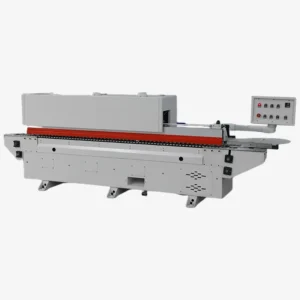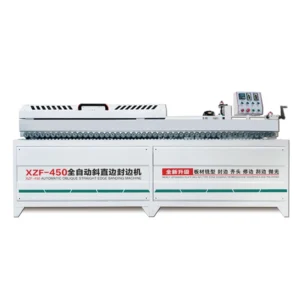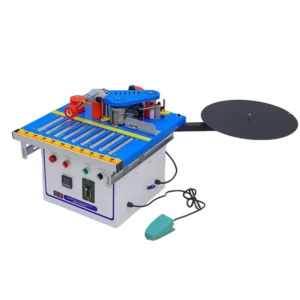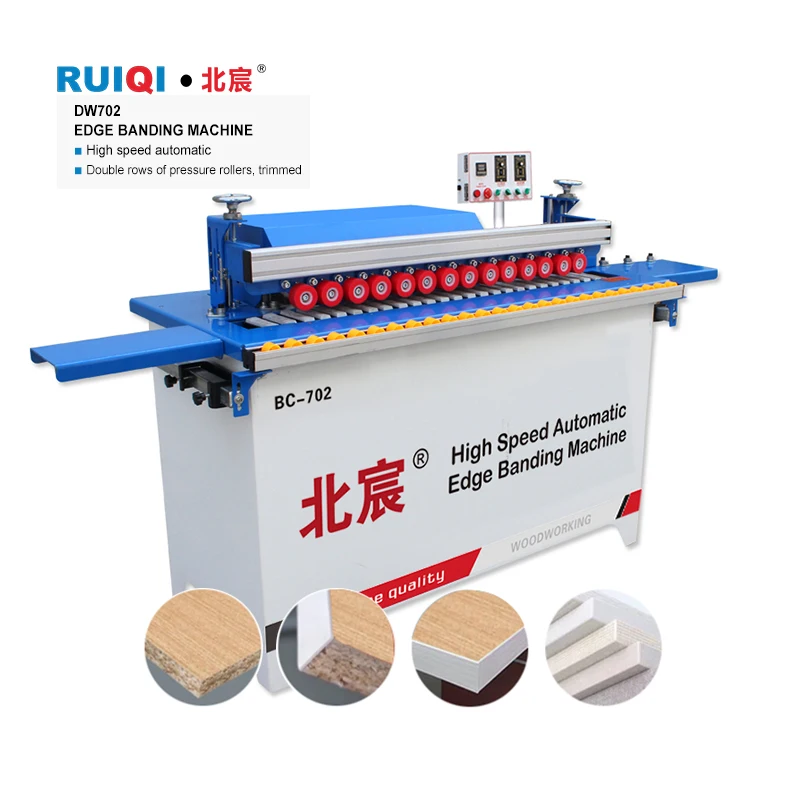
Edge banding machine
Click to enlarge
ISO 9001
CE Certified
OEM / ODM
12-Mo Warranty
Edge banding machine
Wood Finishing Edge Banding Machine – Industrial Application
<p>Supported by engineer-led configuration and factory test records on your specific panel stock before shipment.</p>
100+
Countries
MOQ 1
Unit
15-25 Days
Lead Time
3800W Total Power
Automatic Head And Tail
DW702
Edge Banding Machine
MDF Panel
Plywood Edge Banding
Process And Application
- Full OEM/ODM support -- custom logo, voltage (110V-440V), multilingual panels
- ISO 9001 & CE certified, 5 national patents, 60 professional engineers
- 12-month warranty, remote technical support & spare parts service
- Professional export packaging, customs clearance support, on-time delivery
Precision-ground workflow integration — the DW702 combines gluing, trimming, and polishing within a single compact footprint, addressing substrate-dependent edge quality issues that often surface only after full production batches are completed.
Technical Specifications
| Parameter | Value |
|---|---|
| Model | DW702 |
| Product Type | Automatic Edge Banding Machine |
| Total Power | 3800W |
| Voltage & Frequency | 220V/380V/customization (frequency to be confirmed at order) |
| Edge Banding Thickness Range | 0.3–3 mm |
| Edge Banding Height Range | 0–50 mm |
| Glue Pot Capacity | 1000 ml |
| Trimming Power | 800W × 2 |
| Polishing Power | 180W × 2 |
| Vacuum Power | 1200W |
| Transmission Power | 140W |
| Edge Power | 20W |
| Air Source Pressure | 0.4–0.8 MPa |
| Minimum Sheet Length | 25 cm |
| Minimum Sheet Width | 10 cm |
| Overall Dimensions (L×W×H) | 120 × 55 × 110 cm |
| Net Weight | 105 kg |
| Key Features | Automatic head-and-tail trimming, integrated vacuum extraction, multi-language control panel (Chinese/English standard, others on request) |
| Plug Options | EU, USA, AU, UK |
Application Suitability
| Application | Material or Output |
|---|---|
| Custom cabinet door edge finishing | MDF and particleboard with 0.4–2 mm PVC banding |
| Kitchen and bathroom cabinetry production | Plywood and blockboard with PVC or veneer edge strips |
| Furniture panel sealing for moisture protection | Medium density fiberboard with polymer or wood veneer edges |
| Polymer door frame edge treatment | Polymer door panels with matching PVC banding |
| Small-batch workshop edge processing | Mixed substrates including particleboard and solid wood panels |
Why Substrate Selection Changes Everything About Edge Banding Machine Woodworking Process
The same machine setting that produces perfect edges on MDF will fail on plywood if glue temperature and feed parameters are not adjusted for each material’s porosity and density.
I have watched cabinet makers unbox a new edge banding machine for furniture production, run test pieces on standard chipboard, and declare it ready for work — only to discover visible glue lines and poor adhesion when they switched to the plywood they actually used for bathroom vanities. Different substrates absorb heat differently, and particleboard’s open structure demands different glue penetration than the denser, layered surface of plywood. [NEED_CITE: substrate porosity and hot-melt adhesive penetration requirements] Without material-specific test runs before full production, edge adhesion failures appear only after assembled furniture reaches the customer.
How Glue Behavior Differs Across Common Panel Substrates
When running MDF through the DW702 edge banding machine, the material’s uniform density allows consistent glue film distribution across the panel edge. The 1000 ml glue pot maintains thermal stability across a continuous run of panels, which matters because temperature fluctuation causes uneven adhesive viscosity. Plywood, by contrast, presents alternating grain directions at the edge that create micro-channels where glue can pool or starve, making the automatic trimming sequence critical for removing excess material cleanly.
Matching Edge Banding Thickness to the Trim and Polish Sequence
The 0.3–3 mm edge banding thickness range covers both thin veneer strips and thicker PVC profiles used in high-wear furniture applications. Thicker banding requires more aggressive trimming passes, and the dual 800W trimming motors on the DW702 provide sufficient torque for clean end-cuts without tearing the material. Polishing wheels then remove any micro-burrs left by trimming, producing a sealed edge that prevents moisture ingress — a requirement for cabinetry installed in humid environments like bathrooms and kitchens. [NEED_CITE: edge sealing requirements for cabinetry in high-humidity installations]
What the Numbers Mean for Your Actual Panel Sizes
The minimum sheet dimensions of 25 cm length and 10 cm width define the smallest workpiece the DW702 can process through its feed mechanism. For workshops cutting narrow drawer components or small shelf brackets, this sets a practical lower bound on what can be edge-banded automatically versus manually. The 0–50 mm edge banding height accommodates standard panel thicknesses used in furniture and cabinet production, from thin 16 mm particleboard shelving up to thicker blockboard countertop substrates. Panel thickness directly affects how the trimming cutters engage the edge — thicker panels present more material to the trim station, requiring proper cutter alignment to avoid chipping the substrate face.
The Hidden Cost of Skipping Material-Specific Test Runs
Selecting an edge banding machine for furniture production without running your actual substrate through it first creates a false sense of readiness. I have seen workshops accept delivery based on factory test results using standard MDF, then spend days adjusting glue temperature and feed rate when their production plywood behaved completely differently. The cost shows up as scrapped panels, rework labor, and delayed shipments — problems that compound when the machine sits in a production line where every hour of downtime cascades to downstream assembly stations. [NEED_CITE: production downtime cost in panel processing workflows]
Why Sourcing Through Process-Focused Channels Matters
The DW702 ships with a factory test record run on your specified panel thickness and substrate type, so you can verify edge adhesion and trim quality before the machine leaves the factory. Voltage and plug configuration are confirmed at order stage — the 220V/380V options with EU, USA, AU, and UK plug types eliminate the scenario where a machine arrives and cannot be connected to local power without an external transformer. Operation manuals are supplied in the language your operators read, preventing commissioning delays caused by misread parameter settings. The four-stage QC process includes a pre-shipment verification that checks trimming alignment, vacuum suction, and glue flow against documented specifications. Engineer-led configuration recommendations account for your actual material mix, not just catalog specs.
Documentation & Verification
- Factory test record on your specific MDF, plywood, or particleboard substrate before dispatch
- Electrical schematic confirming voltage, frequency, and plug type for your facility
- Operation and maintenance manual in your agreed language with parameter setting guides
- Spare parts list covering trimming blades, polishing wheels, and vacuum filters
- CE declaration of conformity and ISO 9001 certificate for customs and compliance
Installation, Commissioning & Support
- Confirm floor space for the 120 × 55 cm footprint with clearance for panel infeed and outfeed
- Provide dedicated circuit matching the confirmed voltage and 3800W total power draw
- Machine ships as a single unit at 105 kg, positioned via standard pallet jack without crane rigging
- First-run calibration of trimming cutters and polishing wheels using your production panels
- Operator training on glue pot refill procedure for the 1000 ml capacity and daily vacuum filter cleaning
- Verify air compressor delivers stable 0.4–0.8 MPa to the machine’s pneumatic inlet
Before You Request a Quote
Share the specific substrates you run — MDF, plywood, particleboard, or a mix — along with the edge banding materials and thicknesses your products require. Specify your facility’s voltage, frequency, and the language your operators need on the control panel. If you are integrating this edge banding machine woodworking process into an existing line, describe your upstream cutting and downstream drilling stations so feed height and throughput can be matched.
Frequently Asked Questions
Q: Which substrates and edge banding materials is the DW702 compatible with?
A: The DW702 handles MDF, plywood, particleboard, blockboard, and polymer door panels with PVC or veneer edge banding from 0.3 to 3 mm thick. Glue behavior varies across substrates — MDF’s uniform density gives consistent adhesion, while plywood’s layered edge requires careful temperature control to avoid glue pooling in grain channels. Factory testing on your actual material confirms results before shipment.
Q: How does the automatic head-and-tail trimming work on short panels?
A: Dual 800W trimming motors perform automatic end cuts as each panel passes through, trimming the leading and trailing edge banding flush with the panel surface. The minimum sheet length the machine accepts is 25 cm, and minimum width is 10 cm. Panels below these dimensions require manual edge finishing or a different feed configuration discussed at the quotation stage.
Q: What air supply pressure does the machine require, and what happens if it is insufficient?
A: The DW702 requires 0.4–0.8 MPa air pressure to operate pneumatic clamping and feed components. Insufficient pressure causes inconsistent panel holding during trimming, resulting in uneven cuts or chipped edges. Install a dedicated air regulator with a pressure gauge at the machine inlet to maintain stable supply regardless of other equipment drawing from the same compressor system.
Q: What glue types work with the DW702 for different banding materials?
A: Standard EVA hot-melt adhesive suits most PVC and veneer banding applications on MDF and particleboard. PUR adhesive may be specified for moisture-resistant requirements such as bathroom cabinetry. The 1000 ml glue pot accommodates both types, though temperature settings differ between adhesive chemistries. Confirm your adhesive type at order stage so the factory can preset and document the correct operating temperature.
Q: What maintenance schedule applies to the trimming blades and polishing wheels?
A: Trimming blades require inspection after a set number of production hours depending on substrate abrasiveness — particleboard dulls blades faster than MDF. Polishing wheels wear gradually and should be replaced when surface finish quality degrades. The 1200W vacuum system filters need regular cleaning to maintain suction. A detailed maintenance schedule with intervals specific to your material mix is included in the operation manual.
Technical Specifications
| Parameter | Value |
|---|---|
| Product Name | Wood Finishing Edge Banding Machine – Industrial Application |
| Category | Edge banding machine |
| Voltage Options | 110V / 220V / 380V / 440V (customizable) |
| Frequency | 50Hz / 60Hz (customizable) |
| Certification | ISO 9001, CE |
| MOQ | 1 Unit |
| Lead Time | 15-25 Working Days |
| Warranty | 12 Months |
| OEM / ODM | Available -- logo, color, panel language |
* Detailed technical specifications vary by model. Please contact us with your specific requirements for a complete datasheet.
Shipping & Export
-
Export Packaging
Heavy-duty wooden crate with foam padding and moisture protection
-
Shipping Methods
Sea freight (FCL/LCL), air freight, express -- we support all methods
-
Customs Support
Full documentation: CO, commercial invoice, packing list, HS code assistance
-
Port of Loading
Tianjin / Qingdao port, China -- 20 years export experience
OEM / ODM Services
-
Logo & Branding
Custom logo printing, color scheme, and nameplate engraving
-
Voltage Configuration
110V / 220V / 380V / 440V, 50Hz / 60Hz -- any region supported
-
Multilingual Panels
Control panels in English, Spanish, French, Arabic and more
-
Custom Specifications
Modified dimensions, accessories, or feature sets on request
Get a Quote
Request Product Inquiry
Fill in your details and we'll respond within 24 hours with pricing and availability.
Direct Contact
How It Works
-
1
Confirm requirements & budget
Tell us your factory scale and processing needs
-
2
Receive recommendation & quote
We match the right machine with full specs
-
3
Negotiate & place order
OEM terms, voltage, payment and delivery
-
4
Production & QC inspection
Multi-stage quality control by 60 engineers
-
5
Export packaging & shipment
Professional packing, customs clearance
-
6
After-sales support
12-month warranty, remote tech support
You May Also Like