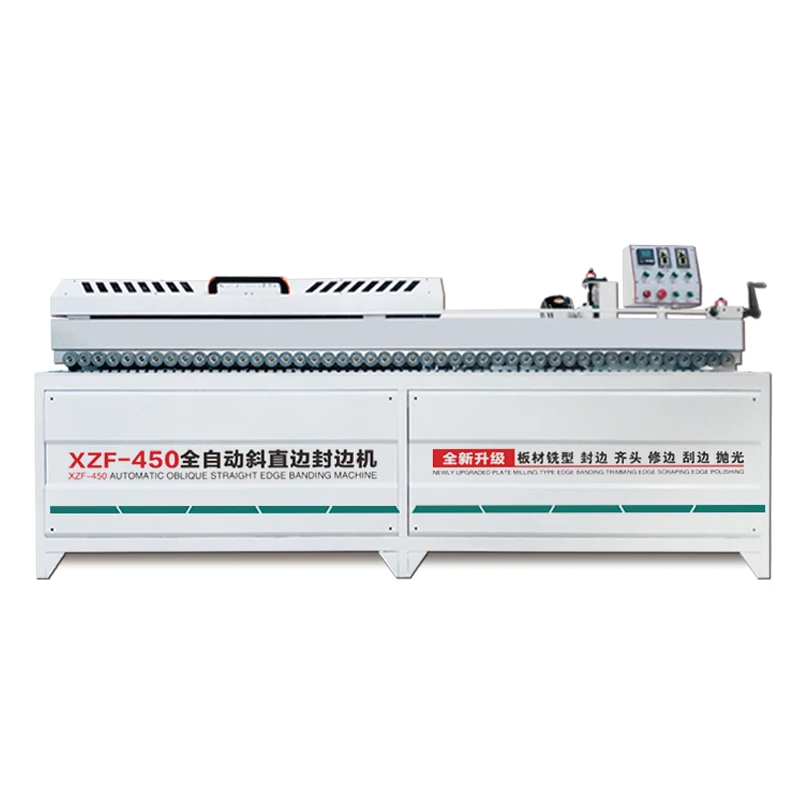
Edge banding machine
Click to enlarge
ISO 9001
CE Certified
OEM / ODM
12-Mo Warranty
Edge banding machine
45 Degree Automatic Edge Banding Machine for MDF Plywood – Industrial Application
<p><strong>XZF450 Automatic Edge Banding Machine, 9.5kW, 380V/415V, 0-12m/min Feed</strong> — handles 30°/45°/60° edge banding across MDF, plywood, and particleboard substrates. Pre-milling with 4kW motor removes saw marks for flat edges, while 0.3-3mm thickness range supports PVC, veneer, and melamine banding materials with consistent glue line control.</p> <ul> <li>7-stage process from pre-milling through polishing ensures assembly-ready edge quality on angled and straight panels</li> <li>Dual 2.2kW trimming motors deliver chip-free end cuts on MDF and particleboard at variable feed speeds</li> </ul> <p>Verified tolerance backed by four-stage QC and pre-shipment testing on your actual substrate samples, with operation manual provided in your facility's language.</p>
100+
Countries
MOQ 1
Unit
15-25 Days
Lead Time
380V
4KW Pre-Milling
Edge Banding Machine
MDF Plywood
Process Application
XZF450
- Full OEM/ODM support -- custom logo, voltage (110V-440V), multilingual panels
- ISO 9001 & CE certified, 5 national patents, 60 professional engineers
- 12-month warranty, remote technical support & spare parts service
- Professional export packaging, customs clearance support, on-time delivery
Patented Edge Consistency — verified through four-stage QC that checks every pre-milled panel before it leaves the factory floor.
Technical Specifications
| Parameter | Value |
|---|---|
| Model | XZF450 |
| Product Type | Automatic Edge Banding Machine |
| Total Power | 9.5 kW |
| Voltage | 380V / 415V |
| Pre-milling Motor | 4 kW |
| Trimming Power | 2.2 kW × 2 |
| Polishing Power | 0.4 kW × 2 |
| Vacuum Power | 550 W |
| Transmission Power | 180 W |
| Feed Speed | 0–12 m/min |
| Edge Banding Height | 0–50 mm |
| Edge Banding Thickness | 0.3–3 mm |
| Minimum Sheet Length | 30 cm |
| Minimum Sheet Width | 15 cm |
| Glue Pot Capacity | 4000 ml |
| Air Source Pressure | 0.5–0.7 MPa |
| Machine Dimensions | 300 × 65 × 135 cm |
| Machine Weight | 430 kg |
| Control Language Options | Chinese, English, Spanish, French (customizable) |
| Plug Options | EU, USA, AU, UK |
| Standard Functions | Pre-milling, 30°/45°/60° edge banding, trimming, scraping, polishing, high-power dust extraction |
Application Suitability
| Application | Material or Output |
|---|---|
| Custom cabinet door panels | MDF with PVC or melamine edge banding |
| Angled furniture joints | Plywood requiring 45° edge treatment |
| Wardrobe and shelving panels | Particleboard with 0.3–3 mm veneer or PVC strips |
| Polymer door framing | Solid wood and blockboard substrates |
| Medium-volume batch production | Mixed board runs requiring quick changeover |
Why Glue Lines Show Up on Some Boards and Not Others
Inconsistent edge banding quality across panel materials usually traces back to substrate edge flatness, not the glue itself.
I once spent an entire afternoon at a custom cabinet factory outside Dezhou. The owner had just uncrated a new edge bander and the PVC strip on his MDF doors kept lifting at the corners. The machine was fine — the problem was that his MDF density was higher than what the factory used during test runs, so the saw blade left micro-ridges that the glue could not bridge. After we added a pre-milling pass, the problem disappeared. That experience shaped how I approach every installation now: I ask buyers to send actual board samples before we configure the machine. [NEED_CITE: substrate density variation and its effect on edge adhesion]
When an edge banding machine process application skips the pre-milling stage, any saw marks, tear-out, or surface irregularity on the panel edge transfers directly into the finished product. The 4 kW pre-milling motor on the XZF450 removes a thin layer from the substrate edge before glue enters the equation, giving you a flat bonding surface regardless of whether you are running MDF, plywood, or particleboard.
How Pre-Milling Changes the Bonding Equation
The 4 kW pre-milling station cuts away saw marks and surface defects before the panel reaches the glue roller. This step matters because MDF and particleboard behave differently under a saw blade — particleboard tends to chip at the surface while MDF compresses and leaves raised fibers. Without pre-milling, the glue fills those imperfections rather than forming a uniform bond, which is why you see visible glue lines on some substrates and not others. The edge banding machine process application benefits from this stage most when switching between board types during a single production shift.
Managing Feed Speed Across Substrate Densities
A 0–12 m/min adjustable feed range lets operators slow down for dense MDF or speed up for lighter particleboard. Higher density boards need a slightly slower pass so the glue has adequate open time to wet the substrate surface. Running the same feed rate across every material is a common mistake I see in workshops that are scaling from manual to automated production. Dialing in the correct speed for each board type keeps the edge strip seated and prevents the trailing-end lifting that causes rework. [NEED_CITE: open time requirements for EVA hot melt adhesives on engineered wood panels]
Reading the Specs That Actually Matter on the Shop Floor
The 0.3–3 mm edge banding thickness range covers PVC, melamine, and real wood veneer strips, so a single machine handles the majority of materials a cabinet or furniture shop will stock. The dual 2.2 kW trimming motors perform flush and radius trimming in one pass, removing overhang without chipping brittle melamine edges. A 4000 ml glue pot holds enough EVA adhesive for sustained production without frequent refills, reducing temperature fluctuation in the glue bath. The 550 W vacuum extraction at the trimming station pulls chips away from the work zone, preventing debris from embedding in fresh glue joints downstream. These four parameters together determine whether your edge banding machine process application produces consistent, assembly-ready panels or generates a pile of rejects at the drilling station.
What Happens When Configuration Ignores the Workshop Reality
A machine arrives with a control panel the operator cannot read, and commissioning stalls for weeks while someone translates the interface. Or the voltage on the nameplate does not match the workshop supply, tripping breakers the first time the pre-milling motor starts under load. I have seen edge banders of this class sit idle for months because nobody confirmed whether the facility ran 380V or 415V before the order was placed. The cost is not just the shipping — it is the delayed production schedule and the frustrated crew standing around a machine they cannot switch on. [NEED_CITE: electrical supply mismatch as a leading cause of imported machinery downtime]
Why Production Managers Choose This Configuration
The XZF450 comes with pre-milling, trimming, scraping, and polishing in one continuous pass, so panels move from raw edge to finished edge without secondary handling. Language-configurable control panels mean the operator reads instructions in English, Spanish, or French from day one rather than guessing at icon meanings. Voltage is confirmed during the quotation stage against your facility supply, not discovered at the electrical cabinet. Every unit runs through a four-stage inspection — incoming components, in-process assembly, finished product function, and pre-shipment verification with your sample material when possible. The machine handles 30°/45°/60° angles within the same production run, removing the need for separate setups when your job list includes both straight cabinet sides and angled corner units.
Documentation & Verification
- Electrical schematic confirming 380V/415V wiring matched to your facility supply
- Factory test record on your actual MDF or plywood samples before dispatch
- Operation and maintenance manual in English, Spanish, French, or your preferred language
- Spare parts list with part numbers for trimming blades, glue rollers, and scraping inserts
- CE declaration of conformity for European market import compliance
- Packing photographs and customs documentation for smooth port clearance
Installation, Commissioning & Support
- Requires a level concrete floor with clearance for the 300 cm machine length plus infeed and outfeed space
- Dedicated 380V/415V three-phase circuit rated for the 9.5 kW total draw
- Ships partially assembled; trimming and polishing heads need final alignment on site
- First-run calibration includes glue temperature, feed speed, and trimming depth for your board stock
- Glue pot and scraper blade are the primary wear items — spare sets ship with the machine
- Weekly vacuum filter cleaning on the 550 W extraction unit maintains chip-free edge quality
What to Share Before Requesting a Quotation
Send us the board types you run most often — MDF density, particleboard grade, plywood ply count — along with the edge banding materials you stock. Confirm your workshop voltage and frequency, the language your operators need on the control panel, and whether your current production includes angled edge work at 45° or 60°. If you can ship a few panel offcuts and edge strip samples, we will run a test pass and include the results with your formal quotation.
Frequently Asked Questions
Q: How does pre-milling affect edge quality on MDF versus particleboard?
A: Particleboard chips easily at the cut edge, leaving a rough surface that prevents uniform glue contact. MDF compresses under a saw blade, raising fibers that create a textured bonding face. The 4 kW pre-milling station on the XZF450 removes a thin layer from either substrate, producing a flat edge that accepts glue evenly. The result is a consistent bond line with no visible gaps, regardless of which board type you load next.
Q: What glue temperature works best for PVC versus veneer edge banding?
A: EVA hot melt adhesives typically run between 180°C and 200°C for PVC strips, while real wood veneer often needs a slightly lower temperature to prevent scorching. The XZF450 glue pot maintains stable temperature across its 4000 ml capacity, but operators should verify the adhesive manufacturer’s datasheet for each material. Adjusting feed speed alongside temperature gives you finer control over open time and bond strength.
Q: Can the machine handle straight and 45° edge banding in one session?
A: Yes. The XZF450 supports 30°, 45°, and 60° edge banding in addition to standard 90° straight edges. Operators switch between angles by adjusting the guide rail and pressure rollers — no separate machine or tooling change is required. This flexibility matters when a single furniture order includes both flat cabinet sides and angled display shelving that need matching edge finishes.
Q: What dust extraction setup is needed to protect edge quality?
A: The built-in 550 W vacuum at the trimming station captures the majority of chips and dust at the source. For sustained production, connecting a central dust collector to the extraction port keeps the work zone clean and prevents debris from embedding in fresh glue joints. Regular filter maintenance on both the onboard vacuum and any external collector maintains consistent suction and extends machine component life.
Technical Specifications
| Parameter | Value |
|---|---|
| Product Name | 45 Degree Automatic Edge Banding Machine for MDF Plywood – Industrial Application |
| Category | Edge banding machine |
| Voltage Options | 110V / 220V / 380V / 440V (customizable) |
| Frequency | 50Hz / 60Hz (customizable) |
| Certification | ISO 9001, CE |
| MOQ | 1 Unit |
| Lead Time | 15-25 Working Days |
| Warranty | 12 Months |
| OEM / ODM | Available -- logo, color, panel language |
* Detailed technical specifications vary by model. Please contact us with your specific requirements for a complete datasheet.
Shipping & Export
-
Export Packaging
Heavy-duty wooden crate with foam padding and moisture protection
-
Shipping Methods
Sea freight (FCL/LCL), air freight, express -- we support all methods
-
Customs Support
Full documentation: CO, commercial invoice, packing list, HS code assistance
-
Port of Loading
Tianjin / Qingdao port, China -- 20 years export experience
OEM / ODM Services
-
Logo & Branding
Custom logo printing, color scheme, and nameplate engraving
-
Voltage Configuration
110V / 220V / 380V / 440V, 50Hz / 60Hz -- any region supported
-
Multilingual Panels
Control panels in English, Spanish, French, Arabic and more
-
Custom Specifications
Modified dimensions, accessories, or feature sets on request
Get a Quote
Request Product Inquiry
Fill in your details and we'll respond within 24 hours with pricing and availability.
Direct Contact
How It Works
-
1
Confirm requirements & budget
Tell us your factory scale and processing needs
-
2
Receive recommendation & quote
We match the right machine with full specs
-
3
Negotiate & place order
OEM terms, voltage, payment and delivery
-
4
Production & QC inspection
Multi-stage quality control by 60 engineers
-
5
Export packaging & shipment
Professional packing, customs clearance
-
6
After-sales support
12-month warranty, remote tech support
You May Also Like