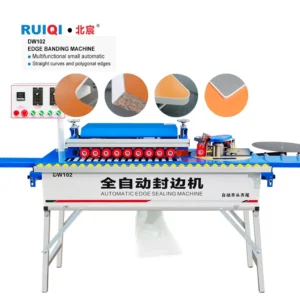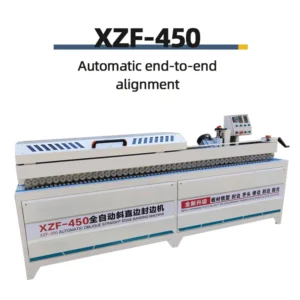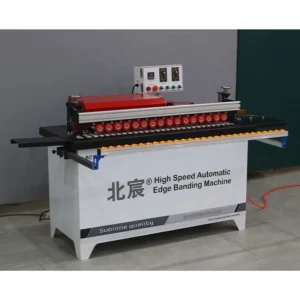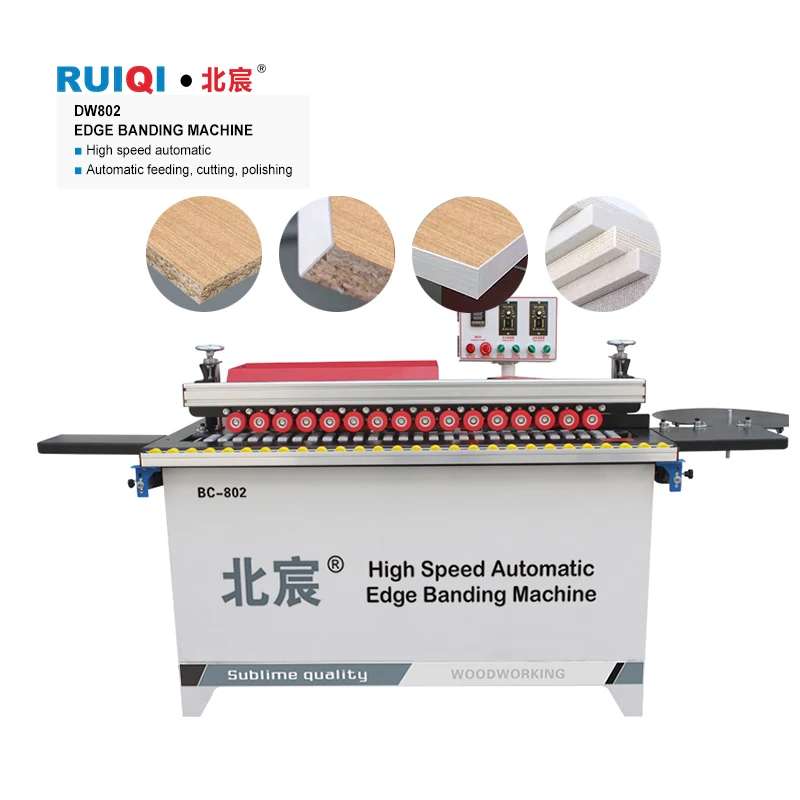
Edge banding machine
Click to enlarge
ISO 9001
CE Certified
OEM / ODM
12-Mo Warranty
Edge banding machine
Automatic Edge Banding Machine for Cabinet Melamine Board – Industrial Application
<p><strong>DW802 Automatic Edge Banding Machine, 4200W, 0.3–3mm Edge Thickness</strong> — processes MDF, particleboard, plywood and ecological board with dual 800W trimming stations and automatic head-and-tail cutting for clean end-finish. The 4000ml glue pot supports continuous runs while the integrated vacuum system manages dust at the trimming stage. - 220V/380V or custom voltage confirmed before production - Four-stage QC with pre-shipment test on your target substrate - CE certified with operation manual in your agreed language</p>
100+
Countries
MOQ 1
Unit
15-25 Days
Lead Time
380V
Cabinet Production
CE Certified
DW802
Edge Banding Machine
Process And Application
- Full OEM/ODM support -- custom logo, voltage (110V-440V), multilingual panels
- ISO 9001 & CE certified, 5 national patents, 60 professional engineers
- 12-month warranty, remote technical support & spare parts service
- Professional export packaging, customs clearance support, on-time delivery
Precision Ground Components — The DW802 Automatic Edge Banding Machine is built on verified tolerance and four-stage QC, delivering edge sealing consistency that downstream cabinet assembly relies on.
Technical Specifications
| Parameter | Value |
|---|---|
| Model | DW802 |
| Product Type | Automatic Edge Banding Machine |
| Total Power | 4200W |
| Voltage & Frequency | 220V / 380V / customization |
| Overall Dimensions (L×W×H) | 130 × 60 × 95 cm |
| Net Weight | 135 kg |
| Minimum Sheet Length | 25 cm |
| Minimum Sheet Width | 10 cm |
| Edge Banding Height | 0–50 mm |
| Edge Banding Thickness Range | 0.3–3 mm |
| Trimming Power | 800W × 2 stations |
| Polishing Power | 180W × 2 |
| Edge Feed Power | 140W |
| Transmission Power | 140W |
| Vacuum Power | 1200W |
| Glue Pot Capacity | 4000 ml |
| Air Source Pressure | 0.4–0.8 MPa |
| Standard Functions | Edge banding, trimming, polishing, automatic head and tail cutting, vacuum extraction |
| Language Options | Chinese and English standard; Spanish and other languages customizable |
| Plug Options | EU, USA, AU, UK |
| Assembly State | Fully assembled, packed in wooden crate |
| Certification | CE |
| Feed Speed | (basis not stated in source — confirm with manufacturer) |
| Tolerance | (basis not stated in source — verify test record) |
Application Suitability
| Application | Material or Output |
|---|---|
| Cabinet door and carcass edge sealing | MDF and particleboard with melamine or PVC banding |
| Custom furniture panel finishing | Plywood and ecological board with veneer or ABS edge |
| Small-batch joinery production | Solid wood panels requiring clean glue-line trimming |
| Mixed-substrate workshop runs | Alternating MDF, particleboard and plywood within a single shift |
Why Substrate Changes Everything on an Automatic Edge Banding Machine Process and Application
A machine tuned for MDF will not automatically produce acceptable edges on particleboard.
I learned this the hard way in a cabinet factory across Southeast Asia. We had dialled in every parameter — glue temperature, feed rate, trimming depth — on MDF test panels. The edge finish was clean, the glue line invisible. Then the production manager loaded particleboard, and within an hour half the workshop floor was stacked with rejects: chipped corners, white scrape marks, visible glue squeeze-out. The pre-milling and scraping stations needed a completely different setup for the softer substrate, and nobody had planned for that switch [NEED_CITE: substrate-specific edge banding parameter adjustment practices].
This is the gap between a spec sheet and actual output quality. The DW802 handles edge banding thickness from 0.3 to 3 mm and a glue pot capacity of 4000 ml, which gives it range — but range only matters if the operator understands how each substrate responds under the trimming and polishing heads. An automatic edge banding machine process and application guide like this one exists to close that gap before production starts, not after the reject pile grows.
Glue Behaviour Across Substrate Types
The 4000 ml glue pot on the DW802 reduces refill interruptions during continuous runs, which matters when you are processing a mixed batch of cabinet components. MDF absorbs glue differently than particleboard — the denser fibre structure of MDF allows a thinner glue film to achieve full adhesion, while particleboard’s porous surface demands a heavier application. When the glue film is too thin on particleboard, you get delamination at the trimming stage. When it is too thick on MDF, squeeze-out contaminates the scraping station and leaves white lines that require manual touch-up.
Temperature control inside the pot is equally substrate-dependent. PVC banding softens at lower temperatures and bonds well with standard EVA hot melt, while thicker ABS or veneer banding may need a higher pot temperature to maintain open-time adhesion. Confirming the glue pot temperature range with the manufacturer before ordering ensures the automatic edge banding machine process and application matches the specific banding materials in your production schedule [NEED_CITE: EVA hot melt temperature ranges for edge banding materials].
Trimming and Polishing: Where Edge Quality Is Won or Lost
The dual 800W trimming stations on the DW802 handle material removal across the full 0.3–3 mm banding thickness range. On thin PVC at 0.4 mm, the trimming cutters need minimal engagement — too aggressive a setting and the cutter digs into the panel face, scoring the melamine surface. On 2 mm ABS or wood veneer, the stations must remove substantially more material, and the cutter geometry must stay sharp to avoid tearing rather than shearing the banding edge.
The automatic head and tail cutting function addresses a specific failure point: the leading and trailing edges of each panel. Manual trimming of these endpoints introduces inconsistency, especially on smaller workpieces where the panel is harder to stabilise by hand. With minimum sheet dimensions of 25 cm by 10 cm, the DW802 can process narrow drawer sides and small shelf panels that larger edge banders cannot feed reliably. The integrated 1200W vacuum system pulls dust and trimming debris away from the polishing wheels, preventing embedded particles from scratching the banding surface during the final finish pass.
Reading the Spec Sheet Against Your Production Reality
The overall dimensions of 130 × 60 × 95 cm and a net weight of 135 kg place the DW802 in a compact footprint category, which matters for workshops where floor space constrains line layout. The 4200W total power draw across all stations — trimming, polishing, vacuum, transmission and edge feed — means the machine can run on a standard workshop circuit without dedicated high-amperage wiring, provided the voltage is confirmed at 220V or 380V to match local supply.
The edge banding height range of 0–50 mm covers standard panel thicknesses used in cabinet carcass and door production, from 16 mm particleboard up to thicker shelving stock. Air source pressure between 0.4 and 0.8 MPa drives the pneumatic actuators for head-and-tail cutting and station engagement; if your workshop compressor cannot sustain this range consistently, the pneumatic stations will cycle unevenly and edge quality will drift across a batch [NEED_CITE: pneumatic pressure stability requirements for edge banding machinery].
The Cost of Skipping Substrate-Specific Setup
Factories that buy a single edge bander and run it across every substrate without parameter adjustment pay for it in downstream assembly. Panels with visible glue lines get rejected at the inspection bench. Chipped corners on particleboard mean the hinge boring station cannot reference a clean edge, and the resulting misalignment shows up as doors that will not close square. Operators compensate by slowing the feed rate, which reduces throughput and creates a bottleneck that backs up the entire cutting-to-assembly line.
The hidden cost is rework time. A panel that fails edge quality inspection must be stripped, re-banded and re-trimmed — consuming three times the machine time of a first-pass good panel. Over a production week, these rejects accumulate into measurable lost capacity and wasted banding material [NEED_CITE: rework impact on panel processing workshop throughput].
Why Source This Configuration Here
In-house manufacturing with patented cutting mechanisms means the trimming stations on the DW802 are built to a verified tolerance standard, not assembled from generic off-the-shelf components. Four-stage QC covers incoming material inspection through pre-shipment verification, so the machine that arrives at your dock has been tested against specification before crating.
Voltage, plug type and control panel language are confirmed before production begins — the 220V/380V/custom voltage range and EU, USA, AU, UK plug options are configured to your facility supply, and the control interface is delivered in the language your operators read. An engineer-led configuration recommendation with a formal quotation within twenty-four hours means you receive a documented specification matched to your substrate and banding material mix, not a generic catalog price. Factory visits are welcomed for buyers who want to see the DW802 running on their own panel stock before committing to an order.
Documentation & Verification
- CE declaration of conformity covering the DW802 edge banding machine
- Machine specification sheet with confirmed glue pot temperature range
- Electrical schematic matching your ordered voltage and plug configuration
- Factory test record processed on your specified substrate and banding material
- Operation and maintenance manual in the agreed operator language
- Spare parts list covering trimming cutters, polishing wheels and pneumatic seals
Installation, Commissioning & Support
- Requires a level floor pad supporting 135 kg across the 130 × 60 cm footprint
- Dedicated circuit matching confirmed voltage (220V or 380V) at 4200W total draw
- Arrives fully assembled in wooden crate — uncrate, connect power and air supply
- First-run commissioning includes glue temperature calibration and trimming station alignment
- Compressor must sustain 0.4–0.8 MPa for consistent pneumatic head-and-tail cutting
- Trimming cutter and polishing wheel replacement intervals documented in manual
What to Include in Your Enquiry
To receive a configuration recommendation matched to your production, specify the substrate types and panel thicknesses you process most frequently, the edge banding materials and thicknesses in your current inventory, and the voltage and frequency at your facility. If you are running mixed batches of MDF, particleboard and plywood within the same shift, note the approximate volume split so the engineer can advise on glue pot setup and trimming station configuration. Request a sample processing test on your actual panel stock before finalising the order.
Frequently Asked Questions
Q: Which substrate and banding combinations produce the cleanest glue line on the DW802?
A: MDF with 0.4 mm PVC banding generally produces the most consistent glue line because the dense fibre surface allows a thin, even adhesive film. Particleboard with thicker ABS or veneer banding requires higher glue application and careful trimming setup to avoid chipping at the porous edge. Request a factory test record on your specific substrate before ordering.
Q: How does the 0.3–3 mm edge thickness range affect trimming station setup?
A: Thinner banding at 0.3–0.5 mm requires minimal trimming cutter engagement to avoid scoring the panel face, while 2–3 mm veneer or ABS demands deeper cuts and sharper tooling. The dual 800W trimming stations on the DW802 accommodate this range, but operators must adjust station depth when switching between banding thicknesses within a production run.
Q: What glue types are compatible with the 4000 ml pot, and what temperature range does it support?
A: The glue pot is designed for standard EVA hot melt adhesives commonly used in panel edge banding. The specific operating temperature range depends on the adhesive formulation and banding material — confirm the exact range with the manufacturer to ensure compatibility with PVC, ABS and veneer banding in your production mix.
Q: How does the automatic head-and-tail function perform on minimum-size panels?
A: The DW802 accepts panels as small as 25 cm by 10 cm, and the automatic head-and-tail cutting trims the leading and trailing banding edges without manual intervention. On these smaller workpieces, consistent pneumatic pressure at 0.4–0.8 MPa is critical to ensure clean cuts without panel shift during the trimming cycle.
Q: Can the machine maintain edge quality across continuous runs without glue temperature drift?
A: The 4000 ml glue pot volume provides thermal mass that helps stabilise temperature during continuous operation, reducing the frequency of refill interruptions. However, long production runs on heat-sensitive banding materials may require periodic temperature verification to prevent adhesive degradation or insufficient bonding at the trailing end of a batch.
Technical Specifications
| Parameter | Value |
|---|---|
| Product Name | Automatic Edge Banding Machine for Cabinet Melamine Board – Industrial Application |
| Category | Edge banding machine |
| Voltage Options | 110V / 220V / 380V / 440V (customizable) |
| Frequency | 50Hz / 60Hz (customizable) |
| Certification | ISO 9001, CE |
| MOQ | 1 Unit |
| Lead Time | 15-25 Working Days |
| Warranty | 12 Months |
| OEM / ODM | Available -- logo, color, panel language |
* Detailed technical specifications vary by model. Please contact us with your specific requirements for a complete datasheet.
Shipping & Export
-
Export Packaging
Heavy-duty wooden crate with foam padding and moisture protection
-
Shipping Methods
Sea freight (FCL/LCL), air freight, express -- we support all methods
-
Customs Support
Full documentation: CO, commercial invoice, packing list, HS code assistance
-
Port of Loading
Tianjin / Qingdao port, China -- 20 years export experience
OEM / ODM Services
-
Logo & Branding
Custom logo printing, color scheme, and nameplate engraving
-
Voltage Configuration
110V / 220V / 380V / 440V, 50Hz / 60Hz -- any region supported
-
Multilingual Panels
Control panels in English, Spanish, French, Arabic and more
-
Custom Specifications
Modified dimensions, accessories, or feature sets on request
Get a Quote
Request Product Inquiry
Fill in your details and we'll respond within 24 hours with pricing and availability.
Direct Contact
How It Works
-
1
Confirm requirements & budget
Tell us your factory scale and processing needs
-
2
Receive recommendation & quote
We match the right machine with full specs
-
3
Negotiate & place order
OEM terms, voltage, payment and delivery
-
4
Production & QC inspection
Multi-stage quality control by 60 engineers
-
5
Export packaging & shipment
Professional packing, customs clearance
-
6
After-sales support
12-month warranty, remote tech support
You May Also Like