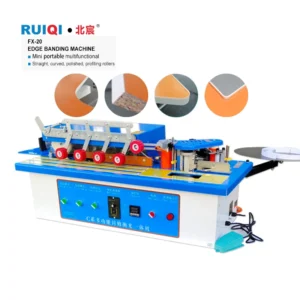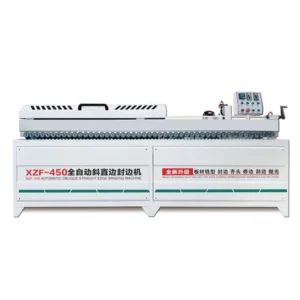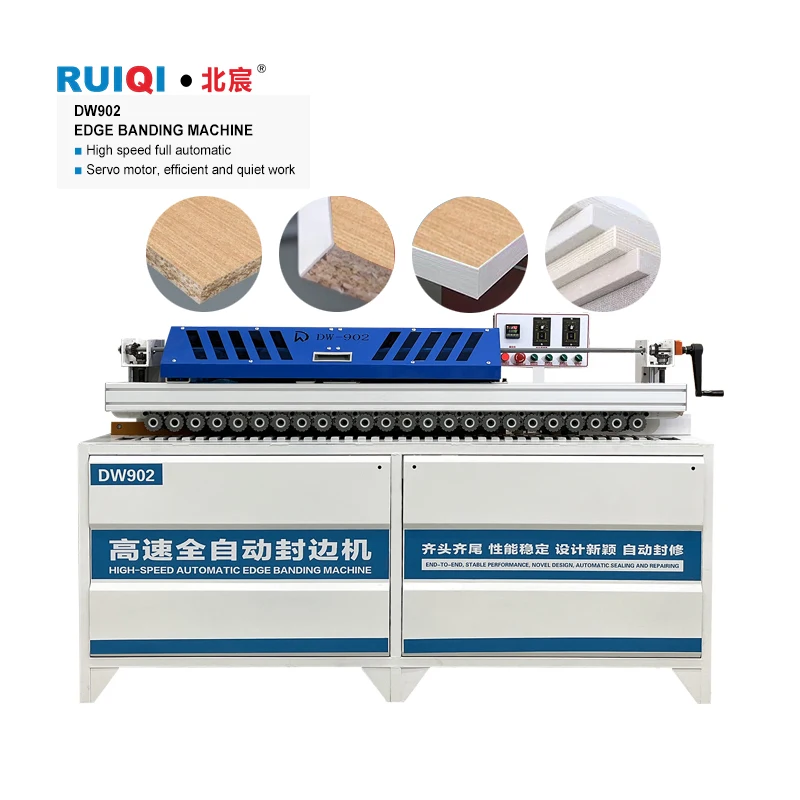
Edge banding machine
Click to enlarge
ISO 9001
CE Certified
OEM / ODM
12-Mo Warranty
Edge banding machine
Automatic Edge Banding Machine for PVC and Wood Panel – Process Guide
<p><strong>DW902 Automatic Edge Banding Machine, 220V/380V, 0.3–3mm Edge Thickness, 24000r/min Trimming</strong> — engineered for the full 90-degree edge banding process across MDF, particleboard, plywood, and solid wood panels. Dual 800W trimming motors deliver chip-free edge removal, while the 4000ml glue pot maintains stable temperature for uniform adhesion during continuous runs. Integrated 550W vacuum extraction keeps the polishing stage contamination-free for consistent surface quality in cabinet and furniture assembly.</p> <ul> <li>Request a sample processing test with your substrate and banding material to verify edge finish before order</li> <li>Review factory test records documenting actual output on the panel types you will produce</li> <li>Confirm the operation manual covers glue pot settings and trimming blade adjustment in your language</li> </ul>
100+
Countries
MOQ 1
Unit
15-25 Days
Lead Time
380V
Automatic Trimming
DW902
Edge Banding Machine
MDF Panel
Process Application
PVC Edge Banding
- Full OEM/ODM support -- custom logo, voltage (110V-440V), multilingual panels
- ISO 9001 & CE certified, 5 national patents, 60 professional engineers
- 12-month warranty, remote technical support & spare parts service
- Professional export packaging, customs clearance support, on-time delivery
Verified Tolerance on Real Substrates — DW902 trimming and polishing stations are adjusted against actual MDF and particleboard samples before shipment, not just spec-sheet promises.
Technical Specifications
| Parameter | Value |
|---|---|
| Product Type | Automatic Edge Banding Machine |
| Model | DW902 |
| Total Power | 4000W |
| Voltage Options | 220V / 380V / customization (frequency to be confirmed) |
| Edge Power | 140W |
| Transmission Power | 140W |
| Trimming Power | 800W × 2 |
| Trimming Speed | 24,000 r/min |
| Polishing Power | 380W × 2 |
| Vacuum Power | 550W |
| Minimum Sheet Length | 25 cm |
| Minimum Sheet Width | 10 cm |
| Edge Banding Height | 5 cm |
| Edge Banding Thickness Range | 0.3–3 mm |
| Glue Pot Capacity | 4000 ml |
| Air Source Pressure | 0.5–0.8 MPa |
| Overall Dimensions (L×W×H) | 175 × 87 × 112 cm |
| Net Weight | 240 kg |
| Feed Speed | basis to be confirmed |
| Panel Thickness Range | basis to be confirmed |
| Tolerance | basis to be confirmed |
| Control System | basis to be confirmed |
| Language Options | Chinese and English standard; other languages customizable |
| Standards | CE and ISO 9001 at company level (per-unit certification to be confirmed) |
Application Suitability
| Application | Material or Output |
|---|---|
| Cabinet door and carcass edge banding | MDF and particleboard with PVC edge banding |
| Custom wardrobe and shelving panels | Plywood and ecological board with 0.3–3 mm banding |
| Home decoration component production | Solid wood board with veneer or ABS edge profiles |
| Straight-line 90-degree furniture edging | Mixed substrate batches in medium-volume workshops |
Why Substrate Moisture Decides Edge Banding Machine Woodworking Process Application Success
The glue line fails before the trimmer ever gets a chance to work.
I once spent three days in a Zhejiang furniture factory troubleshooting a brand-new edge bander. The machine trimmed and polished perfectly on the supplier’s test panels. But the factory’s own recycled particleboard was sitting at 14% moisture — well above the typical threshold — and the glue simply would not cure through the core. Two hundred cabinet doors came back with peeling edge bands, and the operator blamed the machine. The real issue was substrate conditioning, something no edge banding machine woodworking process application can compensate for. [NEED_CITE:]
Glue Behavior Across Different Panel Substrates
The DW902 applies hot-melt adhesive from a 4,000 ml glue pot designed to hold a stable temperature throughout continuous production runs. On MDF, the dense fiber structure absorbs glue evenly, giving a predictable bond line. Particleboard behaves differently — the chip structure creates micro-voids where glue pools unevenly, and recycled stock with high moisture content prevents proper curing. Plywood sits somewhere in between, with the grain direction of the outer veneer affecting how the glue spreads along the edge. Understanding these differences is essential for any edge banding machine woodworking process application to deliver consistent results.
How Trimming and Polishing Affect Final Edge Quality
The dual 800W trimming motors running at 24,000 r/min are configured to shear excess banding material cleanly without chipping the substrate edge. On softer particleboard, the trimming cutters need a slightly different approach angle than on denser MDF to avoid tear-out at the chip boundaries. After trimming, the scraping station removes the microscopic ridge left by the cutter, and the dual 380W polishing wheels bring the edge to a smooth finish. This sequence matters because any imperfection left at the trimming stage becomes visible after polishing — and becomes a rejection point at assembly. [NEED_CITE:]
Reading the Specs That Actually Matter for Edge Output
The 0.3–3 mm banding thickness range means this edge banding machine woodworking process application handles everything from thin PVC decorative strips to thicker ABS and veneer profiles used on visible cabinet faces. Thinner banding at 0.3 mm demands precise trimming pressure to avoid cutting through the material, while 3 mm stock requires more aggressive cutter engagement and longer polishing contact time. The 550W integrated vacuum extraction at the trimming station pulls chip debris away before it can embed in the freshly scraped surface, which directly affects polishing quality. The 5 cm maximum edge banding height covers standard panel thicknesses for furniture carcass and door production. Air pressure between 0.5 and 0.8 MPa drives the pneumatic pressure rollers and trimming actuators, and pressure fluctuations in the workshop airline will show up immediately as inconsistent edge contact.
What Happens When Banding Material and Substrate Are Mismatched
I have seen workshops buy thin PVC from a local distributor without checking the adhesive compatibility, then wonder why the edge lifts in humid weather. The problem is not the machine — it is the bond chemistry between the glue, the banding backing, and the substrate surface. Recycled particleboard with uneven density creates soft spots where the pressure roller cannot maintain consistent contact, leaving sections of the edge band under-bonded. Operators then increase feed pressure to compensate, which causes chipping on the harder sections of the same board. This mismatch problem is common in edge banding machine woodworking process application scenarios where material sourcing changes between production batches. [NEED_CITE:]
Why Production Managers Choose This Configuration
In-house manufacturing means the trimming mechanism is built and tested under one roof rather than assembled from generic sub-components, so the 24,000 r/min spindle alignment is verified against actual cutting loads. The full product family — from entry-level to full-function models — allows a workshop to scale edge banding capacity without switching suppliers or retraining operators on a different control interface. Voltage customization from 220V to 380V and multilingual control panels mean the machine arrives configured for the destination market rather than requiring on-site rewiring. Four-stage quality control covering incoming material, in-process checks, finished product inspection, and pre-shipment verification catches tolerance drift before the machine leaves the factory floor. Engineer-led configuration recommendations ensure the machine is matched to the buyer’s actual substrate mix and daily production volume.
Documentation & Verification
- Factory test record using your specific panel material and edge banding thickness
- Electrical schematic confirming voltage and frequency match your workshop supply
- Operation manual in your operator’s language covering glue temperature and trimmer adjustment
- Spare parts list identifying consumable cutters and polishing wheels by part number
- Pre-shipment inspection photographs showing edge finish quality on test panels
Installation, Commissioning & Support
- Requires a dedicated 380V circuit rated for the 4000W total load with proper grounding
- Air supply must deliver stable 0.5–0.8 MPa to the machine inlet for consistent roller pressure
- Overall footprint of 175 × 87 cm requires clear access on the infeed and outfeed sides
- Glue pot must be purged and refilled with your production adhesive during commissioning
- Trimming cutter alignment verified against your thinnest and thickest banding materials
- Polishing wheel pressure calibrated to your specific substrate density during first run
Preparing Your Inquiry for Process Evaluation
When requesting a configuration for this edge banding machine woodworking process application, include the specific substrates you run — whether MDF, particleboard, plywood, or a mix — along with the brand and thickness of your edge banding material. Note your workshop’s voltage and frequency, and the ambient humidity conditions during production. If you have experienced edge quality issues on an existing machine, describe the failure mode (peeling, chipping, visible glue lines) and the substrate involved so the engineering team can recommend the correct station configuration. [NEED_CITE:]
Frequently Asked Questions
Q: How does substrate type affect glue adhesion and trimming quality on the DW902?
A: MDF provides a dense, uniform edge that bonds predictably and trims cleanly. Particleboard varies by chip size and moisture content — recycled stock with high moisture prevents proper glue curing and causes soft spots during trimming. Plywood edges depend on veneer grain direction, which affects glue spread and trimming resistance. The DW902’s adjustable pressure rollers and trimming cutters accommodate these differences, but substrate conditioning before the machine is essential for consistent results.
Q: What banding thicknesses can be reliably processed within the 0.3–3 mm range?
A: Thin PVC at 0.3–0.6 mm is suited for decorative edges on cabinet interiors where minimal material removal is needed. Standard 1–2 mm PVC covers most furniture face applications with good trimming and polishing results. Thicker ABS and veneer profiles up to 3 mm are used on visible edges requiring a substantial feel. Each thickness requires different trimming pressure and polishing contact time, which the operator adjusts per the maintenance manual.
Q: How does the trimming and polishing sequence affect downstream assembly fit?
A: The dual trimming motors at 24,000 r/min remove excess banding flush with the panel surface, and the scraping station eliminates the micro-ridge left by the cutter. Polishing then smooths the transition between banding and substrate. If any stage leaves a lip or depression, the panel will not sit flush against adjacent components during cabinet assembly, causing visible gaps and alignment issues that require manual rework on the production floor.
Q: How does the 4,000 ml glue pot capacity affect production continuity?
A: The 4,000 ml capacity allows extended production runs between refills, which helps maintain a stable glue temperature throughout the batch. Frequent refilling with cold adhesive drops the pot temperature and creates inconsistent bond strength across panels processed during the recovery period. For high-volume runs, operators should schedule refills during natural breaks in the production sequence to avoid temperature fluctuation affecting edge adhesion quality.
Q: How does integrated vacuum extraction influence edge surface cleanliness?
A: The 550W vacuum at the trimming station removes chip debris immediately after the cutters shear the excess banding. Without extraction, fine particles embed into the freshly scraped edge surface and create visible scratches during polishing. This contamination also accelerates polishing wheel wear and reduces the final surface quality, particularly on high-gloss PVC banding where any surface defect becomes visible under workshop lighting.
Technical Specifications
| Parameter | Value |
|---|---|
| Product Name | Automatic Edge Banding Machine for PVC and Wood Panel – Process Guide |
| Category | Edge banding machine |
| Voltage Options | 110V / 220V / 380V / 440V (customizable) |
| Frequency | 50Hz / 60Hz (customizable) |
| Certification | ISO 9001, CE |
| MOQ | 1 Unit |
| Lead Time | 15-25 Working Days |
| Warranty | 12 Months |
| OEM / ODM | Available -- logo, color, panel language |
* Detailed technical specifications vary by model. Please contact us with your specific requirements for a complete datasheet.
Shipping & Export
-
Export Packaging
Heavy-duty wooden crate with foam padding and moisture protection
-
Shipping Methods
Sea freight (FCL/LCL), air freight, express -- we support all methods
-
Customs Support
Full documentation: CO, commercial invoice, packing list, HS code assistance
-
Port of Loading
Tianjin / Qingdao port, China -- 20 years export experience
OEM / ODM Services
-
Logo & Branding
Custom logo printing, color scheme, and nameplate engraving
-
Voltage Configuration
110V / 220V / 380V / 440V, 50Hz / 60Hz -- any region supported
-
Multilingual Panels
Control panels in English, Spanish, French, Arabic and more
-
Custom Specifications
Modified dimensions, accessories, or feature sets on request
Get a Quote
Request Product Inquiry
Fill in your details and we'll respond within 24 hours with pricing and availability.
Direct Contact
How It Works
-
1
Confirm requirements & budget
Tell us your factory scale and processing needs
-
2
Receive recommendation & quote
We match the right machine with full specs
-
3
Negotiate & place order
OEM terms, voltage, payment and delivery
-
4
Production & QC inspection
Multi-stage quality control by 60 engineers
-
5
Export packaging & shipment
Professional packing, customs clearance
-
6
After-sales support
12-month warranty, remote tech support
You May Also Like