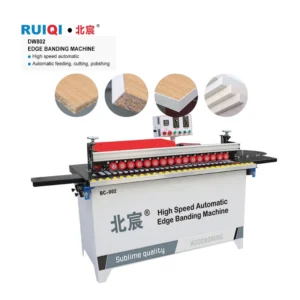
Edge banding machine
Click to enlarge
ISO 9001
CE Certified
OEM / ODM
12-Mo Warranty
Edge banding machine
Automatic Plywood Edge Banding Machine with PLC Control for Production
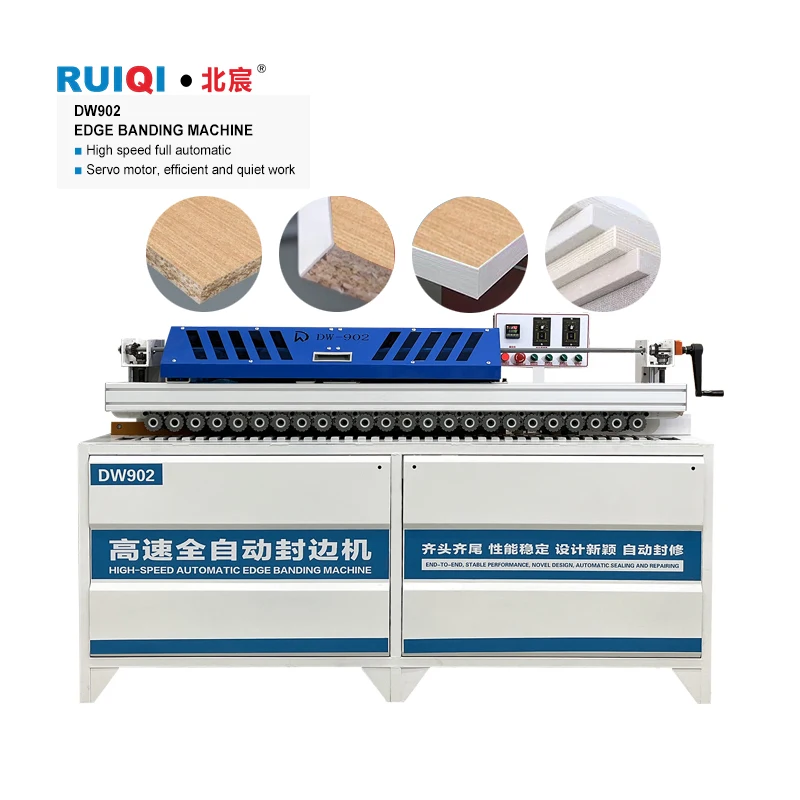
<p><strong>DW902 Automatic Edge Banding Machine, 220V/380V, PLC Control, 0.3-3mm Edge Thickness</strong> — designed for 90° straight-line edge banding on plywood, MDF, and particleboard.</p> <ul> <li>Double hot air system activates glue consistently across moisture-resistant and coated substrates, minimizing visible glue lines</li> <li>Trimming at 24000r/min with 4 oblique pressure wheel groups ensures clean edge finishing and stable bonding pressure for downstream assembly</li> </ul> <p>Supported by four-stage QC with pre-shipment test records on your specific substrate material.16017</p>
100+
Countries
MOQ 1
Unit
15-25 Days
Lead Time
CE Certified
DW902
Edge Banding Machine
MDF Cabinet
PLC Control
Plywood Furniture
Precision Processing
- Full OEM/ODM support -- custom logo, voltage (110V-440V), multilingual panels
- ISO 9001 & CE certified, 5 national patents, 60 professional engineers
- 12-month warranty, remote technical support & spare parts service
- Professional export packaging, customs clearance support, on-time delivery
Precision-Bonded Edges — the DW902 achieves consistent adhesion across MDF, plywood, and particleboard through its double hot air system and four groups of oblique pressure wheels, verified at ±0.3–3mm edge banding thickness.
Technical Specifications
| Parameter | Value |
|---|---|
| Model | DW902 |
| Product Type | Automatic Edge Banding Machine |
| Total Power | 4000W |
| Voltage | 220V / 380V / Customization Available |
| Control System | PLC Control |
| Trimming Power / Speed | 800W × 2 at 24000 r/min |
| Polishing Power | 380W × 2 |
| Edge Banding Thickness Range | 0.3–3 mm |
| Edge Banding Height | Up to 50 mm |
| Minimum Sheet Length | 250 mm |
| Minimum Sheet Width | 100 mm |
| Glue Pot Capacity | 4000 ml |
| Air Source Pressure | 0.5–0.8 MPa |
| Vacuum Power | 550W |
| Product Dimensions | 1750 × 870 × 1120 mm |
| Product Weight | 240 kg |
| Language Options | Chinese, English (customizable to Spanish or other languages) |
| Plug Options | EU, USA, AU, UK |
| Certifications | CE, ISO 9001 |
Application Suitability
| Application | Material or Output |
|---|---|
| Cabinet door and carcass edge finishing | MDF with melamine or PVC lamination |
| Plywood furniture panel edging | Plywood boards up to 50 mm edge height |
| Custom wardrobe and storage unit production | Particleboard with 0.3–3 mm PVC or veneer banding |
| Home decoration built-in joinery | Ecological board and solid wood panels |
| Small to medium batch panel processing | Mixed substrate workshops requiring flexible setup |
Why Visible Glue Lines Keep Showing Up on Finished Panels
Substrate porosity and surface energy vary between MDF, plywood, and particleboard — a single glue temperature setting cannot bond all three cleanly.
I once worked with a custom cabinet shop that ran MDF in the morning and particleboard after lunch on the same machine without adjusting parameters. By the end of the week, the particleboard edges were lifting and the MDF showed excess glue squeeze-out. The operator blamed the adhesive, but the real issue was the bonding process had no flexibility built in. [NEED_CITE: substrate surface energy differences and hot-melt adhesion requirements]. When a production manager sees inconsistent edge quality across materials, the root cause almost always traces back to how the machine delivers heat and pressure to the glue line.
How Heat Delivery Changes Between Substrates
The DW902 uses a double hot air system rather than a single heating element. This matters because MDF absorbs heat differently than plywood — MDF’s dense fiber structure holds thermal energy longer, while plywood’s layered grain dissipates it unevenly. With two air streams, the operator can maintain consistent glue activation temperature regardless of which substrate is running through the machine. This directly addresses one of the most common complaints on the workshop floor: edges that look fine immediately after banding but develop hairline separation after the panel cools and acclimates to the shop environment.
Pressure Uniformity Across the Bond Line
Four groups of oblique pressure wheels apply force at an angle rather than straight down. This angled contact compensates for minor surface irregularities in plywood veneers and the slight thickness variation you get in particleboard from the pressing stage. Straight vertical pressure tends to push thin PVC banding into low spots, leaving high spots under-bonded. The oblique arrangement spreads the clamping force across a wider contact patch, which is especially noticeable when running 0.3 mm melamine edging on boards that have not been sanded perfectly flat. [NEED_CITE: pressure wheel geometry effect on edge banding adhesion uniformity].
What the Trimming Speed Means for Edge Finish
The twin trimming heads run at 24000 r/min with 800W motors each. At this speed, the cutters shear through PVC and wood veneer banding cleanly rather than tearing the material, which is what happens when trimming motors lack sufficient RPM for the feed rate. The relationship between feed speed and cutter speed determines whether you get a glass-smooth trimmed edge or a micro-chipped surface that shows up under LED lighting in the finished kitchen or wardrobe. For plywood edges in particular, where the banding must bridge across alternating grain directions in the substrate, maintaining this cutter speed prevents the banding from lifting at the trim point.
The Cost of Ignoring Substrate-Specific Setup
When a workshop buys an edge bander based on price alone and skips the process matching step, the consequences show up downstream. Panels with poorly bonded edges fail during CNC routing because the vibration breaks the glue line. Assembled cabinets develop edge gaps within weeks as humidity cycles stress the weakened bond. Operators spend time re-gluing and re-trimming boards that should have been right the first time. The waste is not just material — it is the production hours lost to rework and the credibility lost with the end customer who sees the defect in their installed furniture. [NEED_CITE: edge bonding failure modes in panel furniture assembly].
Why Process Validation Matters Before You Commit
Every substrate behaves differently under heat, pressure, and mechanical trimming. A machine that handles one material well may struggle with another if the process parameters are not adjustable. This is why we approach every Automatic Edge Banding Machine configuration as a process problem first and a hardware question second. The DW902’s 0.3–3 mm thickness range covers most PVC and veneer materials used in cabinet and furniture production, but the actual bond quality depends on matching glue temperature, air volume, pressure wheel force, and trimming speed to your specific board stock.
What Sets This Procurement Path Apart
In-house manufacturing means the cutting mechanism patents and precision-ground components are built under one roof, not assembled from third-party kits. The four-stage quality control process — incoming material inspection, in-process checks, finished product verification, and pre-shipment testing — catches tolerance drift before the machine leaves the factory. Voltage customization from 220V to 380V (or other configurations) is handled during production, not as a field modification. An engineer reviews your processing requirements and delivers a formal configuration proposal within 24 hours, so you know exactly what the machine will do before you commit. Factory visits are welcomed, and sample processing tests on your actual panel material can be arranged before order confirmation. [NEED_CITE: manufacturing quality control stages in industrial woodworking machinery].
Documentation & Verification
- CE declaration of conformity covering the DW902’s electrical and mechanical safety requirements
- Machine specification sheet listing every process parameter including trimming speed and glue pot capacity
- Factory test record demonstrating edge bonding quality on your specific substrate and banding thickness
- Electrical schematic with voltage and plug configuration confirmed for your facility’s power supply
- Operation and maintenance manual in your chosen language with troubleshooting guidance
Installation, Commissioning & Support
- Requires a dedicated power circuit matching the confirmed voltage (220V or 380V) for the 4000W total load
- Compressed air supply at 0.5–0.8 MPa must be available at the machine’s 1750 mm footprint location
- PLC control panel configured in your specified language before shipment to reduce commissioning time
- Glue pot filled with 4000 ml capacity allows extended production runs between refill stops
- Trimming cutters and polishing pads included as wearing parts with recommended replacement intervals
- Vacuum extraction port for the 550W dust collection system requires connection to your workshop extraction network
Preparing Your Inquiry
To configure the right Automatic Edge Banding Machine setup for your line, share the substrate types and board thicknesses you process most frequently, along with the edge banding materials and thicknesses you plan to run. Let us know your facility’s voltage and frequency, your preferred control panel language, and whether you need a sample processing test on your actual panel stock before confirming the order.
Frequently Asked Questions
Q: How does substrate type affect glue temperature and pressure settings on this machine?
A: MDF, plywood, and particleboard each have different thermal conductivity and surface porosity. MDF retains heat longer, so glue temperature can run slightly lower. Plywood requires more even heat distribution due to its grain structure, which is where the double hot air system helps. Particleboard’s porous surface absorbs adhesive quickly, demanding consistent pressure from the oblique wheels to maintain a full bond line.
Q: What edge banding materials work within the 0.3–3 mm thickness range?
A: This range covers standard PVC edging used in cabinet production, thin melamine strips for cost-sensitive applications, and real wood veneer banding for higher-end furniture. Thicker materials at the 3 mm end typically require slower feed rates and higher glue volume to ensure complete adhesion across the full contact width.
Q: How can I verify edge bonding quality before the panels go to assembly?
A: Request a factory test record run on your specific substrate and banding material. The test should show cross-section inspection of the glue line, peel-back testing on sample edges, and visual inspection under strong lighting. You can also arrange a sample processing test at the factory before confirming your order.
Q: What is the relationship between the 24000 r/min trimming speed and feed rate?
A: Higher trimming RPM allows faster feed speeds while maintaining a clean cut. If the feed rate exceeds what the cutter speed can handle, the trimming heads tear the banding material instead of shearing it, leaving visible micro-chips on the edge. The 800W motors provide enough torque to sustain 24000 r/min under cutting load without stalling.
Technical Specifications
| Parameter | Value |
|---|---|
| Product Name | Automatic Plywood Edge Banding Machine with PLC Control for Production |
| Category | Edge banding machine |
| Voltage Options | 110V / 220V / 380V / 440V (customizable) |
| Frequency | 50Hz / 60Hz (customizable) |
| Certification | ISO 9001, CE |
| MOQ | 1 Unit |
| Lead Time | 15-25 Working Days |
| Warranty | 12 Months |
| OEM / ODM | Available -- logo, color, panel language |
* Detailed technical specifications vary by model. Please contact us with your specific requirements for a complete datasheet.
Shipping & Export
-
Export Packaging
Heavy-duty wooden crate with foam padding and moisture protection
-
Shipping Methods
Sea freight (FCL/LCL), air freight, express -- we support all methods
-
Customs Support
Full documentation: CO, commercial invoice, packing list, HS code assistance
-
Port of Loading
Tianjin / Qingdao port, China -- 20 years export experience
OEM / ODM Services
-
Logo & Branding
Custom logo printing, color scheme, and nameplate engraving
-
Voltage Configuration
110V / 220V / 380V / 440V, 50Hz / 60Hz -- any region supported
-
Multilingual Panels
Control panels in English, Spanish, French, Arabic and more
-
Custom Specifications
Modified dimensions, accessories, or feature sets on request
Get a Quote
Request Product Inquiry
Fill in your details and we'll respond within 24 hours with pricing and availability.
Direct Contact
How It Works
-
1
Confirm requirements & budget
Tell us your factory scale and processing needs
-
2
Receive recommendation & quote
We match the right machine with full specs
-
3
Negotiate & place order
OEM terms, voltage, payment and delivery
-
4
Production & QC inspection
Multi-stage quality control by 60 engineers
-
5
Export packaging & shipment
Professional packing, customs clearance
-
6
After-sales support
12-month warranty, remote tech support
You May Also Like