Edge banding machine
Click to enlarge
ISO 9001
CE Certified
OEM / ODM
12-Mo Warranty
Edge banding machine
CNC Woodworking Straight Bevel Edge Bander for Cabinet Door – Industrial Application
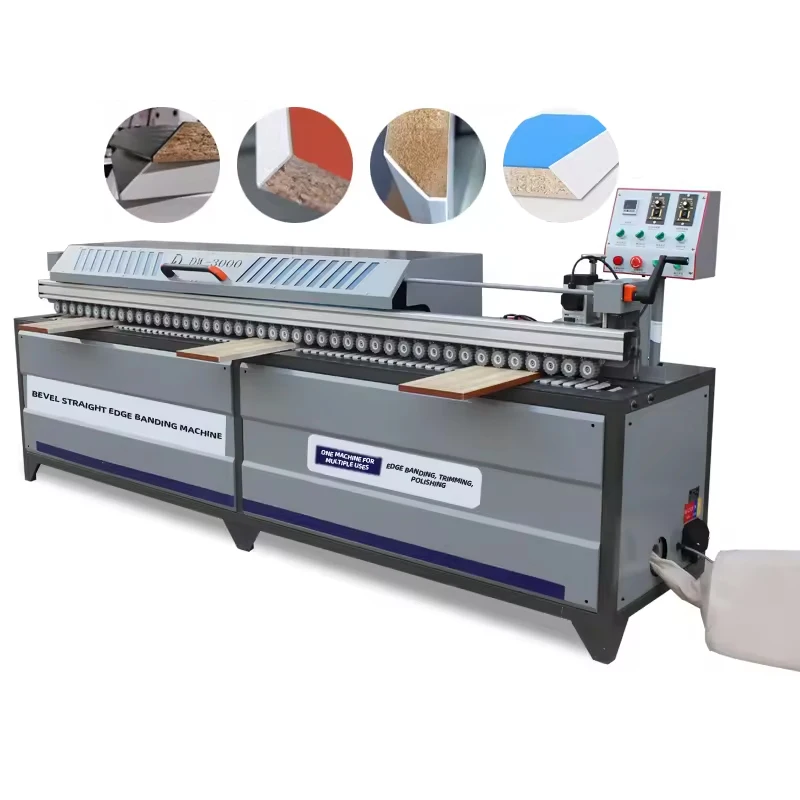
<p><strong>DW3000 Fully Automatic Straight and Bevel Edge Banding Machine, 11KW, 380V/415V, 0.3-3MM Edge Banding Thickness</strong> — handles both 45° bevel and 90° straight edge banding in a single pass.</p> <ul> <li><strong>Double heat gun design (2.2KW×2)</strong> with 8 groups of oblique pressure wheels (30-90° adjustable) controls glue spread and adhesion on MDF, particleboard, and plywood substrates, minimizing visible glue lines on cabinet door assemblies.</li> <li>Pre-milling, trimming, scraping, polishing, and slotting stations maintain edge profile accuracy for downstream cabinet door fitting.</li> </ul> <p>Four-stage QC with pre-shipment verification ensures voltage, glue pot stability, and trimming tolerance match your facility requirements before dispatch.</p>
100+
Countries
MOQ 1
Unit
15-25 Days
Lead Time
11KW Motor
380V
Bevel Edge Bander
Cabinet Door Production
DW3000
Edge Banding Machine
MDF Panel
Process And Application
- Full OEM/ODM support -- custom logo, voltage (110V-440V), multilingual panels
- ISO 9001 & CE certified, 5 national patents, 60 professional engineers
- 12-month warranty, remote technical support & spare parts service
- Professional export packaging, customs clearance support, on-time delivery
Precision-Ground Edge Banding — The DW3000 handles both 45-degree bevel and 90-degree straight profiles in one pass, addressing the inconsistent glue lines that cause cabinet door rejection on mixed MDF and particleboard runs.
Technical Specifications
| Parameter | Value |
|---|---|
| Model | DW3000 |
| Product Type | Fully Automatic Straight and Bevel Edge Banding Machine |
| Total Power | 11 kW |
| Voltage | 380V / 415V (basis not stated in source — confirm frequency and phase) |
| Pre-milled Motor | 2.2 kW |
| Heating Power | 2.2 kW × 2 (double heat gun design) |
| Feed Speed | 0–12 m/min (160W motor) |
| Transmission Speed | 0–12 m/min (180W motor) |
| Trimming Motor | 2.2 kW × 2 (spindle trimming motor, 3 spindle motors total) |
| Polishing Motor | 0.4 kW × 2 |
| Vacuum Power | 550 W |
| Edge Banding Height | 0–50 mm |
| Edge Banding Thickness | 0.3–3 mm |
| Minimum Sheet Length | 30 cm |
| Minimum Sheet Width | 15 cm |
| Glue Pot Capacity | 4000 ml |
| Air Source Pressure | 0.5–0.7 MPa |
| Oblique Pressure Wheels | 8 groups, angle adjustable from 30° to 90° |
| Feeding Mechanism | Double cylinder feeding belt |
| Product Size | 299 × 65 × 130 cm |
| Product Weight | 430 kg |
| Control Panel Language | Chinese and English standard; other languages customizable |
| Plug Options | EU, USA, AU, UK available |
| Edge Band Slotting Device | Included, slotting height adjustable |
| Certifications | CE, ISO 9001 |
Application Suitability
| Application | Material or Output |
|---|---|
| Cabinet door production requiring 45° bevel edge finishing | MDF, particleboard with PVC edge banding |
| Straight edge banding on wardrobe and storage panels | Plywood and particleboard substrates |
| Custom furniture components with mixed edge profiles | Solid wood panels with veneer banding |
| Slotting for integrated hinge or connector preparation | MDF and particleboard up to 50 mm banding height |
Why Voltage Verification Must Precede the Purchase Order
A 380V machine arriving at a 415V facility will sit idle until the electrical infrastructure is rebuilt.
The edge banding machine process and application depends entirely on consistent power delivery. I remember a bevel edge bander shipped to a Middle East workshop where the local grid ran 415V but the machine was configured for 380V without confirmation. The unit refused to start, the heater elements drew excessive current on startup attempts, and the production manager spent weeks sourcing a step-down transformer. The glue pot alone on this DW3000 pulls 2.2 kW × 2 across two heat guns — running that load on mismatched voltage risks element burnout before the first panel is edged [NEED_CITE: voltage and frequency standards by export market]. Production managers specifying dual-angle equipment must confirm phase, frequency, and tolerance band before signing.
Glue Line Control Across Substrate Variations
The edge banding machine process and application reveals its weaknesses when switching between MDF and particleboard without adjustment. MDF absorbs adhesive differently than particleboard due to fiber density, often leaving starved glue joints on MDF edges while particleboard shows squeeze-out. The double heat gun design on the DW3000 allows the operator to set independent temperature zones for the glue roller and the banding material itself, keeping EVA adhesive at optimal viscosity as substrates change through the shift.
How Eight Pressure Wheel Groups Maintain Profile Contact
When a cabinet door profile shifts from a 90-degree straight edge to a 45-degree bevel, the contact surface area between the pressure wheel and the banding changes. Eight groups of oblique pressure wheels, adjustable from 30 to 90 degrees, distribute clamping force across the full banding width regardless of the angle. This prevents the localized pressure points that cause the banding to lift at the trailing edge after the panel exits the machine. The adjustable range means the same setup handles both profile types without mechanical changeover between batches [NEED_CITE: edge banding adhesion mechanics on engineered wood substrates].
Reading the Spec Sheet Against Actual Workshop Conditions
The 0–12 m/min feed speed governs how long each panel section remains in the glue activation zone. Slower feed gives EVA adhesive more dwell time under heat, improving bond strength on dense MDF, but reduces throughput on high-volume particleboard runs. The 4000 ml glue pot capacity determines how many linear meters of edging can run before refill — at full 50 mm banding height and 3 mm thickness, consumption increases noticeably, requiring the operator to monitor levels during long production runs. The pre-milling station at 2.2 kW removes saw marks and sizing errors from the panel edge before adhesive application, which is essential for maintaining the claimed tolerance through trimming and polishing.
What Happens When Configuration Choices Get Skipped
Skipping the voltage and frequency confirmation means discovering incompatibility only after the container clears customs. The machine sits in the workshop while electricians reconfigure the supply panel, the production schedule collapses, and the furniture factory misses its own delivery commitments. Similarly, accepting a standard control panel in a language the operator cannot read stalls commissioning entirely — the operator guesses at parameters, glue temperature drifts, and banding adhesion fails intermittently across the shift. These are not equipment defects but configuration oversights that could have been caught at the quotation stage [NEED_CITE: industrial equipment commissioning failures due to documentation language barriers].
Why Production Managers Source This Equipment Here
In-house manufacturing with patented cutting mechanisms means the tolerance stated on the spec sheet is measurable on the machine before it leaves the factory. The full product family ranges from entry-level to full-function models, so a workshop scaling from manual edge banding to automated dual-angle capability can remain within one supplier relationship. Voltage, control panel language, and plug configuration are confirmed per order rather than assumed. A four-stage QC process covers incoming material, in-process assembly, finished product testing, and pre-shipment verification — the factory test record documents performance on your specific substrate. Engineer-led configuration recommendations arrive within 24 hours of inquiry, with formal quotation including voltage confirmation.
Documentation & Verification
- CE declaration of conformity for the DW3000 edge banding configuration
- ISO 9001 certificate covering manufacturing and quality management processes
- Machine specification sheet with confirmed voltage, frequency, and phase details
- Electrical schematic matching the installed motor and heater configuration
- Factory test record showing edge banding results on your substrate material
- Operation and maintenance manual in the agreed operator language
- Spare parts list with part numbers for wear components
Installation, Commissioning & Support
- 11 kW total power draw requires a dedicated circuit with appropriate breaker rating
- 299 cm length requires workshop access for straight-line positioning
- Double cylinder feeding belt tension calibrated during first commissioning run
- Glue pot temperature stabilized across both 2.2 kW heat guns before production start
- Oblique pressure wheel angles set for your standard 45° and 90° profiles
- Control panel language confirmed and verified with operator during training
- Air supply at 0.5–0.7 MPa confirmed at machine inlet before glue system activation
Before You Submit an Inquiry
Specify the substrate types you will run most frequently — MDF, particleboard, plywood, or a mix — and the edge banding material and thickness range you require. Confirm your facility voltage, phase, and frequency so the electrical configuration matches your grid. Indicate whether your operators need the control panel in a language beyond Chinese and English, and whether you need sample processing tests on your own panel stock before shipment.
Frequently Asked Questions
Q: How does substrate density affect glue line visibility, and what machine adjustments compensate?
A: MDF fibers absorb EVA adhesive more readily than particleboard, often leaving starved joints. The double heat gun design allows independent temperature adjustment for the glue roller and banding pre-heater. Slower feed speed increases adhesive dwell time on dense substrates, while the eight-group oblique pressure wheels maintain consistent clamping force across both material types.
Q: Which edge banding materials work within the 0.3–3 mm thickness range?
A: PVC, ABS, melamine, and veneer banding all fall within this range. Thicker PVC and real wood veneer benefit from the pre-heater function to soften the material before it reaches the pressure zone. The adjustable slotting device accommodates varying banding heights up to 50 mm across different panel thicknesses.
Q: How does pre-milling interact with downstream trimming to maintain edge profile accuracy?
A: The 2.2 kW pre-milling motor removes saw marks and sizing errors from the raw panel edge, creating a flat reference surface. The three spindle trimming motors then cut the banding flush to this prepared edge. Without pre-milling, trimming follows the existing panel irregularities, producing visible variation in the finished edge profile.
Q: How do you verify pressure wheel contact across curved versus straight cabinet door profiles?
A: The eight oblique pressure wheel groups adjust independently from 30 to 90 degrees. On curved profiles, the operator sets the wheels to match the contour, distributing pressure across the full banding width. Straight edges use a uniform 90-degree setting. Consistency is confirmed by running test panels and inspecting the glue spread pattern after trimming.
Technical Specifications
| Parameter | Value |
|---|---|
| Product Name | CNC Woodworking Straight Bevel Edge Bander for Cabinet Door – Industrial Application |
| Category | Edge banding machine |
| Voltage Options | 110V / 220V / 380V / 440V (customizable) |
| Frequency | 50Hz / 60Hz (customizable) |
| Certification | ISO 9001, CE |
| MOQ | 1 Unit |
| Lead Time | 15-25 Working Days |
| Warranty | 12 Months |
| OEM / ODM | Available -- logo, color, panel language |
* Detailed technical specifications vary by model. Please contact us with your specific requirements for a complete datasheet.
Shipping & Export
-
Export Packaging
Heavy-duty wooden crate with foam padding and moisture protection
-
Shipping Methods
Sea freight (FCL/LCL), air freight, express -- we support all methods
-
Customs Support
Full documentation: CO, commercial invoice, packing list, HS code assistance
-
Port of Loading
Tianjin / Qingdao port, China -- 20 years export experience
OEM / ODM Services
-
Logo & Branding
Custom logo printing, color scheme, and nameplate engraving
-
Voltage Configuration
110V / 220V / 380V / 440V, 50Hz / 60Hz -- any region supported
-
Multilingual Panels
Control panels in English, Spanish, French, Arabic and more
-
Custom Specifications
Modified dimensions, accessories, or feature sets on request
Get a Quote
Request Product Inquiry
Fill in your details and we'll respond within 24 hours with pricing and availability.
Direct Contact
How It Works
-
1
Confirm requirements & budget
Tell us your factory scale and processing needs
-
2
Receive recommendation & quote
We match the right machine with full specs
-
3
Negotiate & place order
OEM terms, voltage, payment and delivery
-
4
Production & QC inspection
Multi-stage quality control by 60 engineers
-
5
Export packaging & shipment
Professional packing, customs clearance
-
6
After-sales support
12-month warranty, remote tech support
You May Also Like