Edge banding machine
Click to enlarge
ISO 9001
CE Certified
OEM / ODM
12-Mo Warranty
Edge banding machine
Curve & Linear Edge Banding Machine for Plywood – Process Application
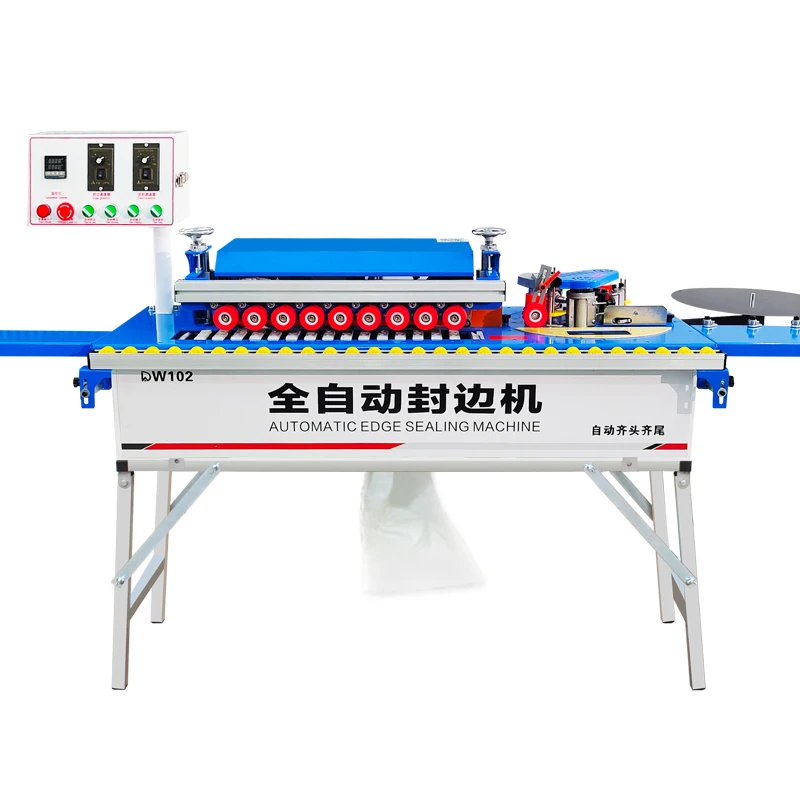
<p><strong>DW102 Automatic Curve / Linear Edge Banding Machine, 220V/380V, 0.3–3mm Banding Thickness</strong> — handles both curved and straight profiles with automatic head/tail trimming and dual polishing stations.</p> <ul> <li>1000 ml glue pot and vacuum hold maintain adhesion consistency on MDF, plywood, and particleboard</li> <li>Edge trimming and polishing in one pass deliver assembly-ready panels without rework</li> </ul> <p>Supported by engineer-led configuration and pre-shipment testing on your actual substrate material to verify seal and trim quality before dispatch.</p>
100+
Countries
MOQ 1
Unit
15-25 Days
Lead Time
380V
CE Certified
DW102
Edge Banding Machine
MDF Panel
Plywood
Process Application
- Full OEM/ODM support -- custom logo, voltage (110V-440V), multilingual panels
- ISO 9001 & CE certified, 5 national patents, 60 professional engineers
- 12-month warranty, remote technical support & spare parts service
- Professional export packaging, customs clearance support, on-time delivery
Process Validation First — Every DW102 edge banding machine ships with a factory test record run on your specified substrate, not just a generic demo board.
Technical Specifications
| Parameter | Value |
|---|---|
| Model | DW102 |
| Product Type | Automatic Curve / Linear Edge Banding Machine |
| Rated Power | 3800W |
| Voltage & Frequency | 220V/380V/customization (frequency to be confirmed) |
| Overall Dimensions (L×W×H) | 128×47×69 cm |
| Net Weight | 75 kg |
| Minimum Sheet Length | 25 cm |
| Minimum Sheet Width | 5 cm |
| Edge Banding Height | 0–50 mm |
| Edge Banding Thickness | 0.3–3 mm |
| Trimming Power | 650W × 2 |
| Polishing Power | 180W × 2 |
| Glue Pot Capacity | 1000 ml |
| Vacuum Power | 1200W |
| Air Supply Requirement | 0.5–0.8 MPa |
| Transmission Power | 60W |
| Standard Features | Curved and straight edge banding, edge trimming, polishing, automatic head and tail, with vacuum |
| Language Options | Chinese, English (customizable to Spanish or other languages) |
| Plug Options | EU, USA, AU, UK |
| Certification | CE |
Application Suitability
| Application | Material or Output |
|---|---|
| Cabinet door and carcass edge sealing | MDF, particleboard, plywood |
| Custom furniture visible edge finishing | MDF, blockboard, wood panels |
| Polymer door profile banding | Polymer door substrates with straight and curved edges |
| Small-batch joinery with mixed panel shapes | Plywood, MDF with both linear and radius profiles |
Why Substrate Choice Matters More Than Machine Price
The edge banding machine process application substrate combination determines your final edge quality far more than any spec sheet number.
When a workshop buys an edge bander based solely on feed speed or motor count, the first real test comes when the operator loads a panel that behaves differently from the factory demo material. Particleboard absorbs heat differently from MDF. Plywood edges are porous and uneven. A cheap melamine edge band reacts to glue temperature in ways that premium PVC never will. I once watched a Peruvian cabinetmaker run beautiful PVC samples on a test day, then switch to a local supplier’s melamine strip the following week — the glue temperature was wrong for that material, and the edges lifted in waves. The edge banding machine process application substrate triangle must be validated together, not assumed [NEED_CITE: adhesive temperature profiles for PVC versus melamine edge banding materials].
Curved and Straight Banding in One Footprint
The DW102 handles both radius profiles and linear edges without requiring a second machine or a manual changeover station. For a workshop that produces shaped cabinet doors alongside standard rectangular carcass panels, this dual capability keeps floor space requirements modest. The vacuum hold system at 1200W keeps the panel registered against the fence whether the edge is straight or following a curve, which directly affects how consistently the trimming stations engage the material.
How Trimming and Polishing Stations Define Assembly Readiness
Two independent 650W trimming motors cut the head and tail of the edge band flush with the panel face, then the 180W × 2 polishing wheels remove the micro-burr left behind. This sequence matters because downstream hardware — hinges, drawer runners, shelf pins — all reference the panel edge as a datum surface. If the trimming step leaves a ridge, the hinge mounting plate sits slightly proud and the door hangs crooked. The edge banding machine process application substrate relationship shows up here most clearly: denser substrates like MDF produce cleaner trim results than particleboard, which can chip at the cut line if the trimming blade is dull [NEED_CITE: edge chipping behavior on particleboard versus MDF during mechanical trimming].
Reading the Numbers That Actually Affect Your Panels
The 0–50 mm edge banding height range covers standard 18 mm cabinet board as well as thicker shelving and worktop substrates up to 50 mm. The 0.3–3 mm banding thickness range spans thin PVC foil for concealed edges up to solid wood lipping for visible furniture faces. The 1000 ml glue pot capacity supports a continuous run of panels before requiring a refill — for a small workshop doing a batch of thirty cabinet doors, that means the operator does not stop mid-batch to top up adhesive, which avoids cold-start glue lines on the first panel after a pause. The 0.5–0.8 MPa air supply requirement means the pneumatic pressure rollers and trimming actuators need a stable compressor line; if your shop air drops below 0.5 MPa during simultaneous use of other pneumatic tools, the pressure roller contact force decreases and band adhesion weakens at the leading edge of the panel.
What Happens When Voltage Is Confirmed After Shipment
A machine wired for 380V three-phase arriving at a workshop with only 220V single-phase supply becomes a heavy crate sitting on the floor. The DW102 supports 220V/380V/customizable voltage configurations, but the specific frequency — 50Hz or 60Hz — must match the local grid. Motors rated for 50Hz running on a 60Hz supply spin faster than designed, which changes feed speed and trimming motor RPM, altering the cut quality in ways that are difficult to diagnose without an oscilloscope. Confirming voltage and frequency before production starts avoids this entirely [NEED_CITE: voltage and frequency standards by export market].
Why Procurement Starts With Your Actual Material Stack
The manufacturer offers in-house production with patented cutting mechanisms, verified tolerance records, and a four-stage QC process that includes pre-shipment testing on your specified panel material. Voltage, language, and plug type customization is treated as standard configuration, not a special request. The engineer-led proposal process means the quotation you receive within 24 hours is based on your actual panel dimensions, edge profile shapes, and production volume rather than a generic catalog price. The full documentation package — from electrical schematics confirming your voltage to operation manuals in your operator’s language — ships with the machine so commissioning does not stall waiting for translated paperwork.
Documentation & Verification
- CE declaration of conformity specific to the DW102 edge banding machine
- Factory test record using your panel material and edge band thickness before dispatch
- Electrical schematic confirming voltage, frequency, and plug type for your facility
- Operation and maintenance manual in the language your operators read
- Spare parts list identifying trimming blades, polishing wheels, and glue pot wear components
- Pre-shipment packing photographs for logistics and customs clearance
Installation, Commissioning & Support
- Dedicated electrical circuit matching confirmed voltage (220V or 380V) with appropriate breaker rating for 3800W total draw
- Stable compressor line delivering 0.5–0.8 MPa with a moisture trap upstream of the machine air inlet
- Level floor surface required within the 128×47 cm footprint to prevent panel drift during feeding
- First-run parameter setting for glue temperature matched to your specific edge band material type
- Trimming and polishing station adjustment demonstrated on your sample panels during remote commissioning guidance
- Replacement trimming blades and polishing wheels identified in the spare parts list for ongoing inventory planning
What We Need to Configure Your Machine Correctly
Before any quotation is issued, the engineering team needs to know which panel materials you run most often — MDF, plywood, particleboard, or a mix — along with the edge banding material type and thickness you source locally. Share your facility voltage and frequency, and whether your operators need the control interface in English, Spanish, or another language. If your production includes curved panel edges, provide the minimum radius so the vacuum hold and feed path can be verified against your actual workpieces.
Frequently Asked Questions
Q: How does edge quality differ between MDF, plywood, and particleboard on this machine?
A: MDF produces the cleanest trimmed edge due to its uniform density. Plywood edges are fibrous and may require slower feed speeds to prevent tear-out. Particleboard is the most prone to chipping at the trim line, and sharp trimming blades are essential. Requesting a factory test on your specific substrate before shipment confirms the edge finish your assembly process requires.
Q: What glue type and temperature work best for PVC versus veneer edge banding on curved profiles?
A: PVC banding typically bonds well with standard EVA hot melt at moderate temperatures, while natural wood veneer requires higher glue temperature and more precise control to avoid bleed-through. On curved profiles, the glue open time matters more because the band follows a longer path. Confirming your banding material type during the proposal stage ensures the glue pot settings match.
Q: How does the vacuum system affect banding adhesion on curved versus straight edges?
A: The 1200W vacuum hold keeps the panel registered against the machine fence, which is critical on curved edges where lateral forces push the workpiece away from the feed path. On straight edges, the vacuum supplements mechanical clamping. If the vacuum cup placement does not match your panel width range, curved edge banding can shift during the glue application phase.
Q: What downstream assembly tolerance can I expect after trimming and polishing?
A: The automatic head and tail trimming cuts the band flush with the panel face, and the polishing stations remove residual burrs. This produces an edge that sits flat for hinge mounting and drawer runner installation. Actual assembly tolerance depends on your panel cutting accuracy upstream — the bander trims to the panel edge it receives, so any gap or overhang in the substrate cut carries through to the finished edge.
Q: How do I match feed speed to different edge banding thicknesses from 0.3 to 3 mm?
A: Thinner banding such as 0.3 mm PVC foil requires careful feed speed control to prevent stretching or tearing during application. Thicker 3 mm solid wood lipping needs adequate glue coverage and longer pressure roller contact time. The DW102 transmission system and pressure roller arrangement handle the full 0.3–3 mm range, and the operator manual provides starting parameters for each thickness bracket that you fine-tune during your first production runs.
Technical Specifications
| Parameter | Value |
|---|---|
| Product Name | Curve & Linear Edge Banding Machine for Plywood – Process Application |
| Category | Edge banding machine |
| Voltage Options | 110V / 220V / 380V / 440V (customizable) |
| Frequency | 50Hz / 60Hz (customizable) |
| Certification | ISO 9001, CE |
| MOQ | 1 Unit |
| Lead Time | 15-25 Working Days |
| Warranty | 12 Months |
| OEM / ODM | Available -- logo, color, panel language |
* Detailed technical specifications vary by model. Please contact us with your specific requirements for a complete datasheet.
Shipping & Export
-
Export Packaging
Heavy-duty wooden crate with foam padding and moisture protection
-
Shipping Methods
Sea freight (FCL/LCL), air freight, express -- we support all methods
-
Customs Support
Full documentation: CO, commercial invoice, packing list, HS code assistance
-
Port of Loading
Tianjin / Qingdao port, China -- 20 years export experience
OEM / ODM Services
-
Logo & Branding
Custom logo printing, color scheme, and nameplate engraving
-
Voltage Configuration
110V / 220V / 380V / 440V, 50Hz / 60Hz -- any region supported
-
Multilingual Panels
Control panels in English, Spanish, French, Arabic and more
-
Custom Specifications
Modified dimensions, accessories, or feature sets on request
Get a Quote
Request Product Inquiry
Fill in your details and we'll respond within 24 hours with pricing and availability.
Direct Contact
How It Works
-
1
Confirm requirements & budget
Tell us your factory scale and processing needs
-
2
Receive recommendation & quote
We match the right machine with full specs
-
3
Negotiate & place order
OEM terms, voltage, payment and delivery
-
4
Production & QC inspection
Multi-stage quality control by 60 engineers
-
5
Export packaging & shipment
Professional packing, customs clearance
-
6
After-sales support
12-month warranty, remote tech support
You May Also Like