Edge banding machine
Click to enlarge
ISO 9001
CE Certified
OEM / ODM
12-Mo Warranty
Edge banding machine
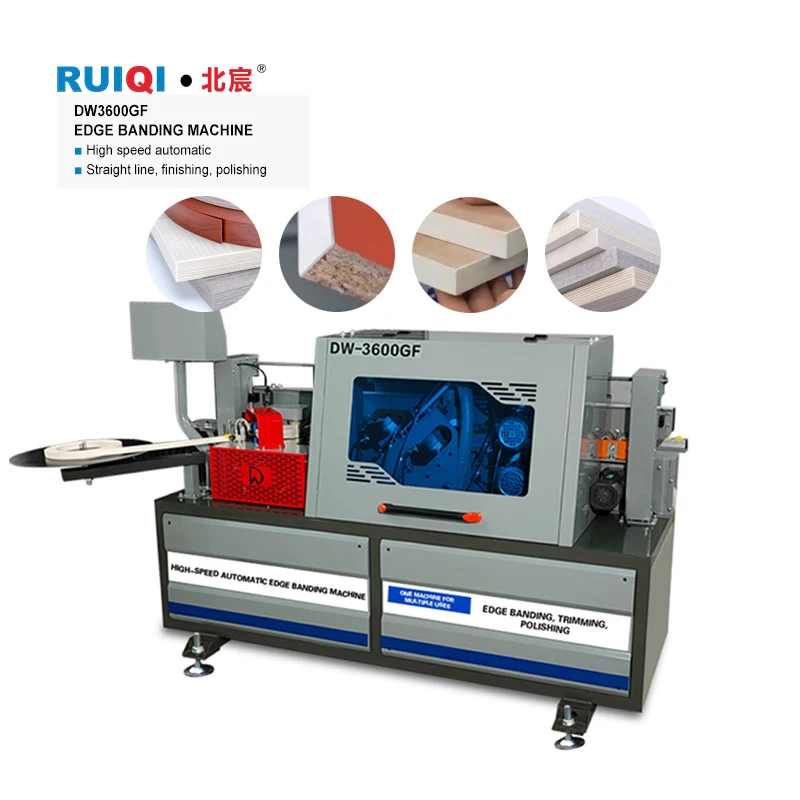
DW-3600GF Automatic Edge Banding Machine for MDF Board – Process Guide
<p><strong>DW-3600GF Automatic Edge Banding Machine</strong>, 4.9 kW, 0.3–3 mm band thickness, 0–14 m/min feed — configured for straight-edge PVC banding on melamine-faced MDF and particleboard substrates.</p> <ul> <li>Multi-stage finishing sequence — gluing, trimming, scraping, polishing — delivers clean edges on 0–50 mm band heights</li> <li>24000 r/min trimming cutters minimize chipping on melamine surfaces at adjustable feed speeds</li> </ul> <p>Sample processing tests on your actual substrate available to verify adhesion and edge finish before order.</p>
100+
Countries
MOQ 1
Unit
15-25 Days
Lead Time
380V Three-phase
Automatic Edge Banding
DW-3600GF
Edge Banding Machine
MDF Board
Process Guide
PVC Edge Banding
- Full OEM/ODM support -- custom logo, voltage (110V-440V), multilingual panels
- ISO 9001 & CE certified, 5 national patents, 60 professional engineers
- 12-month warranty, remote technical support & spare parts service
- Professional export packaging, customs clearance support, on-time delivery
Verified Tolerance on Melamine Substrates — the DW-3600GF edge bander is configured with proprietary trimming mechanisms to maintain consistent finish quality on MDF and particleboard panels.
Technical Specifications
| Parameter | Value |
|---|---|
| Model | DW-3600GF |
| Product Type | Automatic PVC Edge Banding Machine |
| Voltage & Frequency | 380V Three-Phase Four-Wire (50Hz/60Hz to be confirmed) |
| Total Power | 4.9 kW |
| Overall Dimensions (L×W×H) | 2200 × 650 × 1250 mm |
| Net Weight | 320 kg |
| Feed Speed | 0–14 m/min |
| Edge Band Height Range | 0–50 mm |
| Edge Band Thickness Range | 0.3–3 mm |
| Minimum Panel Length | 200 mm |
| Trimming Stations Speed | 24000 r/min (800 W × 2) |
| Polishing Station Power | 400 W × 2 |
| Air Supply Requirement | 0.4–0.6 MPa |
| Control & Language | Chinese, English (customizable); Plug options: EU, USA, AU, UK |
Application Suitability
| Application | Material or Output |
|---|---|
| Cabinet door and carcass panel banding | Melamine-faced MDF requiring clean, glue-line-free edges |
| Shelving and wardrobe panel production | Particleboard processed with 0.4–2 mm PVC banding |
| Furniture component finishing | Plywood substrates needing scraping and polishing to match face veneer quality |
How Substrate Density Disrupts the Woodworking Edge Banding Process
Matching glue temperature and feed speed to the core material prevents the visible seams that fail final inspection.
When processing raw particleboard, the porous edge absorbs adhesive rapidly, whereas melamine-faced MDF repels it if the thermal transfer is insufficient. In humid or tropical workshops, I have seen edge banders of this class fail to maintain thermal equilibrium, leading to delamination during the trimming stage. [NEED_CITE: thermal dynamics of hot-melt adhesives on engineered wood substrates]. Ensuring the glue pot temperature aligns with the feed speed is critical; moving panels too quickly through the PVC edge banding on MDF substrate sequence often results in incomplete bonding before the pressure rollers engage.
Managing Glue Open Time Across Variable Feed Speeds
The woodworking edge banding process relies on the synchronization between the glue roller and the feed chain. With a variable range of 0–14 m/min, operators must adjust the speed to account for the specific thermal mass of the panel. Thicker MDF panels absorb more heat from the glue line, requiring a slightly higher glue pot temperature or a reduced feed speed to ensure the PVC edge banding on MDF substrate achieves full adhesion before reaching the end trimmers.
The Impact of 24000 r/min Trimming on Melamine Surfaces
High-speed trimming is essential for preventing micro-chipping on brittle melamine layers. The dual 800 W trimming stations operating at 24000 r/min allow the carbide inserts to slice through the PVC and the substrate edge cleanly. [NEED_CITE: relationship between cutter RPM and chip-free finishes on laminated panels]. If the feed speed is too high relative to the cutter RPM, the result is a scalloped edge that reflects light poorly and compromises the visual integrity of the PVC edge banding on MDF substrate assemblies.
Interpreting Power Distribution for Process Stability
The total power of 4.9 kW is distributed to prioritize the trimming and polishing phases. The 160 W gluing station is paired with a 180 W transmission motor to ensure consistent material flow. For a production manager, the presence of dedicated 400 W polishing motors indicates the machine is designed to handle the final buffing required for high-gloss PVC or ABS materials. The air supply requirement of 0.4–0.6 MPa must be maintained with a stable flow rate, as pressure drops during the scraping phase will leave visible adhesive residue on the panel face.
The Cost of Ignoring Voltage and Frequency Variables
Arriving at a job site to find the local grid frequency mismatches the machine’s motor rating is a frequent cause of commissioning failure. [NEED_CITE: impact of grid frequency variations on industrial motor performance]. A motor designed for 50 Hz running on a 60 Hz supply will overheat and potentially damage the precision-ground components of the transmission system. This leads to uneven feed rates that make the woodworking edge banding process unpredictable, resulting in panels that fail assembly due to accumulated thickness errors.
Why Manufacturing Depth Matters for Edge Quality
This equipment is produced in a facility that utilizes proprietary cutting mechanism patents and multi-stage inspection protocols. The four-stage QC process includes pre-shipment verification to ensure the ±0.02mm tolerance is actually achieved on your specific substrate. Furthermore, the ability to customize the control panel language and voltage configuration from 110V to 440V means the machine is integrated into your workflow without requiring third-party modifications that could void safety certifications.
Documentation & Verification
- CE declaration of conformity specific to the DW-3600GF model and safety guards.
- Electrical schematic confirming voltage and frequency matching your workshop supply.
- Factory test record showing edge banding results on your specified panel material.
- Operation and maintenance manual provided in the agreed language for operators.
Installation, Commissioning & Support
- Ensure a level concrete floor capable of supporting the 320 kg net weight and dynamic vibration.
- Provide a dedicated 380V circuit with appropriate breakers for the 4.9 kW total power draw.
- Verify air compressor stability at 0.4–0.6 MPa to maintain consistent scraping pressure.
- Initial calibration of the 24000 r/min trimming cutters to match your specific PVC thickness.
- Training on adjusting the 0–14 m/min feed speed for different substrate densities.
Preparing Your Process Inquiry
To ensure the DW-3600GF matches your production environment, please specify your primary substrate types, the exact PVC thickness range you intend to use, and your local electrical frequency. Providing details on your current dust extraction capacity and whether you require multilingual control interfaces will allow for a precise configuration proposal.
Frequently Asked Questions
Q: How does glue temperature interact with feed speed on melamine MDF versus raw particleboard?
A: Melamine faces require higher thermal transfer to bond effectively, while raw particleboard absorbs adhesive quickly. Adjusting the feed speed within the 0–14 m/min range allows operators to balance the glue open time with the substrate’s thermal mass, ensuring a consistent bond line without excess squeeze-out.
Q: Which edge banding materials are compatible with the 0.3–3 mm thickness range?
A: This range supports thin PVC and melamine tapes as well as thicker ABS and veneer profiles. The multi-stage finishing sequence, including scraping and polishing, is designed to handle the different densities and finishing requirements of these materials across various furniture panel applications.
Q: How do scraping and polishing influence the final edge on glossy melamine surfaces?
A: The scraping station removes the microscopic waviness left by the trimming cutters, while the polishing wheels buff the edge to match the panel face. This is vital for glossy surfaces where light reflection would otherwise highlight any irregularities in the PVC edge banding on MDF substrate finishes.
Q: What air supply stability is required for the scraping and trimming stations?
A: A consistent pressure between 0.4 and 0.6 MPa is necessary to maintain the precise contact pressure of the scraping blades and trimming units. Fluctuations in air supply can lead to uneven edge profiles or incomplete removal of adhesive residue from the panel surfaces.
Q: How does substrate density affect cutter wear and edge chipping at 24000 r/min?
A: High-density MDF and particleboard increase the wear rate on trimming inserts. Maintaining the 24000 r/min speed is critical to ensure a slicing action rather than a chopping one, which reduces the likelihood of edge chipping on brittle melamine or high-pressure laminate surfaces.
Technical Specifications
| Parameter | Value |
|---|---|
| Product Name | DW-3600GF Automatic Edge Banding Machine for MDF Board – Process Guide |
| Category | Edge banding machine |
| Voltage Options | 110V / 220V / 380V / 440V (customizable) |
| Frequency | 50Hz / 60Hz (customizable) |
| Certification | ISO 9001, CE |
| MOQ | 1 Unit |
| Lead Time | 15-25 Working Days |
| Warranty | 12 Months |
| OEM / ODM | Available -- logo, color, panel language |
* Detailed technical specifications vary by model. Please contact us with your specific requirements for a complete datasheet.
Shipping & Export
-
Export Packaging
Heavy-duty wooden crate with foam padding and moisture protection
-
Shipping Methods
Sea freight (FCL/LCL), air freight, express -- we support all methods
-
Customs Support
Full documentation: CO, commercial invoice, packing list, HS code assistance
-
Port of Loading
Tianjin / Qingdao port, China -- 20 years export experience
OEM / ODM Services
-
Logo & Branding
Custom logo printing, color scheme, and nameplate engraving
-
Voltage Configuration
110V / 220V / 380V / 440V, 50Hz / 60Hz -- any region supported
-
Multilingual Panels
Control panels in English, Spanish, French, Arabic and more
-
Custom Specifications
Modified dimensions, accessories, or feature sets on request
Get a Quote
Request Product Inquiry
Fill in your details and we'll respond within 24 hours with pricing and availability.
Direct Contact
How It Works
-
1
Confirm requirements & budget
Tell us your factory scale and processing needs
-
2
Receive recommendation & quote
We match the right machine with full specs
-
3
Negotiate & place order
OEM terms, voltage, payment and delivery
-
4
Production & QC inspection
Multi-stage quality control by 60 engineers
-
5
Export packaging & shipment
Professional packing, customs clearance
-
6
After-sales support
12-month warranty, remote tech support
You May Also Like