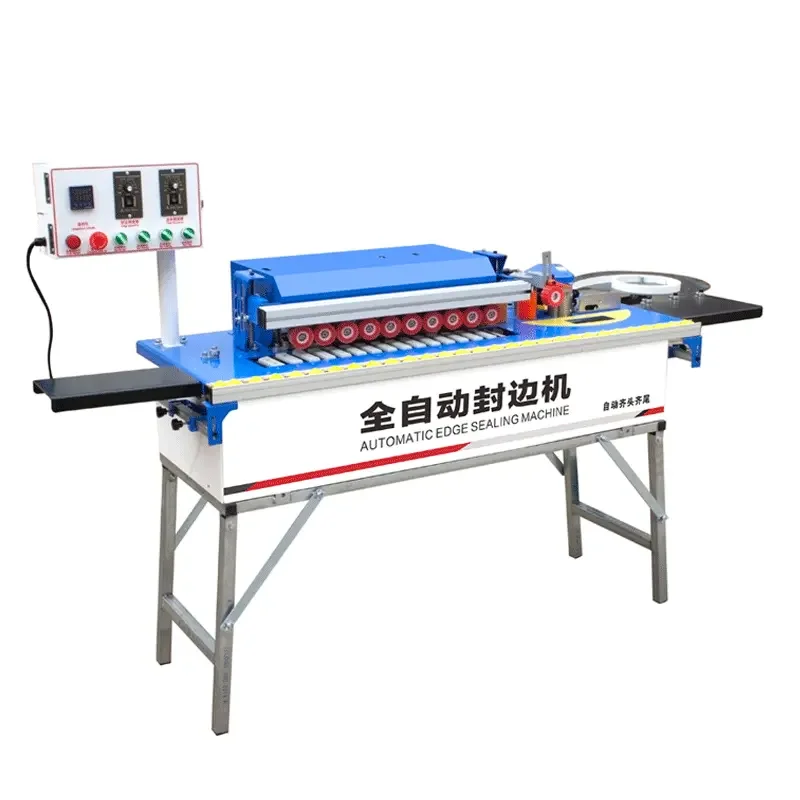
Edge banding machine
Click to enlarge
ISO 9001
CE Certified
OEM / ODM
12-Mo Warranty
Edge banding machine
DW102 Automatic Edge Banding Machine for MDF Plywood – Process Application
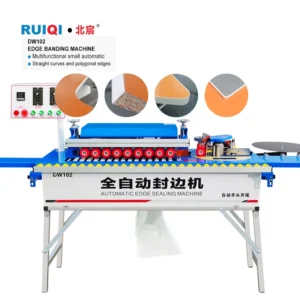
<p><strong>DW102 Automatic Edge Banding Machine, 3800W, 0.3–3mm Banding Thickness, Curved & Straight</strong> — processes MDF, plywood, particleboard and polymer substrates in one compact pass. Dual 650W trimming stations and 1000ml glue pot handle mixed-panel runs with consistent edge finish across varying densities. Automatic head and tail cutting with vacuum hold delivers clean ends on both profiles. Suitable for cabinet makers and joinery workshops moving into semi-automatic production. Factory test records available on your specific substrate and banding combination before shipment.</p>
100+
Countries
MOQ 1
Unit
15-25 Days
Lead Time
== Gate == identifier: DW102 → PASS == 分析 == - 核心品类词: Edge Banding Machine (from product_type) - 机型词: DW102 - 规格技术词: Vacuum Hold
Automatic Cutting
Automatic Cutting (from specs: vacuum
automatic head and tail cutting) - 应用物料词: MDF Plywood (from title/applications) - 站点成交词: ruiqiwoodwork.com → PROCESS AND APPLICATION → Emphasis: substrate behaviour
cut accuracy → Process Application 导向
DW102
edge quality
Edge Quality Process
glue and banding material selection
MDF Plywood
Vacuum Hold
推导: Edge Quality Process == Tags == Edge Banding Machine
- Full OEM/ODM support -- custom logo, voltage (110V-440V), multilingual panels
- ISO 9001 & CE certified, 5 national patents, 60 professional engineers
- 12-month warranty, remote technical support & spare parts service
- Professional export packaging, customs clearance support, on-time delivery
In-house manufacturing — The DW102 is produced on a dedicated line with four-stage quality control, allowing every trimming and polishing station to be tested with your specific panel material before dispatch.
Technical Specifications
| Parameter | Value |
|---|---|
| Model | DW102 |
| Product Type | Automatic Edge Banding Machine |
| Total Power | 3800W |
| Voltage | 220V / 380V / customization |
| Edge Banding Thickness Range | 0.3–3mm |
| Edge Banding Height Range | 0–50mm |
| Minimum Sheet Length | 250mm |
| Minimum Sheet Width | 50mm |
| Glue Pot Capacity | 1000ml |
| Trimming Power | 650W × 2 |
| Polishing Power | 180W × 2 |
| Vacuum Power | 1200W |
| Transmission Power | 60W |
| Edge Power | 20W |
| Air Source Pressure | 0.5–0.8MPa |
| Product Dimensions (L×W×H) | 1280 × 470 × 690mm |
| Net Weight | 75kg |
| Key Features | Curved and straight edge banding, edge trimming, polishing, automatic head and tail cutting, vacuum hold |
| Plug Options | EU, USA, AU, UK |
| Language Options | Chinese, English, customizable (source value — verify against manufacturer catalog) |
Application Suitability
| Application | Material or Output |
|---|---|
| Cabinet door and carcass production | MDF and particleboard panels with PVC or melamine banding |
| Custom furniture short runs | Plywood and blockboard with veneer or polymer edge strips |
| Polymer door finishing | Polymer substrates requiring curved and straight edge profiling |
| Joinery workshop scale-up | Mixed board materials transitioning from manual to semi-automatic banding |
Why Glue Temperature Matters More Than Feed Speed
Edge banding quality on mixed substrates depends on matching glue temperature to the banding material, not simply running faster.
In my experience across Southeast Asian furniture workshops, the most common cause of edge failure is not the machine itself but a mismatch between the glue pot setting and the banding material in use. A PVC strip may bond cleanly at one temperature, while a real wood veneer demands a different thermal profile entirely. When the operator switches materials without adjusting, visible glue lines appear or the banding lifts within hours. This edge banding machine woodworking process variable is often overlooked until an entire batch of cabinet doors comes back from the customer with peeling edges [NEED_CITE: common edge banding failure modes in humid climates].
Glue Pot Behavior Across Banding Materials
The 1000ml glue pot on the DW102 provides enough adhesive volume for continuous runs without frequent refill stops. For PVC banding in the 0.4–2mm range, standard EVA hot melt at typical operating temperatures delivers reliable adhesion on MDF and particleboard. When switching to wood veneer, the thermal conductivity of the material changes, and the operator must allow the glue pot to stabilize at a setting suited to that thinner, more heat-sensitive strip. Running veneer at PVC temperatures is a frequent source of delamination in mixed-material workshops.
Trimming and Polishing for Edge Finish Consistency
The dual 650W trimming stations remove excess banding material from both top and bottom edges in a single pass. On dense substrates like plywood, the trimming cutters encounter more resistance than on low-density particleboard, making the independent power rating relevant to maintaining a clean cut without chatter. Following trimming, the dual 180W polishing stations smooth the edge to a finished surface. The sequence from trimming to polishing within one compact machine footprint means the edge banding machine woodworking process stays contained, reducing handling damage between stations.
How Panel Thickness Range Shapes Your Output
The 0–50mm edge banding height range covers the majority of panel stock used in cabinet and furniture production, from thin 9mm MDF shelving to 40mm blockboard worktops. The 0.3–3mm banding thickness range accommodates everything from thin melamine foil to thicker PVC and veneer strips. When you pair this with the minimum sheet dimensions of 250mm length and 50mm width, the DW102 handles small offcuts and narrow components that larger automatic banders cannot feed reliably. This matters in custom furniture environments where panel sizes vary from job to job [NEED_CITE: panel dimension ranges in custom cabinet manufacturing].
The Cost of Ignoring Substrate Behavior
A machine set up for one material and then fed a different substrate without adjustment will produce edges that pass visual inspection at the machine but fail during assembly or in the field. Plywood edges tend to be more porous than MDF, absorbing glue differently and sometimes requiring a thicker adhesive application. Particleboard with low internal bond strength can chip during trimming if cutter speed and feed rate are not matched to the board density. These edge banding machine woodworking process variables compound when the workshop runs multiple materials in a single shift without pausing to recalibrate [NEED_CITE: substrate density effects on edge trimming quality].
What This Machine Gives You at the Process Level
The DW102 is built in a facility that runs four-stage quality control from incoming material through pre-shipment verification, so the trimming and polishing stations arrive calibrated rather than requiring extensive on-site adjustment. Voltage is configurable between 220V and 380V or customized further, which means the machine can be specified to match your workshop supply before it leaves the factory. The control panel language is selectable, preventing the commissioning delays that occur when an operator cannot read the interface. The vacuum hold system at 1200W keeps panels stable during curved edge work, addressing a specific challenge in custom furniture production. Engineer-led configuration recommendations are provided within 24 hours of inquiry, so the machine arrives matched to your actual production mix rather than a generic setup.
Documentation & Verification
- CE declaration of conformity covering the DW102 automatic edge banding machine
- Factory test record using your specified panel material and banding type
- Electrical schematic confirming voltage and plug configuration before dispatch
- Operation manual in your chosen language covering glue pot and trimming adjustments
- Spare parts list identifying wear items for trimming cutters and polishing wheels
Installation, Commissioning & Support
- Verify workshop supply matches the configured 220V or 380V input before connecting the 3800W total load
- Ensure air supply delivers 0.5–0.8MPa to support the vacuum hold and pneumatic trimming functions
- Allow clearance around the 1280 × 470mm footprint for panel feeding on both curved and straight passes
- Confirm glue pot temperature settings for each banding material during first-day commissioning runs
- Review the multilingual operation manual for trimming station adjustment procedures specific to your substrates
- Stock replacement trimming cutters and polishing pads based on the spare parts list provided at delivery
Before You Request a Quote
Share the specific panel materials you run — MDF, particleboard, plywood, or polymer — along with the banding types and thicknesses you use most often. Confirm your workshop voltage and frequency so the machine can be configured before production. If you run curved edge profiles regularly, note the smallest radius you need so the vacuum and feed system can be validated for your application.
Frequently Asked Questions
Q: What glue types and temperature settings suit PVC versus wood veneer banding?
A: EVA hot melt works well for PVC banding on MDF and particleboard at standard operating temperatures. Wood veneer is more heat-sensitive and typically requires a lower glue pot temperature to prevent scorching or adhesive bleed-through. The DW102 glue pot allows temperature adjustment between materials, but the operator must change settings when switching banding types to maintain consistent adhesion and avoid visible glue lines on finished edges.
Q: How does edge finish quality differ between MDF, particleboard, and plywood?
A: MDF produces the cleanest trimmed edge due to its uniform density. Particleboard can chip at the trim point if cutter settings are not matched to its lower internal bond strength. Plywood edges are more fibrous and may require slower feed rates or sharper trimming cutters to avoid tear-out. The dual 650W trimming stations on this machine provide sufficient power for all three substrates when properly adjusted.
Q: What adjustments are needed when switching between curved and straight edge profiles?
A: Curved edge banding relies on the vacuum hold system to keep the panel stable as the edge curves through the trimming and polishing stations. Straight edges feed more predictably and generally allow faster throughput. The operator should reduce feed speed on tight curves and verify that the automatic head and tail cutting sensors align correctly with the panel contour to avoid overcut or undercut at the ends.
Q: How can I verify edge quality before committing to a full production run?
A: Request a factory test using your exact panel material and banding combination. Inspect the trimmed edge for chatter marks, check the glue line visibility under workshop lighting, and test adhesion by pulling a section of banding after it has fully cooled. This process-level validation catches substrate compatibility issues before the machine enters your production environment.
Q: What upstream panel preparation affects edge banding results?
A: Panel edges must be cleanly cut and free of dust before entering the banding station. A dull saw blade upstream leaves a rough edge that prevents uniform glue contact, resulting in weak spots along the band. Moisture content in the panel also affects glue curing, particularly in humid environments where boards stored in open workshops can absorb enough moisture to interfere with hot melt adhesion.
Technical Specifications
| Parameter | Value |
|---|---|
| Product Name | DW102 Automatic Edge Banding Machine for MDF Plywood – Process Application |
| Category | Edge banding machine |
| Voltage Options | 110V / 220V / 380V / 440V (customizable) |
| Frequency | 50Hz / 60Hz (customizable) |
| Certification | ISO 9001, CE |
| MOQ | 1 Unit |
| Lead Time | 15-25 Working Days |
| Warranty | 12 Months |
| OEM / ODM | Available -- logo, color, panel language |
* Detailed technical specifications vary by model. Please contact us with your specific requirements for a complete datasheet.
Shipping & Export
-
Export Packaging
Heavy-duty wooden crate with foam padding and moisture protection
-
Shipping Methods
Sea freight (FCL/LCL), air freight, express -- we support all methods
-
Customs Support
Full documentation: CO, commercial invoice, packing list, HS code assistance
-
Port of Loading
Tianjin / Qingdao port, China -- 20 years export experience
OEM / ODM Services
-
Logo & Branding
Custom logo printing, color scheme, and nameplate engraving
-
Voltage Configuration
110V / 220V / 380V / 440V, 50Hz / 60Hz -- any region supported
-
Multilingual Panels
Control panels in English, Spanish, French, Arabic and more
-
Custom Specifications
Modified dimensions, accessories, or feature sets on request
Get a Quote
Request Product Inquiry
Fill in your details and we'll respond within 24 hours with pricing and availability.
Direct Contact
How It Works
-
1
Confirm requirements & budget
Tell us your factory scale and processing needs
-
2
Receive recommendation & quote
We match the right machine with full specs
-
3
Negotiate & place order
OEM terms, voltage, payment and delivery
-
4
Production & QC inspection
Multi-stage quality control by 60 engineers
-
5
Export packaging & shipment
Professional packing, customs clearance
-
6
After-sales support
12-month warranty, remote tech support
You May Also Like