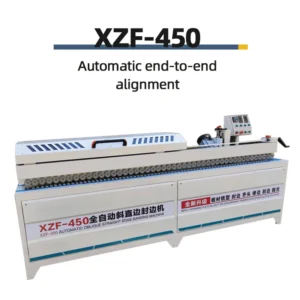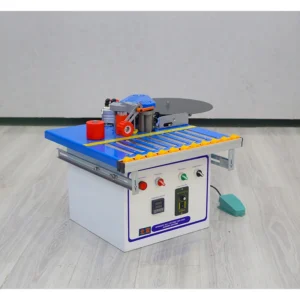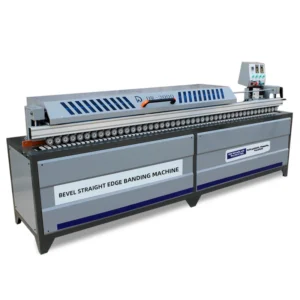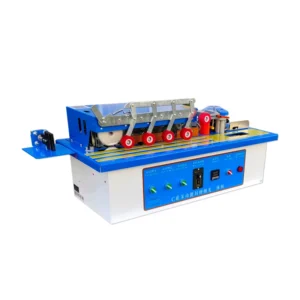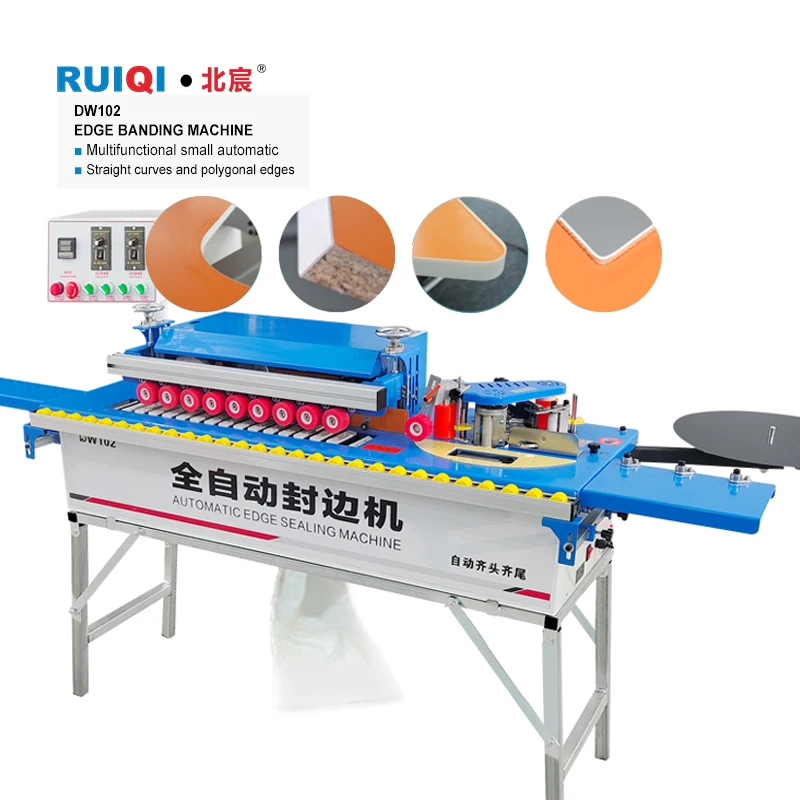
Edge banding machine
Click to enlarge
ISO 9001
CE Certified
OEM / ODM
12-Mo Warranty
Edge banding machine
DW102 Automatic Edge Banding Machine for Wood Panel | Industrial Application
<p><strong>DW102 Semi-automatic Edge Banding Machine, 0.3–3mm banding thickness, 220V/380V</strong> — engineered for consistent edge quality across MDF, particleboard, plywood and blockboard substrates.</p> <ul> <li>Handles straight and curved profiles with dual 650W trimming and dual 180W polishing stations for a clean, glue-line-free finish</li> <li>1000ml glue pot capacity and integrated vacuum support continuous runs with minimal interruption</li> <li>Minimum sheet dimensions 25cm × 5cm accommodate both standard panels and smaller offcuts</li> </ul> <p>Backed by four-stage QC with pre-shipment verification, engineer-led configuration within 24 hours, and full voltage and language customization to match your workshop's requirements.</p>
100+
Countries
MOQ 1
Unit
15-25 Days
Lead Time
380V
DW102
Edge Banding Machine
MDF Panel
Plywood Edge Banding
Process Application
Semi Automatic Edge Bander
Vacuum System
- Full OEM/ODM support -- custom logo, voltage (110V-440V), multilingual panels
- ISO 9001 & CE certified, 5 national patents, 60 professional engineers
- 12-month warranty, remote technical support & spare parts service
- Professional export packaging, customs clearance support, on-time delivery
Voltage flexibility as standard — the DW102 edge bander ships with configurable 220V/380V wiring and confirmed frequency matching, preventing the workshop-floor shock of a machine that cannot power on upon arrival.
Technical Specifications
| Parameter | Value |
|---|---|
| Model | DW102 |
| Product Type | Semi-automatic Edge Banding Machine |
| Total Power | 3800W |
| Voltage | 220V / 380V / customizable (confirm 50Hz/60Hz) |
| Edge Banding Height | 0–50 mm |
| Edge Banding Thickness | 0.3–3 mm |
| Minimum Sheet Length | 250 mm |
| Minimum Sheet Width | 50 mm |
| Glue Pot Capacity | 1000 ml |
| Trimming Power | 650W × 2 |
| Polishing Power | 180W × 2 |
| Vacuum Power | 1200W |
| Air Source Pressure | 0.5–0.8 MPa |
| Product Size | 128 × 47 × 69 cm |
| Product Weight | 75 kg |
| Language Options | Chinese, English standard; Spanish and others customizable |
| Plug Options | EU, USA, AU, UK |
Application Suitability
| Application | Material or Output |
|---|---|
| Cabinet door and carcass panel edging | MDF and particleboard with PVC or melamine banding |
| Plywood furniture component finishing | Plywood panels with veneer or PVC edge strips |
| Blockboard shelving and partition edging | Blockboard with 0.3–3 mm banding materials |
| Polymer door and specialty panel profiles | Straight and curved edges on polymer substrates |
| Custom joinery short-run production | Mixed board types in small to medium batch sizes |
Why Glue Lines Show Up on Some Panels and Not Others
Substrate density and surface porosity determine how well hot-melt adhesive bonds — and inconsistent glue lines across different board types usually point to a process mismatch, not a machine defect.
When a furniture factory switches from MDF to particleboard on the same edge banding machine process application without adjusting glue temperature or feed rate, the result is often visible glue lines on the more porous substrate. Particleboard absorbs adhesive differently than MDF, and veneer banding reacts to heat and pressure in ways that PVC does not [NEED_CITE: substrate porosity and hot-melt adhesion behaviour]. The DW102 semi-automatic edge bander addresses this by allowing operators to control the variables at each station — from the 1000 ml glue pot through dual trimming and dual polishing — so the setup can be tuned to each material rather than locked into a single default.
How Substrate Choice Shapes the Edge Banding Process
MDF offers a smooth, uniform surface that accepts most hot-melt adhesives readily, making it the most forgiving substrate for edge banding machine process application work. Particleboard, with its coarser surface texture, demands higher glue temperatures and more consistent pressure at the bonding zone to achieve full adhesion across the porous face. Plywood introduces grain variation that can cause uneven bonding if the banding material is too rigid, which is why thinner PVC or veneer strips in the 0.3–1 mm range often perform better on this substrate. The DW102’s 0.3–3 mm banding thickness range gives production managers room to match strip selection to substrate rather than forcing one banding type across all panel types.
Managing Glue Temperature Across Mixed Material Runs
Running MDF in the morning and switching to plywood after lunch means the glue pot temperature that worked for the first batch may produce cold joints or starved glue lines on the second. The 1000 ml glue pot on the DW102 provides enough reservoir volume to maintain thermal stability during these changeovers, reducing the temperature swings that occur in smaller pots when cold adhesive is added mid-run [NEED_CITE: hot-melt glue pot thermal recovery in edge banding]. Operators working with veneer banding — which is particularly sensitive to excessive heat — benefit from this stability, as overheated adhesive can bleed through thin veneer and create surface defects that polishing cannot correct.
Trimming and Polishing Station Configuration Explained
The dual 650W trimming stations handle the bulk of excess banding removal, cutting flush to the panel face on both top and bottom edges in a single pass. Following this, the dual 180W polishing stations buff the trimmed edge to remove any micro-burrs left by the cutters, producing the smooth transition between banding and panel surface that cabinet manufacturers require for visible edges. For curved edge work, the semi-automatic feed path allows operators to guide panels through the trimming zone at a controlled rate, which matters because curved profiles generate uneven cutting forces that a fixed-speed automatic feed cannot compensate for. The integrated 1200W vacuum system captures trimmings and adhesive dust at the source, keeping the polishing wheels clean and preventing debris from scoring freshly trimmed edges.
What Happens When Voltage and Frequency Are Assumed
Machines quoted without confirming local voltage and frequency arrive at the workshop and simply will not start — or worse, run at incorrect motor speeds that compromise trimming accuracy and glue pot heating. The DW102 supports 220V and 380V configurations with plug options covering EU, USA, AU, and UK standards, but the frequency confirmation (50Hz versus 60Hz) must be specified before production, as it directly affects motor RPM and therefore trimming cutter speed. A 650W trimming motor designed for 50Hz running on a 60Hz supply will overspeed, generating excessive heat at the cutter and reducing edge finish quality [NEED_CITE: motor frequency and RPM relationship in industrial woodworking equipment]. This is a specification that belongs on the purchase order, not discovered during commissioning.
The Cost of Skipping a Material-Specific Test Run
Purchasing an edge banding machine based on a demonstration run using the factory’s standard MDF and PVC stock — then discovering that your actual production plywood and veneer combination produces chipped edges and poor adhesion — is a recurring pattern in equipment procurement. The trimming cutters may need different geometry for veneer versus PVC, and the polishing wheels may require softer compound for delicate wood veneer surfaces. These variables only surface when the machine processes the actual materials it will handle in daily production, which is why requesting a test run with your own panel stock and banding material is not optional but essential.
Why Production Managers Source the DW102 Here
In-house manufacturing with patented cutting mechanisms means the trimming stations on the DW102 are built and tested under one roof, with verified tolerance data available before shipment. The full product family — from entry-level models through to full-function pre-milling configurations — allows a workshop to add capacity later without changing suppliers or retraining operators on a different control philosophy. Voltage and language customization is treated as standard procedure rather than a special request, so control panels ship in the operator’s working language and electrical systems match the facility supply. Four-stage quality control with pre-shipment verification ensures the machine is tested against documented parameters, not just powered on and crated. Engineer-led configuration recommendations are provided with formal quotation within 24 hours of receiving the production requirements.
Documentation & Verification
- CE declaration of conformity covering the DW102 edge banding machine assembly
- ISO 9001 certificate for the manufacturing quality management system
- Machine specification sheet with confirmed voltage, frequency, and plug type
- Electrical schematic showing wiring diagram for the specified voltage configuration
- Factory test record using your panel thickness and banding material before dispatch
- Operation and maintenance manual supplied in the agreed operator language
Installation, Commissioning & Support
- Requires a dedicated circuit matching the confirmed 220V or 380V supply with appropriate breaker rating for the 3800W total load
- Air compressor connection at 0.5–0.8 MPa for pneumatic actuators at trimming and cutting stations
- Compact 128 × 47 × 69 cm footprint fits standard workshop layouts with clearance for panel infeed and outfeed
- First-run parameter setup includes glue pot temperature calibration for the specified banding material type
- Operator training covers curved versus straight edge feed technique and trimming adjustment procedures
- Spare parts list covers trimming cutters, polishing wheels, and glue pot heating elements for local stocking
What to Include in Your Inquiry
To receive an accurate configuration proposal for the DW102 semi-automatic edge banding machine, provide the panel materials you will be processing — MDF, particleboard, plywood, or a mix — along with the banding types and thicknesses required for your product range. Specify your facility voltage, frequency, and the language needed for the operation manual and control interface. If your production includes curved edge profiles, note the minimum curve radius so the feed path suitability can be confirmed before order.
Frequently Asked Questions
Q: How does glue selection affect edge quality on MDF versus particleboard?
A: MDF’s dense, uniform surface bonds well with standard EVA hot-melt adhesives at moderate temperatures. Particleboard’s porous structure requires higher glue application temperatures and adequate open time for the adhesive to penetrate and anchor. Running both substrates on the same DW102 setup without adjusting glue pot temperature typically produces visible starved joints on particleboard while over-gluing MDF panels.
Q: What banding materials and thicknesses can the DW102 handle?
A: The machine processes PVC, melamine, and veneer banding in the 0.3–3 mm thickness range. Thinner veneer strips require lower glue temperatures and gentler polishing pressure to prevent surface damage, while 3 mm PVC demands full trimming power from the dual 650W stations. Material choice directly determines the trimming cutter geometry and polishing wheel compound needed for a clean finish.
Q: How do I verify edge quality before committing to volume production?
A: Request a sample processing test using your actual panel material and banding stock. The DW102 can be run with your substrates to verify edge smoothness, glue adhesion strength, and trimming accuracy under production conditions. Review the factory test record documenting these results against your quality standards before the machine ships.
Q: What are the electrical and air supply requirements for installation?
A: The DW102 requires a confirmed 220V or 380V supply at either 50Hz or 60Hz, with a dedicated circuit rated for the 3800W total power draw. An air compressor delivering 0.5–0.8 MPa is needed for pneumatic functions at the trimming and head/tail cutting stations. Plug type — EU, USA, AU, or UK — is specified at order to match your facility outlets.
Q: How does the DW102 handle curved edges compared to straight runs?
A: The semi-automatic feed system allows the operator to guide panels through curved profiles at a controlled rate, adjusting feed pressure as the curve geometry changes. Straight runs proceed at a consistent pace through all stations. Curved edge work requires the operator to manage banding tension manually to prevent lifting at tight radii, a technique covered during commissioning training.
Technical Specifications
| Parameter | Value |
|---|---|
| Product Name | DW102 Automatic Edge Banding Machine for Wood Panel | Industrial Application |
| Category | Edge banding machine |
| Voltage Options | 110V / 220V / 380V / 440V (customizable) |
| Frequency | 50Hz / 60Hz (customizable) |
| Certification | ISO 9001, CE |
| MOQ | 1 Unit |
| Lead Time | 15-25 Working Days |
| Warranty | 12 Months |
| OEM / ODM | Available -- logo, color, panel language |
* Detailed technical specifications vary by model. Please contact us with your specific requirements for a complete datasheet.
Shipping & Export
-
Export Packaging
Heavy-duty wooden crate with foam padding and moisture protection
-
Shipping Methods
Sea freight (FCL/LCL), air freight, express -- we support all methods
-
Customs Support
Full documentation: CO, commercial invoice, packing list, HS code assistance
-
Port of Loading
Tianjin / Qingdao port, China -- 20 years export experience
OEM / ODM Services
-
Logo & Branding
Custom logo printing, color scheme, and nameplate engraving
-
Voltage Configuration
110V / 220V / 380V / 440V, 50Hz / 60Hz -- any region supported
-
Multilingual Panels
Control panels in English, Spanish, French, Arabic and more
-
Custom Specifications
Modified dimensions, accessories, or feature sets on request
Get a Quote
Request Product Inquiry
Fill in your details and we'll respond within 24 hours with pricing and availability.
Direct Contact
How It Works
-
1
Confirm requirements & budget
Tell us your factory scale and processing needs
-
2
Receive recommendation & quote
We match the right machine with full specs
-
3
Negotiate & place order
OEM terms, voltage, payment and delivery
-
4
Production & QC inspection
Multi-stage quality control by 60 engineers
-
5
Export packaging & shipment
Professional packing, customs clearance
-
6
After-sales support
12-month warranty, remote tech support
You May Also Like