Edge banding machine
Click to enlarge
ISO 9001
CE Certified
OEM / ODM
12-Mo Warranty
Edge banding machine
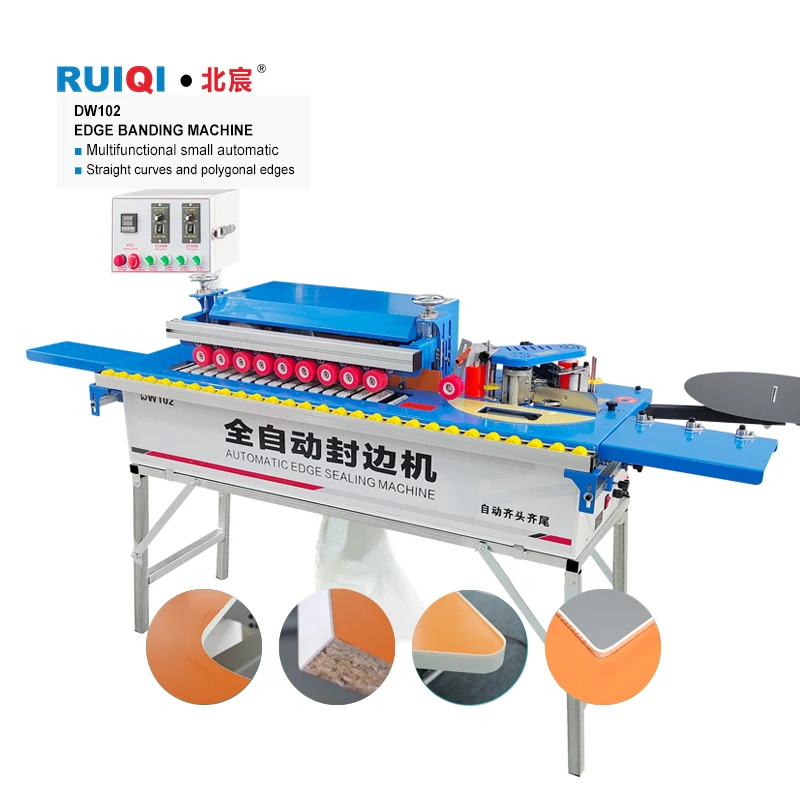
DW102 Semi Automatic Edge Banding Machine for MDF Plywood – Compact
<p><strong>DW102 Semi-Automatic Edge Banding Machine, 3800W, 0.3–3mm Banding Thickness, 0.5–0.8MPa</strong> — handles MDF, plywood and particleboard with integrated gluing, head-and-tail cutting, dual 650W trimming and dual 180W polishing stations for clean edges on both straight and curved profiles. The 1000ml glue pot supports continuous runs, while vacuum hold ensures stable panel feed at minimum 25×5cm sheet size.</p> <p>Backed by four-stage QC with pre-shipment verification, voltage and language customization as standard, and a formal quotation within 24 hours for your specific substrate test.</p>
100+
Countries
MOQ 1
Unit
15-25 Days
Lead Time
- Full OEM/ODM support -- custom logo, voltage (110V-440V), multilingual panels
- ISO 9001 & CE certified, 5 national patents, 60 professional engineers
- 12-month warranty, remote technical support & spare parts service
- Professional export packaging, customs clearance support, on-time delivery
Verified Tolerance Control — the DW102 maintains consistent edge sealing across MDF, plywood and particleboard through its integrated trimming and polishing workflow, grounded in two decades of woodworking machinery manufacturing with full voltage and language customization available before dispatch.
Technical Specifications
| Parameter | Value |
|---|---|
| Model | DW102 |
| Product Type | Semi-Automatic Edge Banding Machine |
| Rated Power | 3800W (total) |
| Voltage & Frequency | 220V / 380V / customizable |
| Overall Dimensions (L×W×H) | 128×47×69 cm |
| Net Weight | 75 kg |
| Minimum Sheet Length | 25 cm |
| Minimum Sheet Width | 5 cm |
| Edge Banding Height | 0–50 mm |
| Edge Banding Thickness | 0.3–3 mm |
| Trimming Power | 650W × 2 |
| Polishing Power | 180W × 2 |
| Vacuum Power | 1200W |
| Transmission Power | 60W |
| Edge Feed Power | 20W |
| Air Source Pressure | 0.5–0.8 MPa |
| Glue Pot Capacity | 1000 ml |
| Standard Features | Curved and straight edge banding, edge trimming, polishing, automatic head-and-tail cutting, vacuum hold |
| Language Options | Chinese and English standard; Spanish or other languages customizable |
Application Suitability
| Application | Material or Output |
|---|---|
| Cabinet panel edge sealing | MDF and particleboard with PVC or veneer banding |
| Custom furniture straight and curved edges | Plywood and blockboard up to 50 mm edge height |
| Polymer door edge finishing | Polymer composites with 0.3–3 mm banding thickness |
| Small-batch workshop production | Mixed substrate runs requiring quick material changeover |
Why Substrate Choice Dictates Your Edge Banding Machine Woodworking Process Setup
Matching glue temperature and feed rate to the actual panel material prevents the visible glue lines that shut down finishing lines.
I spent years on the assembly floor before moving into technical sales, and the most common edge banding failure I have witnessed was not a machine fault — it was a mismatch. A customer once ran thin wood veneer through a semi-automatic bander set up for standard PVC. The glue pot temperature was too high, the feed speed too aggressive, and the veneer bubbled across every panel. Their line stood idle for two days while they sourced replacement stock. The edge banding machine woodworking process only delivers clean results when the operator understands how MDF absorbs heat differently from particleboard, and how plywood grain direction affects trimming pressure [NEED_CITE: substrate thermal absorption differences in edge banding applications].
How Glue, Trimming and Polishing Interact on Mixed Substrates
The DW102 places gluing, head-and-tail cutting, trimming and polishing into a single semi-automatic pass. The 1000 ml glue pot holds enough adhesive for continuous runs without constant refills, which matters when you are working through a batch of cabinet sides on a Friday afternoon. The dual 650W trimming stations handle the bulk of excess banding removal, while the dual 180W polishing stations follow immediately to smooth the transition between banding and panel face.
This sequence is where the edge banding machine woodworking process either succeeds or fails on curved profiles. On a straight MDF edge, trimming is straightforward. On a curved plywood panel for a polymer door assembly, the trimming cutters must follow the contour without lifting the banding at the glue line. The vacuum hold system on this model keeps the banding seated against the panel edge through the trimming and polishing stages, reducing the lifting risk that causes rework downstream.
Banding Thickness Range and What It Means for Material Selection
The 0.3–3 mm edge banding thickness range covers the two dominant material families in furniture production. PVC banding at 0.4–2 mm is the default for cabinet carcasses and shelving where impact resistance matters. Thin wood veneer at 0.3–1 mm is specified for visible surfaces on custom furniture where a painted or stained finish is required. The edge banding machine woodworking process must accommodate both without a full tooling changeover between jobs [NEED_CITE: edge banding material thickness standards for furniture manufacturing].
The automatic head-and-tail cutting function trims the banding flush at both panel ends before the trimming stations engage. This matters because excess banding at the leading edge can catch on the trimming cutter and tear the material rather than slice it. On veneer especially, a clean head cut sets up the rest of the finishing sequence. Operators working with 3 mm PVC on thick blockboard panels will use the full height capacity of the 50 mm edge banding range, while those running 0.4 mm PVC on 18 mm particleboard will adjust the trimming depth accordingly.
Reading the Specification Sheet Against Your Workshop Reality
The 3800W total power draw across all stations means the DW102 can run on a standard workshop circuit without requiring a dedicated high-amperage feed, provided the voltage is confirmed at either 220V or 380V before shipment. The 0.5–0.8 MPa air source pressure requirement means a typical reciprocating or screw compressor rated for woodworking duties will supply both the pneumatic trimming actuators and the 1200W vacuum system. Undersized compressors cause intermittent vacuum loss, which shows up as banding lift at the polishing stage — a fault that looks like a glue problem but is actually an air supply problem.
The Cost of Skipping the Material Conversation Before Purchase
I have seen workshops order a semi-automatic bander based on price and discover after delivery that their thin veneer supplier specifies a glue temperature the machine cannot dial down low enough to handle. The result is scorched veneer, rejected panels and a frustrated operator blaming the equipment. Other workshops find that their compressor delivers 0.4 MPa on a good day, leaving the vacuum hold unreliable and forcing manual edge clamping that defeats the purpose of semi-automatic operation. These are not warranty claims — they are configuration oversights that no amount of post-delivery adjustment can fully correct [NEED_CITE: compressed air requirements for pneumatic edge banding equipment].
Voltage mismatches are another silent problem. A machine wired for 380V/50Hz arriving in a market with 220V/60Hz supply will either not start or will run trimming motors at incorrect speeds, producing chatter marks on the banding surface. The customization options exist to prevent this, but only if the buyer confirms local supply specifications during the quotation stage rather than after the crate arrives.
What Manufacturing Depth Means for Your Edge Bander
The DW102 is built in a facility with two decades of woodworking machinery production, where precision-ground components undergo multi-stage inspection before assembly. The trimming and polishing stations are aligned on the same production line that builds full-function automatic banders, meaning the semi-automatic range benefits from the same component sourcing and quality discipline. Voltage and control panel language customization is treated as standard procedure, not a special request — Spanish-language panels, 440V wiring for specific export markets and custom branding are configured before the machine leaves the factory floor.
A four-stage quality check covers incoming materials, in-process assembly, finished product testing and pre-shipment verification. For a semi-automatic bander, this means the glue pot is tested at operating temperature, the trimming cutters are run against sample stock and the vacuum system is verified at rated pressure before crating. Factory visits are available for buyers who want to witness the test run on their own substrate material.
Documentation & Verification
- CE declaration of conformity covering the DW102 semi-automatic bander
- Factory test record on your specific substrate and banding material before dispatch
- Electrical schematic confirming voltage and frequency matched to your local supply
- Operation manual in your operator’s language covering glue temperature adjustment and trimming setup
- Spare parts list identifying trimming cutters, polishing wheels and glue pot elements by part number
- Packing photographs documenting machine condition prior to crating
Installation, Commissioning & Support
- The 128×47×69 cm footprint fits standard workshop benches without floor anchoring in most configurations
- A dedicated circuit rated for the 3800W total draw with correct voltage prevents motor overload at startup
- The 75 kg net weight allows two-person positioning; confirm bench load capacity before placement
- First-run commissioning includes glue pot temperature calibration against your specific banding material
- Air line connection at 0.5–0.8 MPa must be verified with a gauge at the machine inlet before pneumatic functions are engaged
- Trimming cutter and polishing wheel replacement intervals depend on banding material abrasiveness and daily run hours
What to Include in Your Inquiry
Send us your panel material types and thicknesses, the banding material you currently source or plan to use, and your local voltage and frequency. If your workshop runs both straight and curved profiles, note the minimum curve radius so we can confirm trimming station compatibility. Let us know your preferred control panel language and whether you would like a sample processing test on your actual substrate before the order is finalized.
Frequently Asked Questions
Q: How does substrate type affect glue selection and edge finish quality on a semi-automatic bander?
A: MDF is more porous than particleboard and absorbs heat from the glue pot faster, which can starve the glue line if temperature is set too low. Plywood end grain absorbs adhesive unevenly compared to face grain. The DW102’s 1000 ml glue pot allows temperature adjustment across these substrates, but the operator must match the setting to the specific panel material in the current run.
Q: What banding thickness range can the machine handle, and how does PVC compare to veneer on curved edges?
A: The machine accepts 0.3–3 mm banding. PVC at 0.4–2 mm is flexible enough for tight curves without cracking. Thin veneer at 0.3–1 mm is more brittle on curves and requires lower glue temperature and slower feed to prevent lifting. The vacuum hold keeps veneer seated through trimming on curved profiles when settings are correct.
Q: How does automatic head-and-tail cutting affect downstream assembly fit?
A: Clean head and tail cuts leave the banding flush with the panel ends, which prevents interference when panels meet at cabinet corners. Excess banding at panel ends forces assemblers to hand-trim before joining, adding time and risking damage to the panel edge. The DW102 cuts both ends automatically before trimming stations engage.
Q: What compressor capacity is needed to run the vacuum and pneumatic functions reliably?
A: The machine requires 0.5–0.8 MPa at the inlet. A compressor must deliver this pressure continuously, not just at peak output, because the 1200W vacuum system and pneumatic trimming actuators draw air simultaneously. Measure pressure at the machine inlet with a gauge during operation to confirm your compressor maintains adequate supply.
Q: Can glue pot temperature and feed rate be adjusted for different workshop conditions?
A: Yes. Ambient temperature and humidity affect glue open time and curing speed. In cold workshops, the glue pot may need a higher set point to maintain proper flow. In hot and humid conditions, a lower temperature prevents the glue from setting too slowly. The DW102 allows the operator to dial in the appropriate temperature for current workshop conditions.
Technical Specifications
| Parameter | Value |
|---|---|
| Product Name | DW102 Semi Automatic Edge Banding Machine for MDF Plywood – Compact |
| Category | Edge banding machine |
| Voltage Options | 110V / 220V / 380V / 440V (customizable) |
| Frequency | 50Hz / 60Hz (customizable) |
| Certification | ISO 9001, CE |
| MOQ | 1 Unit |
| Lead Time | 15-25 Working Days |
| Warranty | 12 Months |
| OEM / ODM | Available -- logo, color, panel language |
* Detailed technical specifications vary by model. Please contact us with your specific requirements for a complete datasheet.
Shipping & Export
-
Export Packaging
Heavy-duty wooden crate with foam padding and moisture protection
-
Shipping Methods
Sea freight (FCL/LCL), air freight, express -- we support all methods
-
Customs Support
Full documentation: CO, commercial invoice, packing list, HS code assistance
-
Port of Loading
Tianjin / Qingdao port, China -- 20 years export experience
OEM / ODM Services
-
Logo & Branding
Custom logo printing, color scheme, and nameplate engraving
-
Voltage Configuration
110V / 220V / 380V / 440V, 50Hz / 60Hz -- any region supported
-
Multilingual Panels
Control panels in English, Spanish, French, Arabic and more
-
Custom Specifications
Modified dimensions, accessories, or feature sets on request
Get a Quote
Request Product Inquiry
Fill in your details and we'll respond within 24 hours with pricing and availability.
Direct Contact
How It Works
-
1
Confirm requirements & budget
Tell us your factory scale and processing needs
-
2
Receive recommendation & quote
We match the right machine with full specs
-
3
Negotiate & place order
OEM terms, voltage, payment and delivery
-
4
Production & QC inspection
Multi-stage quality control by 60 engineers
-
5
Export packaging & shipment
Professional packing, customs clearance
-
6
After-sales support
12-month warranty, remote tech support
You May Also Like