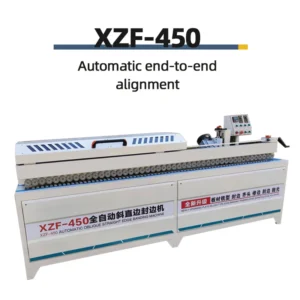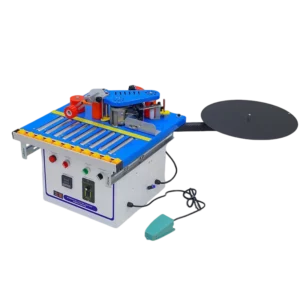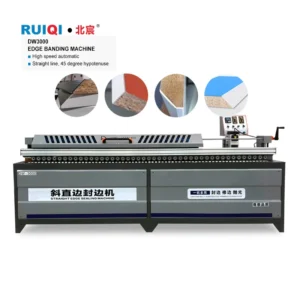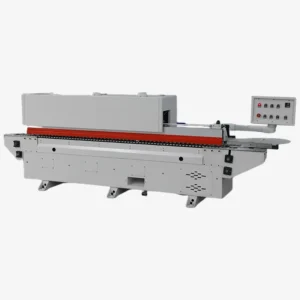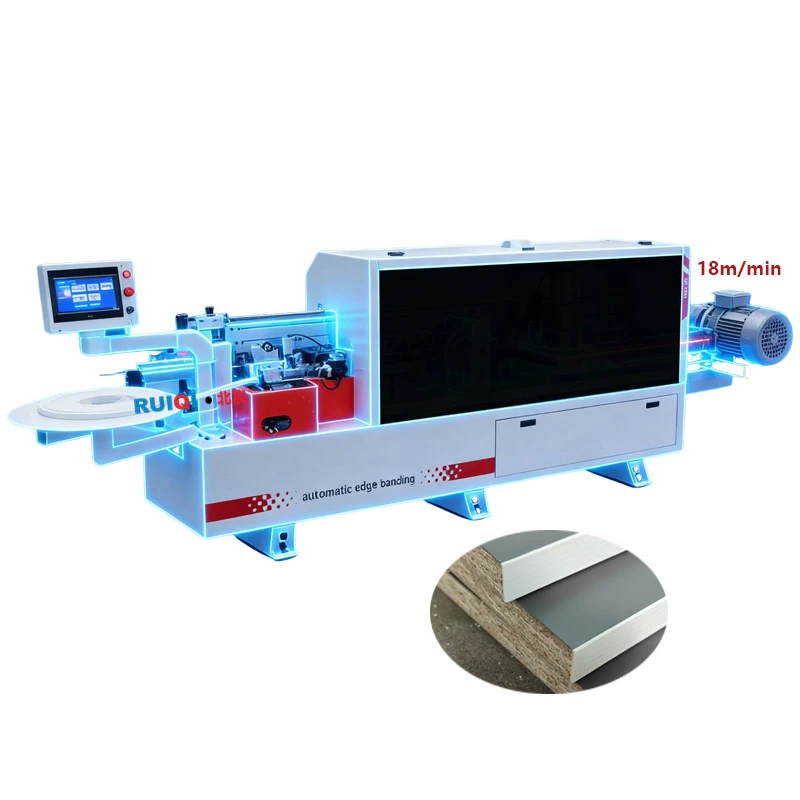
Edge banding machine
Click to enlarge
ISO 9001
CE Certified
OEM / ODM
12-Mo Warranty
Edge banding machine
DW330 Automatic Edge Banding Machine for MDF Panel – Industrial Application
<p><strong>DW330 Automatic Edge Banding Machine</strong>, 18m/min feed speed, 50mm max panel thickness, 7-inch PLC control panel — engineered for consistent edge quality across MDF, particleboard, and plywood substrates.</p> <ul> <li>Enlarged glue pot with single-sided large gluing shaft ensures uniform adhesive distribution on continuous large-board runs</li> <li>Contour trimming with alloy knife and curved scraper delivers clean, glue-line-free finishes on straight and curved edges</li> <li>Double-row pressure rollers maintain stable clamping down to 100mm board width</li> </ul> <p>Backed by a four-stage QC process with pre-shipment verification, engineer-led configuration proposals within 24 hours, and full voltage and language customization to match your facility requirements.</p>
100+
Countries
MOQ 1
Unit
15-25 Days
Lead Time
Automatic Edge Banding
DW330
Edge Banding Machine
MDF Panel
PLC Control Panel
- Full OEM/ODM support -- custom logo, voltage (110V-440V), multilingual panels
- ISO 9001 & CE certified, 5 national patents, 60 professional engineers
- 12-month warranty, remote technical support & spare parts service
- Professional export packaging, customs clearance support, on-time delivery
Uniform Glue Distribution — an enlarged pot and single-sided large gluing shaft keep adhesive flow steady across MDF, particleboard, and plywood runs.
Technical Specifications
| Parameter | Value |
|---|---|
| Model | DW330 |
| Product Type | Automatic Edge Banding Machine |
| Conveying Motor | 1.5 kW |
| Trimming Motor | 0.55 kW × 2 |
| Glue Feeding Motor | 0.37 kW × 2 |
| End Trimming Motor | 0.37 kW × 2 |
| Polishing Motor | 0.37 kW × 2 |
| Total Heating Rod Power | 380 V, 300 W × 4 |
| Transmission Motor | 1500 W, 1:40 speed ratio |
| Feed Speed | 18 m/min (basis not stated in source — confirm board material, thickness, and edge band type before quoting throughput) |
| Narrowest Sealing Plate Width | 120 mm |
| Minimum Machining Size | 200 mm × 100 mm × 9 mm |
| Maximum Plate Thickness | 50 mm |
| Edge Banding Thickness Capacity | Up to 3 mm |
| Beam Height Adjustment | Digital display hand crank (manual) |
| Pressure System | Double-row pressure rollers, aluminum profile pressure beams |
| Glue Pot | Enlarged capacity |
| Gluing Shaft | Large single-sided board gluing shaft |
| Trimming | Contour trimming with alloy knife; curved scraper with contouring device |
| Polishing | Enhanced industrial polishing motor |
| Control System | 7-inch PLC panel, multi-language compatible |
| Outline Dimensions | 350 × 71 × 122 cm |
| Net Weight | 750 kg |
| Standards | CE |
Application Suitability
| Application | Material or Output |
|---|---|
| Custom cabinet door and carcass edge banding | MDF panels with PVC or melamine edge band |
| Wardrobe and shelving panel processing | Particleboard with veneer or PVC strip |
| Plywood furniture component finishing | Plywood panels up to 50 mm thickness |
| Small-batch solid wood edge finishing | Solid wood panels with veneer banding |
| Mixed-substrate workshop environments | Alternating MDF, particleboard, and plywood runs |
Why Substrate Choice Changes the Edge Banding Machine Process Application Entirely
The board material you feed determines every downstream parameter — glue temperature, feed speed, trimming pressure, and final edge quality.
I learned this the hard way in a cabinet factory in Ecuador. A batch of particleboard went through an automatic edge bander set up for MDF parameters, and the pre-milling cutters tore the substrate surface. The result was chipped edges across every door panel in that production run. Particleboard is more brittle at the surface than MDF, and it demands a different approach to pre-milling depth, glue viscosity, and trimming feed rate. The edge banding machine process application you plan for must start with the substrate, not the machine settings [NEED_CITE: substrate density and surface integrity differences between MDF, particleboard, and plywood].
How Glue Pot Capacity Shapes Continuous Runs on Large Panels
When a workshop runs full-size boards back to back, the glue pot is the first component to reveal its limits. The DW330 carries an enlarged glue pot paired with a large single-sided gluing shaft, which means adhesive delivery stays consistent from the first panel to the fiftieth without the operator pausing to top up. On MDF and particleboard, where surface porosity pulls glue into the substrate, this continuous supply prevents the thin, starved glue lines that cause edge band delamination weeks after delivery. The edge banding machine process application here is straightforward: enough adhesive in the system to match the consumption rate of your typical panel run.
Contour Trimming and the Difference Between Acceptable and Assembly-Ready Edges
Edge trimming is where tolerance becomes visible. The DW330 uses contour trimming with an alloy trimming knife, followed by a curved scraper equipped with a contouring device for curved edges. Straight panels get a clean flush trim; panels with radiused corners or shaped profiles receive a matching contour finish without manual rework. For a cabinet factory sending finished doors directly to installation, this means the edge banding machine process application delivers components that pass straight into assembly without a secondary sanding or scraping station. Double-row pressure rollers on aluminum profile beams hold panels as narrow as 120 mm stable through every trimming stage [NEED_CITE: edge finish tolerance requirements for cabinet door assembly].
Reading the Spec Sheet Against Your Actual Panel Range
The DW330 accepts panels from 9 mm to 50 mm thick, with a minimum machining footprint of 200 mm × 100 mm. The digital display hand crank sets beam height manually, which works well in workshops running a limited range of panel thicknesses in sequence. The 7-inch PLC control panel supports multiple languages, so operators who do not read Chinese or English can still navigate feed speed and station controls. For edge banding thickness, the machine handles up to 3 mm, covering standard PVC, melamine, and thin veneer strips. What matters for production planning is matching these ranges to your most common board format — if your daily mix jumps between 9 mm MDF drawer bottoms and 40 mm particleboard shelving, the manual height adjustment becomes a frequency decision rather than a capability question.
The Hidden Cost of Ignoring Voltage and Frequency at the Ordering Stage
A machine built for 380 V three-phase will not start on a 220 V supply, and a motor wound for 60 Hz will overheat on a 50 Hz grid. I have seen edge banders sit idle on factory floors for weeks while the buyer arranges a step-up transformer or rewinds the motor locally — neither of which restores the original thermal rating. The DW330’s heating rods are rated at 380 V, which must match your facility supply exactly. When the voltage question gets skipped during the quotation stage, the edge banding machine process application stalls at commissioning [NEED_CITE: voltage and frequency standards by export market].
What This Workshop Configuration Delivers
The DW330 sits in a product family that spans entry-level through full-function models, so a workshop can scale its edge banding capability without switching suppliers. The single-sided large gluing shaft requires no separate adjustment when running thin edge banding, reducing setup time between jobs. Voltage and control panel language are configured before build, based on confirmed facility supply and operator requirements. Every unit goes through a four-stage quality check covering incoming materials, in-process assembly, finished product verification, and pre-shipment testing. An engineer reviews your panel range and production volume to recommend configuration, with a formal quotation typically issued within one working day.
Documentation & Verification
- Machine specification sheet confirming glue pot capacity and panel thickness range for your substrate
- Electrical schematic with voltage and frequency matched to your facility supply
- Factory test record on your specified panel material and edge band type before dispatch
- Operation and maintenance manual in your agreed language for operator-level reference
- Spare parts list covering alloy trimming knives, pressure rollers, and gluing shaft components
- Packing photographs and customs documentation support for export clearance
Installation, Commissioning & Support
- Floor space requirement based on the 350 × 71 × 122 cm footprint plus operator clearance
- Dedicated electrical circuit matching the 380 V heating rod and 1.5 kW conveying motor load
- Machine arrives assembled; beam height calibration and pressure roller alignment verified at commissioning
- Feed speed and trimming station parameters set to your panel material during first-run test
- Operator training on the 7-inch PLC panel in your specified language before handover
- Spare alloy trimming knives and replacement pressure rollers included in initial delivery
Before You Send the Inquiry
Share your primary panel substrates and the thickness range you process most often, along with the edge banding material type and thickness. Confirm your facility voltage and frequency so the electrical system is built to match. If you run curved or shaped panels, provide a profile drawing so the contour trimming station can be verified against your geometry.
Frequently Asked Questions
Q: How does glue pot capacity affect edge quality on large boards and continuous runs?
A: A small glue pot runs dry during back-to-back large panel processing, producing starved glue lines that weaken the bond. The DW330’s enlarged glue pot maintains steady adhesive volume, and the large single-sided gluing shaft distributes it uniformly across the panel edge without operator intervention between boards.
Q: Which edge banding materials are compatible, and how does glue distribution differ by material?
A: The DW330 handles PVC, melamine, and veneer edge banding up to 3 mm thick. Porous veneer absorbs more adhesive than PVC, so the enlarged glue pot compensates by maintaining consistent supply. The single-sided gluing shaft delivers the same uniform coating regardless of material, with no manual adjustment needed when switching band types.
Q: How does the contour trimming system handle both straight and curved panel edges?
A: Straight edges pass through the alloy trimming knife for a flush cut, while panels with radiused or shaped corners engage the curved scraper with its contouring device. This dual-path trimming produces a consistent edge profile on both geometries without a secondary manual finishing step.
Q: What panel thickness range and minimum board dimensions does the DW330 accept?
A: The machine processes panels from 9 mm to 50 mm thick, with a minimum length of 200 mm and width of 100 mm. Beam height is set via a digital display hand crank. Panels as narrow as 120 mm can be sealed, held stable by double-row pressure rollers on aluminum profile beams.
Q: How do I verify edge banding tolerance and finished quality before committing to a production order?
A: Request a factory test record run on your actual panel substrate and edge banding material. This test confirms glue adhesion, trimming accuracy, and polish finish under controlled conditions. Review the results against your assembly requirements before placing the order.
Technical Specifications
| Parameter | Value |
|---|---|
| Product Name | DW330 Automatic Edge Banding Machine for MDF Panel – Industrial Application |
| Category | Edge banding machine |
| Voltage Options | 110V / 220V / 380V / 440V (customizable) |
| Frequency | 50Hz / 60Hz (customizable) |
| Certification | ISO 9001, CE |
| MOQ | 1 Unit |
| Lead Time | 15-25 Working Days |
| Warranty | 12 Months |
| OEM / ODM | Available -- logo, color, panel language |
* Detailed technical specifications vary by model. Please contact us with your specific requirements for a complete datasheet.
Shipping & Export
-
Export Packaging
Heavy-duty wooden crate with foam padding and moisture protection
-
Shipping Methods
Sea freight (FCL/LCL), air freight, express -- we support all methods
-
Customs Support
Full documentation: CO, commercial invoice, packing list, HS code assistance
-
Port of Loading
Tianjin / Qingdao port, China -- 20 years export experience
OEM / ODM Services
-
Logo & Branding
Custom logo printing, color scheme, and nameplate engraving
-
Voltage Configuration
110V / 220V / 380V / 440V, 50Hz / 60Hz -- any region supported
-
Multilingual Panels
Control panels in English, Spanish, French, Arabic and more
-
Custom Specifications
Modified dimensions, accessories, or feature sets on request
Get a Quote
Request Product Inquiry
Fill in your details and we'll respond within 24 hours with pricing and availability.
Direct Contact
How It Works
-
1
Confirm requirements & budget
Tell us your factory scale and processing needs
-
2
Receive recommendation & quote
We match the right machine with full specs
-
3
Negotiate & place order
OEM terms, voltage, payment and delivery
-
4
Production & QC inspection
Multi-stage quality control by 60 engineers
-
5
Export packaging & shipment
Professional packing, customs clearance
-
6
After-sales support
12-month warranty, remote tech support
You May Also Like