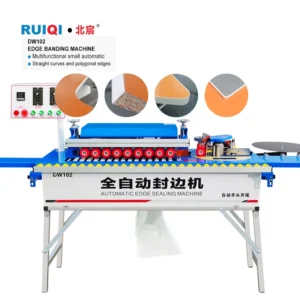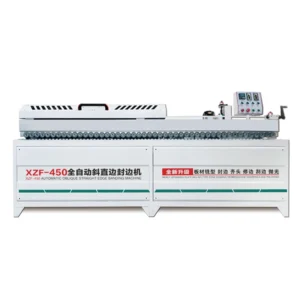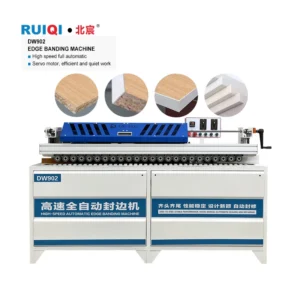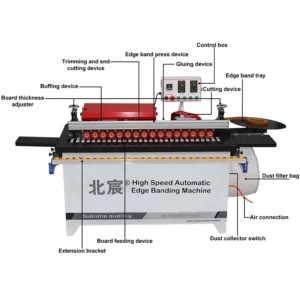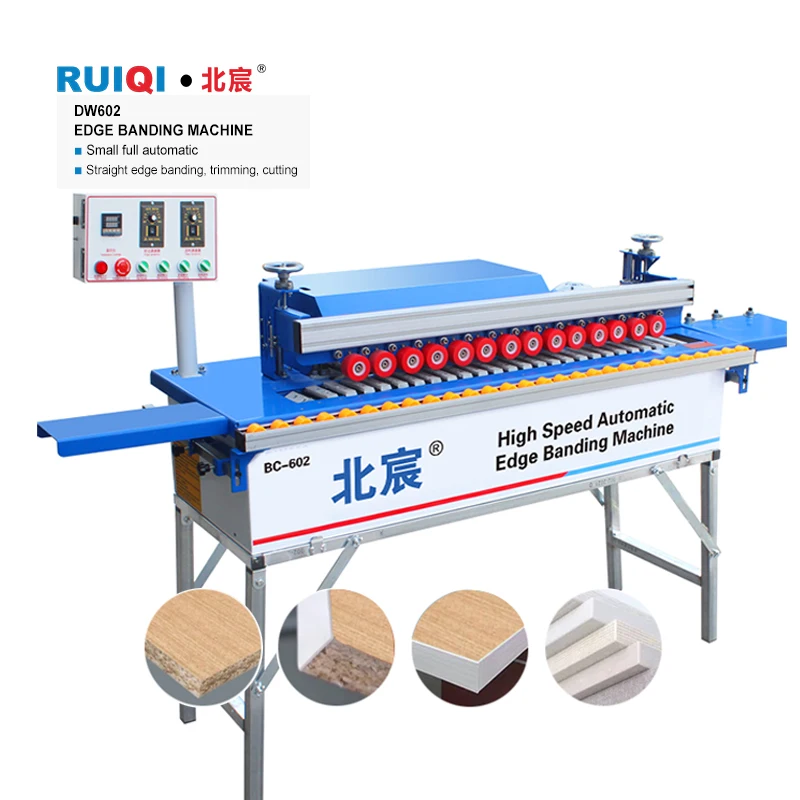
Edge banding machine
Click to enlarge
ISO 9001
CE Certified
OEM / ODM
12-Mo Warranty
Edge banding machine
DW602 Automatic Edge Banding Machine for MDF Plywood | Process Guide
<p><strong>DW602 Automatic Edge Banding Machine, 220V/380V, 0.3–3mm Banding Thickness</strong> — handles MDF, plywood and particleboard with automatic head-and-tail cutting, dual trimming (650W×2) and polishing (180W×2) stations in a single pass. Integrated vacuum maintains edge cleanliness for consistent glue adhesion across substrates, while 1000ml glue pot capacity supports continuous batch runs. Minimum panel size 25cm×5cm accommodates small-part cabinet and furniture production.</p> <ul> <li>Four-stage QC with pre-shipment test records verifying edge finish on your specific substrate and banding material combination.</li> </ul>
100+
Countries
MOQ 1
Unit
15-25 Days
Lead Time
Automatic Edge Banding Machine
Automatic Head And Tail Cutting
DW602
Furniture Factory
Integrated Vacuum
MDF Panel
Plywood Edge Banding
Process Guide
- Full OEM/ODM support -- custom logo, voltage (110V-440V), multilingual panels
- ISO 9001 & CE certified, 5 national patents, 60 professional engineers
- 12-month warranty, remote technical support & spare parts service
- Professional export packaging, customs clearance support, on-time delivery
Precision-ground edge finishing — The DW602 achieves controlled glue application and multi-stage trimming across MDF, plywood, and particleboard, validated through a four-stage inspection before dispatch.
Technical Specifications
| Parameter | Value |
|---|---|
| Model | DW602 |
| Product Type | Automatic Edge Banding Machine |
| Total Power | 3800W |
| Voltage Options | 220V / 380V / Customizable |
| Minimum Sheet Dimension | 25 cm (L) × 5 cm (W) |
| Edge Banding Height Range | 0–50 mm |
| Edge Banding Thickness Range | 0.3–3 mm |
| Trimming Power | 650W × 2 |
| Polishing Power | 180W × 2 |
| Vacuum Power | 1200W |
| Glue Pot Capacity | 1000 ml |
| Air Source Pressure | 0.5–0.8 MPa |
| Product Dimensions | 128 × 47 × 69 cm |
| Standard Features | Edge banding, trimming, polishing, automatic head-and-tail cutting, integrated vacuum |
| Language & Plug Options | Chinese/English standard; EU/USA/AU/UK plugs |
Application Suitability
| Application | Material or Output |
|---|---|
| Cabinet door production | MDF and melamine-faced particleboard |
| Furniture panel finishing | Plywood and blockboard |
| Polymer door manufacturing | Polymer substrates with PVC or veneer banding |
| Custom joinery components | Solid wood panels requiring smooth edge transitions |
Why Substrate Moisture Ruins Edge Quality on a Woodworking Process Edge Banding Machine
Visible glue lines often trace back to the board, not the machine.
I once configured an edge bander for a cabinet shop running standard melamine-faced stock. The trial went perfectly. Then they switched to a cheaper, high-moisture particleboard batch and the glue lines turned yellow within days, with banding lifting off the edges. Entire runs of cabinet doors had to be reworked. That experience made it clear: a woodworking process edge banding machine can only perform as well as the substrate it receives. Material variability — moisture content, surface porosity, resin composition — directly affects how adhesive bonds and cures [NEED_CITE: substrate moisture effects on hot-melt adhesive bonding].
Controlling the Glue Path from Pot to Panel
The DW602 carries a 1000 ml glue pot, sized to sustain continuous batch runs without frequent refills. Consistent melt temperature across that volume matters because uneven heat creates thick spots in the adhesive layer, which show up as ridges under thin PVC banding. For operators running a woodworking process edge banding machine daily, maintaining stable glue viscosity is the difference between invisible joints and rework.
How Debris Undermines Adhesion Before You See It
The integrated 1200W vacuum system pulls dust and chip debris away from the panel edge before the banding meets the glue. On particleboard especially, the cutting and routing upstream generates fine particles that settle into the glue line if not extracted. Without this stage, those particles create microscopic gaps where moisture eventually penetrates and weakens the bond [NEED_CITE: dust contamination impact on edge banding adhesion].
Reading the Power Distribution Across Stations
Each station on the DW602 draws power proportional to its mechanical demand. The trimming motors at 650W × 2 handle the bulk of material removal, shearing excess banding flush with the panel surface. The polishing motors at 180W × 2 follow at lower force, burnishing the trimmed edge to a smooth finish. The 0.3–3 mm banding thickness range means the trimming cutters must accommodate everything from thin melamine strips to solid wood veneer, and the dual-motor setup distributes that load. The 220V/380V voltage configurability ensures the machine can be matched to local supply before it ships, avoiding the situation where a unit arrives on the factory floor and cannot be powered up.
The Cost of Overlooking Small-Part Limits
The minimum sheet dimension of 25 cm × 5 cm defines the lower boundary of what the feed system can grip and transport through each station. Buyers who regularly process narrow drawer sides or small shelving brackets need to check this against their part list. When panels fall below the minimum, they jam in the feed chain or exit the polishing station with untrimmed edges, forcing manual cleanup that erodes any throughput advantage the machine was meant to deliver [NEED_CITE: edge bander minimum workpiece constraints in small-part production].
What This Configuration Actually Means for Your Floor
The DW602 is engineered in a facility with proprietary cutting mechanism patents and a four-stage quality control process covering incoming material through pre-shipment verification. Voltage, control panel language, and plug type are confirmed before production, not after the crate arrives. The machine family spans entry-level to full-function models, so a workshop that starts with the DW602 can scale to higher-throughput units from the same supplier without retraining operators on an unfamiliar interface. An engineer reviews your substrate, banding material, and production volume to confirm the configuration before a formal quotation is issued.
Documentation & Verification
- Factory test record showing edge finish on your specific MDF or particleboard grade
- Electrical schematic confirming voltage and frequency match at your facility
- Operation and maintenance manual in your operator’s working language
- CE declaration of conformity for import compliance
- Spare parts list with part numbers for trimmer blades and polishing wheels
Installation, Commissioning & Support
- Requires a dedicated circuit matching the confirmed 220V or 380V supply for the 3800W total draw
- Compressed air line at 0.5–0.8 MPa must be connected before the glue pot is first energized
- Machine footprint of 128 × 47 cm fits standard workshop aisles with room for infeed and outfeed
- First-run parameter setting covers glue temperature, feed speed, and trimmer depth for your banding thickness
- Trimmer and polisher consumables ship with the unit to cover the initial break-in period
Before You Send an Inquiry
Tell us what board materials you run most often — MDF, particleboard, plywood — and which banding materials you bond to them. Share your local voltage and frequency so the electrical system is configured before build. If you have a target panel size range, include the smallest and largest dimensions so we can verify feed compatibility.
Frequently Asked Questions
Q: What edge quality should I expect on MDF compared to particleboard?
A: MDF typically produces cleaner edges due to its uniform density, resulting in minimal glue line visibility after trimming and polishing. Particleboard varies more by manufacturer and moisture content; higher moisture can cause adhesive discoloration over time. We recommend sending sample panels for a factory test to verify results on your exact stock before ordering.
Q: Which banding materials and thicknesses does the DW602 handle?
A: The machine processes PVC, veneer, and melamine banding from 0.3 mm to 3 mm thick. Thicker veneer banding requires adjusted trimmer settings and slower feed rates to maintain a clean cut. Confirm your specific banding type and supplier during the inquiry stage so glue temperature and pressure can be matched accordingly.
Q: How does the integrated vacuum affect the final edge?
A: The 1200W vacuum extracts dust and fine particles from the panel edge before glue application. On porous substrates like particleboard, this prevents debris from embedding in the adhesive layer, which would otherwise create visible imperfections and weaken the bond over time.
Q: Can the machine run on my local voltage supply?
A: Yes. The DW602 is configurable for 220V, 380V, or other voltages as required. Voltage and frequency are confirmed during the quotation stage, and the electrical system is built and tested to match before shipment. This avoids the common problem of machines arriving incompatible with local power infrastructure.
Q: What is the smallest panel the DW602 can process?
A: The minimum sheet size is 25 cm long by 5 cm wide. Panels smaller than this cannot be reliably gripped by the feed system, leading to misalignment at the trimming and polishing stations. If your production includes parts below this threshold, mention it during inquiry so we can advise on suitability.
Technical Specifications
| Parameter | Value |
|---|---|
| Product Name | DW602 Automatic Edge Banding Machine for MDF Plywood | Process Guide |
| Category | Edge banding machine |
| Voltage Options | 110V / 220V / 380V / 440V (customizable) |
| Frequency | 50Hz / 60Hz (customizable) |
| Certification | ISO 9001, CE |
| MOQ | 1 Unit |
| Lead Time | 15-25 Working Days |
| Warranty | 12 Months |
| OEM / ODM | Available -- logo, color, panel language |
* Detailed technical specifications vary by model. Please contact us with your specific requirements for a complete datasheet.
Shipping & Export
-
Export Packaging
Heavy-duty wooden crate with foam padding and moisture protection
-
Shipping Methods
Sea freight (FCL/LCL), air freight, express -- we support all methods
-
Customs Support
Full documentation: CO, commercial invoice, packing list, HS code assistance
-
Port of Loading
Tianjin / Qingdao port, China -- 20 years export experience
OEM / ODM Services
-
Logo & Branding
Custom logo printing, color scheme, and nameplate engraving
-
Voltage Configuration
110V / 220V / 380V / 440V, 50Hz / 60Hz -- any region supported
-
Multilingual Panels
Control panels in English, Spanish, French, Arabic and more
-
Custom Specifications
Modified dimensions, accessories, or feature sets on request
Get a Quote
Request Product Inquiry
Fill in your details and we'll respond within 24 hours with pricing and availability.
Direct Contact
How It Works
-
1
Confirm requirements & budget
Tell us your factory scale and processing needs
-
2
Receive recommendation & quote
We match the right machine with full specs
-
3
Negotiate & place order
OEM terms, voltage, payment and delivery
-
4
Production & QC inspection
Multi-stage quality control by 60 engineers
-
5
Export packaging & shipment
Professional packing, customs clearance
-
6
After-sales support
12-month warranty, remote tech support
You May Also Like