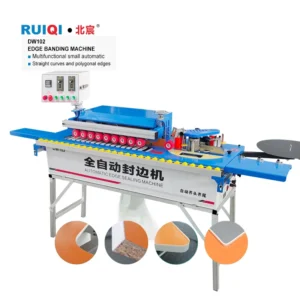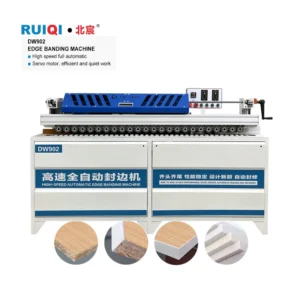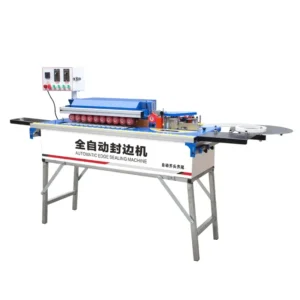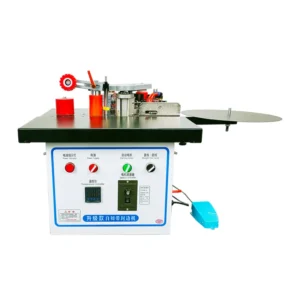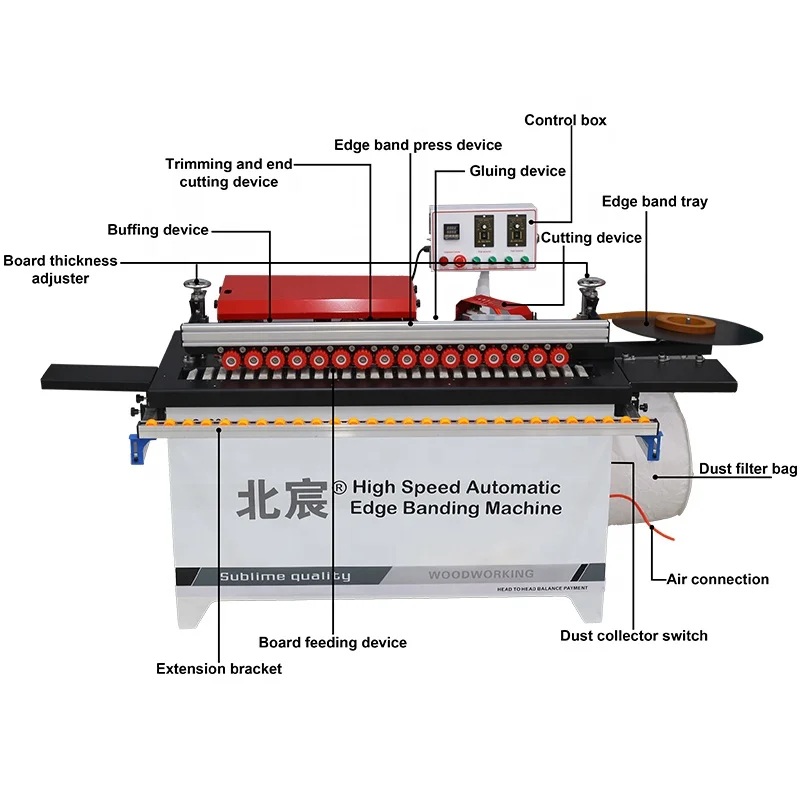
Edge banding machine
Click to enlarge
ISO 9001
CE Certified
OEM / ODM
12-Mo Warranty
Edge banding machine
DW802 Automatic Edge Banding Machine for MDF PVC – Process Guide
<p><strong>DW802 Automatic Edge Banding Machine, 4200W, 0.3–3mm Edge Thickness</strong> — engineered for MDF, particleboard, plywood and solid wood straight-edge banding in furniture workshops.</p> <ul> <li>Integrated gluing, end cutting, trimming and polishing stations deliver clean edges in a single pass</li> <li>4000ml glue pot supports continuous multi-panel runs without frequent refills</li> <li>Vacuum system at the banding station secures strip adhesion for consistent trimming quality</li> <li>Handles 0.3–3mm PVC, melamine and veneer strips with air supply at 0.4–0.8 MPa</li> </ul> <p>Backed by four-stage QC from incoming material to pre-shipment verification, and full OEM customization with voltage and multilingual control panels to match your facility.</p>
100+
Countries
MOQ 1
Unit
15-25 Days
Lead Time
CE Certified
DW802
Edge Banding Machine
Furniture Factory
MDF Panel
Process And Application
- Full OEM/ODM support -- custom logo, voltage (110V-440V), multilingual panels
- ISO 9001 & CE certified, 5 national patents, 60 professional engineers
- 12-month warranty, remote technical support & spare parts service
- Professional export packaging, customs clearance support, on-time delivery
Custom voltage and language settings — every DW802 order confirms local electrical standards and control panel language before assembly, avoiding the on-site commissioning failures that stall furniture production lines.
Technical Specifications
| Parameter | Value |
|---|---|
| Model | DW802 |
| Product Type | Automatic Edge Banding Machine |
| Total Power | 4200W |
| Voltage & Frequency | 220V / 380V / customizable (frequency to confirm with local supply) |
| Overall Dimensions (L×W×H) | 130 × 60 × 95 cm |
| Net Weight | 135 kg |
| Minimum Sheet Length | 25 cm |
| Minimum Sheet Width | 10 cm |
| Edge Banding Height Range | 0–50 mm |
| Edge Banding Thickness Range | 0.3–3 mm |
| Edge Motor Power | 140W |
| Transmission Motor Power | 140W |
| Trimming Motor Power | 800W × 2 |
| Polishing Motor Power | 180W × 2 |
| Vacuum Power | 1200W |
| Air Source Pressure | 0.4–0.8 MPa |
| Glue Pot Capacity | 4000 ml |
| Standard Stations | Gluing, edge banding, end cutting (automatic head and tail), trimming, polishing, vacuum |
| Language Options | Chinese, English; customizable to Spanish or other languages |
| Plug Options | EU, USA, AU, UK |
| Certification | CE |
Application Suitability
| Application | Material or Output |
|---|---|
| Cabinet carcass edge sealing | MDF and particleboard panels with PVC or melamine edge banding |
| Custom furniture straight-edge finishing | Plywood and ecological board with 0.3–3 mm veneer or PVC strips |
| Joinery workshop production runs | Solid wood panels requiring trimming and polishing for assembly-ready edges |
| Small-batch home decoration components | Narrow panels down to 25 cm length and 10 cm width |
Why the Voltage Question Should Come Before the Price on Any Edge Banding Machine Woodworking Process
A machine wired for the wrong supply will trip its main breaker on first startup, leaving your line idle for weeks while a replacement inverter ships overseas.
I learned this the hard way early in my career. An edge bander shipped to a Southeast Asian workshop was wired at 380V while the site ran 415V three-phase. The main motor tripped within seconds of commissioning, and the entire cabinet line sat idle for three weeks waiting for a variable-frequency drive retrofit. That single oversight cost more in lost production than the machine itself. When evaluating the DW802 or any edge banding machine woodworking process setup, the electrical confirmation must be the first line on the order — not an afterthought buried in the shipping documents. [NEED_CITE: voltage and frequency standards by export market]
Glue Application and Substrate Behaviour Across Panel Types
The DW802 carries a 4000 ml glue pot that supports continuous multi-panel runs through MDF, particleboard, plywood and solid wood substrates. Each material absorbs and releases heat differently: MDF tends to draw heat away from the glue film quickly, requiring a stable pot temperature to maintain open time, while particleboard’s porous surface can starve the bond line if the application roller pressure is not set correctly. This edge banding machine woodworking process station keeps the glue at a consistent viscosity across these variations.
End Cutting, Trimming and Polishing in One Continuous Pass
After the banding strip meets the panel edge and the vacuum system presses it firmly in place, the automatic head-and-tail end cutting station trims the overhang flush. The dual 800W trimming motors then remove excess material top and bottom, followed by the 180W × 2 polishing motors that smooth the transition between strip and substrate. For joinery shops processing solid wood or ecological board, this sequence directly affects how tightly panels seat during assembly — a rough trim leaves a visible gap that no amount of hand-sanding fully corrects. [NEED_CITE: CE machinery directive requirements for industrial equipment]
Reading the Spec Sheet Against Your Actual Production Requirements
The DW802’s edge banding thickness range of 0.3–3 mm covers the PVC, melamine and veneer strips most furniture workshops stock. The 0–50 mm banding height range accommodates standard 18 mm and 25 mm carcass panels as well as thicker solid wood components. What matters is matching the trimming motor power and feed characteristics to your daily volume — a trimming motor sized for occasional use will show chatter marks on the cut face when pushed through long production runs, and those marks telegraph through to the final assembled cabinet. The air source pressure requirement of 0.4–0.8 MPa must also be verified against your workshop compressor, as insufficient pressure causes the end-cutting cylinder to lag, leaving a visible step at the panel ends.
What Happens When Feed Height and Upstream Output Are Mismatched
Buying a single edge bander without checking how it interfaces with your panel saw and boring machine creates bottlenecks that compound across the shop floor. A machine set up for narrow panels may struggle with the feed height your sliding table saw produces, and operators forced to re-cut stock lose the productivity gain the automation was meant to deliver. I have seen workshops invest in automated banding only to discover the infeed conveyor height did not align with their existing roller tables, turning a single-pass process into a two-person lifting operation. [NEED_CITE: workflow integration standards for panel processing lines]
What This Machine Brings to Your Workshop Floor
The DW802 integrates gluing, end cutting, trimming and polishing into a single 130 × 60 × 95 cm footprint, fitting workshops where floor space constrains line layout. Voltage is confirmed per order from 220V through 380V or custom configurations, with plug options covering EU, USA, AU and UK standards. Control panel language is set before dispatch — Chinese, English, Spanish or another agreed language — so operators read instructions in their working language from day one. The machine ships with a factory test record run on your specified substrate and edge banding material, giving you verifiable output quality before the crate is sealed. An engineer reviews your production requirements and issues a formal configuration quotation within 24 hours, ensuring the station functions match your actual panel mix.
Documentation & Verification
- CE declaration of conformity covering the DW802 automatic edge banding machine
- Machine specification sheet listing all station motor ratings and voltage configuration
- Electrical schematic with confirmed voltage and plug type for your site
- Factory test record showing sample output on your specified substrate and banding material
- Operation and maintenance manual in the language your operators read
- Spare parts list identifying wear components and reorder references
Installation, Commissioning & Support
- Dedicated 4200W circuit with correct breaker rating for the confirmed voltage
- Compressed air supply delivering 0.4–0.8 MPa at the machine inlet with moisture trap
- Level floor within the 130 × 60 cm footprint, no special foundation required
- Glue pot temperature calibration on your specific edge banding material during first run
- Operator training on station adjustment for switching between PVC and veneer strips
- Wear-part replacement schedule covering trimming cutters and polishing wheels
How to Start the Specification Conversation
Send through the panel materials you process most — substrate type, typical thickness and edge banding strip material — along with your local supply voltage and frequency. Let us know the control panel language your team needs and whether your workshop runs on a single machine or feeds into downstream boring and drilling stations. If you have a specific edge quality benchmark or a panel sample you want tested, share that early so the factory test record reflects your actual production conditions.
Frequently Asked Questions
Q: What substrates and edge banding materials does the DW802 handle, and how does glue behaviour differ?
A: The machine processes MDF, particleboard, plywood, solid wood and ecological board with PVC, melamine or veneer strips from 0.3 to 3 mm thick. MDF draws heat from the glue film faster than particleboard, so pot temperature stability matters more on high-density fibreboard runs to maintain consistent bond strength across a batch.
Q: How do I verify trimming and polishing quality before committing to a full production run?
A: Request the factory test record, which documents sample panels processed on your specified substrate and banding material. Examine the trimmed edge for chatter marks and the polished transition for visible glue lines. This record is generated before the machine leaves the factory, giving you evidence of output quality before shipment.
Q: Can the control panel language be changed for my operators?
A: Yes. The DW802 supports Chinese, English and Spanish as standard options, with other languages available on request. The language is configured during assembly so the panel displays correctly from first power-on, avoiding the commissioning delays that occur when operators cannot read error codes or parameter menus.
Q: What air supply does the machine need for stable operation?
A: The DW802 requires compressed air at 0.4–0.8 MPa, feeding the end-cutting cylinder and vacuum-assist components. Insufficient pressure causes the end-cutting blade to lag, leaving a step at the panel head and tail. A moisture trap at the inlet protects the pneumatic valves from condensation damage over extended production runs.
Technical Specifications
| Parameter | Value |
|---|---|
| Product Name | DW802 Automatic Edge Banding Machine for MDF PVC – Process Guide |
| Category | Edge banding machine |
| Voltage Options | 110V / 220V / 380V / 440V (customizable) |
| Frequency | 50Hz / 60Hz (customizable) |
| Certification | ISO 9001, CE |
| MOQ | 1 Unit |
| Lead Time | 15-25 Working Days |
| Warranty | 12 Months |
| OEM / ODM | Available -- logo, color, panel language |
* Detailed technical specifications vary by model. Please contact us with your specific requirements for a complete datasheet.
Shipping & Export
-
Export Packaging
Heavy-duty wooden crate with foam padding and moisture protection
-
Shipping Methods
Sea freight (FCL/LCL), air freight, express -- we support all methods
-
Customs Support
Full documentation: CO, commercial invoice, packing list, HS code assistance
-
Port of Loading
Tianjin / Qingdao port, China -- 20 years export experience
OEM / ODM Services
-
Logo & Branding
Custom logo printing, color scheme, and nameplate engraving
-
Voltage Configuration
110V / 220V / 380V / 440V, 50Hz / 60Hz -- any region supported
-
Multilingual Panels
Control panels in English, Spanish, French, Arabic and more
-
Custom Specifications
Modified dimensions, accessories, or feature sets on request
Get a Quote
Request Product Inquiry
Fill in your details and we'll respond within 24 hours with pricing and availability.
Direct Contact
How It Works
-
1
Confirm requirements & budget
Tell us your factory scale and processing needs
-
2
Receive recommendation & quote
We match the right machine with full specs
-
3
Negotiate & place order
OEM terms, voltage, payment and delivery
-
4
Production & QC inspection
Multi-stage quality control by 60 engineers
-
5
Export packaging & shipment
Professional packing, customs clearance
-
6
After-sales support
12-month warranty, remote tech support
You May Also Like