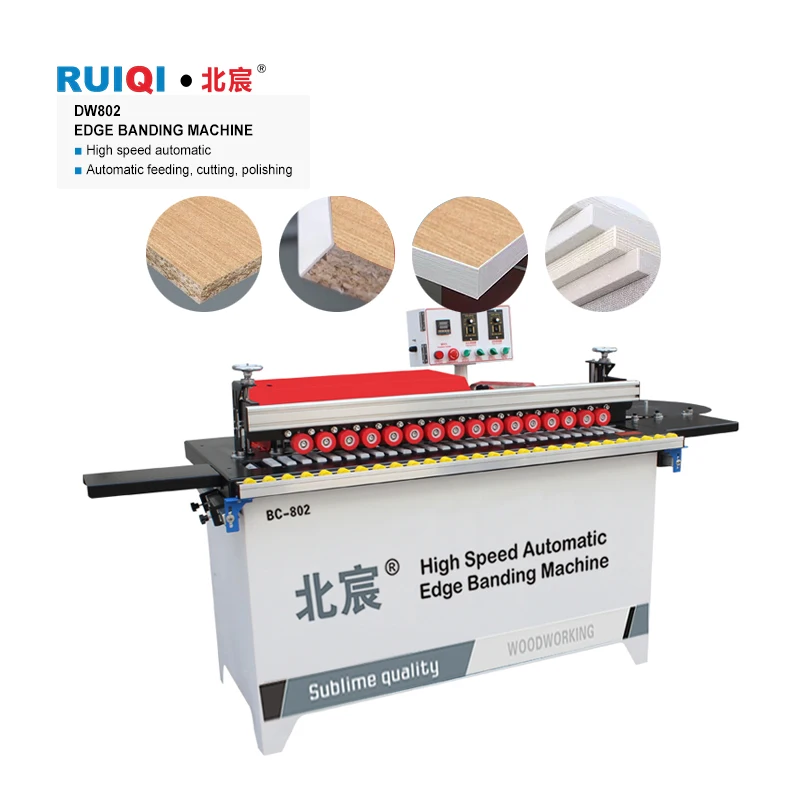
Edge banding machine
Click to enlarge
ISO 9001
CE Certified
OEM / ODM
12-Mo Warranty
Edge banding machine
Edge Banding Machine for MDF and Particleboard – Factory Direct
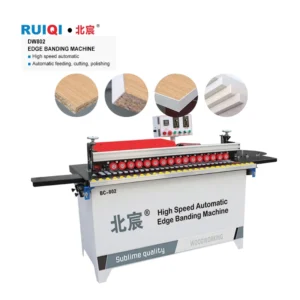
<p><strong>DW802 Automatic Edge Banding Machine, 4200W, 0.3-3mm Edge Thickness, 0-50mm Banding Height</strong> — delivers clean edge sealing on MDF, particleboard, and plywood with integrated trimming and polishing stations.</p> <ul> <li>4000ml glue pot maintains consistent temperature for continuous runs across mixed substrates</li> <li>Dual 800W trimming motors handle dense PVC and wood veneer without stalling</li> <li>Automatic head and tail cutting with vacuum hold-down for panels as short as 25cm</li> </ul> <p>Sample processing tests verify edge quality on your actual stock before order confirmation.</p>
100+
Countries
MOQ 1
Unit
15-25 Days
Lead Time
380V
Automatic Head And Tail
DW802
Edge Banding Machine
Furniture Factory
MDF Panel
Process Application
- Full OEM/ODM support -- custom logo, voltage (110V-440V), multilingual panels
- ISO 9001 & CE certified, 5 national patents, 60 professional engineers
- 12-month warranty, remote technical support & spare parts service
- Professional export packaging, customs clearance support, on-time delivery
Precision-Ground Components — Every DW802 edge bander undergoes multi-stage inspection from raw material to pre-shipment verification, ensuring ±0.02mm trimming accuracy that holds up when your furniture panels reach the assembly bench.
Technical Specifications
| Parameter | Value |
|---|---|
| Model | DW802 |
| Product Type | Automatic Edge Banding Machine |
| Total Power | 4200W |
| Voltage | 220V / 380V / customization available |
| Standard Features | Edge banding, trimming, polishing, automatic head and tail cutting, vacuum hold-down |
| Minimum Sheet Length | 25 cm |
| Minimum Sheet Width | 10 cm |
| Edge Banding Height | 0–50 mm |
| Edge Banding Thickness | 0.3–3 mm |
| Trimming Power | 800W × 2 |
| Polishing Power | 180W × 2 |
| Vacuum Power | 1200W |
| Air Source Pressure | 0.4–0.8 MPa |
| Glue Pot Capacity | 4000 ml |
| Product Size | 130 × 60 × 95 cm |
| Product Weight | 135 kg |
| Assembly State | Fully assembled |
| Language Options | Chinese, English (customizable to Spanish or other languages) |
| Plug Options | EU, USA, AU, UK |
| Certification | CE, ISO 9001 |
Application Suitability
| Application | Material or Output |
|---|---|
| Custom furniture panel edge sealing | MDF, particleboard, plywood |
| Cabinet case goods production | Ecological board, melamine-faced board |
| Home decoration joinery | Solid wood board, blockboard |
| Small-batch bespoke workshop | PVC, wood veneer, and melamine edge banding (0.3–3 mm) |
Why Glue Lines Show Up on Particleboard but Not MDF — and What That Means for Your Edge Banding Machine Process Application
Glue viscosity, pot temperature, and substrate porosity must align before the first panel enters the machine.
I have stood in workshops where the same edge bander produced flawless edges on MDF all morning, then left visible glue streaks the moment the operator switched to particleboard. The difference was not the machine itself — it was how the glue temperature and feed rate interacted with the more porous substrate. Particleboard absorbs heat faster from the adhesive layer, meaning the glue can skin over before the pressure roller achieves full contact. This is the kind of problem that only appears once real production material hits the feed table, not during the supplier’s demonstration run. Understanding how the edge banding machine process application behaves across substrates is what separates a reliable production line from three days of rework [NEED_CITE: substrate porosity effects on hot-melt adhesive bonding in panel processing].
How Glue Pot Capacity Influences Consistency Across a Production Run
The DW802 carries a 4000 ml glue pot, which provides enough adhesive volume to maintain stable thermal mass throughout a typical batch run. Smaller pots lose temperature faster when cold edge banding strip enters the glue zone repeatedly, causing viscosity swings that translate directly into uneven glue lines. With a larger reservoir, the heating element recovers between panels, keeping the adhesive within the optimal application range whether you are running fifty cabinet sides or two hundred shelf boards in a single shift.
Trim Station Power and Its Effect on Dense Edge Materials
When you feed 3 mm PVC or real oak veneer through the trimming station, the cutting load is substantially higher than with thin melamine tape. The DW802’s dual 800W trimming motors carry enough torque to produce flush cuts on denser materials without stalling or leaving chatter marks along the trim line. This matters because a stall mid-trim means a ruined panel and a production interruption that cascades through the rest of your assembly schedule.
Reading the Spec Sheet Against Your Actual Workshop Requirements
A 0.3–3 mm edge banding thickness range covers most furniture production scenarios, from lightweight decorative edging to heavy-duty impact protection on worktops. The 0–50 mm banding height accommodates standard panel thicknesses in the MDF and particleboard family [NEED_CITE: standard panel thickness ranges in custom furniture manufacturing]. The 135 kg product weight and 130 × 60 × 95 cm footprint place this machine in a category where it can be positioned in an existing workshop without major floor plan changes, yet it remains heavy enough to resist vibration during trimming operations. Air source pressure of 0.4–0.8 MPa drives the pneumatic pressure beam and head-and-tail cutting mechanism — confirm your compressor can sustain volume at the upper end of this range when other pneumatic tools are running simultaneously.
What Happens When Voltage and Compressed Air Are Assumed Rather Than Confirmed
I once visited a furniture factory where a newly arrived edge bander sat unplugged for two weeks because the local supply was 220V single-phase and the machine had been wired for 380V three-phase at the factory. Nobody had confirmed the electrical specification during the ordering process, and the rewiring required a certified electrician the workshop did not have on staff. A similar delay happens when the air compressor is undersized: the pressure beam cannot maintain consistent downward force, panels drift during trimming, and the operator blames the machine rather than the air supply. These failures are entirely preventable if the edge banding machine process application is matched to the facility’s utilities before the crate leaves the factory [NEED_CITE: industrial compressed air requirements for pneumatic woodworking machinery].
Why Procurement Decisions Should Start Here
The DW802 supports voltage customization from 220V to 380V and beyond, confirmed in writing before production begins so the machine arrives ready to plug in. Control panels are available in English, Spanish, or other agreed languages, eliminating the commissioning delay that occurs when operators cannot read the interface. A factory test record is produced using your specified panel material and edge banding type, giving you documented evidence of trimming accuracy and glue line quality before the machine ships. The full product family — from entry-level to full-function pre-milling configurations — means a workshop can add capacity over time without introducing a second supplier’s service and parts ecosystem.
Documentation & Verification
- CE declaration of conformity covering the DW802’s electrical and mechanical safety systems
- Factory test record showing edge adhesion and trim accuracy on your specific substrate and banding material
- Electrical schematic with confirmed voltage and plug type matching your facility’s supply
- Operation and maintenance manual in your agreed language covering glue temperature calibration and trim station adjustment
- Spare parts list with identified wear items and recommended replacement intervals
Installation, Commissioning & Support
- Fully assembled delivery — the DW802 arrives at 135 kg and can be positioned with standard workshop lifting equipment
- Dedicated circuit required for 4200W total draw; confirm breaker rating and wire gauge before installation day
- Pneumatic connection at 0.4–0.8 MPa with inline moisture filter to protect the pressure beam and head-and-tail cylinders
- First-run calibration of trimming motors and glue pot thermostat conducted against your panel stock during commissioning
- Operator training covers glue temperature adjustment for different banding materials and trim station alignment checks
Before You Request a Quotation
Send us your primary panel materials, the edge banding types and thicknesses you run most often, and your facility’s voltage and frequency so the configuration is locked down before production. If you are replacing a manual edge banding process, share your approximate daily panel volume and the minimum and maximum sheet dimensions you typically handle — this determines whether the DW802’s 25 cm minimum sheet length and 10 cm minimum width fit your production mix. Let us know your preferred control panel language and plug standard so the machine documentation and electrical interface match your workshop from day one.
Frequently Asked Questions
Q: How does glue pot temperature affect adhesion when switching between MDF and particleboard?
A: Particleboard is more porous than MDF and draws heat from the adhesive faster, which can cause the glue to set before the pressure roller achieves full contact. The DW802’s 4000 ml glue pot maintains thermal stability across material changes, but the operator should verify adhesion quality on the first few panels after a substrate switch and adjust the temperature setting if visible glue lines appear.
Q: Which edge banding materials work within the 0.3–3 mm range, and does trimming power need adjustment?
A: PVC, wood veneer, and melamine all fall within this thickness range. The dual 800W trimming motors handle dense 3 mm PVC and veneer without stalling. No manual power adjustment is needed, but the operator should verify trim quality on thicker materials during setup, as cutter wear increases with denser substrates.
Q: How can I verify edge quality before committing to a full production order?
A: Request a factory test record that documents edge banding adhesion and trimming accuracy using your actual panel material and edge banding type. This record is generated before shipment and provides measurable evidence of glue line visibility, trim flushness, and polishing finish against your quality standard.
Q: What air supply does the pneumatic system require for consistent operation?
A: The DW802 operates at 0.4–0.8 MPa and requires sufficient compressor volume to sustain pressure when the pressure beam, head-and-tail cutter, and any other pneumatic workshop tools run simultaneously. An inline moisture filter is strongly recommended to protect the pneumatic cylinders from condensation damage.
Q: How does the vacuum hold-down system prevent panel shift during trimming?
A: The integrated 1200W vacuum system secures the panel against the feed table, preventing lateral drift when the trimming cutters engage — particularly important on smooth melamine-faced boards where friction alone is insufficient to hold position during high-speed trimming operations.
Technical Specifications
| Parameter | Value |
|---|---|
| Product Name | Edge Banding Machine for MDF and Particleboard – Factory Direct |
| Category | Edge banding machine |
| Voltage Options | 110V / 220V / 380V / 440V (customizable) |
| Frequency | 50Hz / 60Hz (customizable) |
| Certification | ISO 9001, CE |
| MOQ | 1 Unit |
| Lead Time | 15-25 Working Days |
| Warranty | 12 Months |
| OEM / ODM | Available -- logo, color, panel language |
* Detailed technical specifications vary by model. Please contact us with your specific requirements for a complete datasheet.
Shipping & Export
-
Export Packaging
Heavy-duty wooden crate with foam padding and moisture protection
-
Shipping Methods
Sea freight (FCL/LCL), air freight, express -- we support all methods
-
Customs Support
Full documentation: CO, commercial invoice, packing list, HS code assistance
-
Port of Loading
Tianjin / Qingdao port, China -- 20 years export experience
OEM / ODM Services
-
Logo & Branding
Custom logo printing, color scheme, and nameplate engraving
-
Voltage Configuration
110V / 220V / 380V / 440V, 50Hz / 60Hz -- any region supported
-
Multilingual Panels
Control panels in English, Spanish, French, Arabic and more
-
Custom Specifications
Modified dimensions, accessories, or feature sets on request
Get a Quote
Request Product Inquiry
Fill in your details and we'll respond within 24 hours with pricing and availability.
Direct Contact
How It Works
-
1
Confirm requirements & budget
Tell us your factory scale and processing needs
-
2
Receive recommendation & quote
We match the right machine with full specs
-
3
Negotiate & place order
OEM terms, voltage, payment and delivery
-
4
Production & QC inspection
Multi-stage quality control by 60 engineers
-
5
Export packaging & shipment
Professional packing, customs clearance
-
6
After-sales support
12-month warranty, remote tech support
You May Also Like