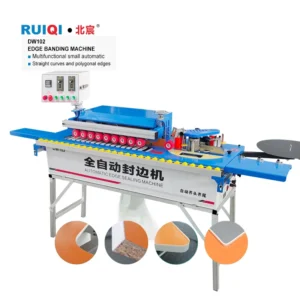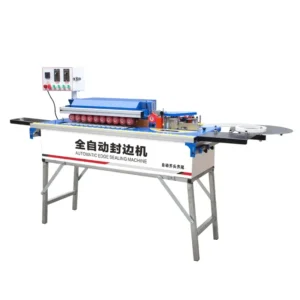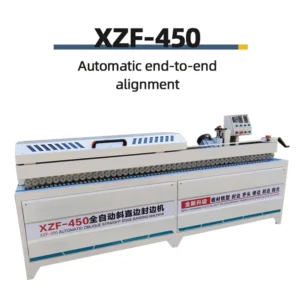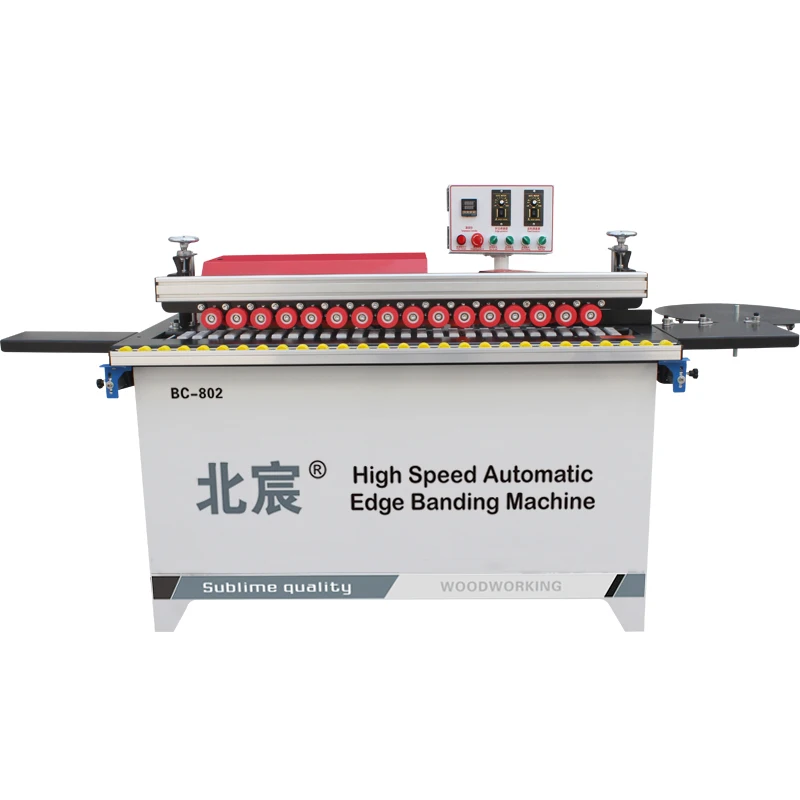
Edge banding machine
Click to enlarge
ISO 9001
CE Certified
OEM / ODM
12-Mo Warranty
Edge banding machine
Edge Gluing Machine for PVC Melamine Wood – Process and Application
<p><strong>DW802 Automatic Edge Banding Machine, 4200W Total Power, 0.3-3mm Banding Thickness</strong> — integrates gluing, trimming, polishing and automatic head-and-tail cutting in a single pass for MDF, particleboard and plywood substrates. The 4000 ml glue pot maintains stable adhesive temperature across continuous runs, reducing visible glue lines on customer-visible surfaces. Dedicated 800W × 2 trimming stations ensure clean end-trim accuracy that directly supports downstream assembly fit.</p> <ul> <li>Banding height 0-50 mm with integrated 1200W vacuum extraction at trimming point</li> <li>Language options include Chinese, English and customizable Spanish control panels</li> <li>Request a sample processing test with your actual panel material and edge banding stock to verify glue line visibility and trim finish before committing to order</li> </ul>
100+
Countries
MOQ 1
Unit
15-25 Days
Lead Time
Automatic Edge Banding Machine
Automatic Head Tail Cutting
Custom Furniture Production
DW802
MDF Panel Edge Sealing
Process And Application
PVC Melamine Edge Banding
Vacuum Edge Banding
- Full OEM/ODM support -- custom logo, voltage (110V-440V), multilingual panels
- ISO 9001 & CE certified, 5 national patents, 60 professional engineers
- 12-month warranty, remote technical support & spare parts service
- Professional export packaging, customs clearance support, on-time delivery
Precision-ground trimming stations — a dedicated 800W × 2 setup removes end overhang and side flash in one pass, preventing the re-work loops that appear when rough-trimmed panels reach the assembly bench.
Technical Specifications
| Parameter | Value |
|---|---|
| Model | DW802 |
| Product Type | Automatic Edge Banding Machine |
| Total Power | 4200 W |
| Voltage & Frequency | 220 V / 380 V / customization (frequency to be confirmed) |
| Glue Pot Capacity | 4000 ml |
| Edge Banding Thickness Range | 0.3 – 3 mm |
| Edge Banding Height Range | 0 – 50 mm |
| Minimum Sheet Length | 250 mm |
| Minimum Sheet Width | 100 mm |
| Trimming Motor | 800 W × 2 |
| Polishing Motor | 180 W × 2 |
| Edge Feed Motor | 140 W |
| Transmission Motor | 140 W |
| Vacuum Power | 1200 W |
| Air Source Pressure | 0.4 – 0.8 MPa |
| Overall Dimensions (L × W × H) | 130 × 60 × 95 cm |
| Net Weight | 135 kg |
| Control Panel Languages | Chinese, English standard; Spanish and other languages customizable |
| Assembly State | Fully assembled |
| Key Features | Gluing, trimming, polishing, automatic head-and-tail cutting, integrated vacuum extraction |
| Standards Referenced | CE, ISO 9001 |
Application Suitability
| Application | Material or Output |
|---|---|
| Custom cabinet door edge banding | MDF and particleboard with 0.4 – 2 mm PVC strip |
| Wardrobe side-panel sealing | Melamine-faced chipboard with matching melamine edge |
| Small-batch plywood shelving | Plywood panels up to 50 mm edge height with thin veneer or PVC |
| Ecological board furniture components | Multi-layer ecological board with pre-glued or hot-melt edge band |
| Home-decoration built-in units | Solid wood panels requiring low-temperature adhesive handling |
Why Visible Glue Lines Keep Returning After a "Successful" Test Run
A clean sample on the first day means very little if the glue pot cannot hold temperature across the twentieth panel.
Many workshops test a handful of boards, approve the edge, and sign the purchase order. Two weeks later, when the shift is running consecutively through a batch of MDF cabinet sides, white glue lines creep back along the substrate. The issue rarely sits with the adhesive itself. It sits with the thermal mass inside the pot and the way heat is replenished between panels [NEED_CITE: thermal stability requirements for hot-melt edge banding adhesives]. On the DW802, a 4000 ml glue pot holds enough melt to buffer temperature drops during continuous feeding, so the adhesive viscosity stays within the range where it wets the substrate rather than sitting on top of it. That buffer matters most when particleboard — porous, fast-absorbing — replaces MDF on the line.
How Substrate Porosity Shifts the Glue Window
MDF and particleboard look interchangeable on a cutting list, yet they pull heat and moisture out of hot-melt adhesive at different rates. Particleboard’s open surface demands a slightly higher glue temperature and a consistent feed rate so the melt penetrates before it skins over. The Edge banding machine process and application on the DW802 keeps the 4000 ml pot at a steady set-point, while the 140 W feed motor maintains panel spacing that prevents the trailing board from cooling the glue film left by the leading one. Operators switching between substrates only need to adjust the pot thermostat in small increments rather than chase runaway temperature swings.
Trimming Accuracy and the Downstream Assembly Gap
When head-and-tail overhang is trimmed by a dedicated 800 W × 2 motor pair, the cut lands squarely on the panel end grain. A clean, square trim means the next panel in an assembled carcase sits flush; a ragged trim leaves a hairline shadow that shows up under lacquer [NEED_CITE: fit tolerance expectations in panel furniture assembly]. The DW802’s automatic head-and-tail station handles edge banding thickness from 0.3 mm to 3 mm, so thin PVC and thicker melamine strips are both severed without crushing the core. Polishing at 180 W × 2 then removes the micro-burr that would otherwise catch dust during spraying.
Reading the Spec Sheet Against Actual Workshop Conditions
Four parameters on this machine deserve a closer look before the order is placed. First, the 0.3 – 3 mm banding thickness range covers the PVC and melamine strips used in most custom-furniture shops, yet veneer below 0.4 mm may require a lower glue temperature to prevent bleed-through. Second, the 0.4 – 0.8 MPa air pressure window drives the pneumatic cylinders that clamp the banding against the panel edge; pressure outside this window causes either incomplete contact or crushed edges on soft particleboard. Third, the 1200 W vacuum unit pulls trimmings away at the point of cut, which matters when fine MDF dust settles on fresh glue and creates the very contamination the operator is trying to avoid. Fourth, the 130 × 60 × 95 cm footprint fits between a sliding table saw and a panel rack in most small workshops, but the 220 V / 380 V dual-voltage rating must be matched to the shop’s actual supply before the motor windings are energized.
What Happens When the Wrong Bending Is Shipped In
Machines quoted without confirming local voltage and frequency arrive with motors wound for a grid that does not exist in the buyer’s facility. The 4200 W total load on the DW802 is manageable, but if a 60 Hz supply receives a 50 Hz-wound motor, the trimming and polishing spindles run hotter and the glue pot thermostat reads low, setting up the exact glue-line failure the operator was trying to avoid. Equally disruptive is a control panel printed in a language the operator cannot read: commissioning stalls while someone translates icon by icon [NEED_CITE: commissioning delays caused by language barriers on imported machinery]. Specifying Spanish, Arabic, or any other language before production is a single-line item on the quotation, yet it is routinely skipped until the crate is open.
Why Sourcing This Configuration Here Reduces Re-Work Risk
In-house manufacturing with patented cutting mechanisms means the trimming station geometry is designed alongside the glue path, not retrofitted after the frame is welded. A full product family from entry-level to full-function lets a workshop add pre-milling or corner-rounding later without changing the supplier or re-training operators on a different control layout. Voltage, language and specification customization is treated as standard rather than an upcharge, so the 220 V / 380 V selection and multilingual panel are confirmed before the machine leaves the bench. Four-stage QC includes a pre-shipment run with the buyer’s own panel stock when requested, catching substrate-specific glue issues before the crate is sealed. An engineer-led configuration proposal arrives within 24 hours, giving the buyer time to cross-check feed height and throughput against the rest of the line.
Documentation & Verification
- CE declaration referencing the DW802 model and total power rating
- Glue-pot temperature log recorded during pre-shipment test with buyer’s panel
- Electrical schematic confirming selected voltage and frequency before dispatch
- Operation manual in the agreed language covering adhesive changeover steps
- Spare-parts list itemizing trimming blades and polishing wheels by part number
- Packing photographs showing crate bracing around the 135 kg frame
Installation, Commissioning & Support
- Verify 220 V / 380 V dedicated circuit with breaker sized for the 4200 W total draw
- Level the 130 × 60 cm base on a flat concrete floor to prevent panel drift during feeding
- Confirm 0.4 – 0.8 MPa air supply with a dryer upstream to protect pneumatic cylinders
- Run the 4000 ml glue pot through a full heat cycle before first production pass
- Set trimming depth on sample stock matching the 0.3 – 3 mm banding thickness range
- Schedule polishing wheel replacement after the initial break-in run to maintain edge gloss
What to Prepare Before Requesting a Quotation
Share the substrate types and thicknesses you run most often, along with the edge banding material and strip thickness currently in stock. Note your facility voltage and frequency, the language your operators read, and whether the machine will sit in-line with existing saws or borers. If you have a panel sample that has previously shown glue-line issues, send it for a test run so the glue temperature and feed parameters can be recorded before the machine is crated.
Frequently Asked Questions
Q: How does the 4000 ml glue pot affect edge quality when running consecutive MDF versus particleboard panels?
A: Particleboard absorbs heat faster than MDF, so a larger melt volume acts as a thermal buffer. The 4000 ml capacity on the DW802 keeps adhesive viscosity stable across a batch, reducing the white-line defects that appear when the pot temperature drops between panels.
Q: Which banding materials and thicknesses give the cleanest trim on this configuration?
A: PVC and melamine strips between 0.4 mm and 2 mm trim cleanly with the 800 W × 2 stations. Thinner veneer requires a lower glue temperature to prevent bleed-through, while strips approaching 3 mm may need a second polishing pass for full gloss.
Q: How does automatic head-and-tail cutting influence panel length accuracy during assembly?
A: The dedicated end-trim station severs overhang squarely, leaving the panel at its programmed length. Consistent end cuts mean carcase sides meet without shadow lines, reducing the filler and re-sanding that add time at the assembly bench.
Q: What air supply conditions are needed to keep trimming and polishing consistent?
A: The pneumatic cylinders operate within 0.4 – 0.8 MPa. A stable, dry air source prevents pressure drops that cause incomplete trimming or uneven polishing pressure, both of which show up as visible lines on the finished edge.
Q: How should glue temperature and feed rate be adjusted when switching substrates?
A: Increase the pot thermostat in small steps when moving from MDF to particleboard, and allow a few panels to pass before measuring glue-line appearance. The 140 W feed motor maintains spacing so the trailing board does not cool the adhesive film ahead of it.
Technical Specifications
| Parameter | Value |
|---|---|
| Product Name | Edge Gluing Machine for PVC Melamine Wood – Process and Application |
| Category | Edge banding machine |
| Voltage Options | 110V / 220V / 380V / 440V (customizable) |
| Frequency | 50Hz / 60Hz (customizable) |
| Certification | ISO 9001, CE |
| MOQ | 1 Unit |
| Lead Time | 15-25 Working Days |
| Warranty | 12 Months |
| OEM / ODM | Available -- logo, color, panel language |
* Detailed technical specifications vary by model. Please contact us with your specific requirements for a complete datasheet.
Shipping & Export
-
Export Packaging
Heavy-duty wooden crate with foam padding and moisture protection
-
Shipping Methods
Sea freight (FCL/LCL), air freight, express -- we support all methods
-
Customs Support
Full documentation: CO, commercial invoice, packing list, HS code assistance
-
Port of Loading
Tianjin / Qingdao port, China -- 20 years export experience
OEM / ODM Services
-
Logo & Branding
Custom logo printing, color scheme, and nameplate engraving
-
Voltage Configuration
110V / 220V / 380V / 440V, 50Hz / 60Hz -- any region supported
-
Multilingual Panels
Control panels in English, Spanish, French, Arabic and more
-
Custom Specifications
Modified dimensions, accessories, or feature sets on request
Get a Quote
Request Product Inquiry
Fill in your details and we'll respond within 24 hours with pricing and availability.
Direct Contact
How It Works
-
1
Confirm requirements & budget
Tell us your factory scale and processing needs
-
2
Receive recommendation & quote
We match the right machine with full specs
-
3
Negotiate & place order
OEM terms, voltage, payment and delivery
-
4
Production & QC inspection
Multi-stage quality control by 60 engineers
-
5
Export packaging & shipment
Professional packing, customs clearance
-
6
After-sales support
12-month warranty, remote tech support
You May Also Like