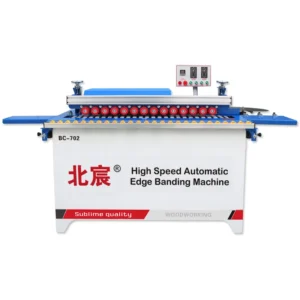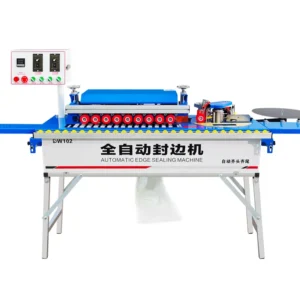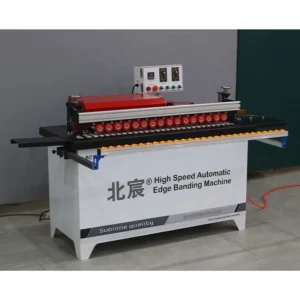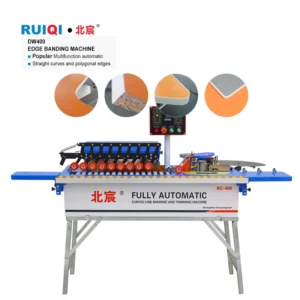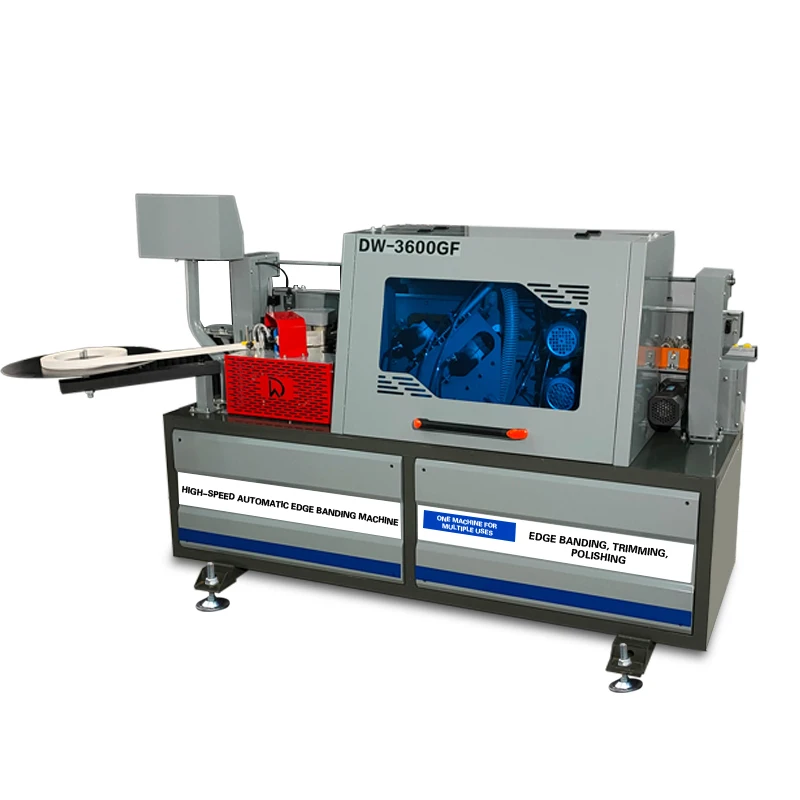
Edge banding machine
Click to enlarge
ISO 9001
CE Certified
OEM / ODM
12-Mo Warranty
Edge banding machine
Industrial Application Automatic Edge Banding Machine for MDF Cabinet Doors
<p><strong>DW-3600GF Automatic Edge Banding Machine, 4.9 kW, 0–14 m/min Feed Speed, 0.3–3 mm Band Thickness</strong> — integrates gluing, front/rear trimming, scraping, polishing and vacuuming in one continuous pass for MDF cabinet doors.</p> <ul> <li>Trimming motors run at 24,000 r/min for clean flush cuts on MDF and particleboard edges</li> <li>Handles PVC, ABS and veneer banding within 0–50 mm height range, matching common cabinet door specifications</li> <li>Adjustable feed speed accommodates different substrate densities and edge materials for consistent edge quality</li> </ul> <p>Supported by four-stage QC with pre-shipment verification and engineer-led configuration within 24 hours.</p>
100+
Countries
MOQ 1
Unit
15-25 Days
Lead Time
380V Three-phase
Automatic Edge Banding Machine
DW-3600GF
Factory Direct
Full Function Edge Bander
MDF Cabinet Door
Process Application
- Full OEM/ODM support -- custom logo, voltage (110V-440V), multilingual panels
- ISO 9001 & CE certified, 5 national patents, 60 professional engineers
- 12-month warranty, remote technical support & spare parts service
- Professional export packaging, customs clearance support, on-time delivery
Precision-Ground Components — The DW-3600GF edge bander’s trimming motors run at 24,000 r/min to hold tight flush tolerances on MDF and particleboard, verified at each stage before dispatch.
Technical Specifications
| Parameter | Value |
|---|---|
| Model | DW-3600GF |
| Product Type | Automatic Edge Banding Machine |
| Rated Power | 4.9 kW |
| Voltage & Frequency | 380V Three-Phase Four-Wire (frequency to be confirmed) |
| Overall Dimensions (L×W×H) | 2200 × 650 × 1250 mm |
| Net Weight | 320 kg |
| Edge Banding Type | Straight edge banding |
| Edge Band Height Range | 0–50 mm |
| Edge Band Thickness Range | 0.3–3 mm |
| Minimum Panel Length | 200 mm |
| Feed Speed | 0–14 m/min |
| Trimming Motor Power | 800W × 2, 24000 r/min |
| Polishing Motor Power | 400W × 2 |
| Edge Banding Motor Power | 160W |
| Transmission Motor Power | 180W |
| Air Supply Requirement | 0.4–0.6 MPa |
| Standard Functions | Gluing, Trimming (front and rear), Scraping, Polishing, Vacuuming |
| Language Options | Chinese and English standard; other languages customizable |
Application Suitability
| Application | Material or Output |
|---|---|
| MDF cabinet door edge banding | MDF panels with PVC or veneer edge banding |
| Panel furniture production | Particleboard and plywood with 0.3–3 mm edge materials |
| Custom joinery straight-line processing | Solid wood panels and composite substrates for cabinet assembly |
Why the Substrate Check Must Come Before the Model Selection
An automatic edge banding machine process application is only as reliable as the material data behind it.
I once configured a full-function edge bander for a custom furniture plant based entirely on their stated daily panel count. The machine was correct for the volume, but the plant was running high-moisture particleboard that the pre-milling station could not handle cleanly. Glue lines became visible on nearly every piece, and actual throughput dropped to roughly half the rated figure. That failure was not mechanical; it was a mismatch between the substrate reality and the configuration chosen. When selecting an edge bander, confirming the exact board density, moisture content, and edge band material is the first step, not an afterthought [NEED_CITE: substrate moisture content and edge adhesion failure rates].
The Station Sequence That Eliminates Secondary Rework
The DW-3600GF routes each panel through gluing, front and rear trimming, scraping, polishing, and vacuuming in one continuous pass. For MDF cabinet door production, this means the edge leaves the machine ready for hinge boring or assembly without a separate cleaning station. Intermediate handling between stations is where most edge damage occurs, so consolidating the sequence into a single automatic edge banding machine process application reduces the risk of chipped corners and contaminated glue surfaces.
Trimming Speed and Edge Finish on Composite Boards
The two trimming motors operate at 24,000 r/min with 800W each, which is significant when processing MDF and particleboard. Lower spindle speeds tend to tear the fiber rather than cut it, leaving a rough edge that shows through thin PVC banding. At this speed, the cutter produces a flush surface that the scraping and polishing stations can refine to a clean finish [NEED_CITE: high-frequency trimming motor effect on MDF edge porosity].
Reading the Specifications Against Your Production Reality
The feed speed range of 0–14 m/min allows operators to slow down for dense MDF and speed up for lighter particleboard runs. The edge band thickness range of 0.3–3 mm covers both thin PVC foil used on budget cabinet lines and thicker ABS or veneer strips required for higher-end furniture. The air supply requirement of 0.4–0.6 MPa must be maintained consistently; pneumatic pressure drops cause uneven glue application and incomplete trimming strokes. With a minimum panel length of 200 mm, the machine handles small cabinet components such as drawer fronts and shelf brackets without requiring a separate manual station. The overall footprint of 2200 × 650 mm fits within most small-to-medium workshop layouts without demanding a dedicated cell.
What Happens When Voltage and Frequency Are Assumed
Machines shipped without confirming local supply specifications arrive at facilities where they either cannot start or run at incorrect motor speeds. A 380V three-phase machine connected to a 220V single-phase supply will not operate, and a 50Hz motor running on 60Hz power will overspeed the trimming spindles beyond their rated tolerance. This is not a warranty issue; it is a configuration oversight that delays commissioning by weeks while replacement motors are sourced. The DW-3600GF supports voltage customization from 110V to 440V, but the correct specification must be confirmed at the quotation stage, not after the crate arrives [NEED_CITE: voltage and frequency standards by export market].
What This Machine Is Built On
The DW-3600GF uses proprietary cutting mechanisms with precision-ground components inspected at multiple stages before assembly. Each unit passes through incoming material inspection, in-process checks, finished product verification, and pre-shipment testing. Voltage, control panel language, and functional specifications are confirmed per order rather than assumed from a standard build. The product family spans entry-level to full-function configurations, so a workshop can add capacity later without switching suppliers or retraining operators on a different control interface.
Documentation & Verification
- Factory test record run on your specific MDF thickness and edge band material before dispatch
- Electrical schematic confirming voltage and frequency match your facility supply
- Operation and maintenance manual in the language your operators actually read
- Spare parts list with part numbers matching the components installed on your unit
- CE declaration of conformity and ISO 9001 certificate for customs and compliance filing
Installation, Commissioning & Support
- Floor space planning around the 2200 × 650 mm footprint with clearance for panel infeed and outfeed
- Dedicated 380V three-phase circuit with correct frequency confirmed before energizing the 4.9 kW system
- Pneumatic line sized to sustain 0.4–0.6 MPa at the machine inlet under continuous cycling
- Feed speed and trimming depth calibrated on your actual panel stock during first-day commissioning
- Polishing wheel replacement intervals documented against your edge band material type and daily run volume
Before You Request a Quotation
Provide the exact panel material you will be running, including board type, thickness range, and typical moisture content. Confirm your facility voltage, phase configuration, and frequency so the electrical system is built correctly from the start. Specify the edge banding material and thickness you use most often, and whether your operators need a control panel in a language other than Chinese or English.
Frequently Asked Questions
Q: How does each station affect final edge quality on MDF cabinet doors?
A: Gluing applies the adhesive layer, front and rear trimming removes overhang flush to the panel surface, scraping eliminates the trimming marks, and polishing brings the edge to a smooth finish. Skipping any station leaves a defect that shows up in final assembly. The DW-3600GF runs all five functions in one pass so the edge is finished when it exits.
Q: Which edge banding materials work within the 0.3–3 mm thickness range?
A: This range covers thin PVC foil commonly used on budget cabinet lines, standard PVC and ABS strips for mid-range furniture, and real wood veneer banding for higher-end applications. The gluing temperature and feed speed need adjustment when switching between material types to maintain consistent adhesion.
Q: How should feed speed be set for different substrate densities?
A: Denser materials like MDF require slower feed speeds to let the trimming cutters engage fully without tearing fibers. Lighter particleboard can run at higher speeds within the 0–14 m/min range. The correct setting depends on your specific board supplier and moisture content, which should be tested during commissioning.
Q: What air supply is needed to run all pneumatic functions reliably?
A: The machine requires 0.4–0.6 MPa at the inlet. Pressure must remain stable across all pneumatic actuators simultaneously; a drop below the minimum causes uneven glue bead application and incomplete trimming strokes. Your compressor and line sizing must account for this continuous demand alongside other pneumatic equipment in the workshop.
Q: How does trimming motor speed affect edge finish on MDF versus particleboard?
A: The 24,000 r/min trimming motors cut MDF fibers cleanly rather than tearing them, which prevents the rough edge that shows through thin PVC banding. Particleboard is less sensitive to spindle speed but still benefits from high-frequency trimming for a consistent flush surface before scraping and polishing.
Technical Specifications
| Parameter | Value |
|---|---|
| Product Name | Industrial Application Automatic Edge Banding Machine for MDF Cabinet Doors |
| Category | Edge banding machine |
| Voltage Options | 110V / 220V / 380V / 440V (customizable) |
| Frequency | 50Hz / 60Hz (customizable) |
| Certification | ISO 9001, CE |
| MOQ | 1 Unit |
| Lead Time | 15-25 Working Days |
| Warranty | 12 Months |
| OEM / ODM | Available -- logo, color, panel language |
* Detailed technical specifications vary by model. Please contact us with your specific requirements for a complete datasheet.
Shipping & Export
-
Export Packaging
Heavy-duty wooden crate with foam padding and moisture protection
-
Shipping Methods
Sea freight (FCL/LCL), air freight, express -- we support all methods
-
Customs Support
Full documentation: CO, commercial invoice, packing list, HS code assistance
-
Port of Loading
Tianjin / Qingdao port, China -- 20 years export experience
OEM / ODM Services
-
Logo & Branding
Custom logo printing, color scheme, and nameplate engraving
-
Voltage Configuration
110V / 220V / 380V / 440V, 50Hz / 60Hz -- any region supported
-
Multilingual Panels
Control panels in English, Spanish, French, Arabic and more
-
Custom Specifications
Modified dimensions, accessories, or feature sets on request
Get a Quote
Request Product Inquiry
Fill in your details and we'll respond within 24 hours with pricing and availability.
Direct Contact
How It Works
-
1
Confirm requirements & budget
Tell us your factory scale and processing needs
-
2
Receive recommendation & quote
We match the right machine with full specs
-
3
Negotiate & place order
OEM terms, voltage, payment and delivery
-
4
Production & QC inspection
Multi-stage quality control by 60 engineers
-
5
Export packaging & shipment
Professional packing, customs clearance
-
6
After-sales support
12-month warranty, remote tech support
You May Also Like