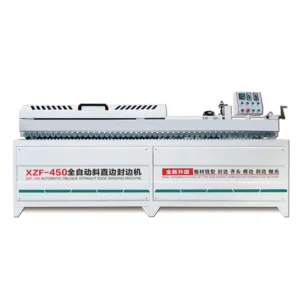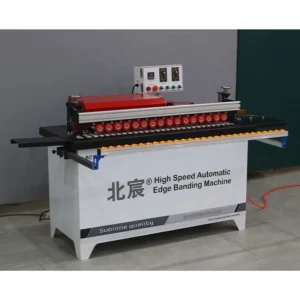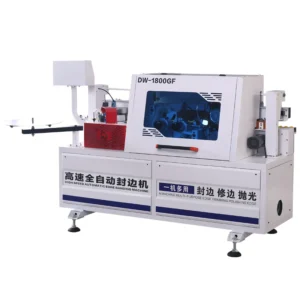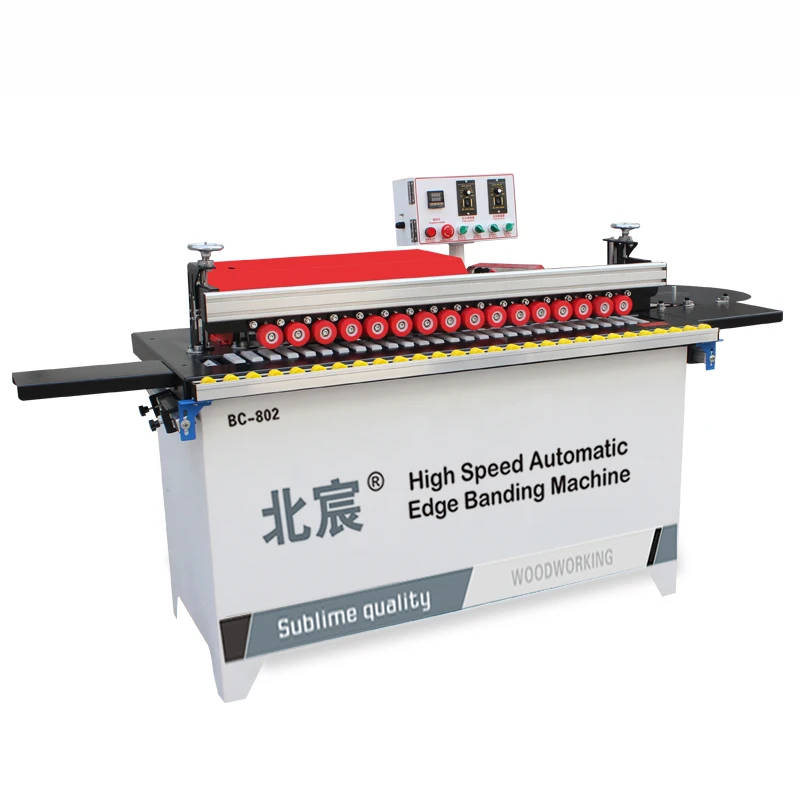
Edge banding machine
Click to enlarge
ISO 9001
CE Certified
OEM / ODM
12-Mo Warranty
Edge banding machine
Industrial Application Edge Banding Machine for Wood Furniture
<p><strong>DW802 Automatic Edge Banding Machine</strong>, 4200W total power, 0.3–3mm edge thickness range — configured for MDF, particleboard and plywood edge sealing in custom furniture production.</p> <ul> <li>Dual 800W trimming stations deliver flush finishing after automatic head-and-tail cutting, while the 4000ml glue pot supports continuous runs without frequent refills</li> <li>Integrated vacuum extraction at the trimming point keeps the work area clean and supports consistent edge quality across varying substrates</li> </ul> <p>Sample processing tests on your specific panel material and edge banding stock are available before order confirmation to verify trimming and polishing results.</p>
100+
Countries
MOQ 1
Unit
15-25 Days
Lead Time
== Gate == identifier: DW802 → 通过 Automatic Edge Banding Machine
Automatic Head And Tail Cutting
DW802
Furniture Factory
MDF Panel
Process And Application
Vacuum System
- Full OEM/ODM support -- custom logo, voltage (110V-440V), multilingual panels
- ISO 9001 & CE certified, 5 national patents, 60 professional engineers
- 12-month warranty, remote technical support & spare parts service
- Professional export packaging, customs clearance support, on-time delivery
Voltage-Adaptive Edge Processing — the DW802 handles 220V to 380V configurations with factory-confirmed frequency matching before dispatch.
Technical Specifications
| Parameter | Value |
|---|---|
| Model | DW802 |
| Product Type | Automatic Edge Banding Machine |
| Total Power | 4200W |
| Voltage & Frequency | 220V/380V/customization (frequency to be confirmed) |
| Minimum Sheet Length | 25cm |
| Minimum Sheet Width | 10cm |
| Edge Banding Height | 0-50mm |
| Edge Banding Thickness | 0.3-3mm |
| Glue Pot Capacity | 4000ml |
| Air Source Pressure | 0.4-0.8MPa |
| Product Size | 130×60×95cm |
| Product Weight | 135kg |
| Key Features | Edge banding, trimming, polishing, automatic head and tail cutting, integrated vacuum |
| Language Options | Chinese, English; other languages customizable |
Application Suitability
| Application | Material or Output |
|---|---|
| Cabinet door and carcase edge sealing | MDF and particleboard with PVC or melamine banding |
| Wardrobe panel processing | Particleboard and ecological board with 0.4–2mm ABS edges |
| Interior fit-out joinery | Plywood and blockboard with wood veneer banding |
| Custom furniture small batch runs | Solid wood panels with thin veneer or PVC strips |
Why Glue Pot Temperature Decides Your Edge Quality Before the Trim Station Even Engages
The woodworking edge banding process succeeds or fails at the glue roller, not at the polishing wheel.
I remember visiting a workshop where the operator had set the glue pot to a single temperature and ran both 0.4mm PVC and 2mm solid wood veneer through the same shift. The PVC held fine on straight MDF runs, but on every curved wardrobe panel, the veneer lifted within days because the adhesive had cooled below bonding threshold before the pressure roller engaged. When evaluating an automatic edge bander, the glue and trimming quality depends entirely on whether the thermal profile matches your specific banding material and substrate combination [NEED_CITE: thermal bonding thresholds for EVA hot melt adhesives on wood substrates]. A machine can have precise trimming stations and excellent polishing wheels, but if the glue bead is inconsistent, the downstream stations are just finishing a defect.
How the 4000ml Glue Pot Reduces Thermal Drift During Continuous Runs
Smaller glue pots on entry-level edge banders lose temperature stability when you run panels back-to-back without pause. The DW802’s 4000ml capacity maintains a larger thermal mass, which means the heating element cycles less aggressively and the adhesive stays within the target viscosity window across a longer production run. For a custom furniture shop processing wardrobe panels in batches, this translates to consistent bead thickness from the first board to the fortieth — the woodworking edge banding process holds its parameters without the operator needing to pause and let the pot recover.
Head-and-Tail Cutting and What It Means for Downstream Assembly
Manual snipping of banding overhang introduces variable start and finish points that show up as gaps or overlaps when panels meet at a cabinet corner. The DW802’s automatic head and tail cutting stations shear the banding flush at the panel’s leading and trailing edges before the material reaches the trimming units. This matters most when you are running ecological board for fitted wardrobes, where every carcase joint must close cleanly. The trimming stations — each rated at 800W — then handle the top and bottom overhang, leaving a uniform edge that the polishing wheels finish to a consistent radius [NEED_CITE: edge finishing standards for assembled cabinet joinery].
Reading the Specification Sheet Against Your Actual Production Requirement
The 0.3–3mm banding thickness range tells you this machine covers thin PVC decorative strips up to thicker ABS or wood veneer used on worktop edges. But thickness alone does not determine outcome: a 2mm wood veneer requires different glue temperature and feed behaviour than 2mm PVC, even though the spec sheet lists both under the same range. The minimum sheet dimensions — 25cm length and 10cm width — indicate this unit can handle small offcut pieces common in custom joinery, not just full-size panels. The integrated vacuum at 1200W extracts trimming dust at the cutting point, which keeps the polishing wheels clean and prevents adhesive contamination on subsequent panels.
What Happens When Voltage and Frequency Are Confirmed After Shipment
A machine wired for 380V/50Hz running on a 60Hz supply spins its motors faster than designed — the trimming cutters overspeed, the feed chain accelerates, and the glue roller applies less adhesive per linear meter because the panel moves through too quickly. I have seen entire shipments of edge banders sit idle in warehouses because the buyer confirmed voltage but not frequency, and the local grid simply did not match the machine’s electrical configuration [NEED_CITE: industrial motor behaviour under frequency mismatch]. The DW802 supports voltage customization from 220V to 380V, but frequency must be confirmed in writing before the electrical cabinet is assembled.
Why This Setup Works for Workshops Scaling from Manual to Automated
The DW802 sits at a point where a joinery workshop moving from handheld edge banding gains automated trimming and polishing without taking on the complexity of a multi-station industrial line. The fully assembled delivery means you are not aligning conveyor sections on your shop floor. The 135kg weight keeps the unit stable during operation without requiring a bolted foundation, which suits workshops in rented industrial units where floor modification is restricted. The customizable control panel language ensures your operators can read the interface from day one, rather than relying on translated stickers over Chinese characters.
What You Actually Receive Before the Crate Arrives
Each unit ships with a factory test record documenting actual edge quality on a material sample you specify — not a generic MDF coupon from the production line. The electrical schematic confirms the voltage and frequency your machine was built for, so your electrician knows what to prepare before uncrating. The operation and maintenance manual arrives in your agreed language, with spare parts cross-referenced to the specific trimming cutters and polishing wheels on your configuration. A CE declaration of conformity accompanies machines destined for markets requiring it. The packing photographs show your exact unit before crating, so you can verify condition against transit damage on arrival.
Installation, Commissioning & Support
- 130×60×95cm footprint requires a level concrete floor with clearance on three sides for panel infeed and operator access
- Dedicated circuit matching confirmed voltage and frequency — do not share with other machinery on the same breaker
- Arrives fully assembled; connect air supply at 0.4–0.8MPa and power before first test run
- Glue pot temperature calibration performed against your specific banding material during commissioning
- Trimming cutter replacement schedule tied to your panel material — MDF dulls carbide faster than particleboard
What to Share When You Open an Inquiry
Send the specific panel substrate you run most often, the banding material type and thickness, and your local voltage and frequency. If you process multiple materials in a single shift, list them all so the glue pot configuration can be set for your most demanding combination. Confirm the language your operators need on the control panel.
Frequently Asked Questions
Q: What glue temperature works best for PVC versus wood veneer edge banding on this machine?
A: PVC typically bonds at lower temperatures than wood veneer, which requires the adhesive to penetrate the porous end grain. The 4000ml glue pot on the DW802 allows separate temperature profiles if you batch your PVC runs separately from veneer runs. Request a sample test on both materials before finalizing your order so the factory can confirm the thermal settings that produce clean adhesion without squeeze-out.
Q: How does panel substrate affect trimming quality and cutter wear?
A: MDF is abrasive and dulls carbide trimming cutters faster than particleboard or plywood. The DW802’s dual 800W trimming stations handle all three substrates, but your maintenance interval for cutter replacement will differ depending on which material dominates your production. Plywood with alternating grain direction can cause micro-chipping on the cutter edge, requiring more frequent inspection than homogeneous particleboard.
Q: What does the 0.3–3mm banding thickness range mean for my material selection?
A: The lower end covers thin decorative PVC for cabinet interiors, while the upper end handles thicker ABS or wood veneer for visible external edges on worktops and shelving. Running banding outside this range risks incomplete trimming or excessive pressure on the feed mechanism. Confirm your most common banding thickness and the factory will validate the pressure roller and trimming station setup for that specific material.
Q: How do I match this edge bander’s throughput with my panel saw and boring machine?
A: The DW802 processes panels sequentially, so its cycle time must align with your upstream cutting rate and downstream drilling capacity. Feed speed for this model should be confirmed directly with the manufacturer based on your panel size mix. A balanced line avoids bottlenecking at the edge banding station while panels queue upstream.
Technical Specifications
| Parameter | Value |
|---|---|
| Product Name | Industrial Application Edge Banding Machine for Wood Furniture |
| Category | Edge banding machine |
| Voltage Options | 110V / 220V / 380V / 440V (customizable) |
| Frequency | 50Hz / 60Hz (customizable) |
| Certification | ISO 9001, CE |
| MOQ | 1 Unit |
| Lead Time | 15-25 Working Days |
| Warranty | 12 Months |
| OEM / ODM | Available -- logo, color, panel language |
* Detailed technical specifications vary by model. Please contact us with your specific requirements for a complete datasheet.
Shipping & Export
-
Export Packaging
Heavy-duty wooden crate with foam padding and moisture protection
-
Shipping Methods
Sea freight (FCL/LCL), air freight, express -- we support all methods
-
Customs Support
Full documentation: CO, commercial invoice, packing list, HS code assistance
-
Port of Loading
Tianjin / Qingdao port, China -- 20 years export experience
OEM / ODM Services
-
Logo & Branding
Custom logo printing, color scheme, and nameplate engraving
-
Voltage Configuration
110V / 220V / 380V / 440V, 50Hz / 60Hz -- any region supported
-
Multilingual Panels
Control panels in English, Spanish, French, Arabic and more
-
Custom Specifications
Modified dimensions, accessories, or feature sets on request
Get a Quote
Request Product Inquiry
Fill in your details and we'll respond within 24 hours with pricing and availability.
Direct Contact
How It Works
-
1
Confirm requirements & budget
Tell us your factory scale and processing needs
-
2
Receive recommendation & quote
We match the right machine with full specs
-
3
Negotiate & place order
OEM terms, voltage, payment and delivery
-
4
Production & QC inspection
Multi-stage quality control by 60 engineers
-
5
Export packaging & shipment
Professional packing, customs clearance
-
6
After-sales support
12-month warranty, remote tech support
You May Also Like