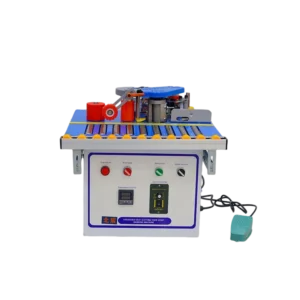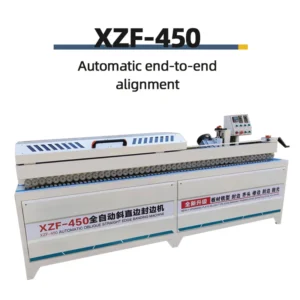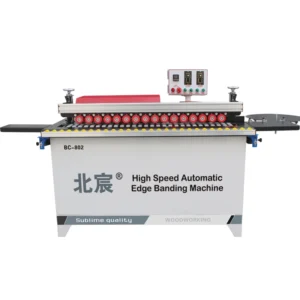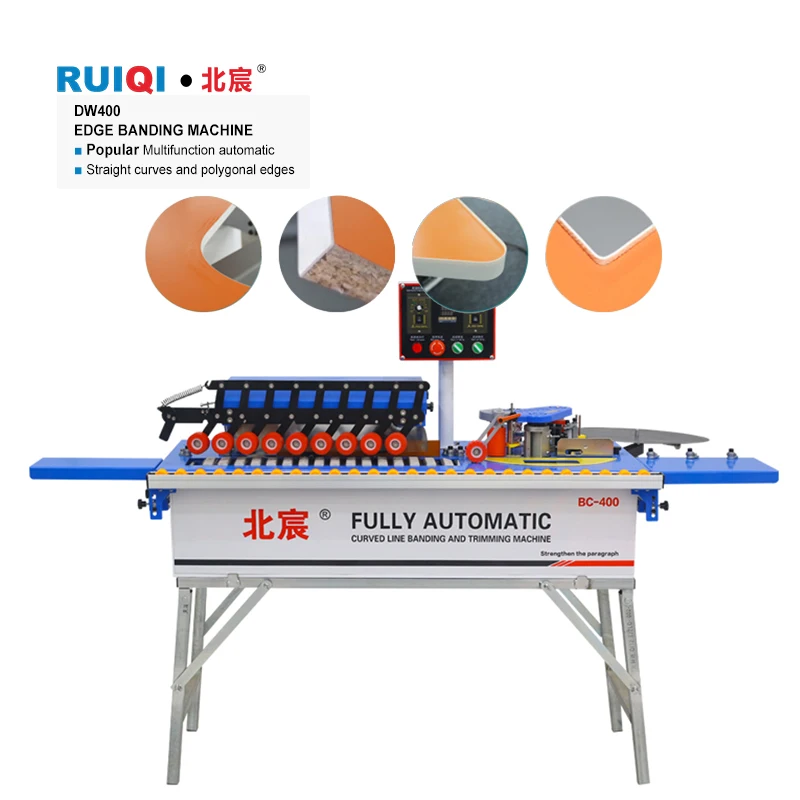
Edge banding machine
Click to enlarge
ISO 9001
CE Certified
OEM / ODM
12-Mo Warranty
Edge banding machine
MDF Panel Edge Banding Machine – Industrial Application
<p><strong>DW400 Edge Banding Machine, 3800W Total Power, 0.3–3mm Edge Thickness</strong> — delivers straight edge banding, trimming, and polishing in one pass across MDF, plywood, and particleboard substrates.</p> <p>Designed for production managers focused on output quality, this machine maintains consistent glue application with its 1000ml glue pot and 0.5–0.8 MPa air supply, while handling edge heights up to 50mm and minimum sheet dimensions of 25×10cm for flexible component processing.</p> <ul> <li>Edge banding thickness: 0.3–3mm for PVC, veneer, and melamine materials</li> <li>Multi-station workflow reduces secondary finishing steps</li> <li>Voltage customization (220V/380V) with multilingual control panel options</li> </ul> <p>Request a sample edge banding test on your actual substrate to verify glue adhesion and trimming finish before committing to production volumes — our engineers provide configuration recommendations with formal quotations within 24 hours.</p>
100+
Countries
MOQ 1
Unit
15-25 Days
Lead Time
380V
Automatic Feeding
DW400
Edge Banding Machine
edge quality
Furniture Factory
MDF Panel
- Full OEM/ODM support -- custom logo, voltage (110V-440V), multilingual panels
- ISO 9001 & CE certified, 5 national patents, 60 professional engineers
- 12-month warranty, remote technical support & spare parts service
- Professional export packaging, customs clearance support, on-time delivery
Precision-ground edge finishing — The DW400 edge bander maintains stable glue application and trimming quality across MDF, plywood, and particleboard substrates commonly encountered in cabinet production.
Technical Specifications
| Parameter | Value |
|---|---|
| Model | DW400 |
| Product Type | Edge Banding Machine |
| Total Power | 3800W |
| Voltage & Frequency | 220V / 380V / customization (frequency basis to be confirmed) |
| Edge Banding Height | 0–50 mm |
| Edge Banding Thickness | 0.3–3 mm |
| Minimum Sheet Length | 25 cm |
| Minimum Sheet Width | 10 cm |
| Glue Pot Capacity | 1000 ml |
| Air Source Pressure | 0.5–0.8 MPa |
| Trimming Power | 650W × 2 |
| Polishing Power | 180W × 2 |
| Vacuum Power | 1200W |
| Overall Dimensions (L×W×H) | 116 × 47 × 69 cm |
| Net Weight | 70 kg |
| Key Features | Straight edge banding, trimming, polishing in one pass |
Application Suitability
| Application | Material or Output |
|---|---|
| Cabinet door edge sealing | MDF and particleboard with PVC or melamine edge banding |
| Custom panel edge finishing | Plywood and blockboard with veneer or PVC strips |
| Polymer door production | Polymer substrates requiring consistent glue adhesion |
| Small-batch joinery components | Offcuts down to 25 cm × 10 cm for custom furniture parts |
Why the Substrate Question Must Come Before the Machine Selection
Edge banding quality depends more on matching the machine’s glue application to your actual material than on the machine’s nominal speed.
I have walked into factories where the edge banding machine woodworking process produced perfect samples on one material, then failed completely when the production manager switched to a cheaper substrate. The glue pot temperature that bonds PVC cleanly to MDF often causes veneer to blister or melamine to lift at the edges. This mismatch accounts for a significant portion of scrapped batches in small-to-medium furniture plants [NEED_CITE: substrate and adhesive compatibility in edge banding operations].
How Substrate Density Affects Glue Penetration and Bond Strength
MDF, particleboard, and plywood each absorb adhesive differently due to their internal structure. The DW400’s 1000 ml glue pot capacity supports continuous edge banding machine woodworking process runs, but the operator must adjust temperature based on substrate porosity. Denser materials require higher glue temperatures for adequate penetration, while porous substrates can wick adhesive away from the bond line if the temperature is too high.
The Relationship Between Edge Thickness and Trimming Load
Within the 0.3–3 mm edge banding thickness range, the trimming stations encounter different mechanical loads. Thin PVC at 0.3 mm requires minimal cutting force and produces fine dust, while 3 mm solid wood veneer demands sustained torque from the 650W × 2 trimming motors. The edge banding machine woodworking process must account for this variation; running thick materials continuously without checking trimming blade condition leads to chatter marks visible on the finished edge.
Reading the Specs: What Air Pressure and Feed Dimensions Mean for Your Workshop
The 0.5–0.8 MPa air source pressure requirement drives the edge pressing rollers and pneumatic trimming actuators. Insufficient pressure causes weak bond lines; excessive pressure can crush softer edge materials before the adhesive cures. The minimum sheet dimensions of 25 cm length and 10 cm width define the smallest component this machine can process, which matters for workshops cutting custom drawer fronts or small cabinet dividers from larger panels. The 0–50 mm edge banding height accommodates standard panel thicknesses used in furniture production, though operators should verify that their specific panel thickness falls within the machine’s clamping range before committing to a production run [NEED_CITE: pneumatic pressure requirements for edge banding machinery].
What Happens When Configuration Does Not Match Production Reality
Buying a machine rated for light-duty use and running it at production volumes causes premature wear on feed mechanisms and trimming bearings. The edge banding machine woodworking process breaks down when the equipment was selected based on price rather than actual daily throughput and material mix. Operators then blame the machine for edge lifting or uneven polishing, when the root cause is a mismatch between machine class and application intensity [NEED_CITE: equipment selection and production volume alignment].
Why Sourcing From This Supplier Reduces Configuration Risk
The DW400 is manufactured in-house with proprietary cutting mechanisms that hold verified tolerances through the trimming stage. Voltage customization from 220V to 380V prevents the situation where machines arrive at a facility and cannot connect to local power infrastructure. Language options on the control panel mean operators can read settings without translation delays during commissioning. The four-stage quality control process includes pre-shipment verification on actual panel samples, catching tolerance issues before the machine leaves the factory. Engineer-led configuration recommendations within 24 hours ensure the machine specification matches the buyer’s substrate mix and production volume rather than generic catalog assumptions.
Documentation & Verification
- CE declaration of conformity applicable to the DW400 edge bander configuration
- Electrical schematic confirming voltage and frequency for your facility’s power supply
- Factory test record on your specific panel thickness and edge material before dispatch
- Operation and maintenance manual in your operator’s working language
- Spare parts list with part numbers for trimming blades and polishing wheels
Installation, Commissioning & Support
- Footprint of 116 × 47 cm requires level floor with clearance for sheet infeed and outfeed
- 3800W total power demands dedicated circuit matching confirmed voltage and frequency
- Air supply at 0.5–0.8 MPa must connect to the machine’s pneumatic inlet before first run
- Initial glue pot temperature calibration on your actual edge material during commissioning
- Trimming blade replacement procedure and spare blade inventory for continuous production
What We Need to Quote the Right Configuration
Provide your primary panel material, typical edge banding type and thickness, and daily production volume. Confirm your facility voltage and frequency so the electrical system matches local infrastructure. Specify the language your operators read so the control panel and manual support immediate commissioning without translation delays.
Frequently Asked Questions
Q: How does substrate type affect edge banding quality and glue selection?
A: MDF absorbs adhesive uniformly, while particleboard’s uneven density creates weak spots if glue temperature is too low. Plywood’s cross-grain structure requires different pressure settings than MDF. The DW400’s adjustable glue pot temperature and pneumatic pressure range allow operators to dial in settings for each substrate type.
Q: What edge banding materials are compatible within the 0.3–3 mm thickness range?
A: PVC, veneer, and melamine strips all fall within this range. Thin PVC at 0.3 mm is common for cabinet interiors, while 2–3 mm veneer suits visible furniture edges. Each material requires different glue temperatures and trimming speeds, which operators must adjust on the control panel.
Q: How does glue pot capacity influence continuous production consistency?
A: The 1000 ml capacity supports extended runs without frequent refilling, which maintains stable temperature and viscosity. Smaller pots cool down between refills, causing inconsistent adhesion. For high-volume production, operators should monitor glue level and replenish before the pot drops below the heating element coverage zone.
Q: What air supply requirements must be met for stable operation?
A: The machine requires 0.5–0.8 MPa pressure to drive edge pressing rollers and pneumatic trimming actuators. Insufficient pressure causes weak bonds and incomplete trimming cycles. Facilities must install a dedicated air line with pressure regulation and moisture filtration to prevent water contamination in the pneumatic system.
Q: How do I verify edge finish quality before full production?
A: Request a sample test using your actual panel material and edge banding stock. Inspect the glue line for gaps, run a fingernail along the trimmed edge for smoothness, and check polishing uniformity. This verification catches substrate-adhesive mismatches before committing to a production batch.
Technical Specifications
| Parameter | Value |
|---|---|
| Product Name | MDF Panel Edge Banding Machine – Industrial Application |
| Category | Edge banding machine |
| Voltage Options | 110V / 220V / 380V / 440V (customizable) |
| Frequency | 50Hz / 60Hz (customizable) |
| Certification | ISO 9001, CE |
| MOQ | 1 Unit |
| Lead Time | 15-25 Working Days |
| Warranty | 12 Months |
| OEM / ODM | Available -- logo, color, panel language |
* Detailed technical specifications vary by model. Please contact us with your specific requirements for a complete datasheet.
Shipping & Export
-
Export Packaging
Heavy-duty wooden crate with foam padding and moisture protection
-
Shipping Methods
Sea freight (FCL/LCL), air freight, express -- we support all methods
-
Customs Support
Full documentation: CO, commercial invoice, packing list, HS code assistance
-
Port of Loading
Tianjin / Qingdao port, China -- 20 years export experience
OEM / ODM Services
-
Logo & Branding
Custom logo printing, color scheme, and nameplate engraving
-
Voltage Configuration
110V / 220V / 380V / 440V, 50Hz / 60Hz -- any region supported
-
Multilingual Panels
Control panels in English, Spanish, French, Arabic and more
-
Custom Specifications
Modified dimensions, accessories, or feature sets on request
Get a Quote
Request Product Inquiry
Fill in your details and we'll respond within 24 hours with pricing and availability.
Direct Contact
How It Works
-
1
Confirm requirements & budget
Tell us your factory scale and processing needs
-
2
Receive recommendation & quote
We match the right machine with full specs
-
3
Negotiate & place order
OEM terms, voltage, payment and delivery
-
4
Production & QC inspection
Multi-stage quality control by 60 engineers
-
5
Export packaging & shipment
Professional packing, customs clearance
-
6
After-sales support
12-month warranty, remote tech support
You May Also Like