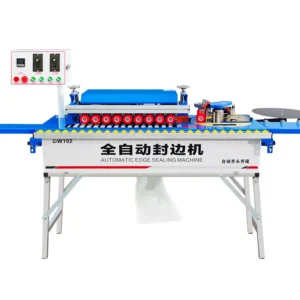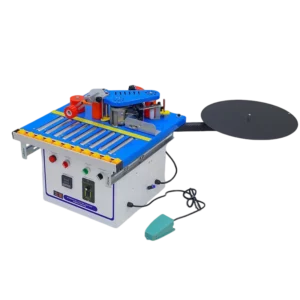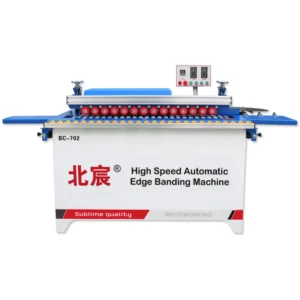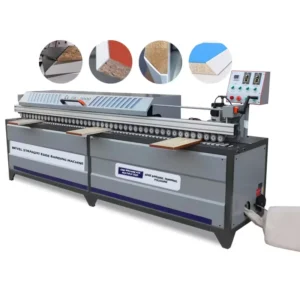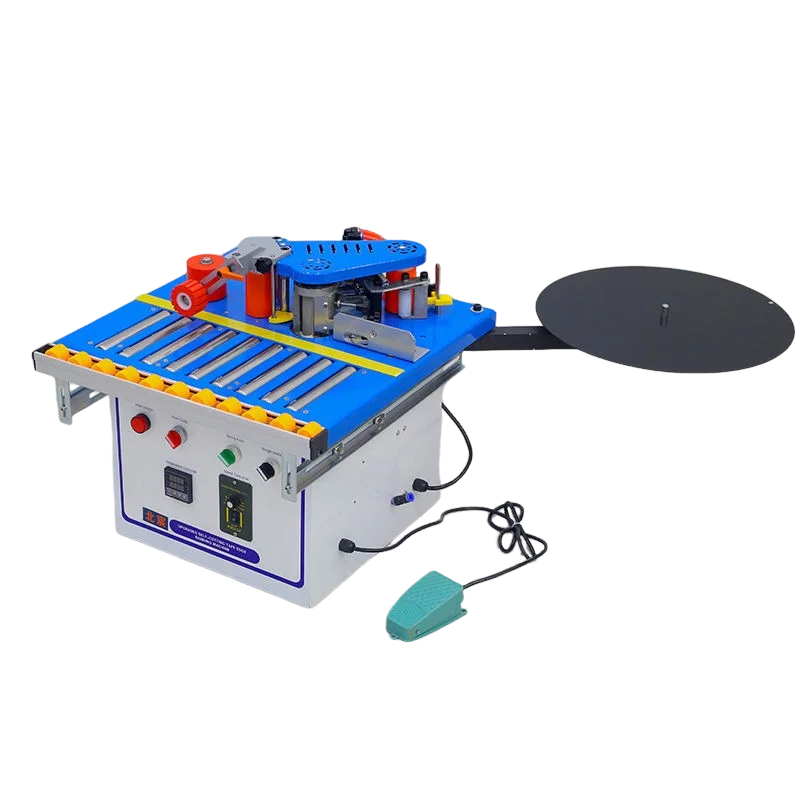
Edge banding machine
Click to enlarge
ISO 9001
CE Certified
OEM / ODM
12-Mo Warranty
Edge banding machine
MDF Particleboard Portable Edge Banding Machine for Woodworking
<p><strong>Portable Edge Banding Machine, 1000W, 0.3–3mm Banding Thickness, 0–50mm Edge Height</strong> — designed for straight and curved edge sealing on MDF, particleboard, plywood and solid wood panels.</p> <ul> <li><strong>Hot melt glue system</strong> with 1000ml pot capacity supports continuous small-batch runs; handles PVC, melamine and veneer banding across curved and linear profiles</li> <li>Compact benchtop footprint (50×50×47cm, 23kg) suits joinery workshops, on-site installation and furniture rework; 220V/380V customization with multilingual control options</li> </ul> <p>Sample processing tests on your substrate verify glue line quality before order, backed by four-stage QC with pre-shipment verification and engineer-led configuration guidance within 24 hours.</p>
100+
Countries
MOQ 1
Unit
15-25 Days
Lead Time
220V 380V
Benchtop Hot Melt Glue System
Curved Edge Sealing
MDF Particleboard
Portable Edge Banding Machine
Process And Application
ST-70
- Full OEM/ODM support -- custom logo, voltage (110V-440V), multilingual panels
- ISO 9001 & CE certified, 5 national patents, 60 professional engineers
- 12-month warranty, remote technical support & spare parts service
- Professional export packaging, customs clearance support, on-time delivery
Voltage and language customization as standard — this benchtop hot melt system ships with confirmed 220V/380V configuration and operator-level documentation in the agreed language before dispatch.
Technical Specifications
| Parameter | Value |
|---|---|
| Product Type | Portable Edge Banding Machine |
| Total Power | 1000 W |
| Voltage & Frequency | 220V / 380V / customization (frequency to be confirmed) |
| Overall Dimensions (L×W×H) | 50 × 50 × 47 cm |
| Net Weight | 23 kg |
| Edge Banding Height Range | 0–50 mm |
| Edge Banding Thickness Range | 0.3–3 mm |
| Minimum Sheet Length | 25 cm |
| Minimum Sheet Width | 3 cm |
| Edge Power | 20 W |
| Air Source Pressure | 0.5–0.8 MPa |
| Glue Pot Capacity | 1000 ml |
| Standard Features | Curved and straight edge banding |
| Plug Options | EU, USA, AU, UK |
| Language Options | Chinese, English; customization available |
Application Suitability
| Application | Material or Output |
|---|---|
| Custom cabinet edge sealing | MDF and particleboard with PVC or melamine banding |
| On-site furniture installation | Plywood and ecological board cut-to-size panels |
| Small-batch joinery production | Solid wood board with veneer edge banding |
| Furniture repair and rework | Delaminated or damaged banding on existing cabinetry |
| Home decoration workshops | Straight and curved profile edge finishing |
Why Glue Temperature Matters More Than Feed Speed on a Portable Edge Banding Machine Woodworking Process
The substrate dictates the glue behaviour, not the machine setting.
I once set up a benchtop hot melt unit for a cabinet maker who ran standard PVC banding on MDF all day without issue. The following week they switched to real wood veneer on the same particleboard, kept the same glue pot temperature, and an entire batch delaminated before it left the shop. Veneer absorbs heat differently from PVC, and particleboard draws moisture from the adhesive at a different rate than MDF [NEED_CITE: adhesive bond behaviour on wood-based substrates]. A portable edge banding machine woodworking process demands that the operator understands these material interactions because there is no automated temperature compensation on a benchtop unit — the adjustment is entirely manual.
Substrate Behaviour and Glue Line Consistency
MDF presents a dense, uniform surface that allows hot melt adhesive to spread evenly across the bond line, producing a clean edge with minimal squeeze-out. Particleboard is more porous and absorbs adhesive unevenly, which means the operator must monitor glue coverage more closely on each pass. Plywood introduces grain direction as a variable — banding applied against the face grain bonds differently than banding applied to an end-grain edge. Understanding these differences is central to getting reliable results from a portable edge banding machine woodworking process, particularly when switching between materials within the same production run.
Curved Edge Control and Pressure Technique
Straight edges allow the operator to push the panel past the glue roller at a steady rate, relying on the bench surface for alignment. Curved edges remove that stability. The operator must apply consistent hand pressure while guiding the panel through a radius, and any hesitation creates a thick spot in the glue line or a starved bond area. With banding thickness ranging from 0.3 to 3 mm, thinner PVC conforms to tight radii more readily, while veneer in the upper range can crack if the curve is too aggressive [NEED_CITE: minimum bending radius for wood veneer edge banding]. This is where a portable edge banding machine woodworking process separates skilled operators from novices — the machine applies the glue, but the hand controls the outcome.
How the 1000 ml Glue Pot and 0.3–3 mm Banding Range Shape Daily Output
A 1000 ml glue pot provides enough adhesive for sustained small-batch runs without pausing to refill, which matters when a joinery workshop is edging twenty or thirty cabinet panels in sequence. The 0.3–3 mm banding thickness range covers the materials most commonly specified in furniture and cabinetry: thin melamine for cost-sensitive carcass work, mid-range PVC for visible door and drawer fronts, and thicker veneer for premium solid-wood-effect finishes. The 20 W edge power drives the feed mechanism for the banding strip itself, while the 1000 W total power maintains the glue pot at working temperature throughout the shift.
What Happens When Configuration Gets Overlooked
A workshop in a region running 60 Hz power received a unit configured for 50 Hz, and the glue pot never reached stable operating temperature — the adhesive remained too viscous, producing weak bonds that failed during assembly. The frequency mismatch was not caught until the first batch of panels was rejected on the production floor [NEED_CITE: voltage and frequency standards by export market]. Similarly, an operator handed a control panel in a language they cannot read will guess at temperature settings, and guessing with hot melt adhesive leads to either charred glue at excessive temperatures or incomplete bonding at insufficient heat. These are not machine defects; they are configuration oversights that surface only after the equipment is on the shop floor.
Why Buyers Source This Equipment Here
In-house manufacturing with proprietary cutting mechanisms means the glue application components are produced and inspected under the same quality system as the rest of the machine. Voltage, plug type and control language are confirmed at the order stage rather than treated as an afterthought — the 220V/380V customization and EU/USA/AU/UK plug options are standard selections, not special requests. Every unit goes through a four-stage QC process that includes a pre-shipment functional test with the buyer’s specified banding material, so the glue line quality is verified before the machine leaves the factory rather than discovered on the customer’s bench.
Documentation & Verification
- CE declaration of conformity covering portable woodworking machinery safety requirements
- Factory test record run on your specified banding material and substrate before dispatch
- Electrical schematic confirming voltage, frequency and plug configuration for your market
- Operation and maintenance manual translated into the operator’s working language
- Spare parts list with glue pot and feed mechanism component identifiers
Installation, Commissioning & Support
- Bench mounting requires a stable surface rated for 23 kg plus operational vibration from the 1000 W motor
- Dedicated electrical circuit matching confirmed voltage and frequency, with correct plug type pre-installed
- First-run commissioning includes glue pot temperature calibration on your specific banding material thickness
- Operator training covers hand-pressure technique for curved edges within the 0–50 mm height range
- Air supply connection at 0.5–0.8 MPa for pneumatic feed assist components
What to Include in Your Inquiry
Send your primary substrate type and the banding material you intend to run — PVC, melamine or veneer — along with the thickness range. Confirm your local voltage and frequency so the electrical configuration is built correctly before production. If you are processing curved panels, specify the minimum radius so we can verify banding conformity during the pre-shipment test.
Frequently Asked Questions
Q: Which glue type and temperature setting works best for MDF vs. particleboard?
A: MDF generally bonds well with standard EVA hot melt at moderate temperatures due to its dense, uniform surface. Particleboard is more porous and may require a slightly higher temperature or a filled EVA formulation to ensure adequate penetration and bond strength. Always run a test piece on your actual substrate before committing to a production batch.
Q: How does banding thickness affect glue consumption and bond strength?
A: Thinner banding around 0.3 mm requires less adhesive and conforms easily to curved edges, but offers limited impact resistance. Thicker banding up to 3 mm absorbs more heat during application, demanding a higher glue pot temperature and more generous adhesive coverage to achieve full bond across the wider contact surface.
Q: Does the substrate edge need preparation before banding?
A: The edge should be clean, dry and free of tear-out from the cutting saw. A rough or chipped edge creates voids in the glue line that weaken the bond. This benchtop unit applies adhesive and banding but does not include a pre-milling station, so edge quality depends on your upstream cutting process.
Q: How does portable edge banding quality compare to a full-size automatic machine?
A: A benchtop unit relies on manual feed and hand pressure, so consistency depends heavily on operator skill. For small batches and on-site work it produces acceptable results, but downstream assembly requiring tight tolerance across hundreds of panels is better served by an automatic edge bander with powered feed and multiple trimming stations.
Technical Specifications
| Parameter | Value |
|---|---|
| Product Name | MDF Particleboard Portable Edge Banding Machine for Woodworking |
| Category | Edge banding machine |
| Voltage Options | 110V / 220V / 380V / 440V (customizable) |
| Frequency | 50Hz / 60Hz (customizable) |
| Certification | ISO 9001, CE |
| MOQ | 1 Unit |
| Lead Time | 15-25 Working Days |
| Warranty | 12 Months |
| OEM / ODM | Available -- logo, color, panel language |
* Detailed technical specifications vary by model. Please contact us with your specific requirements for a complete datasheet.
Shipping & Export
-
Export Packaging
Heavy-duty wooden crate with foam padding and moisture protection
-
Shipping Methods
Sea freight (FCL/LCL), air freight, express -- we support all methods
-
Customs Support
Full documentation: CO, commercial invoice, packing list, HS code assistance
-
Port of Loading
Tianjin / Qingdao port, China -- 20 years export experience
OEM / ODM Services
-
Logo & Branding
Custom logo printing, color scheme, and nameplate engraving
-
Voltage Configuration
110V / 220V / 380V / 440V, 50Hz / 60Hz -- any region supported
-
Multilingual Panels
Control panels in English, Spanish, French, Arabic and more
-
Custom Specifications
Modified dimensions, accessories, or feature sets on request
Get a Quote
Request Product Inquiry
Fill in your details and we'll respond within 24 hours with pricing and availability.
Direct Contact
How It Works
-
1
Confirm requirements & budget
Tell us your factory scale and processing needs
-
2
Receive recommendation & quote
We match the right machine with full specs
-
3
Negotiate & place order
OEM terms, voltage, payment and delivery
-
4
Production & QC inspection
Multi-stage quality control by 60 engineers
-
5
Export packaging & shipment
Professional packing, customs clearance
-
6
After-sales support
12-month warranty, remote tech support
You May Also Like