Edge banding machine
Click to enlarge
ISO 9001
CE Certified
OEM / ODM
12-Mo Warranty
Edge banding machine
MDF PVC Wood Edge Bander – Industrial Application
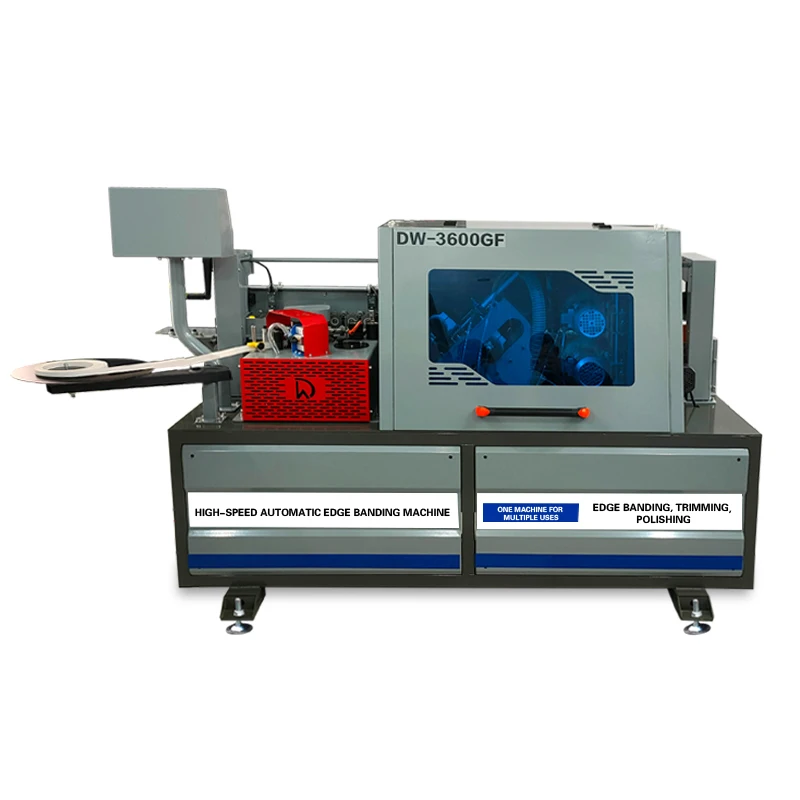
<p><strong>DW-3600GF Automatic Edge Banding Machine, 380V, 0–14 m/min feed, 0.3–3 mm banding range</strong> — delivers gluing, trimming, scraping and polishing in a single pass for MDF, plywood and particleboard with PVC edge banding.</p> <ul> <li>Trimming motors run at 24000 r/min for clean flush cuts on PVC and veneer, reducing visible glue lines across varying substrate densities</li> <li>Adjustable feed speed and 0.4–0.6 MPa air supply integrate into standard workshop setups without auxiliary equipment changes</li> </ul> <p>Backed by four-stage QC with pre-shipment test records and engineer-led voltage confirmation to match your facility supply.</p>
100+
Countries
MOQ 1
Unit
15-25 Days
Lead Time
380V
Automatic Feeding
DW-3600GF
Edge Banding Machine
Furniture Factory
MDF Panel
Process And Application
PVC Edge Banding
- Full OEM/ODM support -- custom logo, voltage (110V-440V), multilingual panels
- ISO 9001 & CE certified, 5 national patents, 60 professional engineers
- 12-month warranty, remote technical support & spare parts service
- Professional export packaging, customs clearance support, on-time delivery
Precision-ground trim stations — dual 800 W motors at 24000 r/min verified on MDF and particleboard before shipment, not just promised on a spec sheet.
Technical Specifications
| Parameter | Value |
|---|---|
| Model | DW-3600GF |
| Product Type | Automatic Edge Banding Machine |
| Total Power | 4.9 kW |
| Voltage & Frequency | 380V, three-phase four-wire (frequency to be confirmed for local supply) |
| Edge Band Height Range | 0–50 mm |
| Edge Band Thickness Range | 0.3–3 mm |
| Minimum Panel Length | 200 mm |
| Feed Speed | 0–14 m/min (basis to be confirmed) |
| Trimming Motor Power | 800 W × 2, 24000 r/min |
| Polishing Motor Power | 400 W × 2 |
| Transmission Power | 180 W |
| Edge Banding Motor Power | 160 W |
| Air Supply Requirement | 0.4–0.6 MPa |
| Overall Dimensions (L×W×H) | 2200 × 650 × 1250 mm |
| Net Weight | 320 kg |
| Standard Functions | Gluing, trimming, front and rear trimming, scraping, polishing, vacuuming |
| Control System | To be confirmed (PLC / relay / manual) |
| Panel Thickness Range | To be confirmed |
| Tolerance | To be confirmed |
| Language Options | Chinese and English standard; Spanish and other languages on request |
| Plug Options | EU, USA, AU, UK |
| Certification | CE declaration, ISO 9001 quality system |
Application Suitability
| Application | Material or Output |
|---|---|
| Cabinet panel edge finishing | MDF and particleboard with 0.4–2 mm PVC banding |
| Wardrobe and shelving components | Plywood panels with veneer or melamine edge band |
| Custom furniture small-batch runs | Solid wood panels with thicker PVC up to 3 mm |
| Joinery workshop production scaling | Mixed substrates requiring single-pass gluing through polishing |
| Kitchen cabinet door processing | Moisture-resistant MDF with pre-milled edge preparation |
Why Glue Line Visibility Ruins a Perfectly Cut Panel
The edge banding machine process and application on low-density substrates demands adjustable glue feed and consistent pressure, not just a hot pot and a roller. Substrate density determines how much adhesive the open pores absorb before the band makes contact. I have watched panels leave a machine looking clean at the outfeed, only for the glue line to turn visible under workshop lighting once the residual heat dissipates. Regenerated MDF with uneven density distribution is the worst offender — some sections drink the adhesive, others leave it standing on the surface [NEED_CITE: MDF density variation and adhesive absorption behaviour]. The DW-3600GF addresses this through its adjustable feed speed range, allowing the operator to slow the panel through the gluing zone when running porous boards and speed up on sealed surfaces.
Substrate Behaviour Across MDF, Plywood and Particleboard
Each board type reacts differently to heat, pressure, and trimming force. MDF cuts cleanly under the 24000 r/min trimming motors but can fuzz at the top edge if the scraper angle is set too aggressively. Plywood demands more care because cross-grain layers tend to chip during front and rear trimming, especially on thinner veneer banding. The edge banding machine process and application on particleboard sits somewhere between the two — it trims well but the open chip structure requires a thicker glue film to achieve full adhesion. Matching feed speed to substrate is not optional; it is the difference between a panel that passes visual inspection and one that gets rejected at the assembly bench.
Glue Pot Temperature and Banding Material Selection
PVC edge banding between 0.3 and 1 mm reacts quickly to heat, and excessive glue pot temperature can cause the material to stretch through the pressure zone, leaving a wavy edge after trimming. Thicker PVC up to 3 mm absorbs more heat before becoming pliable, so the pot must run warmer and the feed must slow to allow full thermal transfer. Veneer banding behaves entirely differently — it does not stretch, but it can crack across the grain if the roller pressure is too high. [NEED_CITE: thermal behaviour of PVC versus veneer edge banding under pressure roller contact]. The six-function sequence on this machine — gluing, trimming, front and rear trimming, scraping, polishing, and vacuuming — allows the operator to tune each station independently for the material on the infeed table.
Reading the Specs That Actually Affect Your Output
The 0–14 m/min feed speed range matters because it defines how the machine handles transitions between panel types within a single shift. A workshop cutting wardrobe panels from 18 mm particleboard and drawer fronts from 12 mm MDF will need to change speed between batches, and a wider range keeps both jobs on the same machine. The dual 800 W trimming motors at 24000 r/min provide the spindle speed needed for clean flush cuts on PVC without visible chatter marks — lower RPM trimming leaves micro-steps that the scraper must then remove, adding wear to consumable blades. The 0.4–0.6 MPa air supply window aligns with standard workshop compressors, meaning no dedicated high-pressure line is needed. Edge band height from 0 to 50 mm covers everything from slim shelf edging to thick solid-wood banding on worktops. Panel length down to 200 mm means small offcuts and drawer components can run without a secondary manual operation.
What Happens When Machine and Material Are Mismatched
I have seen joinery workshops buy an entry-level bander for a production volume it was never designed to sustain, then blame the machine when trimming quality degrades after a few weeks of continuous running. The issue is not the equipment — it is the mismatch between throughput expectation and mechanical duty cycle. [NEED_CITE: edge bander duty cycle and trimming motor thermal limits under continuous operation]. Similarly, a machine quoted without voltage confirmation arrives at a facility with a different supply standard and sits idle until a transformer is sourced. The DW-3600GF is specified at 380V three-phase four-wire, but frequency must be confirmed against the buyer’s local grid before production begins.
Why Buyers Come Back After Their First Order
In-house manufacturing with patented cutting mechanisms means the trimming stations are built and calibrated on the same floor where final assembly happens, not sourced from a third party and bolted on. The four-stage quality control process covers incoming material, in-process assembly, finished product verification, and pre-shipment testing — with the option for the buyer to supply actual panel stock for a sample processing run. Voltage, plug type, and control panel language are confirmed at the quotation stage, not discovered at the container door. Engineer-led configuration recommendations are provided within 24 hours of an inquiry that includes factory scale and processing requirements, so the machine shipped matches the material processed [NEED_CITE: pre-shipment verification protocol for woodworking machinery exports].
Documentation & Verification
- Factory test record run on buyer-supplied MDF or particleboard samples before dispatch
- CE declaration of conformity matching the DW-3600GF configuration as shipped
- Electrical schematic with confirmed voltage and frequency for the destination facility
- Operation and maintenance manual in the operator’s agreed language
- Spare parts list with trimming blades, scraper inserts, and polishing wheels identified by part number
Installation, Commissioning & Support
- The 4.9 kW total power draw requires a dedicated three-phase circuit with proper grounding at the installation point
- Air supply at 0.4–0.6 MPa must be clean and dry; an inline filter-regulator is recommended upstream of the machine
- Overall dimensions of 2200 × 650 × 1250 mm require minimum 500 mm clearance on both sides for operator access and maintenance
- First commissioning includes trimming motor alignment check and scraper angle adjustment on the buyer’s actual panel stock
- Daily vacuuming of the extraction ports and weekly inspection of trimming blades at 24000 r/min maintains edge finish consistency
Before You Request a Quotation
Send the actual panel material, thickness, and edge banding stock you plan to run — regenerated MDF behaves differently from virgin fibre board, and no catalogue spec can predict the result on your substrate. Confirm your facility voltage and frequency, the control panel language your operators need, and whether you will run single shifts or continuous production. If sample processing is important to your decision, ship enough material for a full test run across all six stations.
Frequently Asked Questions
Q: How does substrate density affect glue line visibility and trimming settings?
A: Low-density MDF and recycled particleboard absorb adhesive unevenly, leaving visible glue lines on some sections and starved bonds on others. Slowing the feed speed through the gluing zone and adjusting glue film thickness compensates for this. Trimming motor speed and scraper angle must also be tuned to avoid fuzzing on soft substrates or chipping on plywood cross-grain.
Q: What PVC thicknesses produce the best finish at different feed speeds?
A: Thin PVC between 0.3 and 1 mm requires lower glue pot temperature and moderate feed speed to prevent stretching under the pressure roller. Thicker banding up to 3 mm needs warmer glue and slower feed for full thermal transfer. The trimming and scraping stations must be re-adjusted whenever banding thickness changes significantly.
Q: How should glue pot temperature be adjusted for workshop conditions?
A: Cold workshops below 15°C require higher pot temperature to maintain adhesive viscosity and open time. Hot environments above 35°C may cause the glue to set too slowly, requiring a temperature reduction. Veneer banding generally needs a cooler pot than PVC to avoid scorching the wood surface during pressure contact.
Q: How do I request a sample test with my own materials?
A: Ship representative panels and edge banding stock to the factory for a full six-station processing run. The test record documents glue line quality, trimming finish, and scraper result on your specific substrate, providing a verified baseline before the machine is built or dispatched to your facility.
Technical Specifications
| Parameter | Value |
|---|---|
| Product Name | MDF PVC Wood Edge Bander – Industrial Application |
| Category | Edge banding machine |
| Voltage Options | 110V / 220V / 380V / 440V (customizable) |
| Frequency | 50Hz / 60Hz (customizable) |
| Certification | ISO 9001, CE |
| MOQ | 1 Unit |
| Lead Time | 15-25 Working Days |
| Warranty | 12 Months |
| OEM / ODM | Available -- logo, color, panel language |
* Detailed technical specifications vary by model. Please contact us with your specific requirements for a complete datasheet.
Shipping & Export
-
Export Packaging
Heavy-duty wooden crate with foam padding and moisture protection
-
Shipping Methods
Sea freight (FCL/LCL), air freight, express -- we support all methods
-
Customs Support
Full documentation: CO, commercial invoice, packing list, HS code assistance
-
Port of Loading
Tianjin / Qingdao port, China -- 20 years export experience
OEM / ODM Services
-
Logo & Branding
Custom logo printing, color scheme, and nameplate engraving
-
Voltage Configuration
110V / 220V / 380V / 440V, 50Hz / 60Hz -- any region supported
-
Multilingual Panels
Control panels in English, Spanish, French, Arabic and more
-
Custom Specifications
Modified dimensions, accessories, or feature sets on request
Get a Quote
Request Product Inquiry
Fill in your details and we'll respond within 24 hours with pricing and availability.
Direct Contact
How It Works
-
1
Confirm requirements & budget
Tell us your factory scale and processing needs
-
2
Receive recommendation & quote
We match the right machine with full specs
-
3
Negotiate & place order
OEM terms, voltage, payment and delivery
-
4
Production & QC inspection
Multi-stage quality control by 60 engineers
-
5
Export packaging & shipment
Professional packing, customs clearance
-
6
After-sales support
12-month warranty, remote tech support
You May Also Like