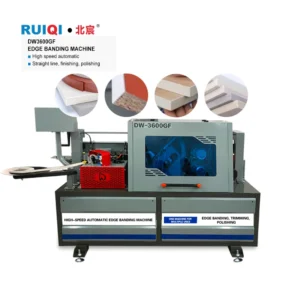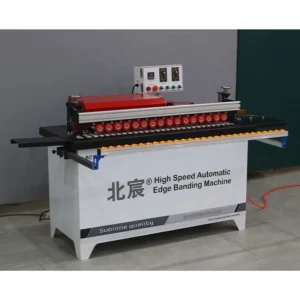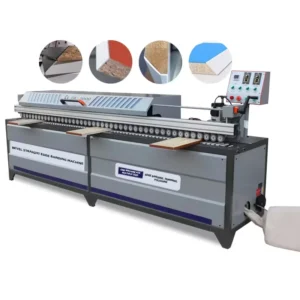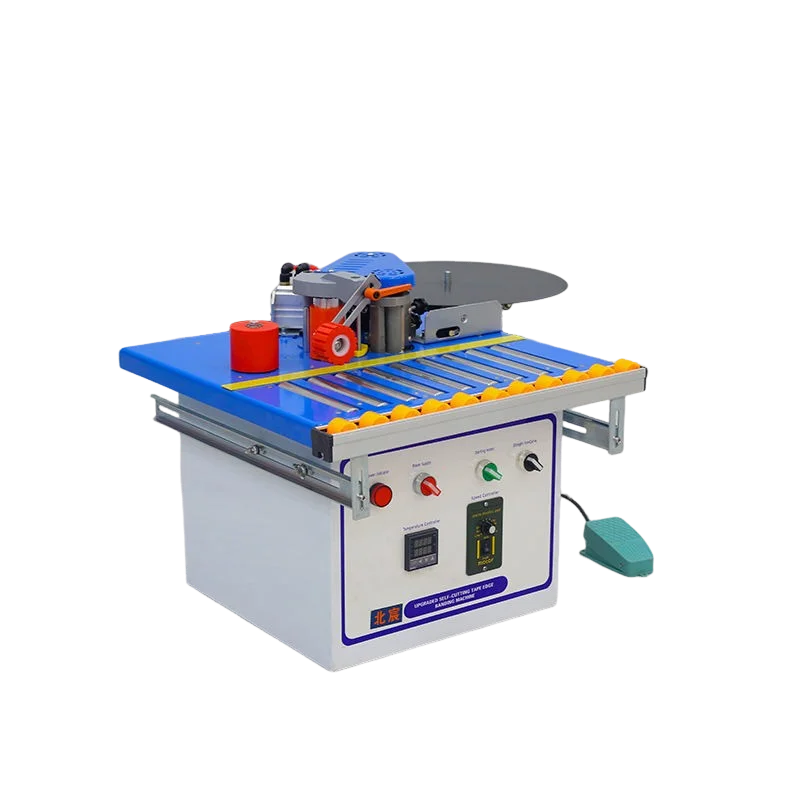
Edge banding machine
Click to enlarge
ISO 9001
CE Certified
OEM / ODM
12-Mo Warranty
Edge banding machine
Mini Edge Bander for Small Workshop and Home Use – Entry Level
<p><strong>Mini Portable Edge Bander</strong> with 0.3–3mm banding thickness, 0–6m/min manual feed, and 1000W total power — designed for controlled glue application on curved and straight profiles across MDF, plywood, and particleboard in small-batch workshops.</p> <ul> <li>Handles PVC, ABS, and veneer edge materials with operator-adjusted feed speed for real-time glue line inspection</li> <li>Supports panels from 25cm × 3cm, enabling edge sealing on offcuts, repair pieces, and shaped cabinet components</li> <li>1000ml glue pot with temperature management to match substrate porosity differences between MDF and plywood</li> </ul> <p>Backed by four-stage pre-shipment QC and factory test records verifying edge adhesion on your specified materials before dispatch.</p>
100+
Countries
MOQ 1
Unit
15-25 Days
Lead Time
0.3-3mm Edge Bander
Curved And Straight Edge Bander
Edge Banding Machine
Manual Control Tabletop Bander
MDF And Plywood Edge Bander
Mini Portable Edge Bander
Small Workshop Edge Bander
- Full OEM/ODM support -- custom logo, voltage (110V-440V), multilingual panels
- ISO 9001 & CE certified, 5 national patents, 60 professional engineers
- 12-month warranty, remote technical support & spare parts service
- Professional export packaging, customs clearance support, on-time delivery
Precision in Small-Batch Edges — A manual tabletop edge bander built for workshops where substrate variety and batch inconsistency demand operator-controlled glue temperature and feed pace on every panel.
Technical Specifications
| Parameter | Value |
|---|---|
| Product Type | Manual Control Tabletop Edge Banding Machine |
| Total Power | 1000W |
| Voltage & Frequency | 220V/380V/customization |
| Feed Speed | 0–6 m/min (operator-controlled) |
| Edge Banding Thickness | 0.3–3 mm |
| Edge Banding Height | 0–50 mm |
| Minimum Sheet Length | 25 cm |
| Minimum Sheet Width | 3 cm |
| Glue Pot Capacity | 1000 ml |
| Edge Power | 20W |
| Air Source Pressure | 0.5–0.8 MPa |
| Product Size | 50 × 50 × 47 cm |
| Net Weight | 23 kg |
| Control System | Manual control |
| Assembly State | Tabletop / portable unit |
| Standard Features | Curved and straight edge banding |
| Language Options | Chinese, English; custom languages available |
| Plug Options | EU, USA, AU, UK |
| Standards | CE, ISO 9001 |
Application Suitability
| Application | Material or Output |
|---|---|
| Small-batch cabinet door and drawer front edge sealing | MDF, particleboard, plywood with PVC or ABS banding |
| On-site furniture repair and renovation edge work | Installed cabinetry and built-in joinery, curved profiles |
| Startup joinery shop transitioning from hand-applied banding | Solid wood board, ecological board, veneer banding 0.3–3 mm |
| Custom-shaped panel edge finishing | Curved and straight contours on narrow stock (min 25 cm × 3 cm) |
Why Visible Glue Lines Keep Ruining Small Workshop Output
Substrate porosity and uncontrolled glue temperature are the real culprits behind inconsistent edge adhesion — not the banding material itself.
I have watched entire batches of particleboard shelving get rejected because the glue line turned visible once the panels cooled. MDF soaks up hot melt faster than plywood, and if the operator does not adjust the pot temperature between substrates, the bond either starves or squeezes out. With a manual tabletop edge bander, the operator controls feed pace and can visually inspect the glue line in real time, catching adhesion failures before they compound across a batch. [NEED_CITE: substrate absorption rates and hot melt adhesion behaviour on engineered wood panels]
How Edge Banding Quality Depends on Feed Pace and Operator Judgement
At feed speeds between 0 and 6 m/min, the operator sets the rhythm based on what the edge looks like as the banding meets the panel. Slower feed allows the hot melt to penetrate porous substrates like MDF before the banding passes the pressure roller zone. This level of control matters when the edge banding quality and substrate behaviour vary from one sheet to the next, which is typical in small-batch custom furniture work.
Curved Profiles and the Glue Gap Problem
Straight edges are forgiving. Curved edges — radius corners, contoured cabinet fronts, arched shelving — create a gap between the banding and the panel that straight-edge automatic machines cannot address without special tooling. The curved and straight edge capability of this manual unit lets the operator press the banding into the contour by hand, maintaining contact through the curve while the glue sets. This is where a portable tabletop form factor earns its place: it goes to the workpiece rather than requiring the workpiece to feed through a fixed station.
Reading the Specs Through a Production Lens
The 0.3–3 mm edge banding thickness range covers PVC, ABS, and wood veneer — the three materials most small workshops stock. Thicker ABS at 2–3 mm demands higher glue temperature and slower feed to ensure full wet-out, while 0.3 mm PVC veneer requires less heat and a quicker pass to avoid melt-through. The 1000 ml glue pot capacity supports continuous runs of approximately one to two hours before refill, depending on panel perimeter and banding width. Air source pressure at 0.5–0.8 MPa drives the edge trimming and snipping functions; below 0.5 MPa, the trimmer stalls on thicker banding. [NEED_CITE: hot melt adhesive operating temperature ranges for PVC and ABS edge banding materials]
What Happens When the Machine and the Material Do Not Match
Ordering a tabletop edge bander without confirming the local voltage is one of the most common reasons machines arrive dead on site. A 220V unit plugged into a 380V supply will destroy the heating element before the first panel is edged. Similarly, running cheap off-brand PVC banding through a machine set for standard-grade material causes bubbling and delamination because the melt index differs. I have seen this exact scenario waste a full production run of cabinet fronts. [NEED_CITE: edge banding material melt index variation and its effect on hot melt bonding]
Why Procurement from a Manufacturing-Depth Supplier Matters
In-house manufacturing with patented cutting mechanisms means the trimming accuracy on this edge bander is verified at the factory, not assumed from component sourcing. Voltage, plug type, and control panel language are configured before shipment — not left for the buyer to sort out locally. The four-stage QC process covers incoming material inspection through pre-shipment testing on the buyer’s specified substrate and banding material. Engineer-led configuration ensures the machine is matched to the workshop’s actual production profile rather than sold as a generic unit. Factory visits are available so buyers can witness sample processing before committing.
Documentation & Verification
- Factory test record on your specified substrate and edge banding material before dispatch
- Electrical schematic confirming voltage, frequency, and plug configuration for your market
- Operation manual in your agreed language covering glue pot temperature and feed rate settings
- CE declaration of conformity for machinery safety compliance
- Spare parts list with part numbers for glue pot elements, trimming blades, and feed rollers
Installation, Commissioning & Support
- Requires a stable workbench rated for at least 30 kg to support the 23 kg unit plus operational load
- Dedicated 220V or 380V circuit matching the confirmed voltage configuration before first power-on
- Arrives as a single tabletop unit — no floor anchoring or foundation work required
- First commissioning includes setting glue pot temperature to match your banding material thickness
- Operator training covers manual feed pacing and real-time glue line inspection techniques
- Replacement glue pot elements and trimming blades available as standard spare parts
Before You Request a Quote
Send details on the substrates you work with most — MDF, particleboard, plywood, or solid wood — along with the edge banding material and thickness you typically use. Confirm your local voltage, frequency, and preferred plug type. If your panels include curved profiles, provide the minimum radius so the engineer can verify the machine handles the contour. A sample processing test using your actual materials can be arranged before order confirmation.
Frequently Asked Questions
Q: How does substrate porosity affect glue temperature settings and feed speed on different panel materials?
A: MDF absorbs hot melt adhesive faster than plywood or particleboard, requiring either a higher glue pot temperature or a slower feed speed to maintain adequate bond strength. Operators running mixed substrates in the same batch must adjust settings between sheets. The manual feed control on this tabletop unit allows real-time pace adjustment without stopping the machine.
Q: Which edge banding materials work within the 0.3–3 mm range and how does thickness affect trimming?
A: PVC, ABS, and wood veneer banding all fall within this thickness range. Thicker ABS at 2–3 mm requires sharper trimming blades and slightly more air pressure to achieve a clean cut. Thinner PVC at 0.3 mm trims easily but is more sensitive to excessive glue temperature. Blade wear increases noticeably with sustained ABS processing.
Q: How does manual feed speed control impact adhesion quality on curved versus straight panel edges?
A: On curved profiles, a slower feed speed allows the operator to press the banding into the contour while the adhesive remains open. Straight edges can be fed faster since the contact surface is uniform. The 0–6 m/min range gives enough headroom for both scenarios without switching machines or tooling.
Q: Can this machine handle offcuts and small repair pieces given the minimum panel dimensions?
A: The minimum sheet length of 25 cm and width of 3 cm covers most offcut and repair scenarios encountered in on-site furniture renovation and small-batch custom work. Pieces smaller than these dimensions typically require hand-applied banding. For repair work on installed cabinetry, the portable tabletop form factor allows the machine to be positioned near the workpiece.
Q: How does the 1000 ml glue pot capacity affect batch consistency when sealing multiple panels?
A: A full pot supports continuous operation across a moderate batch of panels before refill is needed. Maintaining consistent glue temperature throughout the run depends on the heating element cycling and operator monitoring. For large production runs, scheduling a refill break at the midpoint helps avoid temperature drop near the bottom of the pot where residue accumulates.
Technical Specifications
| Parameter | Value |
|---|---|
| Product Name | Mini Edge Bander for Small Workshop and Home Use – Entry Level |
| Category | Edge banding machine |
| Voltage Options | 110V / 220V / 380V / 440V (customizable) |
| Frequency | 50Hz / 60Hz (customizable) |
| Certification | ISO 9001, CE |
| MOQ | 1 Unit |
| Lead Time | 15-25 Working Days |
| Warranty | 12 Months |
| OEM / ODM | Available -- logo, color, panel language |
* Detailed technical specifications vary by model. Please contact us with your specific requirements for a complete datasheet.
Shipping & Export
-
Export Packaging
Heavy-duty wooden crate with foam padding and moisture protection
-
Shipping Methods
Sea freight (FCL/LCL), air freight, express -- we support all methods
-
Customs Support
Full documentation: CO, commercial invoice, packing list, HS code assistance
-
Port of Loading
Tianjin / Qingdao port, China -- 20 years export experience
OEM / ODM Services
-
Logo & Branding
Custom logo printing, color scheme, and nameplate engraving
-
Voltage Configuration
110V / 220V / 380V / 440V, 50Hz / 60Hz -- any region supported
-
Multilingual Panels
Control panels in English, Spanish, French, Arabic and more
-
Custom Specifications
Modified dimensions, accessories, or feature sets on request
Get a Quote
Request Product Inquiry
Fill in your details and we'll respond within 24 hours with pricing and availability.
Direct Contact
How It Works
-
1
Confirm requirements & budget
Tell us your factory scale and processing needs
-
2
Receive recommendation & quote
We match the right machine with full specs
-
3
Negotiate & place order
OEM terms, voltage, payment and delivery
-
4
Production & QC inspection
Multi-stage quality control by 60 engineers
-
5
Export packaging & shipment
Professional packing, customs clearance
-
6
After-sales support
12-month warranty, remote tech support
You May Also Like