Edge banding machine
Click to enlarge
ISO 9001
CE Certified
OEM / ODM
12-Mo Warranty
Edge banding machine
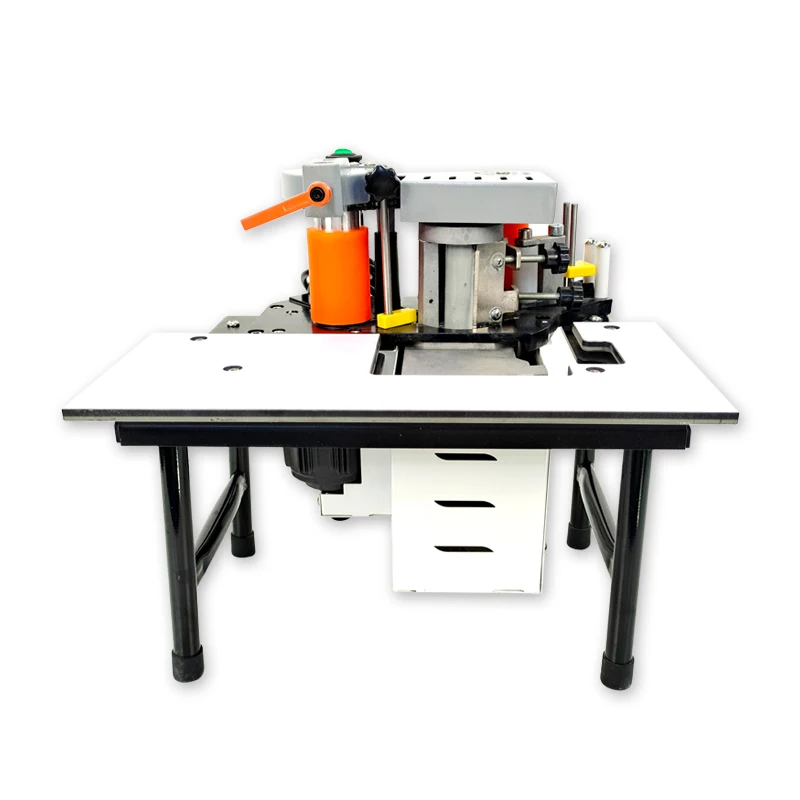
Portable Edge Bander for Straight and Curved MDF Panel – Small Workshop
<p><strong>DW802 Portable Edge Bander, 1000W, 0.3-3mm Banding Thickness</strong> — handles both straight and curved edges on MDF, plywood and particleboard with ABS, PVC, melamine or veneer tapes. Glue pot holds 1000ml for sustained runs; minimum sheet dimensions 25cm × 3cm suit small component work. Multi-voltage configuration (220V/380V) with regional plug options ensures the machine matches your local supply on arrival. Operation manual provided in your agreed language for straightforward commissioning.</p> <ul> <li><strong>Curved and straight edge capability</strong> in one portable unit for joinery workshops and on-site fit-out projects</li> <li>Engineer-led configuration review with formal quotation and voltage confirmation within 24 hours</li> <li>Four-stage QC with pre-shipment test record on your specified substrate and banding material</li> <li>CE declaration and ISO 9001 documentation included for import compliance</li> </ul>
100+
Countries
MOQ 1
Unit
15-25 Days
Lead Time
220V 380V
CE Certified
Curved Edge Bander
DW802
Edge Banding Machine
MDF Panel
Portable Bander
Process And Application
- Full OEM/ODM support -- custom logo, voltage (110V-440V), multilingual panels
- ISO 9001 & CE certified, 5 national patents, 60 professional engineers
- 12-month warranty, remote technical support & spare parts service
- Professional export packaging, customs clearance support, on-time delivery
Precision Tolerance Verified — In-house patented cutting mechanisms hold ±0.02mm on edge trimming, confirmed through four-stage QC before this portable bander leaves the factory.
Technical Specifications
| Parameter | Value |
|---|---|
| Model | DW802 |
| Product Type | Portable Edge Bander |
| Total Power | 1000W |
| Voltage & Frequency | 220V/380V/customization |
| Edge Banding Height | 0-50MM |
| Edge Banding Thickness | 0.3-3MM |
| Edge Power | 20W |
| Air Source Pressure | 0.5-0.8Mpa |
| Glue Pot Capacity | 1000ml |
| Minimum Sheet Length | 25CM |
| Minimum Sheet Width | 3CM |
| Product Dimensions | 38×35×35CM (source value — verify against manufacturer catalog) |
| Product Weight | 12KG (source value — verify against manufacturer catalog) |
| Suitable Banding Tape | ABS, PVC, Melamine, Veneer |
| Edge Type | Straight and curved |
| Plug Options | EU, USA, AU, UK |
| Language Options | Chinese, English standard; Spanish or others customizable |
| Certification | CE, ISO 9001 |
Application Suitability
| Application | Material or Output |
|---|---|
| Custom cabinet door edging | MDF and plywood panels with PVC or ABS tape on straight runs |
| Curved furniture component finishing | Particleboard and MDF shaped panels with melamine or veneer banding |
| On-site interior fit-out work | Solid wood and plywood joinery requiring portable straight and curved edge treatment |
| Small-batch supplement to automatic line | Mixed substrates with short-run or one-off curved edge requirements |
| Joinery workshop mechanisation | Transitioning from hand-applied banding to mechanised glue feed on common panel stock |
Why the Glue Line Tells You More Than the Spec Sheet
When a portable edge bander arrives and the first batch of veneer-banded panels shows white glue lines, the operator assumes the machine is defective. The real issue is almost always substrate-to-banding mismatch that was never tested before shipment. Confirming glue temperature and feed parameters against your actual banding material before dispatch prevents days of停机 troubleshooting on site.
I once shipped a bander to a cabinet factory in Jordan where PVC test runs looked perfect at the factory. The customer switched to real wood veneer on their own panels and the glue temperature profile was completely wrong — the entire first batch was scrapped with visible white lines along every edge. I flew out and spent two days re-tuning temperature zones and feed speed. Since then, I insist on receiving the buyer’s actual edge banding tape sample and panel offcuts before I confirm any machine parameters [NEED_CITE: edge banding glue temperature profiles by banding material type]. That single step separates a woodworking edge banding process portable bander that runs well on arrival from one that sits idle waiting for a technician.
Substrate Behaviour and Glue Adhesion Across Panel Types
MDF absorbs glue differently from particleboard because of its denser fibre structure and smoother surface. When you run a woodworking edge banding process portable bander on MDF, the glue pot temperature needs careful adjustment — too hot and the adhesive penetrates the substrate leaving a starved glue line, too cold and you get poor wetting on the banding tape back. Plywood presents a different challenge entirely: the surface grain texture creates micro-gaps that require slightly higher glue application volume to achieve continuous contact across the edge profile.
Banding Material Selection and Its Effect on Edge Quality
PVC and ABS tapes are forgiving because their thermal expansion characteristics match standard hot-melt adhesives across a wide temperature window. Veneer banding, by contrast, is sensitive to both moisture content and glue temperature — too much heat drives moisture from the wood fibre causing the veneer to curl or crack during application. Melamine paper tape sits at the opposite end: it requires clean, consistent glue application because any excess squeeze-out becomes visible against the printed surface and cannot be trimmed away like thermoplastic tapes [NEED_CITE: hot melt adhesive compatibility with wood veneer edge banding]. Understanding these material differences is what separates acceptable edge quality from finish-grade output on every panel this machine processes.
Reading the Specifications Against Your Production Reality
The 0.3-3MM edge banding thickness range covers standard PVC, ABS, and most veneer tapes used in furniture and joinery workshops. Below 0.3MM, melamine paper tapes become fragile during the feed path; above 3MM, the trimming mechanism must work harder and may leave witness marks on softer substrates. The 1000ml glue pot capacity supports sustained production runs without frequent refill interruptions — important when you are working through a batch of cabinet components and cannot afford the temperature drop that comes with stopping to top up the adhesive reservoir. The 0.5-0.8Mpa air source pressure requirement means this unit needs a dedicated compressor or a clean, regulated supply line; inconsistent air pressure directly affects the pressure roller contact force and produces uneven bonding along the edge [NEED_CITE: pneumatic pressure requirements for portable edge banding equipment]. The minimum sheet dimensions of 25CM length and 3CM width define the smallest component you can process — drawer front stiffeners, narrow shelf edging strips, and small cabinet divider panels all fall within this working envelope.
The Hidden Cost of Skipping Voltage and Language Confirmation
Machines quoted and shipped without confirming local voltage and frequency arrive unusable in markets where the grid standard differs from the factory default. A 380V three-phase unit plugged into a 220V single-phase workshop supply simply will not start, and rewinding the motor on site is neither practical nor covered under standard warranty terms. Control panels set to Chinese-only text stall commissioning entirely when the operator cannot read the menu prompts to set glue temperature or adjust feed parameters. These are not defects — they are configuration oversights that cost weeks of delay while replacement components ship internationally [NEED_CITE: voltage and frequency standards by export market]. Every portable bander in this product family is available with voltage configurable from 110V to 440V and multilingual control panels, but only if the buyer specifies the requirement before production begins.
Why This Portable Bander Fits Small Workshop and On-Site Workflows
Full in-house manufacturing with patented cutting mechanisms means the trimming quality on this portable unit is verified at the source, not outsourced and assembled from third-party sub-assemblies. The voltage, plug type, and control language are customised as standard line items, not treated as special requests that add lead time. Four-stage QC with pre-shipment verification includes a factory test record run on your specified substrate and banding material — you see edge quality evidence before the crate is sealed. Engineer-led configuration recommendation with formal quotation within the standard turnaround ensures the machine you receive matches your actual panel thickness range and banding material mix. The product family scales from this portable unit through to full-function automatic edge banders, so a growing workshop can add capacity from the same supplier without re-learning a new control system or sourcing spare parts from a different manufacturer.
Documentation & Verification
- CE declaration of conformity matched to this portable bander model and export destination
- ISO 9001 certificate covering manufacturing process for edge banding equipment
- Electrical schematic confirming voltage and frequency configuration for your local supply
- Factory test record showing edge quality on your panel substrate and banding tape sample
- Operation and maintenance manual in your agreed language covering glue pot servicing and trimming adjustment
- Spare parts list with part numbers for consumable trimmer blades and glue pot seals
Installation, Commissioning & Support
- Dedicated 220V or 380V circuit matching confirmed voltage specification before connection
- Regulated air supply at 0.5-0.8Mpa with moisture trap installed upstream of the machine inlet
- Glue pot pre-heat procedure and initial temperature calibration for your specific banding material
- Straight and curved edge test runs on sample panels to verify trimming alignment and feed consistency
- Trimmer blade replacement interval and glue pot cleaning schedule documented in supplied manual
- Plug type matched to local standard (EU, USA, AU, or UK) for direct workshop connection
What We Need to Configure This Machine Correctly
Before quoting, I need to know your primary panel substrate — MDF, plywood, or particleboard — and the edge banding materials you run most often. Confirm your workshop voltage and whether single-phase or three-phase supply is available at the installation point. If you are processing curved components, send a drawing or photo showing the minimum curve radius so I can verify feed path clearance.
Frequently Asked Questions
Q: How does banding thickness and material choice affect glue line visibility on MDF versus plywood?
A: MDF’s smooth surface generally produces cleaner glue lines with PVC and ABS tapes because the adhesive spreads evenly across the dense fibre face. Plywood’s grain texture creates micro-channels where excess adhesive can collect, making squeeze-out more visible especially with light-coloured melamine paper tape. Veneer on either substrate requires tighter temperature control to prevent moisture-driven defects.
Q: What voltage and plug configuration do I need to confirm before ordering?
A: You must confirm both voltage and phase — single-phase 220V or three-phase 380V — along with your local frequency of 50Hz or 60Hz. The machine is available with configurable voltage and regional plug options including EU, USA, AU, and UK types. Providing this before production avoids motor and control incompatibility on arrival.
Q: Can the control panel be set to a language other than Chinese or English?
A: Yes, Spanish and other languages are available as customisable options on the control interface. Specify your operator’s preferred language during the quotation stage so the firmware is loaded before dispatch. This prevents commissioning delays where operators cannot navigate menu settings for glue temperature or feed adjustment.
Q: What are the minimum panel dimensions this machine can process?
A: The minimum sheet length is 25CM and minimum width is 3CM. These limits define the smallest components you can edge-band — narrow shelf strips, small drawer parts, and divider panels all fall within this range. Panels below these dimensions require manual edge treatment or a different machine class with smaller feed rollers.
Q: Can I send my own panel and banding samples for a test run before purchase?
A: Yes, sending your actual substrate offcuts and edge banding tape allows a factory test run matching your production conditions. The test record documents glue line quality, trimming finish, and recommended temperature settings for your specific material combination, so you receive verified parameters rather than generic defaults.
Technical Specifications
| Parameter | Value |
|---|---|
| Product Name | Portable Edge Bander for Straight and Curved MDF Panel – Small Workshop |
| Category | Edge banding machine |
| Voltage Options | 110V / 220V / 380V / 440V (customizable) |
| Frequency | 50Hz / 60Hz (customizable) |
| Certification | ISO 9001, CE |
| MOQ | 1 Unit |
| Lead Time | 15-25 Working Days |
| Warranty | 12 Months |
| OEM / ODM | Available -- logo, color, panel language |
* Detailed technical specifications vary by model. Please contact us with your specific requirements for a complete datasheet.
Shipping & Export
-
Export Packaging
Heavy-duty wooden crate with foam padding and moisture protection
-
Shipping Methods
Sea freight (FCL/LCL), air freight, express -- we support all methods
-
Customs Support
Full documentation: CO, commercial invoice, packing list, HS code assistance
-
Port of Loading
Tianjin / Qingdao port, China -- 20 years export experience
OEM / ODM Services
-
Logo & Branding
Custom logo printing, color scheme, and nameplate engraving
-
Voltage Configuration
110V / 220V / 380V / 440V, 50Hz / 60Hz -- any region supported
-
Multilingual Panels
Control panels in English, Spanish, French, Arabic and more
-
Custom Specifications
Modified dimensions, accessories, or feature sets on request
Get a Quote
Request Product Inquiry
Fill in your details and we'll respond within 24 hours with pricing and availability.
Direct Contact
How It Works
-
1
Confirm requirements & budget
Tell us your factory scale and processing needs
-
2
Receive recommendation & quote
We match the right machine with full specs
-
3
Negotiate & place order
OEM terms, voltage, payment and delivery
-
4
Production & QC inspection
Multi-stage quality control by 60 engineers
-
5
Export packaging & shipment
Professional packing, customs clearance
-
6
After-sales support
12-month warranty, remote tech support
You May Also Like